
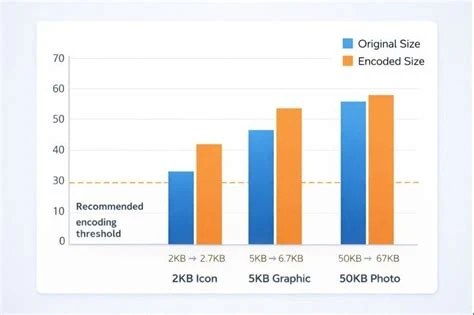
If you've ever encoded a file into Base64 and noticed the result is noticeably larger than the original, you've run into a fixed property of the encoding, not a bug. The answer to "base64 how much bigger" is straightforward: Base64 output is about 33% larger than the input for data that divides evenly into 3-byte chunks, and slightly more than that once padding gets involved on odd-sized inputs.
Base64 encoding increases data size by roughly 33% because it converts every 3 bytes of binary data (24 bits) into 4 text characters (using 6 bits each), and it adds padding characters to keep output length a multiple of 4. This overhead is fixed and unavoidable, though it remains smaller than most other binary-to-text encoding schemes.
The 33% figure isn't an estimate or a rule of thumb, it's a direct mathematical result of how Base64 maps binary data onto a limited set of printable characters. For a file of 300 bytes, the encoded output lands at exactly 400 characters. Scale that up to a 3 MB file, and you get roughly 4 MB of Base64 text. This ratio holds steady regardless of what the original data actually contains, whether it's an image, a PDF, or raw binary.
Where things get slightly less clean is at the edges of a file, where the input length isn't a perfect multiple of 3 bytes. In those cases, padding characters get added to the output, which can push the effective overhead a bit past 33% for very small inputs. The exact math behind this is covered in detail in this guide to calculating Base64 string length, but the short version is that the 33% baseline is the theoretical minimum, and real files often land just slightly above it.
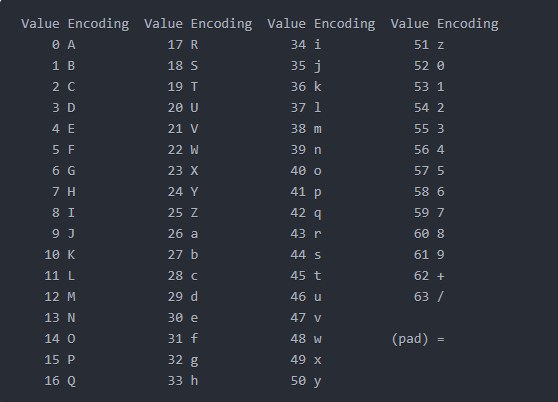
To understand why does base64 increase size at all, you have to look at what Base64 is actually doing under the hood. Binary data is made of 8-bit bytes. Base64 doesn't transmit that data as-is, because many transmission and storage systems (email, some older text protocols, certain JSON contexts) aren't reliable for arbitrary 8-bit binary content. So Base64 re-encodes the data using only 64 printable ASCII characters, letters, digits, plus two symbols like + and /.
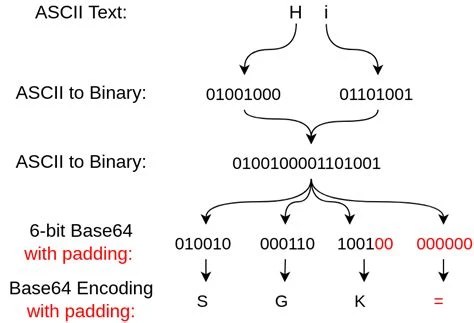
Representing 64 distinct values requires exactly 6 bits (since 2^6 = 64). That's the core mechanism: Base64 takes 3 bytes of input, which is 24 bits total, and repackages those same 24 bits into 4 groups of 6 bits each. Each 6-bit group becomes one output character. So 3 input bytes become 4 output characters.
Do the arithmetic and the overhead falls out immediately: 4 characters out for every 3 bytes in is a ratio of 4/3, or 1.333. That's where the 33% expansion comes from, and it's completely independent of the content being encoded. It's a structural property of moving from an 8-bit alphabet down to a 6-bit alphabet, not something that varies by compressibility or file type. This is also the core distinction covered in the comparison between Base64 and hex encoding, since hex uses an even smaller alphabet and pays an even bigger size penalty for it.
The 3-to-4 mapping works cleanly when the input length is an exact multiple of 3 bytes. Most real files aren't. If a file is 3,001 bytes long, the last group has only 1 leftover byte instead of a full 3. Base64 still needs to output complete 4-character blocks, so it pads the final group with zero bits and marks the padding using the = character.
This is why base64 padding exists: it's not decorative, it's functional. When a decoder reads a Base64 string, it needs to know exactly how many of the final group's bits are meaningless filler versus actual data. One trailing = means the last group represented 2 original bytes; two trailing = characters mean it represented just 1 original byte. Without this marker, the decoder would have no way to tell where real data ends and padding begins, and it could reconstruct the wrong number of bytes at the end of the file.
Padding also guarantees that Base64 output length is always a multiple of 4, which matters for both parsers and for basic sanity checks. A Base64 string with a length that isn't divisible by 4 is malformed and can't be decoded correctly. The full mechanics of this, including how the = character is interpreted at the bit level, are broken down in this explanation of why Base64 uses == padding.
It might seem odd to call a scheme that inflates data by 33% "compact," but the question of why is base64 the most compact only makes sense in comparison to the other realistic options for representing binary data as printable text. Once you frame it that way, Base64's overhead looks fairly modest.
Hexadecimal encoding represents each byte as two characters (0-9, A-F), using only 4 bits of information per character even though 8 bits would fit in a printable character. That means hex output is always exactly double the input size, a 100% overhead. Base64's 33% is less than a third of that.
Older encodings like uuencode, once common for transmitting binary attachments over text-only mail systems, use similarly inefficient bit-packing and carry comparable or worse overhead than Base64, along with less consistent handling across implementations.
The reason Base64 wins out is its use of a 64-character alphabet, the largest set of characters that's still universally safe across text protocols, mail systems, and URLs (with minor variants). Since 64 is a clean power of 2, Base64 can pack exactly 6 bits per character with no wasted space. Fewer usable characters, like hex's 16, force each character to represent fewer bits, which is a direct trade for a larger output. This is the same underlying logic explored in the comparison of Base64 versus Base62 encoding, where dropping two characters from the alphabet to avoid ambiguity in certain contexts comes at the cost of slightly less efficient packing.
The 33% expansion isn't just a math curiosity, it shows up as real cost in systems that handle binary data as text. Email attachments encoded in Base64 (as MIME does by default) take up more bandwidth and storage on mail servers than the raw file would. A 10 MB attachment becomes roughly 13.3 MB of transmitted data, which adds up across large mailboxes and archives.
The same pattern shows up in modern APIs. Embedding binary data, like an image or a file, directly inside a JSON payload as a Base64 string is a common pattern, but it means every such payload is a third larger than the binary itself, before any JSON structural overhead is even counted. For high-traffic APIs, that extra 33% translates into measurably higher bandwidth bills and longer response times, especially on constrained connections.
Storage systems that keep Base64-encoded blobs in databases face the same tax on disk usage and backup size. None of this makes Base64 the wrong choice, since the alternative is often not sending binary data over a text channel at all, but it does mean the overhead should be a deliberate part of capacity planning rather than a surprise. Understanding how Base64 decoding reconstructs the original bytes also helps clarify that none of this overhead survives into the decoded output; it exists only in transit and storage, not in the final binary data.

They estimate payload sizes for APIs that embed files as Base64 strings, accounting for the 33% inflation when setting request size limits or rate limits.
They plan mailbox and storage quotas knowing that MIME attachments are stored and transmitted as Base64, not as raw binary.
They decide whether to inline small images as Base64 data URIs in CSS or HTML, weighing the size overhead against the benefit of fewer HTTP requests.
They budget cellular data usage for apps that upload or download Base64-encoded assets, where every megabyte of overhead affects user data plans.
They calculate storage costs for systems that keep encoded blobs in text or JSON columns instead of dedicated binary storage types.
Compressing the original binary data before encoding reduces the total size, but the 33% expansion ratio still applies to whatever data goes into the Base64 encoder. Compressing after encoding is generally less effective, since Base64 output has higher entropy per character than typical binary data.
Yes. The overhead comes from the bit-to-character mapping itself, not from the content of the file, so it applies equally to images, text, executables, or any other binary data.
No, 33% is the theoretical minimum, since it's fixed by the 3-byte-to-4-character mapping. Padding on small or oddly-sized files can push the overhead slightly above 33%, but never below it.
Larger alphabets exist in theory, but Base64's 64 characters were chosen specifically because they're safe across nearly all text-based systems, including older mail protocols and URLs. A bigger alphabet would need characters that aren't reliably supported everywhere, defeating the purpose of a universal binary-to-text standard.
The 33% size increase in Base64 isn't a flaw to work around, it's the direct cost of making binary data safely representable as plain text. The 3-to-4 byte mapping fixes that ratio mathematically, padding exists purely so decoders can reconstruct the exact original byte count, and among the realistic alternatives for printable-only encoding, Base64's 6-bit-per-character scheme keeps that overhead about as low as it can go.
Stay up to date with new tools, blogs, and improvements.
We respect your privacy. No spam, unsubscribe anytime.