
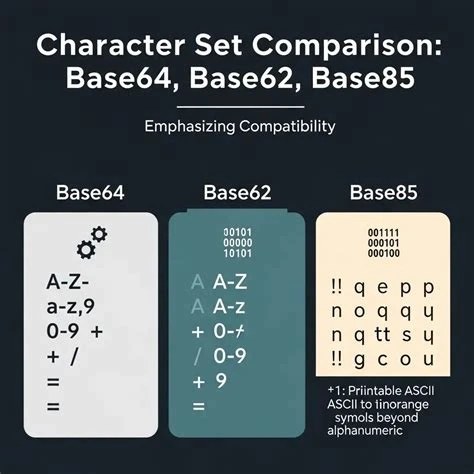
Anyone comparing base64 vs base62 is usually trying to solve one of two problems: how to represent binary data as text, or how to generate a short, safe identifier for a URL. Both are binary-to-text encoding schemes, but they were built with different goals in mind, and the differences show up in output size, character choice, and where each one gets used in practice.
Base64 and base62 are both methods for turning binary data or numbers into text using a limited alphabet. Base64 uses 64 characters, including "+" and "/", and adds padding to keep output length consistent, while base62 uses only letters and digits (62 characters total) and produces shorter, URL-safe strings without padding. The choice between them usually comes down to whether you're encoding raw binary data (base64) or generating a compact, web-friendly identifier (base62).
Base64 and base62 both convert data that isn't naturally text-friendly, like binary files or large numeric IDs, into strings made of ordinary printable characters. This matters because many systems, from email protocols to URLs, were designed to carry plain text safely but choke on arbitrary bytes. Encoding schemes give you a way to represent that data using a fixed, predictable alphabet.
The comparison between base64 vs base62 encoding isn't about one being a strictly better version of the other. Base64 is a formal standard, defined in RFC 4648, built around encoding raw bytes efficiently. Base62 is more of a convention than a standard, often used for encoding integers into compact alphanumeric strings rather than encoding arbitrary binary data directly. Understanding base64 and base62 side by side means looking at their alphabets, their output sizes, and the practical contexts each one was designed to solve.
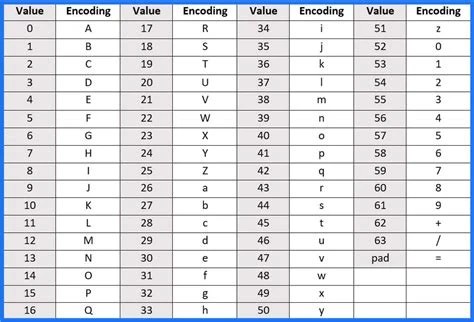
Base64 uses a 64-character alphabet: uppercase A-Z, lowercase a-z, the digits 0-9, plus two symbols, typically "+" and "/". That gives it exactly 64 symbols, which maps cleanly onto 6 bits of binary data per character (2^6 = 64).
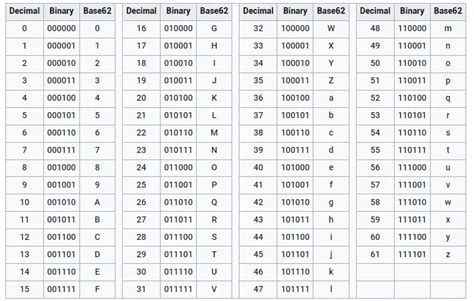
Base62 drops those two symbols and uses only alphanumeric characters, 26 uppercase letters, 26 lowercase letters, and 10 digits, for a total of 62. Because 62 isn't a clean power of two, base62 doesn't map neatly onto fixed bit groups the way base64 does. Instead, it's typically used to encode an integer value by repeated division, similar to how hexadecimal or decimal notation works, just with a bigger base.
The practical implication is straightforward: base62's alphabet is inherently safer for contexts where special characters cause problems, while base64's extra two symbols make it more efficient at representing raw binary data but less friendly in certain text environments like URLs and filenames.
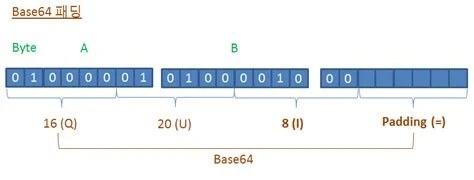
Base64 encodes data in groups of three bytes, converting each group into four base64 characters. When the input length isn't a multiple of three, the output is padded with one or two "=" characters so the result always comes out in multiples of four. This padding is a defining trait of the format and is covered in more detail in a look at why base64 output is roughly 33% larger than the original input.
Base62 doesn't use padding at all. Since it's usually applied to encode a specific integer value rather than a byte stream, the output length varies naturally depending on the size of the number being encoded. A small ID might produce a short string, while a very large number produces a longer one, with no fixed alignment requirement.
For the same input data, base62 can sometimes be more compact than base64, since 62 possible symbols per character carries slightly more information than sticking to alignment boundaries, but the actual gain depends heavily on how the data is structured and whether you're encoding raw bytes or a single integer.
Base64's encoding process is fast because it works on fixed 6-bit chunks, using simple bit-shifting and table lookups. There's no division or modulus arithmetic involved, just slicing bytes into groups and mapping each group to a character.
Base62 usually requires converting a number through repeated division by 62, extracting a remainder each time to determine the next character, and reversing the result at the end. This works well for integers but is more computationally involved than base64's bitwise approach, especially for large numbers, since division operations are generally slower than bit shifts. Decoding follows a similar asymmetry: base64 decoding maps characters back to fixed bit groups, while base62 decoding requires multiplying by 62 and summing at each step.
In most real-world applications the performance difference is negligible unless you're encoding at very high volume, but it's a factor worth knowing when choosing between base64 or base62 for a system that processes millions of encodings per second.
Base64 shows up anywhere binary data needs to travel through text-only channels. Common examples include:
Base62 is mostly used where a short, readable identifier is more useful than exact byte-for-byte reversibility of arbitrary binary data. Typical applications include:
The distinction comes down to what's being encoded: base64 for arbitrary binary payloads, base62 for compact representations of numbers or identifiers.
Base64's "+" and "/" characters cause real problems in URLs. A "+" can be interpreted as a space in query strings, and a "/" can be mistaken for a path separator. This led to the creation of base64url, a variant that swaps those two characters for "-" and "_" and often omits padding to make the output safe for URLs and filenames.
Base62 sidesteps this problem entirely by never including special characters in the first place. Because its alphabet is limited to letters and digits, there's nothing to escape or substitute, which is exactly why it's become a natural choice for web-based identifiers like short link slugs. Anyone weighing base64 or base62 for a URL-facing feature will usually find base62 requires less defensive coding around character escaping.
Base64 has a well-documented expansion ratio: roughly 33% overhead, since every 3 bytes of input become 4 characters of output. This ratio is fixed and predictable regardless of the data being encoded, which makes storage and bandwidth planning straightforward.
Base62's overhead is less fixed. Because it typically encodes integers rather than raw byte streams, the expansion ratio depends on the magnitude of the number involved, but in general use it tends to fall somewhere around 35-40% overhead compared to the original numeric or binary representation, sometimes better, sometimes worse, depending on the specific values.
For applications generating large volumes of encoded strings, like a URL shortening service handling millions of links, small differences in output length add up across storage and network usage. This is one more reason the choice between base64 and base62 encoding tends to hinge on the exact data being represented rather than a blanket size advantage for either one.
Base64 is the better fit when:
In these cases, base64's simpler bit-mapping and its status as a well-established standard make it the more practical choice, and there's rarely a good reason to reinvent that wheel with a custom base62 scheme.
Base62 makes more sense when:
Base62 tends to win in any scenario where the encoded value is meant to be seen, shared, or typed by a person, rather than passed silently between machines.
Use base62 to generate clean, URL-safe slugs for short links and public-facing identifiers without worrying about character escaping.
Rely on base64 to encode binary file data, images, and attachments for transmission through text-based APIs and protocols.
Choose base64url for tokens like JWTs where interoperability with existing authentication standards is required.
Use base62 to convert auto-incrementing numeric IDs into compact, non-sequential-looking public identifiers.
Apply base64 encoding when embedding configuration secrets or certificates into environment variables and config files.
Depend on base62-based short URLs for cleaner links in campaigns, SMS, and social sharing.
Neither is a security mechanism on its own. Both are encoding schemes, not encryption, so they don't hide or protect data, they just represent it differently as text.
Base62 is typically applied to integers rather than arbitrary byte streams, though it's technically possible to treat binary data as a large number and encode it that way. Base64 is the more direct and standard tool for encoding arbitrary binary data.
Base64url solves the URL-safety issue but still generally produces longer strings than base62 for the same numeric value, and its alphabet still includes characters like "-" and "_" that some systems treat as significant.
No. Base62 is a widely used convention rather than a formally standardized scheme, so implementations can vary slightly in character ordering or handling of edge cases.
It depends on the data. For raw binary payloads, base64's fixed 33% overhead is predictable. For encoding a single large integer, base62 can sometimes produce a shorter string, but the comparison isn't apples-to-apples since they're usually applied to different kinds of input.
The real difference between base64 and base62 comes down to what you're encoding and where the result needs to live. Base64 is a standardized, efficient way to turn binary data into text, at the cost of a couple of characters that don't play well with URLs. Base62 trades some encoding efficiency and standardization for an alphabet that's always safe to drop into a link, a filename, or a spoken code. Choosing between base64 or base62 isn't about picking the objectively better format, it's about matching the encoding to the specific requirements of size, safety, and compatibility in front of you.
Stay up to date with new tools, blogs, and improvements.
We respect your privacy. No spam, unsubscribe anytime.