
Anyone who has looked closely at a Base64 string has probably noticed it sometimes ends in one or two equals signs. Understanding why base64 has == padding means understanding how Base64 splits data into fixed-size chunks, and what happens when the input doesn't divide evenly into those chunks.
Base64 encodes data in blocks of 3 bytes, which convert cleanly into 4 output characters. When the input isn't a multiple of 3 bytes, the last block is incomplete, and '=' characters are added to pad it out to the required length of 4. Two equals signs appear specifically when only 1 byte is left over at the end of the input.
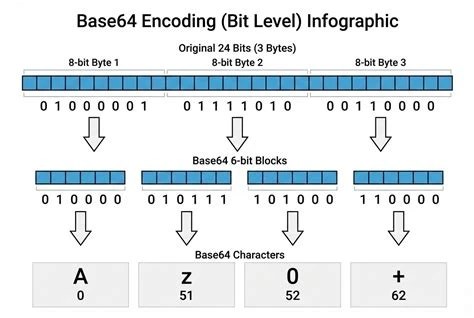
Base64 works by taking binary data 3 bytes at a time. Three bytes equal 24 bits, and Base64 splits those 24 bits into four groups of 6 bits each. Since 6 bits can represent 64 possible values (0-63), each 6-bit group maps to one character from the Base64 alphabet, which includes uppercase and lowercase letters, digits, and two symbols (usually + and /).
This is where the name comes from, and it's also why encoded output is consistently larger than the original input, a relationship covered in more detail in Base64 Size Increase: Why It's 33% Bigger. The 3-byte-to-4-character ratio is clean and predictable, but only when the total input length is an exact multiple of 3. Most real-world data doesn't arrive in neat multiples of 3 bytes, which is exactly where padding becomes necessary.
If a file or string is, say, 10 bytes long, dividing by 3 leaves a remainder of 1 byte. If it's 11 bytes long, the remainder is 2 bytes. Only when the length is exactly divisible by 3, like 9 or 12 bytes, does every group of 3 bytes convert into a full set of 4 characters with nothing left over.
When there's a remainder, the encoder reaches the end of the data with either 1 or 2 bytes left that don't form a complete 3-byte group. Those leftover bytes still need to be converted into Base64 characters, but there aren't enough bits to fill all four 6-bit slots the way a complete group would. This shortfall is the entire reason padding exists.
The '=' character solves the shortfall by acting as a placeholder. It tells a decoder, and any tool or human reading the string, that the final block was built from fewer than 3 input bytes and that some of the expected data simply isn't there. Padding exists to keep every encoded output a clean multiple of 4 characters in length, which matters for tools and parsers that expect Base64 to arrive in even 4-character blocks.
This convention is part of the standard, not an arbitrary formatting choice. Because Base64 strings are meant to be predictable, having a fixed rule for how incomplete final blocks are marked keeps encoding and decoding consistent across different programming languages and libraries. This is one of several structural details worth knowing if you're comparing Base64 vs Hex encoding or trying to calculate exact output lengths, as described in How Long Are Base64 Strings? A Length Calculation Guide.
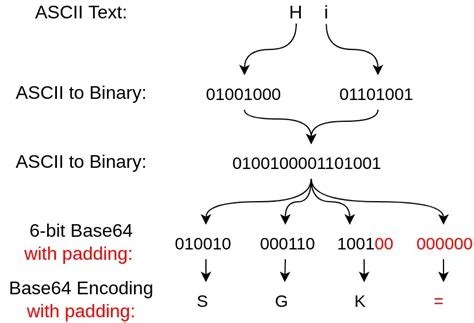
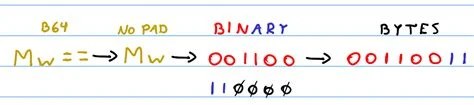
When exactly 1 byte remains at the end of the input, that byte contains 8 bits. Base64 needs 6-bit groups, so 8 bits is only enough to fill one complete 6-bit group and part of a second one. The encoder pads the remaining bits with zeros to complete that second 6-bit group, producing 2 valid Base64 characters from the 8 bits of real data.
But a full block requires 4 characters, and here only 2 have real information behind them. The other two positions in the block have nothing to encode at all, so they're filled with '=' instead of a character derived from data. That's why the string ends in ==: it marks a final block built from just 1 leftover byte instead of the usual 3.
The other possible remainder is 2 bytes, which is 16 bits. Sixteen bits divide into two complete 6-bit groups plus 4 leftover bits, enough for a third 6-bit group once padded with zeros. That gives 3 real Base64 characters from the 2 leftover bytes.
Since a complete block still needs 4 characters, only the fourth position is empty, so it gets filled with a single '='. This is the counterpart to the double-padding case: a remainder of 2 bytes produces one '=', while a remainder of 1 byte produces two. No other padding counts are possible, because the remainder when dividing by 3 can only ever be 0, 1, or 2.
Padding is technically for the benefit of decoders, and different implementations treat it differently. Strict decoders, including many built into standard libraries, expect the padding characters to be present and will reject or error on strings that omit them, treating the input as malformed. This strictness exists because the decoder relies on the total string length being a multiple of 4 to correctly process each block.
Other decoders, particularly in URL-safe or streaming contexts, are more permissive and can infer the original byte count from the number of actual data characters in the final block, without needing '=' at all. Some Base64 variants, like the URL-safe alphabet discussed in comparisons of Base64 vs Base62 encoding, drop padding by convention since '=' can conflict with URL syntax. The tradeoff is that omitting padding shifts the burden of figuring out block boundaries onto the decoder, which works fine as long as every tool in the pipeline agrees on the convention being used. Mixing padded and unpadded expectations is a common source of decoding errors, something covered further in Base64 Decode: A Technical Reference.
Need to know why some API responses or config values end in == so they don't mistake it for a formatting error when validating or storing encoded data.
Work with third-party services that may strip or require padding differently, and need to understand padding rules to avoid decode failures across systems.
Inspect encoded tokens and payloads where correctly interpreting padding is necessary to reconstruct the original byte length accurately.
Use the 3-to-4 byte mapping and padding rules as a concrete example of how binary-to-text encoding schemes handle uneven data lengths.
Write test cases around encoding edge cases, including inputs of length 1, 2, and 3 bytes over the remainder, to confirm padding logic works as expected.
Everything traces back to one simple fact: Base64 processes input in groups of 3 bytes, and most inputs don't end on an exact multiple of 3. When 1 byte is left over at the end, it only supplies enough bits for 2 real Base64 characters, so two '=' characters fill out the rest of the 4-character block. That's the direct answer to why does base64 end with ==: it happens whenever the total input length, in bytes, leaves a remainder of exactly 1 when divided by 3.
When the remainder is 2 bytes instead, only one '=' is needed, since 2 bytes produce 3 real characters rather than 2. And when the input divides evenly by 3, no padding appears at all, because every block is already complete. The number of equals signs at the end of a Base64 string is a direct, decodable clue about how the original data's length lined up against groups of 3 bytes.
No. Since the remainder when dividing by 3 can only be 0, 1, or 2, the only possible padding amounts are none, one '=', or two '='.
The original standard specifies padding as part of correct encoding, but several widely used variants, especially URL-safe Base64, permit or expect it to be omitted.
Not necessarily, as long as the decoder knows to infer the block length from the remaining characters. But mixing padded and unpadded strings across systems that don't agree on the convention can cause errors.
It's simply the character chosen in the original Base64 specification to mark padding, since it isn't part of the standard 64-character encoding alphabet and can't be confused with real encoded data.
Two equals signs mean the last group of input had exactly 1 byte, one equals sign means it had 2 bytes, and no padding means the input length was an exact multiple of 3.
The equals signs at the end of a Base64 string aren't decoration or a quirk of specific tools. They're a direct record of how many bytes were short in the final group of three, encoded right into the output so a decoder can reconstruct the original data exactly.
Stay up to date with new tools, blogs, and improvements.
We respect your privacy. No spam, unsubscribe anytime.