Podcast CPM rates tell you what a sponsor pays for each 1,000 counted ad impressions, but the counted unit can change the result because a download, listener, and impression may describe different deliveries. This guide defines those terms, compares common ad deals, and shows you how to check sponsor-package math against a target before you compare the quote with another package.
What podcast CPM measures
CPM is the cost of 1,000 ad impressions when both figures cover the same campaign or reporting period.
For September 2024, the measured marketplace average for a 60-second podcast ad was $21.37 CPM. Use that figure to compare a quoted rate, but still check the quote's denominator and placement; it's identified as the last independently measured marketplace average in Libsyn marketplace data.
A download is a file or episode delivery count. An impression is the ad exposure that the contract says is billable. A listener is counted using the publisher's method, so one listener can create more than one download or impression.
When you read a quote, what exactly does its denominator count? The contract's delivery definition matters more than the label. A deal called cost per thousand podcast listeners still needs a stated counting method, because you can't check the rate without knowing what the publisher counted.
CPM = (ad spend / impressions) × 1,000
Cost per single impression = ad spend / impressions
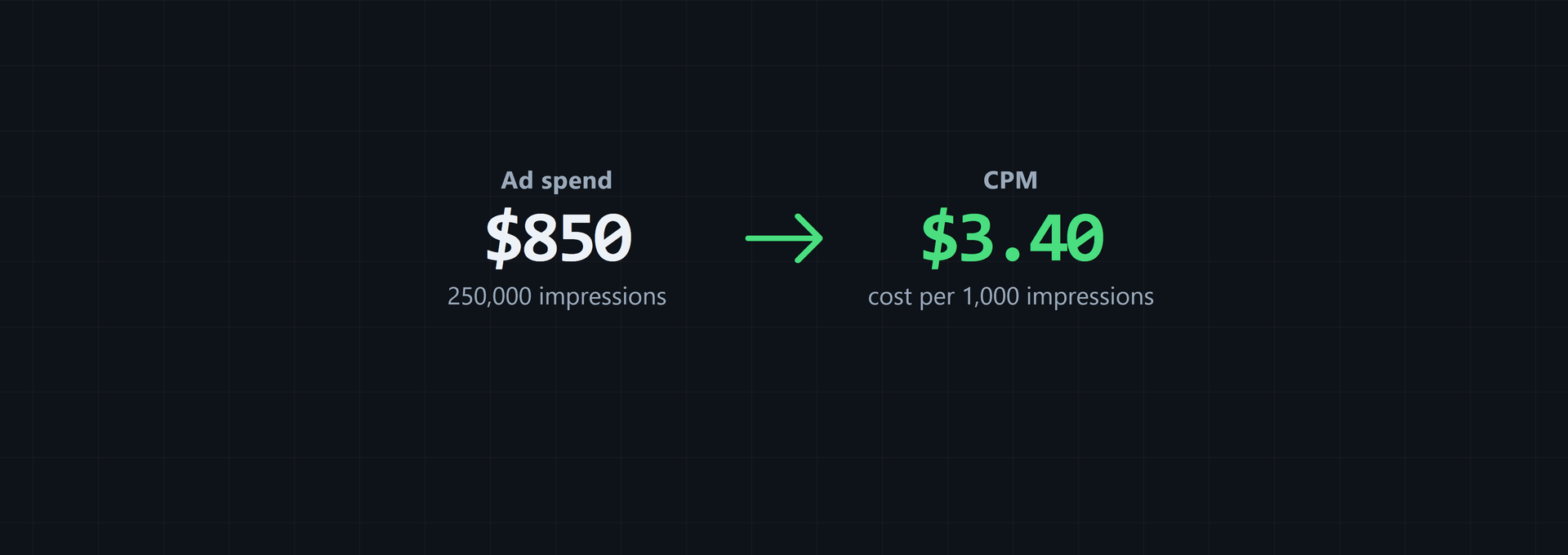
For an illustration, use $850 in spend and 250,000 impressions; these chosen values show the calculation without acting as a market benchmark.
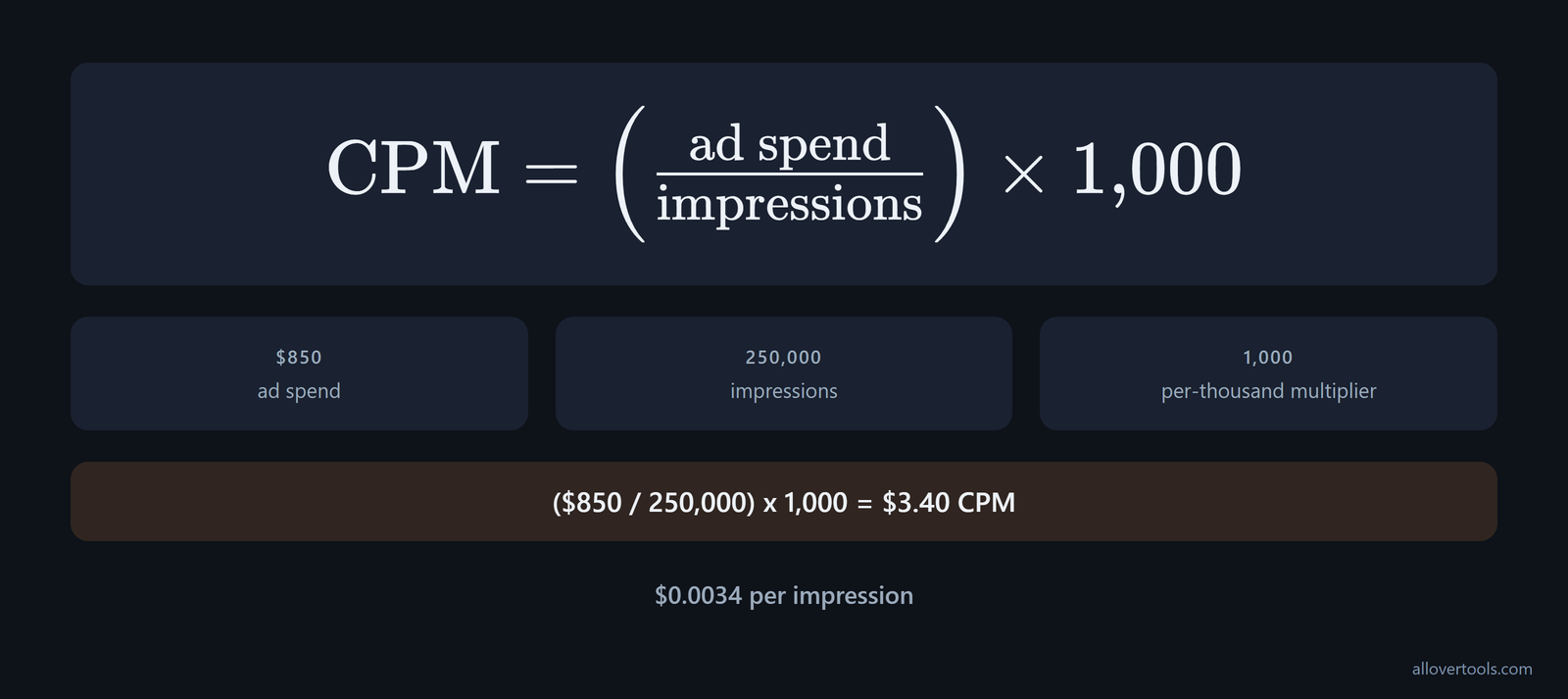
($850 / 250,000) × 1,000 = $3.40 CPM
$850 / 250,000 = $0.0034 per impression
The CPM Calculator performs the same arithmetic. Its Currency and Period controls label the result, but they don't convert amounts, so you must enter spend and impressions from the same campaign or period before using the displayed CPM. That check comes first.
How podcast ad CPM deals are structured
Most podcast ad deals use either an agreed CPM or a fixed package amount. A CPM deal multiplies the agreed rate by the number of thousands of impressions, while a flat-fee package sets one total amount that may cover several placements or episodes.
Before you compare a quote, identify its denominator and ask whether the quantity is a guarantee or a report. Is it based on downloads or estimated listeners, or does it use a delivered impression count? You should also check whether production or placement is included in the price.
A host-read spot has the host record or deliver the sponsor message in the show's voice. A pre-produced spot uses an audio file supplied by the advertiser or agency. Dynamic insertion fills or changes an ad slot for different listeners or later downloads, while a baked-in ad stays in the episode file.
These choices affect what is delivered and how you track the campaign, but they don't change the CPM formula. An audio advertising CPM quote should name its delivery rule, and a host read podcast CPM quote should identify the host-read placement and its counted delivery.
Consider two illustrative sponsor packages. Package A costs $1,200 for 40,000 impressions, while Package B costs $600 for 50,000 impressions.
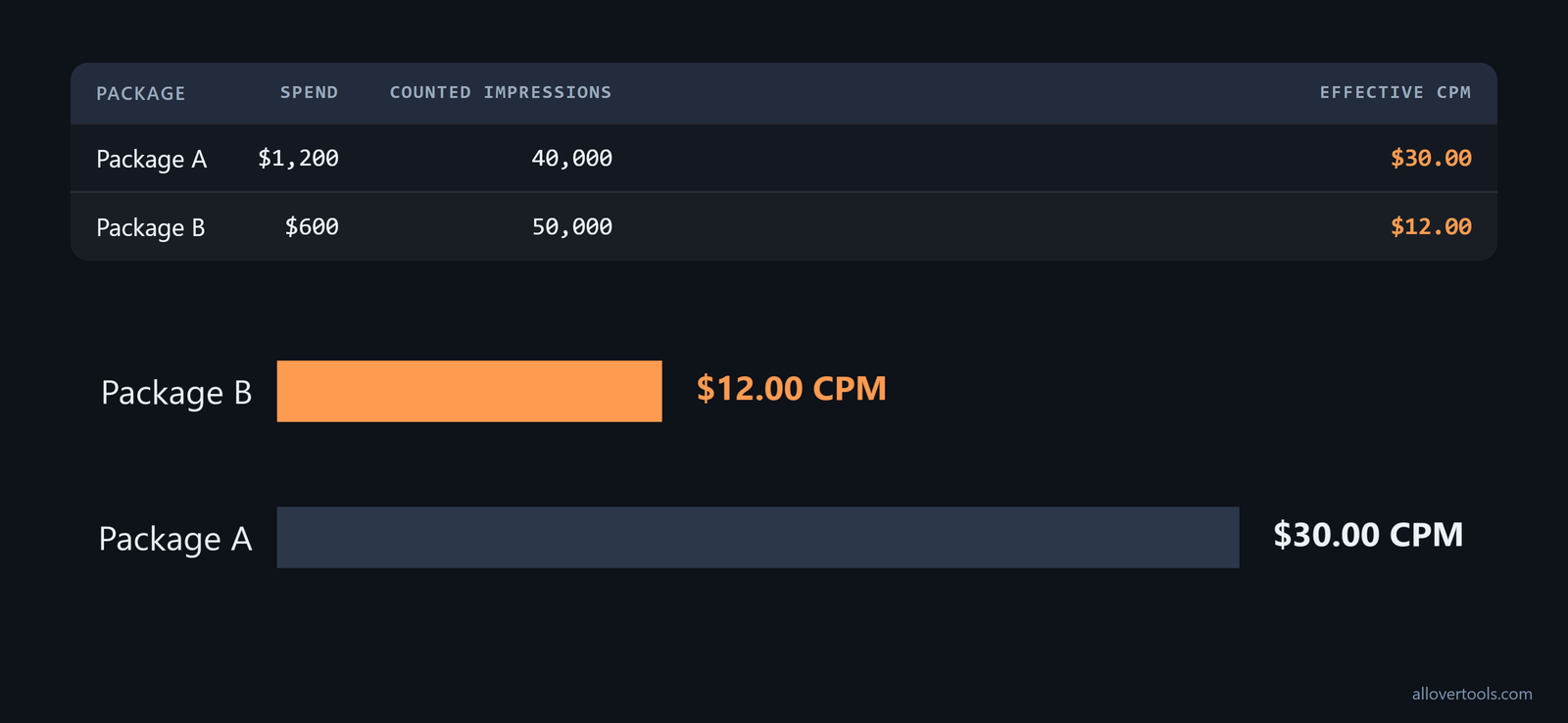
Package A: ($1,200 / 40,000) × 1,000 = $30.00 CPM
Package B: ($600 / 50,000) × 1,000 = $12.00 CPM
These are chosen values, not market prices. You can't compare the packages fairly until their impression definitions and ad integrations match. The units don't match yet.
Host-read and pre-produced spots
The main difference is who supplies the voice and the audio asset. A host-read placement may use a message delivered in the host's style, whereas a pre-produced spot arrives as an advertiser or agency file.
When you review either format, the agreement should describe the integration and state the placement length and episode count. It should also say who records or edits the spot and which delivery count sets the bill, because a package total can otherwise include production work or a placement rule that you can't price separately.
At 100,000 listeners per episode, the two formats produce different budgets: a $25 host-read CPM costs $2,500, while a $15 pre-produced programmatic CPM costs $1,500.
| Format | CPM estimate | Cost at 100,000 listeners |
|---|---|---|
| Baked-in host read | $25 | $2,500 |
| Pre-produced programmatic spot | $15 | $1,500 |
Libsyn's format comparison puts these estimates side by side. Keep the $1,000 gap in view when a package swaps host integration for supplied creative. The listener volume is the same, but the purchase isn't.
Placement changes the benchmark too. A pre-roll is roughly $18 CPM, while a host-read mid-roll can reach about $50 CPM. The premium is linked to listener behavior: mid-rolls are skipped less often than raw completion metrics suggest. The same placement-rate guide cites AdvertiseCast averages of $18 for 30-second ads and $25 for 60-second ads.
Dynamic insertion and baked-in ads
Dynamic insertion uses a changeable ad slot. A baked-in ad is part of the recorded episode file and remains there.
For a dynamic ad, ask what was inserted and during which period. For a baked-in ad, ask what was retained in the file. What does the publisher count as delivered in each case? Request the reporting period and counting rule before you approve the package.
The buying route can move the CPM well beyond the format label. On AudioGo, self-serve inventory typically runs at $12-$25 CPM. Direct show buys commonly range from $25 to $120+ for premium placements; the 2026 rate comparison separates standardized inventory from bespoke sponsorships and host-read integrations. Write the route next to the quote before deciding that one CPM is cheaper.
Dynamic inventory also has different price bands. Programmatic and dynamic insertion typically run at $15-$25 CPM, while run-of-network programmatic inventory can trade as low as $3-$15 CPM. The lower band comes with broad, less targeted delivery, as this 2026 CPM overview explains. Note the targeting control next to the number.
Why podcast CPM rates differ between shows
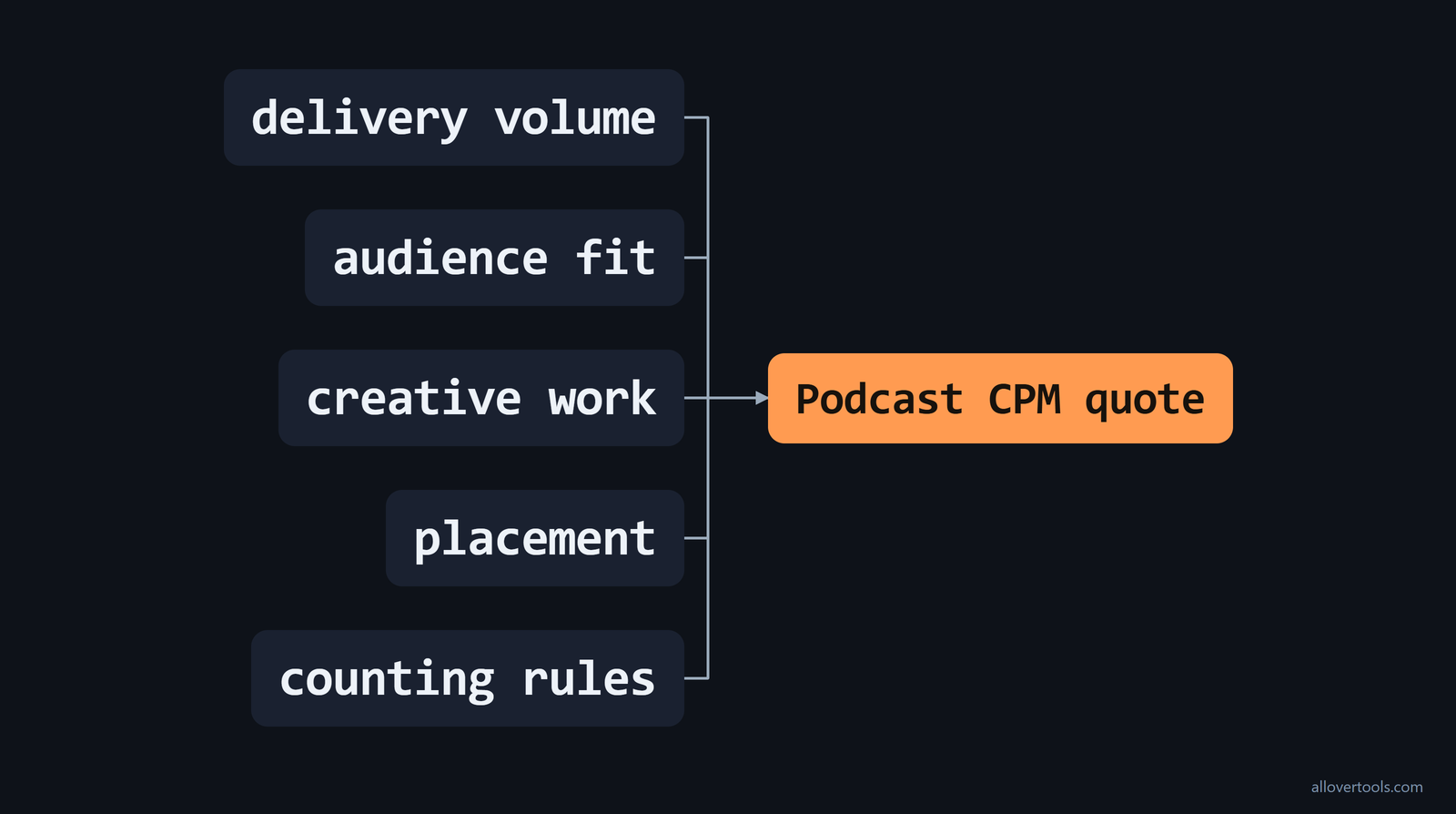
Two shows can receive different CPM quotes because their delivery volume, audience fit, creative work, placement, or counting rules differ, even when both publishers describe the purchase as a CPM deal.
Show size affects available delivery capacity. A smaller niche show may be assessed by how closely its audience fits the sponsor and how much integration the placement includes, while a larger show may offer more delivery capacity. Neither fact tells you whether the package fits your campaign.
A larger audience changes the cash minimum as well as the rate. The tiers below pair typical downloads with CPM and minimum per-episode spend:
| Show tier | Downloads per episode | Typical CPM | Minimum per episode |
|---|---|---|---|
| Micro | 1,000-10,000 | $18-$35 | $200-$500 |
| Mid-tier | 10,000-50,000 | $18-$30 | $500-$2,000 |
| Large | 50,000-150,000 | $15-$28 | $2,000-$8,000 |
| Major | 150,000-500,000 | $12-$25 | $8,000-$25,000 |
the 2026 rate table shows why the lower CPM isn't always the practical choice. A major show can quote less per thousand and still require a much larger episode minimum.
Genre gives another comparison point for host-read inventory. Published 2026 benchmarks put Business at $30 CPM, Health and Fitness at $27, Technology and Education at $26, Fiction at $24, Science, Comedy, and Society and Culture at $23, and Games and Leisure at $22. When checking a quote, use the category that matches the show and compare it with these genre benchmarks. One general range won't fit every audience.
The quote can also change with host-read or pre-produced creative, placement length, delivery method, campaign duration, and episode count. A package based on downloads can't be compared with one based on defined impressions as if the units were identical, so you should identify what a programmatic audio CPM platform counts before comparing its number with a publisher's quote.
Normalize each package by dividing total spend by total counted impressions and multiplying by 1,000. Use the same period and counting unit for every package, because a calculation can't repair a missing denominator or turn downloads into impressions.
Niche and professional podcast CPMs
Two shows with similar download volume can still sit in different CPM bands when the audiences have different intent. Business, technology, and B2B professional podcasts pull $40-$80 CPM; broad comedy or lifestyle shows tend to sit at $15-$35 CPM. InfluenceFlow data gives buyers a way to check whether the premium comes from audience fit rather than reach alone.
Business, finance, and B2B podcasts routinely clear $40+ CPM for host-read sponsorships in 2026, according to the professional-audience benchmark. For these shows, compare the quoted CPM with the audience category and host-read integration before calling a rate above the general $25-$40 host-read range an arithmetic error.
Regional podcast CPM ranges
Compare country and currency together; one ad format doesn't have one global CPM. Targeted dynamically inserted ads typically cost $20-$25 in the US, £21-£25 in the UK, and AUD $35-$45 in Australia. Host-read sponsorships run around $30 in the US, $35-$70+ on premium US shows, and about £30-£45 in the UK, according to Acast's market guidance.
| Market | Targeted dynamic insertion |
|---|---|
| US | $20-$25 |
| UK | £21-£25 |
| Australia | AUD $35-$45 |
| Market | Host-read sponsorship |
|---|---|
| US | About $30; $35-$70+ on premium shows |
| UK | About £30-£45 |
Match the row to the campaign market before comparing a publisher's quote with a US benchmark. Format, country, currency, and local demand can all change the number.
Match podcast show size to campaign goal
Show size can guide the campaign choice, not just explain the price. AudioGo's 2026 framework puts micro shows under 25,000 downloads per episode at $18-$35 CPM for niche targeting and budget-conscious tests. It puts mid-tier shows at 25,000-100,000 downloads and $25-$50 CPM for balanced reach and cost, and premium or top-100 shows over 100,000 downloads at $50-$120 CPM for broad awareness with large budgets.
| Tier | Downloads per episode | Typical CPM | Best fit stated in the framework |
|---|---|---|---|
| Micro | Under 25,000 | $18-$35 | Niche targeting and budget-conscious tests |
| Mid-tier | 25,000-100,000 | $25-$50 | Balanced reach and cost |
| Premium/top-100 | Over 100,000 | $50-$120 | Broad awareness with large budgets |
Use the campaign-goal framework with the publisher's actual denominator. It maps a show tier to an intended use; it doesn't replace recomputing the package's effective CPM.
Normalize the package before comparing it
Put the packages on the same basis before you compare them. Match the period and placement type, then match the counted unit and included costs.
If a quote combines a host-read placement, a pre-produced spot, and a fixed production fee, list each cost separately and record its delivery count before you combine the aligned totals. This keeps a bundled CPM from hiding a component that was never priced.
Recalculate the effective CPM from those totals. If the quote leaves out the denominator, flag the missing input instead of supplying an assumption. Don't fill in missing data.
How to check a podcast sponsor package with CPM math
Start with the publisher's spend and delivery figures, then confirm that the period and counted unit match before you recompute the CPM from the stated impressions.
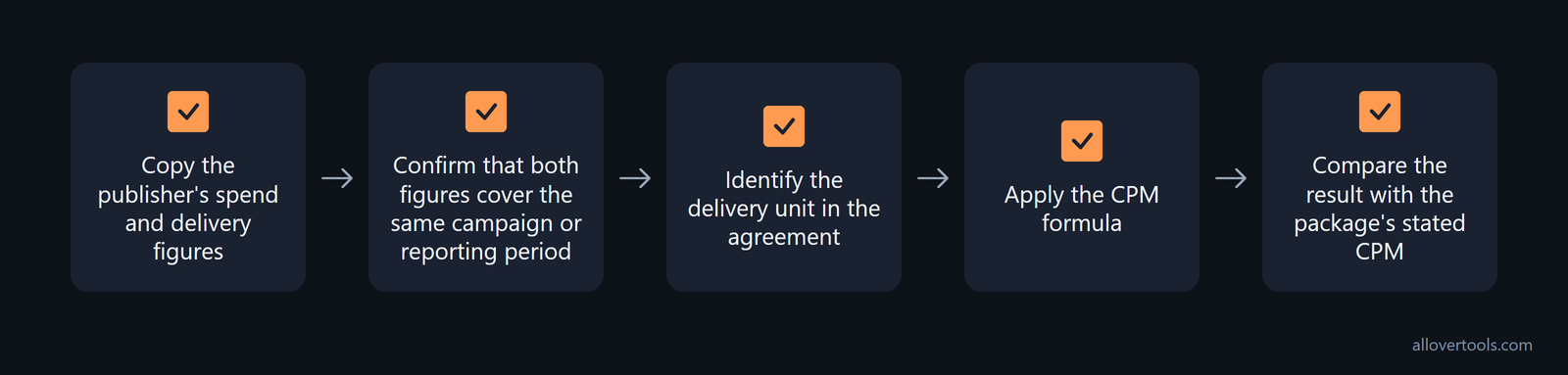
- Copy the publisher's spend and delivery figures.
- Confirm that both figures cover the same campaign or reporting period.
- Identify the delivery unit in the agreement.
- Apply
CPM = (spend / impressions) × 1,000. - Compare the result with the package's stated CPM.
In the CPM Calculator, select Currency and Period, enter Total ad spend and Total impressions, and add Target CPM - optional if you need a comparison value. Then select Calculate CPM.
The result shows Cost per 1,000 impressions (CPM), Cost per single impression, Total impressions (period), and the formula. Zero impressions or invalid input prevents a result, so correct the figures before reading the comparison.
For a target comparison, enter $960 in spend and 120,000 impressions.
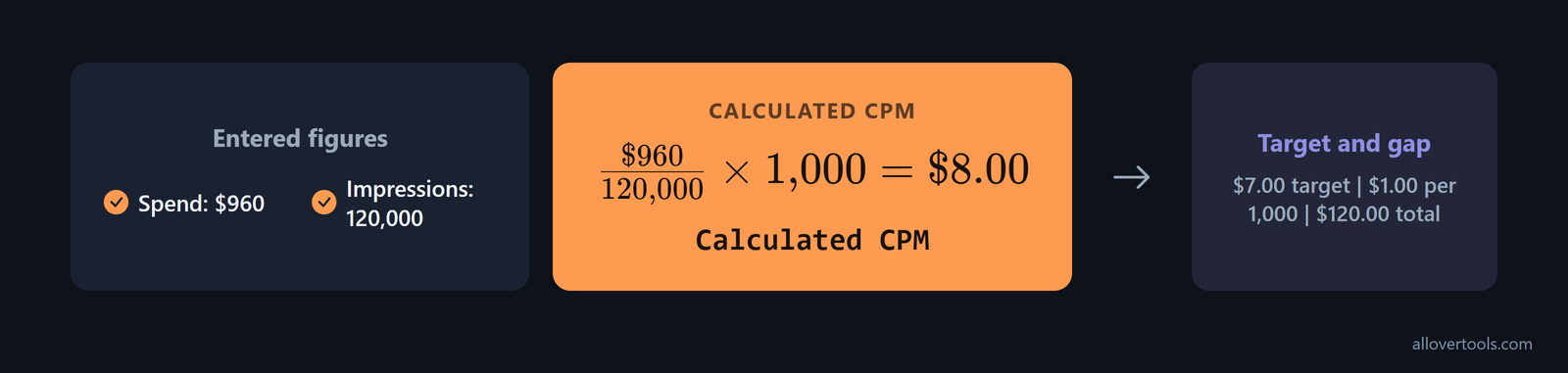
($960 / 120,000) × 1,000 = $8.00 CPM
Target CPM: $7.00
$8.00 - $7.00 = $1.00 gap per 1,000 impressions
($1.00 / 1,000) × 120,000 = $120.00 total-spend gap
The calculator uses only the numbers you enter. It doesn't fetch live rates or ad-account data, and its script makes no network request with those figures, so the calculation stays in your browser while you check the publisher's arithmetic.
Select Copy result or Download result (.txt) to keep the arithmetic with the package figures.
Check the denominator and the target
Check the publisher's counting rule and reporting period before you enter a target, because the target comparison is meaningful only when the denominator matches the package being reviewed.
Target CPM - optional is an arithmetic comparison, not a bid recommendation. Does a target gap tell you which package to buy? No. It shows the difference between the entered CPM and target at the entered impression volume, but it doesn't show which package will perform better.
Measure podcast ad performance beyond CPM
CPM measures delivery cost, not response or business impact, so pair it with the measure that answers your campaign question and keep the counting rule beside the result.
For immediate response, track promo-code use or a landing-page response. Track clicks where a URL exists, then record conversions when your tracking setup attributes them.
Record revenue and direct-response efficiency separately. Keep repeat exposure beside the response data so you can tell whether the counts refer to the same delivery.
Brand effects need a longer view. Recall and branded demand are outcomes to measure over time, not results guaranteed by a CPM.
The Marketing Metrics Calculator uses Campaign, Spend, Impressions, Clicks, Conversions, and Revenue to calculate ROAS, CPM, CPC, CTR, and conversion rate from entered numbers. Record the Attribution assumption because the tool doesn't assign conversions.
For an illustration, enter $1,500 spend, 180,000 impressions, 3,600 clicks, 180 conversions, and $9,000 revenue.
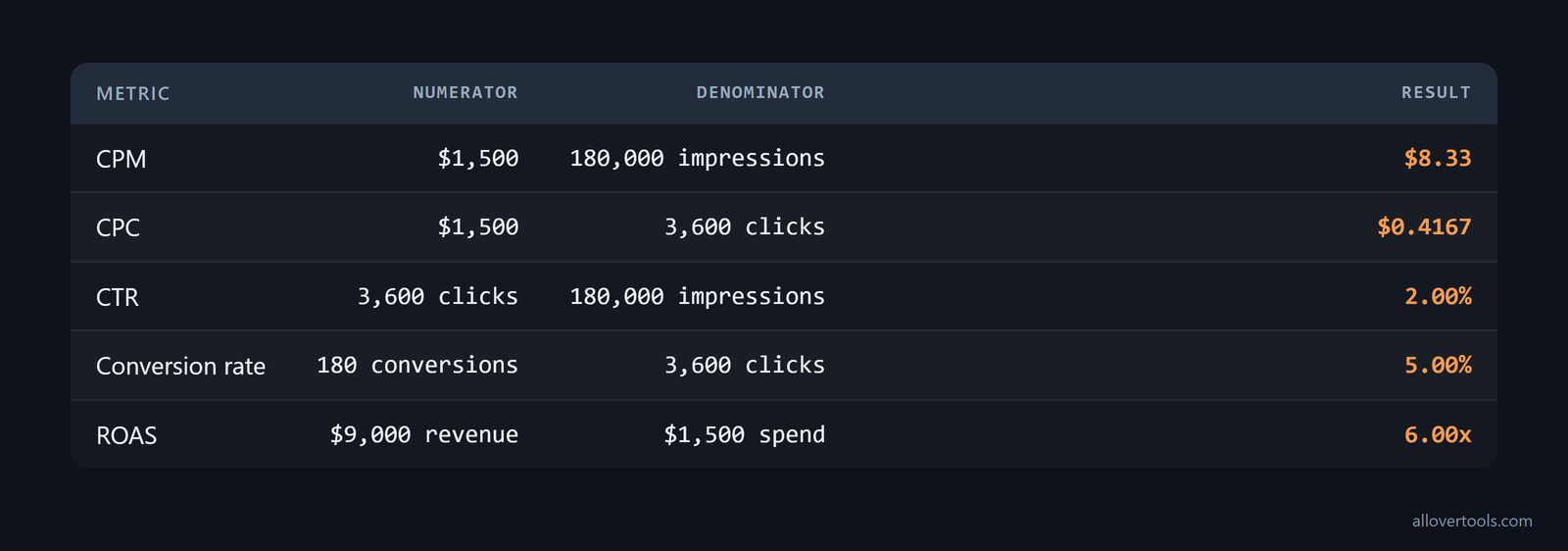
CPM: ($1,500 / 180,000) × 1,000 = $8.33
CPC: $1,500 / 3,600 = $0.4167
CTR: (3,600 / 180,000) × 100 = 2.00%
Conversion rate: (180 / 3,600) × 100 = 5.00%
ROAS: $9,000 / $1,500 = 6.00x
A zero denominator makes the relevant metric N/A. The results still depend on the tracking and attribution model you supply, which means the calculator can't decide whether a conversion belongs to the audio campaign.
The calculator processes entered figures in your browser and doesn't connect to an ad platform or fetch live campaign data.
Separate delivery, response, and brand effects
Keep the measures separate because each answers a different question. Delivery measures counted ad exposure, response measures attributed action, and brand measurement looks at what may accumulate through repeated audio exposure.
Keep the denominator beside each result. A low CPM describes delivery cost, while conversion or revenue describes another part of the campaign.
What to negotiate with a podcast publisher
Before you accept a package, settle the counting rule, delivery promise, creative responsibility, reporting, and outcome measure. A total without a denominator can't be checked, even when the publisher presents it as a complete package.
Treat a quoted CPM as a starting point. In 2026, buy-side data puts host-read mid-rolls at $15-$30 CPM, while sell-side rate cards list the same placement at $25-$40 for most shows. Those figures describe different stages of the deal, so ask where the publisher expects the clearing price to land. the buy-side comparison makes the spread visible.
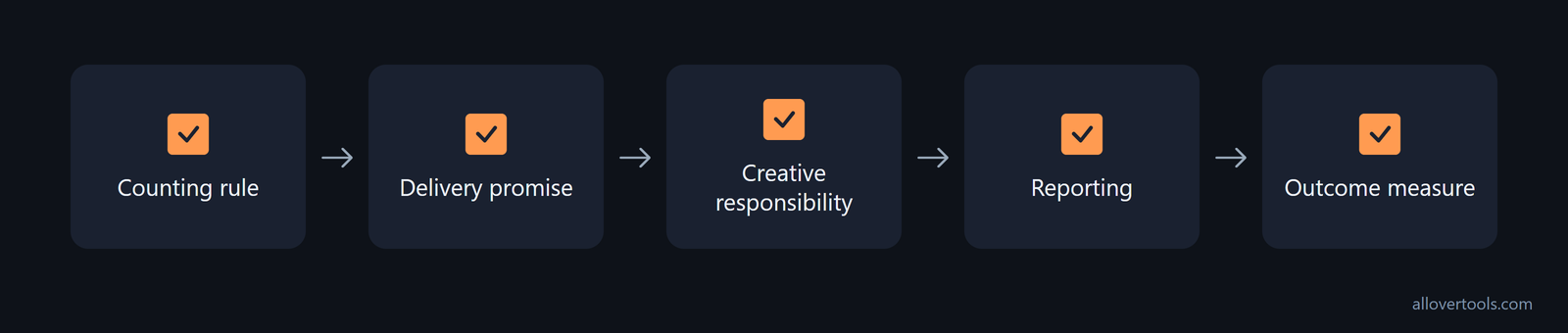
Define the billable unit and document its counting method. Say whether the denominator uses downloads or impressions, then explain how listeners are counted; put the episode count, placement, format, and campaign period in writing.
Record who supplies the host-read or pre-produced work. State whether the ad is dynamic or baked-in, and itemize production and other included costs.
Specify the delivery report fields and timing. Agree what happens if counted delivery is short. Add tracking details, including links, promo codes, and the attribution assumption.
Decide whether you're measuring immediate response, repeated exposure, or a longer-term brand effect. Request the inputs needed to recompute effective CPM instead of accepting an unlabeled package total, then use the CPM Calculator for the final arithmetic check.
Frequently asked questions
What is a good podcast CPM rate?
There's no single good rate without matching the counted unit, audience fit, placement, production, and delivery promise. Recalculate effective CPM only after those definitions and included costs align; no market benchmark is supplied.
Are podcast downloads the same as ad impressions?
No. A download records delivery of an episode or file, while an impression is the ad exposure counted under the agreement. The contract must state its denominator.
How do I calculate CPM for a podcast ad?
Divide ad spend by counted impressions and multiply by 1,000. For the chosen example of $850 and 250,000 impressions, the result is a $3.40 CPM.
Can host-read and pre-produced podcast ads have different CPMs?
Yes. A publisher may price them differently because integration, production responsibility, placement, and audience experience differ, but the CPM formula stays the same. Compare them after the delivery definitions and included work are clear.
Does podcast CPM show whether an ad worked?
No. CPM measures delivery cost, so pair it with tracked responses, conversions, revenue, attribution notes, and longer-term brand measures when those data are available.