The CPM advertising definition is the cost of 1,000 ad impressions, or cost per mille. It puts spend and delivered impressions on one comparable reporting unit. An impression is a recorded ad delivery or exposure.
What does that mean for a view? A view can use a different rule by source, so CPM prices reported exposure rather than attention or clicks, while conversions require a separate measure.
What CPM means in advertising
CPM names a rate for 1,000 reported ad impressions. "Mille" means thousand, so cost per thousand impressions says the same thing in plain English.
The unit gives you a fair way to read small and large campaigns. Total spend alone can't do that. Keep the spend and impression figures within the same scope.
An impression is one logged delivery or exposure in the reporting source, so a view may use another rule and neither term automatically means one distinct person.
Think of CPM as a price tag for exposure. It doesn't measure attention or response.
CPM can be used before and after a campaign. Before delivery, it helps price advertising space; afterward, it shows what 1,000 ad impressions cost. A publisher can base the price on projected impressions, and the advertiser can use the same unit to review the result, as this CPM explanation sets out. A quoted CPM of $15 means an average cost of $15 for 1,000 ad impressions, or $15 for every 1,000 consumers who view the ad.
Treat a CPM purchase as an agreed volume and rate, not just a result calculated later. In common display and paid social buying, advertisers book a specific number of impressions at a set CPM price instead of using a pay-as-you-go model, according to this media-buying definition. For larger publishers, that price can be tied to the impressions a placement receives on a monthly or quarterly basis, as the publisher guidance describes. Before comparing a planned buy with its post-campaign CPM, check the booked impressions, agreed CPM, and time period together.
Impressions, views, and reach are different
Impressions count reported deliveries. Views follow the source's view rule. Unique reach counts distinct people when the source can identify them.
One person can see an ad twice. The report may then show two impressions and one reached person. A view can still follow its own rule.
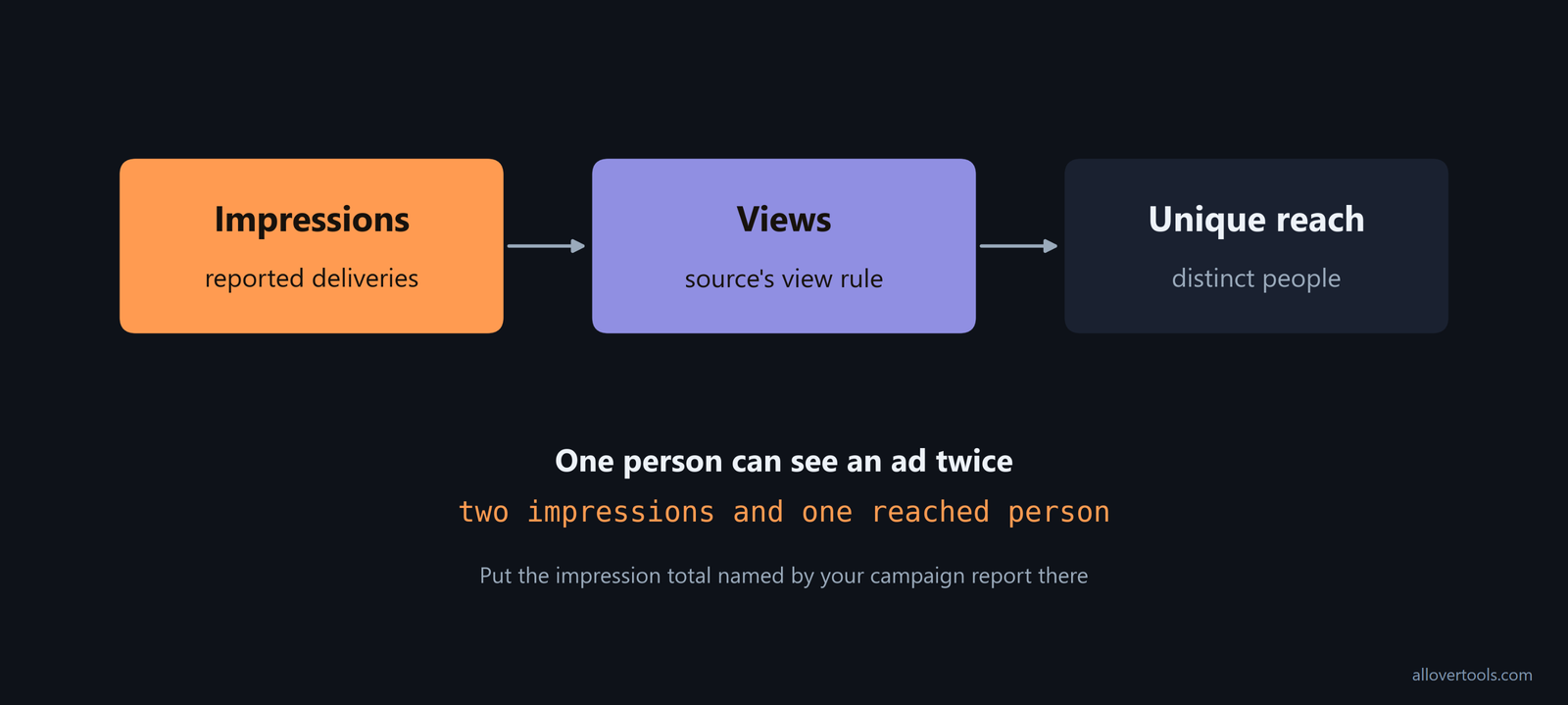
Which number belongs in the denominator? Put the impression total named by your campaign report there, and keep that definition beside the result because it says what was counted, not how many people noticed the message.
Count impressions at the ad level, not the page level. An impression is an ad displayed to a user viewing a web page, and one page can contain multiple ads. A single pageview can therefore produce one impression for each ad displayed.
When comparing CPMs across placements with different ad slots, use ad-level impressions, as the impression definition explains. Cost per impression is often expressed as CPM because the larger unit is easier to manage.
How to calculate CPM from spend and impressions
Start with total ad spend. Divide it by total impressions, then multiply by 1,000. The standard formula is CPM = (Total ad spend / Total impressions) x 1,000.
Use figures from the same period or campaign, because mixing scopes can produce a tidy number that describes neither the spend nor the impressions you meant to measure.
With no impressions, the division is undefined. Zero spend works. With positive impressions, CPM is $0.
To plan from a budget, run the formula backwards. Divide the campaign budget by the number of desired impressions, then multiply by 1,000. The result is the maximum CPM you can afford, according to this planning formula. Set that ceiling before negotiating a buy or placing a bid; otherwise, you may only find out after delivery that the agreed rate didn't fit the budget and impression target.
You can check the arithmetic in the CPM Calculator with the same inputs.
A worked CPM calculation
Use these inputs: $850 and 250,000 impressions.
Total ad spend: $850
Total impressions: 250,000

CPM = ($850 / 250,000) x 1,000
CPM = $3.40

Cost per single impression = $850 / 250,000
Cost per single impression = $0.0034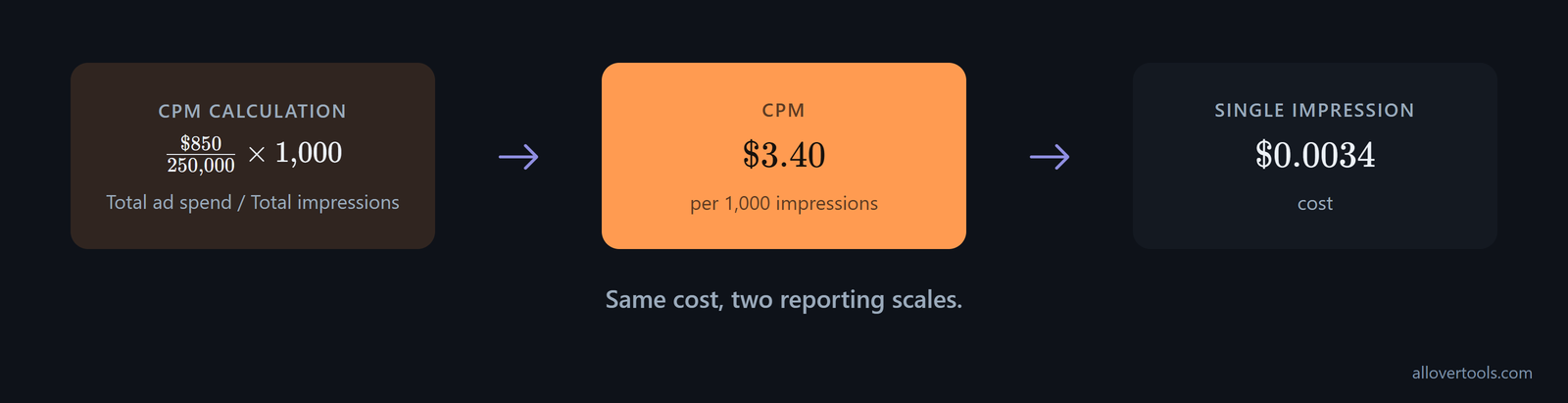
One impression costs $0.0034. Multiply that amount by 1,000, and you get the $3.40 CPM. Same cost, two reporting scales.
Rounding changes the display, not the arithmetic underneath.
Use the CPM Calculator for the same formula
Match every input to the same report before you calculate.
- Choose Currency and Period as display labels.
- Enter Total ad spend and Total impressions for the relevant period or campaign.
- Optionally enter Target CPM - optional for a comparison.
- Select Calculate CPM.
- Read the result, or select Copy result or Download result (.txt) to export the displayed calculation.
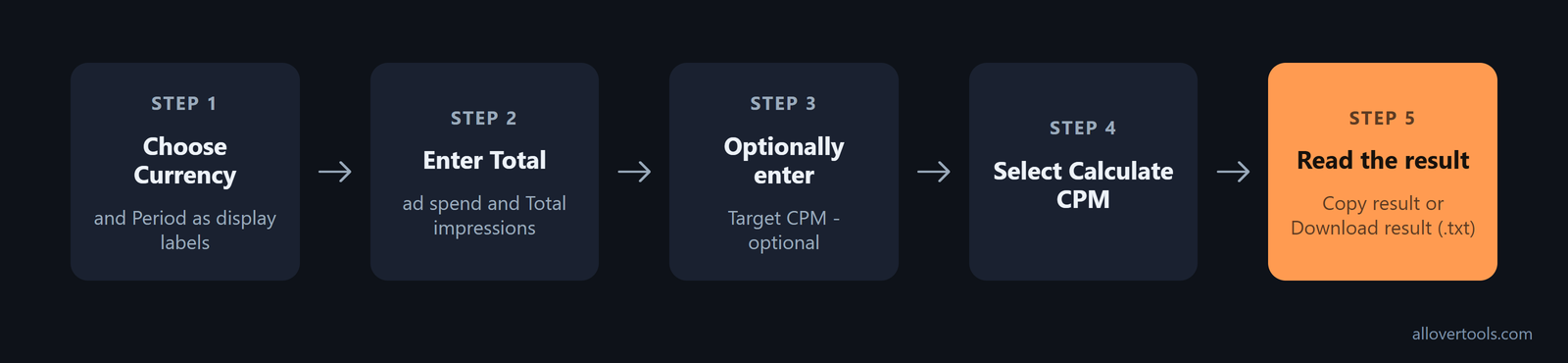
The result shows CPM, cost per single impression, assumptions, and any target gaps, so blank, negative, or zero-impression inputs show an error instead of a result.
Reset clears the entered state and hides the result. Currency labels the display; it doesn't convert amounts or use live rates.
The calculation stays in your browser. There's no fetch, XMLHttpRequest, sendBeacon, or form post carrying the entered figures elsewhere.
When CPM is useful for awareness, reach, and visibility
CPM suits a campaign whose first job is putting a message in front of an audience and tracking the cost of that exposure.
That makes it useful for brand awareness and visibility reports. You can express spend per 1,000 reported impressions without treating a click as the only sign of delivery.
For online campaigns, use the impression count in the display or video report. Read the social report by its own source label before you copy its impression count into a comparison, because the denominator must match the report you're using.
For offline media plans, use the estimated audience or exposure count supplied for print, outdoor, radio, or a similar placement.
The offline denominator needs a clear definition. An estimated exposure isn't automatically the same as a digital impression, and a low CPM alone doesn't prove stronger awareness or better visibility.
CPM can also work as a cross-media benchmark. It puts each buy on a 1,000-view or 1,000-impression basis so you can compare the relative cost of campaigns within and across media. That comparison can include radio, television, newspaper, magazine, out-of-home, and online advertising, as the cross-media definition states. Keep the creative, audience, and objective context with the figures, because CPM answers the cost of the normalized exposure unit.
When views can't be counted directly, use estimated views as the denominator. CPM then shows the cost per 1,000 estimated views of the ad. Mark the denominator as estimated and keep its measurement basis beside the result. Differences in audience measurement methodologies can change the true CPM, according to the estimated-view rule.
What CPM can and cannot tell you
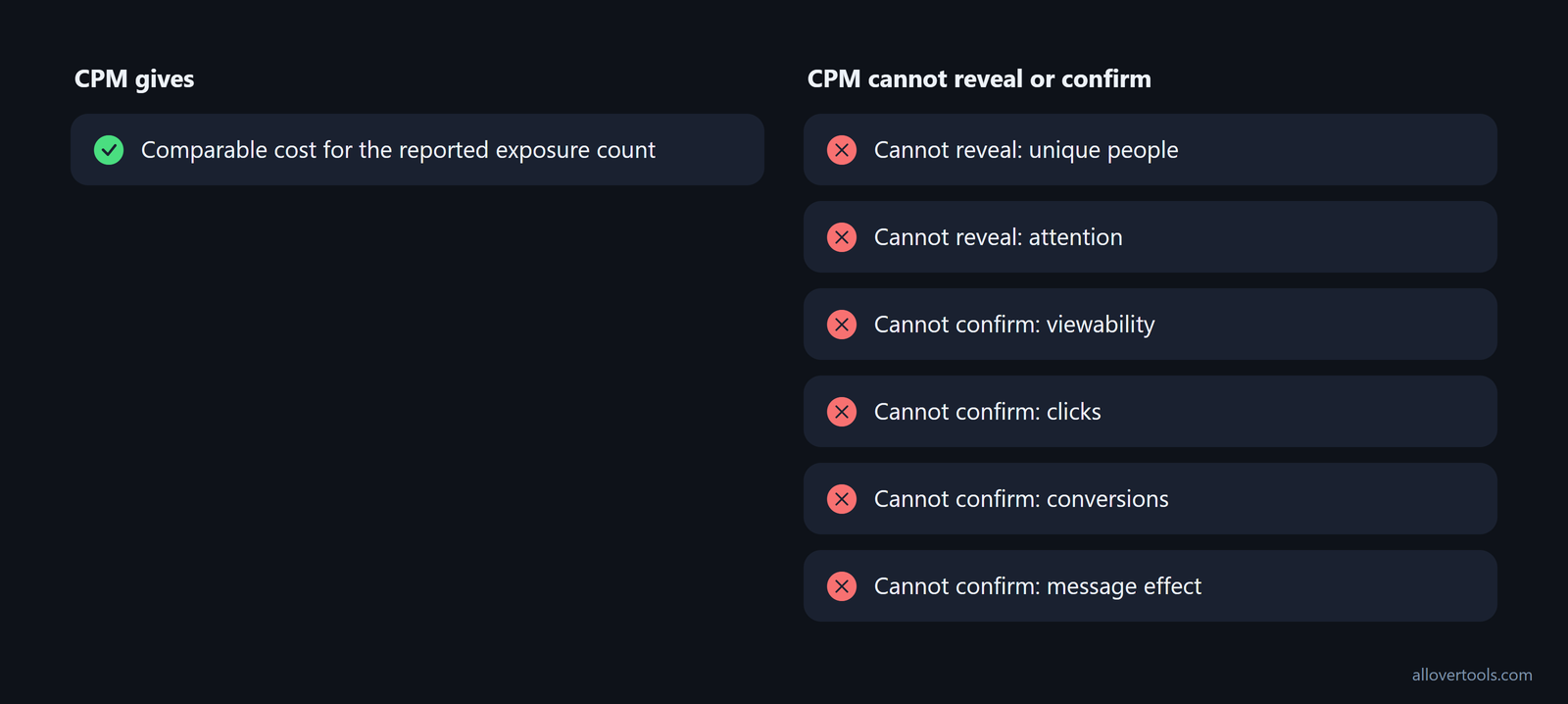
CPM gives you a comparable cost for the reported exposure count. That makes delivery and budget arithmetic easier across campaigns of different sizes.
It can't reveal unique people or attention. It also can't confirm viewability, clicks, conversions, or message effect. Keep the source and denominator definition beside the CPM when you review a report.
Served impressions and viewable impressions use different buying rules. On the Google Display Network, CPM bidding charges per 1,000 views or impressions. Viewable CPM (vCPM) bidding charges only when your ads can be seen, as Google's bidding definition explains. If the campaign is about visible exposure, record whether the buy uses served-impression CPM or viewable CPM before interpreting the result.
CPM versus CPC, CTR, and conversion rate
These metrics answer different questions because each one uses a different denominator.
| Metric | Formula | Question answered |
|---|---|---|
| CPM | Spend / impressions x 1,000 | What did the reported exposure cost? |
| CPC | Spend / clicks | What did each click cost? |
| CTR | Clicks / impressions x 100 | What share of impressions produced clicks? |
| Conversion rate | Conversions / clicks x 100 | What share of clicks produced conversions? |
CPM works when your campaign doesn't require a click. It can't replace click or conversion measures when the objective is response or action.
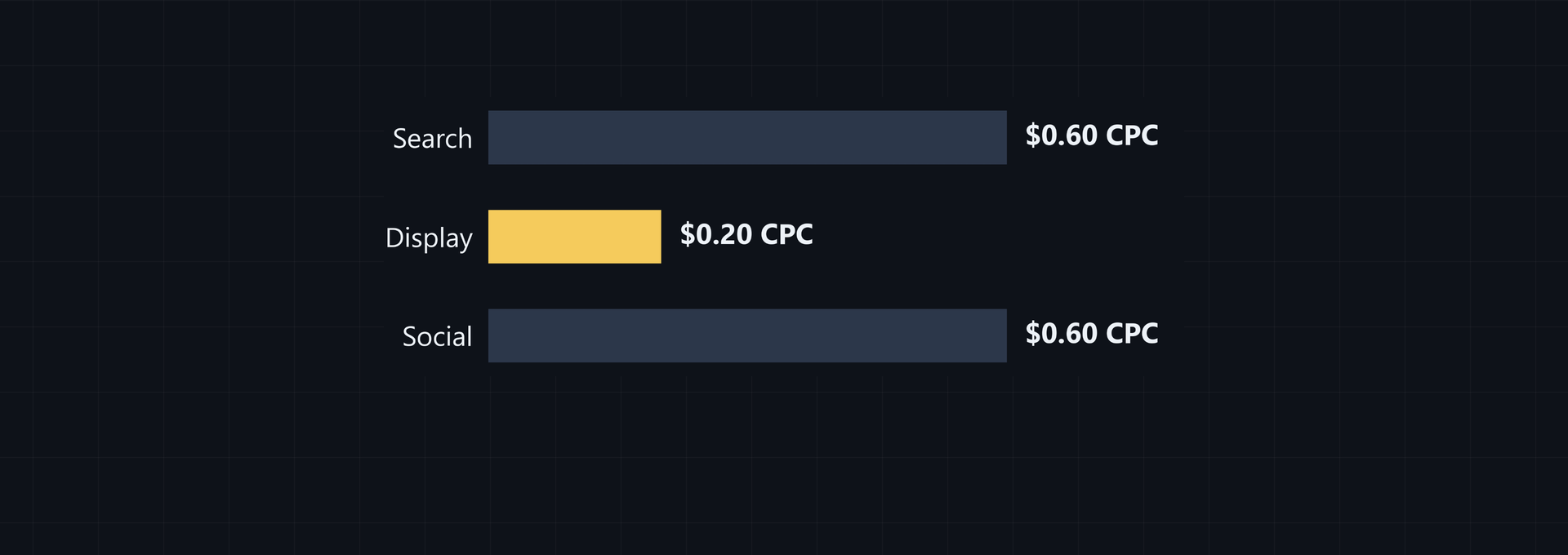
For spend and clicks, use the CPC Calculator. For clicks and impressions, use the CTR Calculator. The Marketing Metrics Calculator puts several campaign rows beside one another. It uses the same CPM formula when impressions are present and shows N/A when a denominator is zero.
Choose the metric that matches the question
Choose CPM for exposure and awareness delivery. Choose CPC for click cost. Use CTR or conversion rate for response quality.
Before you compare CPM, check the impression definitions, reporting periods, currencies, and campaign objectives. A correct calculation can still compare unlike scopes.
Advantages and limitations of CPM pricing
CPM gives exposure budgets a common unit. It makes spend-to-impression arithmetic easy to audit, and it fits awareness campaigns whose first goal is visibility.
Its limits are specific. CPM doesn't count unique reach or confirm that an impression was viewable or noticed. It also doesn't measure clicks or conversions. Ad fraud sits outside the basic formula, as do platform fees and currency conversion.
Those items sit outside the basic formula. The CPM Calculator also leaves out viewability, ad fraud, ad platform fees, and currency conversion.
Check matching periods first. Verify the source's impression or exposure definition. Keep the currency consistent, then pair CPM with the metric that matches your campaign objective.
CPM doesn't need to be the only payment model in a deal. This traditional way to measure advertising cost can sit alongside performance-based models, including a percentage of sale or cost per acquisition (CPA), as the combined-model explanation notes. In a blended arrangement, treat the CPM as the exposure cost, then assess the percentage-of-sale or CPA term against the performance result it governs.
How publishers read RPM and eCPM
Advertiser CPM and publisher revenue per thousand impressions describe different sides of the same thousand-impression unit. For publishers, CPM is technically RPM, or Revenue Per Mille, though advertisers and publishers often use CPM and RPM interchangeably. Some advertising platforms display revenue per thousand impressions as eCPM instead of RPM, as this publisher-side definition explains.
When you read a deal or platform report, first identify which side the number describes: the advertiser's cost per 1,000 impressions or the publisher's revenue per 1,000. A low advertiser CPM doesn't automatically mean low publisher revenue. Fill rates, auction dynamics, and multiple demand sources drive the publisher's effective CPM. Keep the transaction side and metric label beside the number before comparing it.
Common CPM reading mistakes
Most CPM mistakes start with the wrong denominator or with treating the result as a complete performance measure.
If you divide spend by impressions and stop, you have the cost of one impression. CPM needs one more multiplication by 1,000.
Don't mix spend from one period with impressions from another. The denominator must describe the same reporting scope.
Don't treat impressions as unique reach. One person can create more than one impression.
Finally, don't judge campaign success from CPM alone. It says nothing about attention, clicks, conversions, or the campaign's purpose. With zero impressions, CPM is undefined.
Simple online and offline CPM case studies
The examples use the same calculation, but their denominators come from different kinds of reports.
Online awareness campaign
An online awareness campaign uses reported impressions to measure exposure cost, not awareness itself.
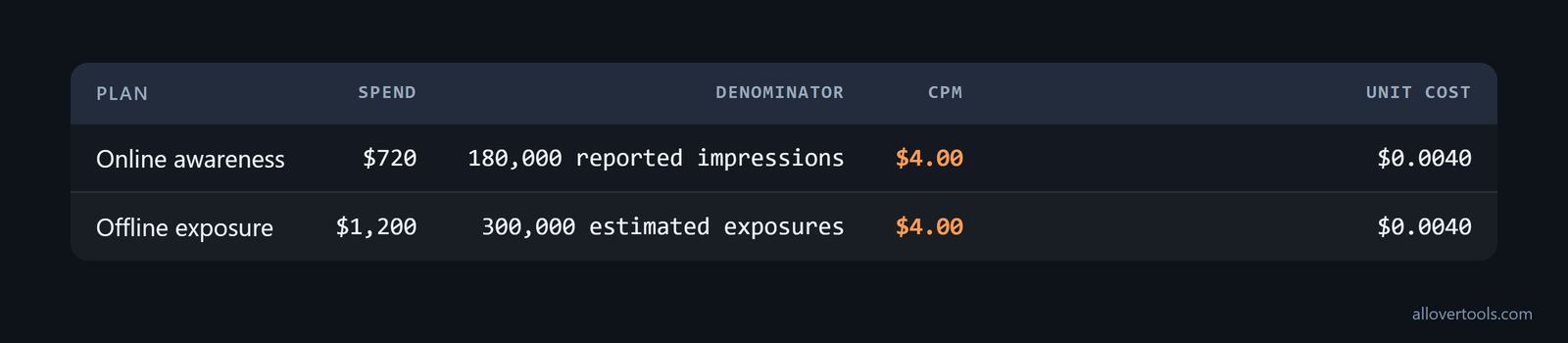
Suppose your campaign spends $720 and reports 180,000 impressions:
CPM = ($720 / 180,000) x 1,000
CPM = $4.00

Cost per impression = $720 / 180,000
Cost per impression = $0.0040
The denominator is reported impressions. The $4.00 CPM is the price for that reported visibility; it doesn't claim an awareness result.
Offline estimated exposure plan
Suppose your offline media plan lists $1,200 in spend and 300,000 estimated exposures:
CPM = ($1,200 / 300,000) x 1,000
CPM = $4.00

Cost per estimated exposure = $1,200 / 300,000
Cost per estimated exposure = $0.0040
The two examples have matching CPMs, but that doesn't prove equal effectiveness. The offline denominator is an estimate, so check its definition before you compare it with a digital impression.
Verify the denominator definitions and calculate CPM for the relevant reporting scope. When your question moves beyond visibility, use CPC or CTR, then use conversion rate to examine completed actions.
Frequently asked questions
What does CPM mean in advertising?
CPM means cost per mille: 1,000 ad impressions. It measures reported exposure as a price, not unique reach, and it can't show clicks or conversions.
How do you calculate CPM from ad spend?
Use CPM = (total ad spend / total impressions) x 1,000, with both figures from the relevant campaign or reporting window. If impressions are zero, the result is undefined.
Is CPM the same as cost per view?
No. CPM uses 1,000 impressions, while a view measure depends on how the reporting source defines a view. Read the denominator named in the report.
When should I use CPM instead of CPC?
Use CPM for an exposure or awareness question and CPC for a click-cost question. CPM alone can't tell you about clicks or conversions.
Can CPM be used for offline advertising?
Yes, when a media plan supplies an exposure or audience denominator. Label it as estimated when appropriate, and check the stated basis before comparing it with digital impressions.