
Founders encounter burn rate formula variants when the same cash movement appears under different sign conventions. Starting cash minus ending cash gives a positive amount consumed; ending cash minus starting cash gives a signed cash change. Expenses minus revenue gives net burn. Choose one convention, label it, and apply it to inputs from the same period. Keep gross burn separate from net burn.
What does burn rate measure?
Burn rate is the pace at which operating activity reduces cash over a stated period. Gross burn is cash operating expenses before revenue. Net burn is those expenses minus cash revenue. Both revenue and expenses need to cover the same period, whether that is a month, quarter, or another defined window.
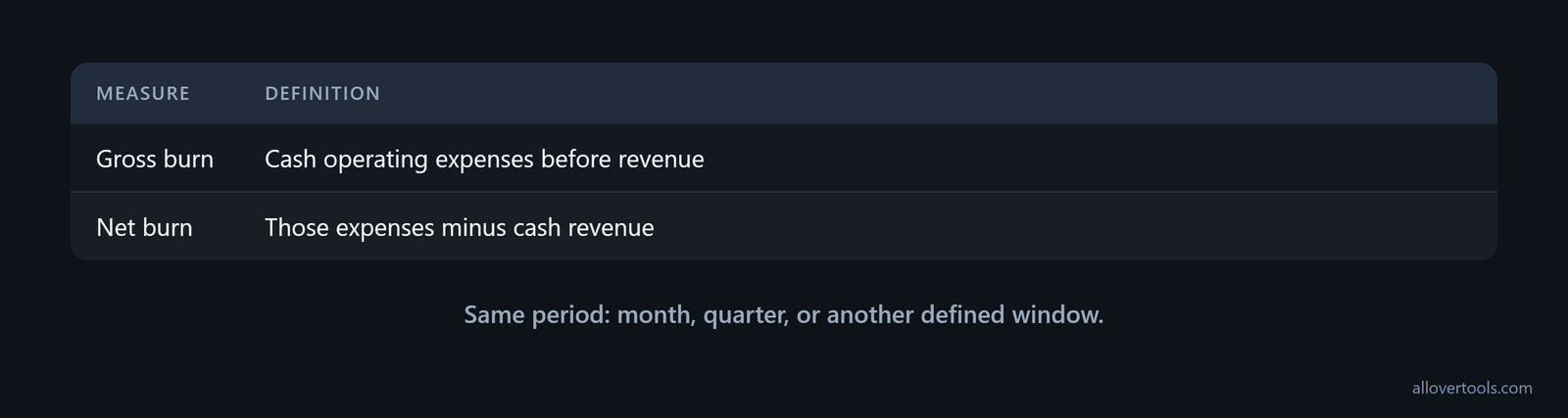
For this view, use cash collected and cash operating expenses. Total assets and accounting profit answer different questions. Financing and one-time cash events can also change the balance without belonging in the operating formula, so keep them separate when checking the numbers.
Keep non-operating cash movements out of burn, even when they extend runway. Fundraising, debt, and investor inflows give the company more runway, but they do not improve burn efficiency. List them separately in the reconciliation. A dashboard can tag equity financing, debt draws, asset disposals, and interest. Asset sales, capital injections, and interest income are also treated as non-operational. Bank transfers and financing activities are excluded from cash flow from operations, as the net burn dictionary sets out.
Set the COGS treatment before entering expenses. One published variant uses (Monthly revenue - Cost of goods sold) - Gross burn rate. Some practitioners put COGS inside the operating expenses already included in gross burn. The version that keeps COGS explicit is set out in this burn-rate formula. CapEx is another scope choice. A published net-burn example adds $50,000 of CapEx to $1,000,000 of operating outflows and subtracts $400,000 of cash inflows. Record whether CapEx is included or excluded; otherwise, two legitimate calculations can look comparable even when they use different cash scopes.
The Burn Rate Calculator uses Current cash balance, Revenue for this period, and Total expenses for this period. It reports monthly gross burn, net burn, and runway.
How to calculate burn from starting and ending cash
The cash-balance method reports what happened to the account during the period. Ending cash minus starting cash gives the signed movement. Starting cash minus ending cash flips that sign and gives the amount consumed as a positive number.
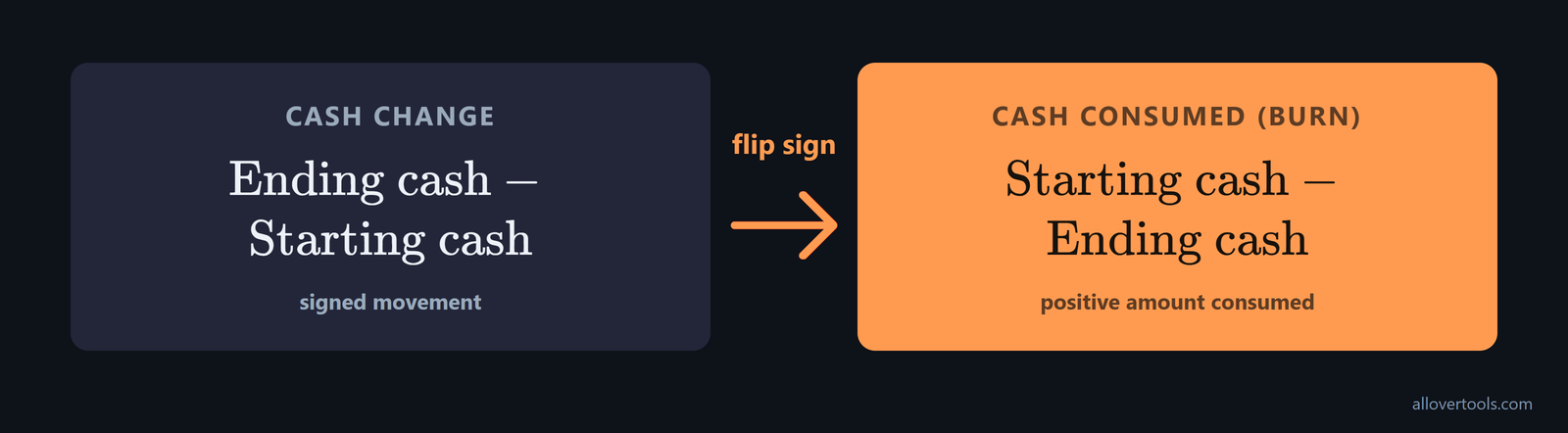
The cash-change sign and the burn sign
Cash change = Ending cash − Starting cash
Cash consumed (burn) = Starting cash − Ending cash
With starting cash of $500,000 and ending cash of $440,000:
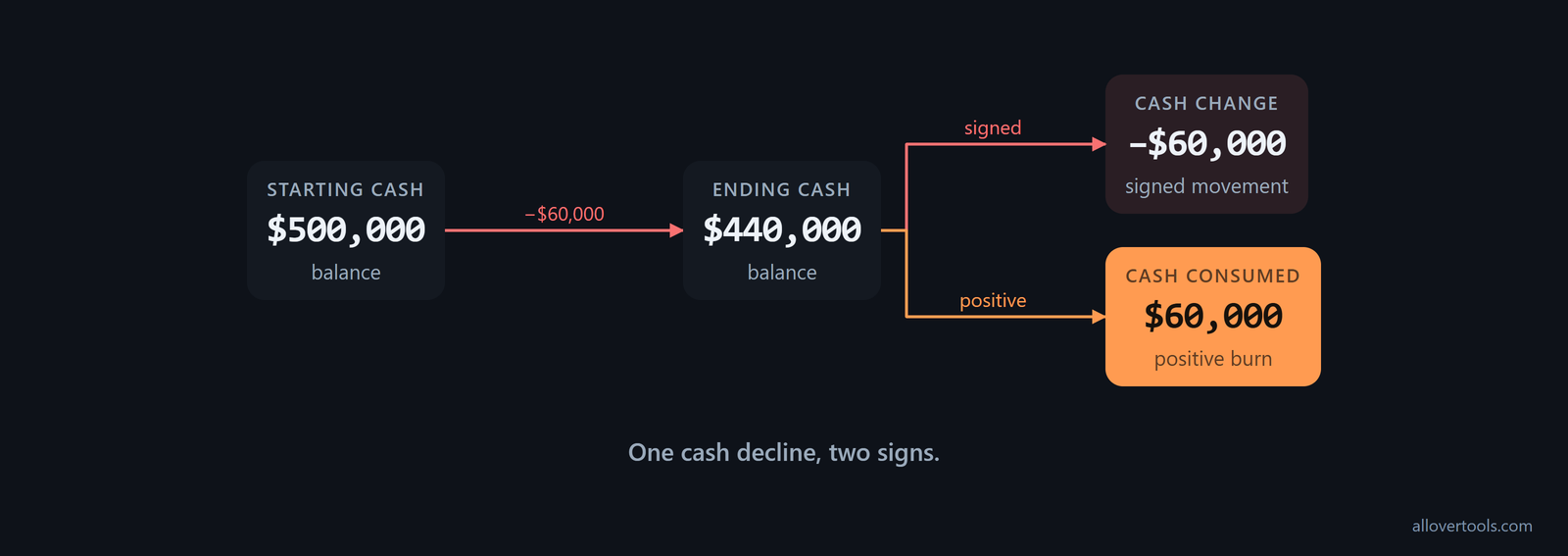
Cash change = $440,000 − $500,000 = −$60,000
Cash consumed = $500,000 − $440,000 = $60,000
The negative figure shows that cash fell. The positive figure shows that the business used $60,000. If cash rises from $500,000 to $510,000, cash change is +$10,000 and cash consumed is −$10,000. With $500,000 at both ends, both measures are $0.
This calculation follows the cash balance, so it can pick up timing effects or other cash items that are missing from an operating formula. The reporting scope needs to be clear before the two methods are compared.
For a multi-month shortcut, calculate average burn with Net burn rate = (starting cash - ending cash) / number of months. This is a quick health check, not necessarily pure operating burn. Unless you adjust the cash scope, it includes operating, investing, and financing cash flows. When the figure is meant to explain operating efficiency, use the more detailed operating-only calculation described in this cash-balance method.
Runway may use average burn instead of the latest month. One worked example averages $750,000 of total spend over 12 months to get $62,500 monthly gross burn. It then subtracts $20,000 monthly revenue to reach $42,500 net burn, as the runway example shows. Smoothing can account for seasonality and one-off payments, but it also hides recent changes in costs or revenue. Compare the trailing average with current-period burn before using the runway figure in a board discussion.
How expenses minus revenue gives net burn
The operating method starts with expenses and cash revenue from the same period:
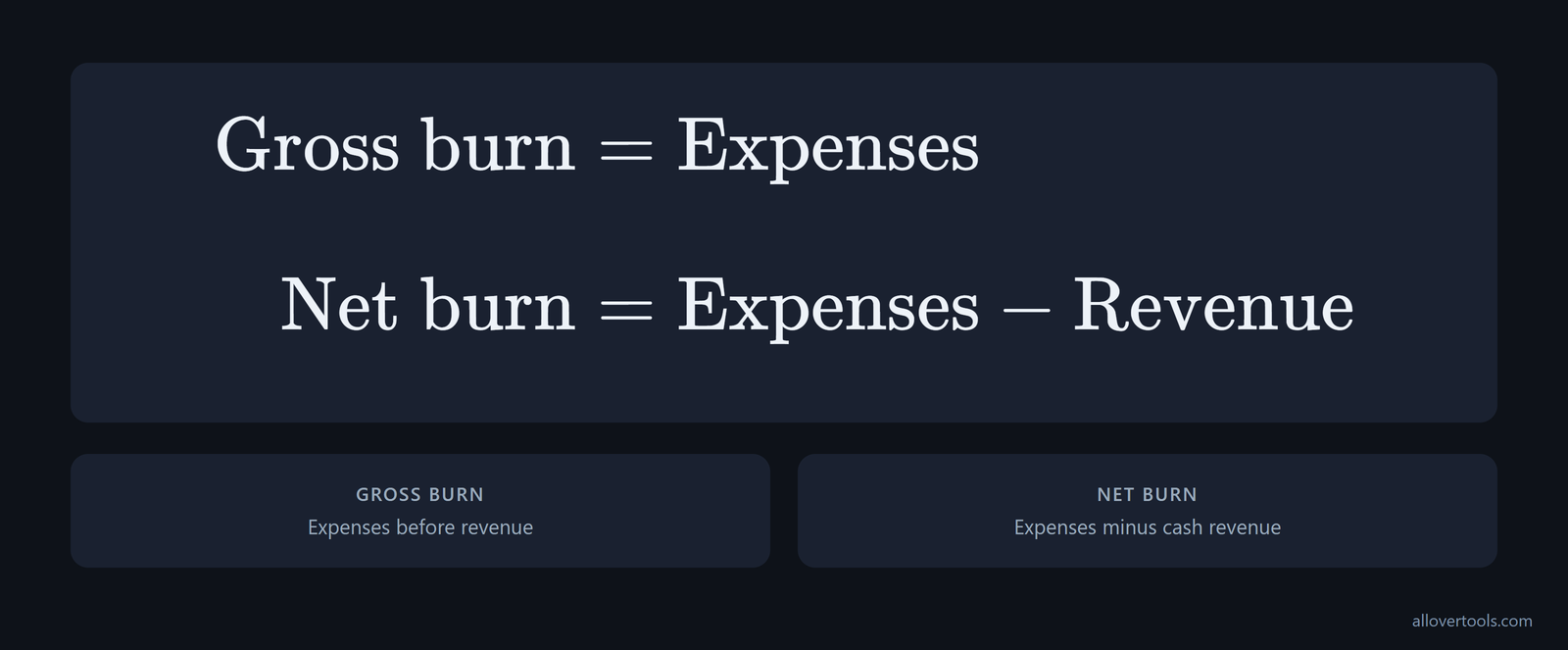
Gross burn = Expenses
Net burn = Expenses − Revenue
Positive net burn means expenses are higher than cash revenue. A negative result means revenue is higher than expenses. The sign is only useful when the report says which convention it uses.
Net burn does not have one universal sign convention. One reference defines it as revenue minus operating expenses, which makes a cash-burning company report a negative number. Another uses expenses minus revenue, making the same depletion positive. The same reversal applies to inflows minus outflows and outflows minus inflows. Put the formula and sign convention next to the figure in board decks and investor updates. That lets an external reader reconcile it, as this burn-rate reference illustrates.
Gross burn versus net burn
With $80,000 of expenses and $20,000 of revenue:
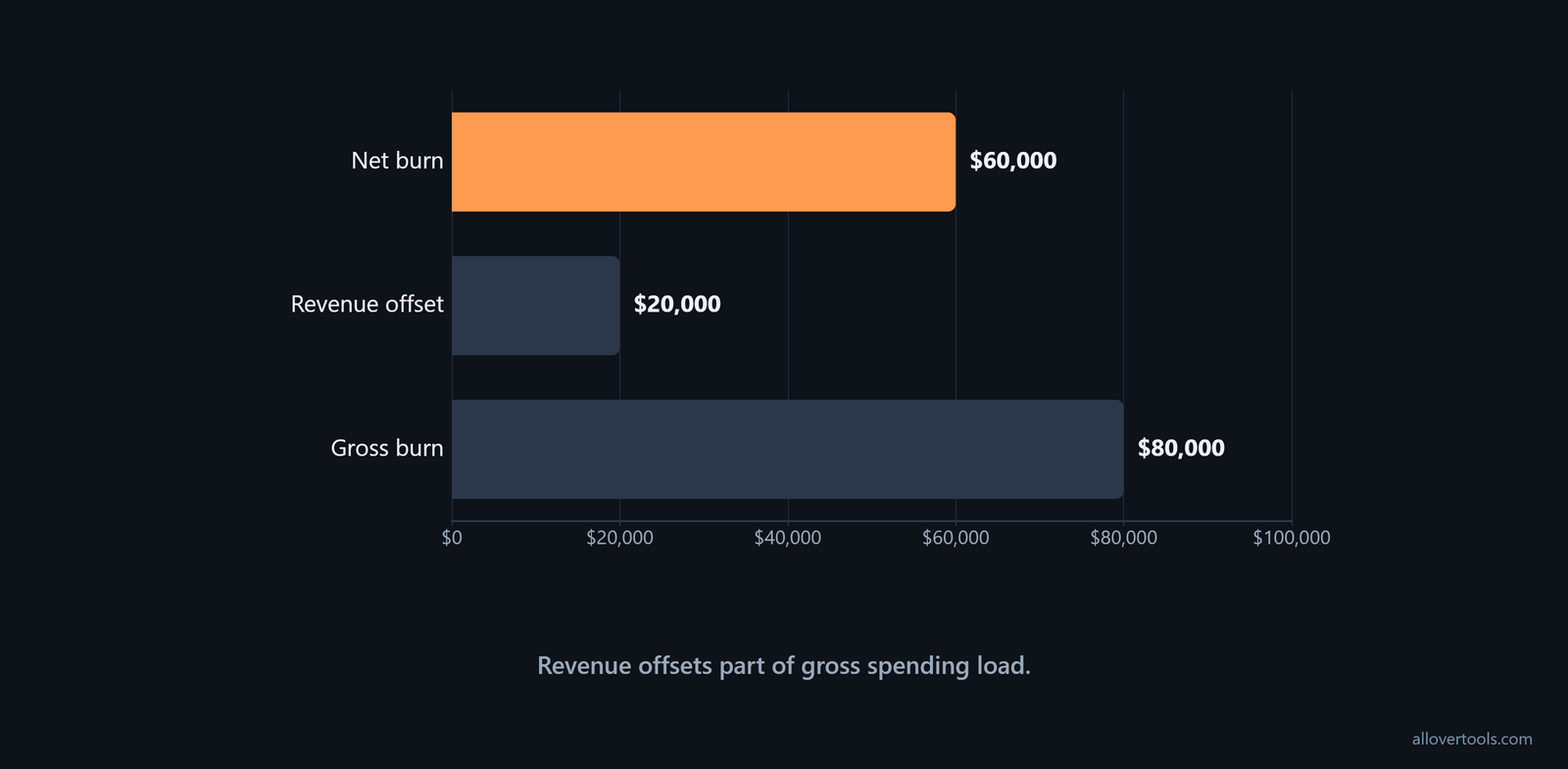
Gross burn = $80,000
Net burn = $80,000 − $20,000 = $60,000
Gross burn shows the full spending load. Net burn shows the $60,000 depletion used for runway. Here, it matches the positive cash-consumed figure in the cash-balance example.
Check any imported rule about gross and net burn against its formula. One published explanation says net burn is equal to or greater than gross burn, never less, while defining net burn with a revenue-and-COGS adjustment against gross burn. That relationship depends on the source's sign convention and cash scope. Validate it against your own figures before carrying the sentence into a dashboard, as the published explanation demonstrates.
When revenue stops, gross burn is the exposure to model. Net burn is used for runway and often gets the most investor attention. Gross burn shows how much cash the company would consume each month to keep operating with zero revenue, according to the startup burn lexicon. For scenario planning, use actual net burn for the base case, a revenue-cut case for downside, and gross burn for the zero-revenue stress case.
A negative net burn is cash growth
Now use $80,000 of expenses and $90,000 of revenue.
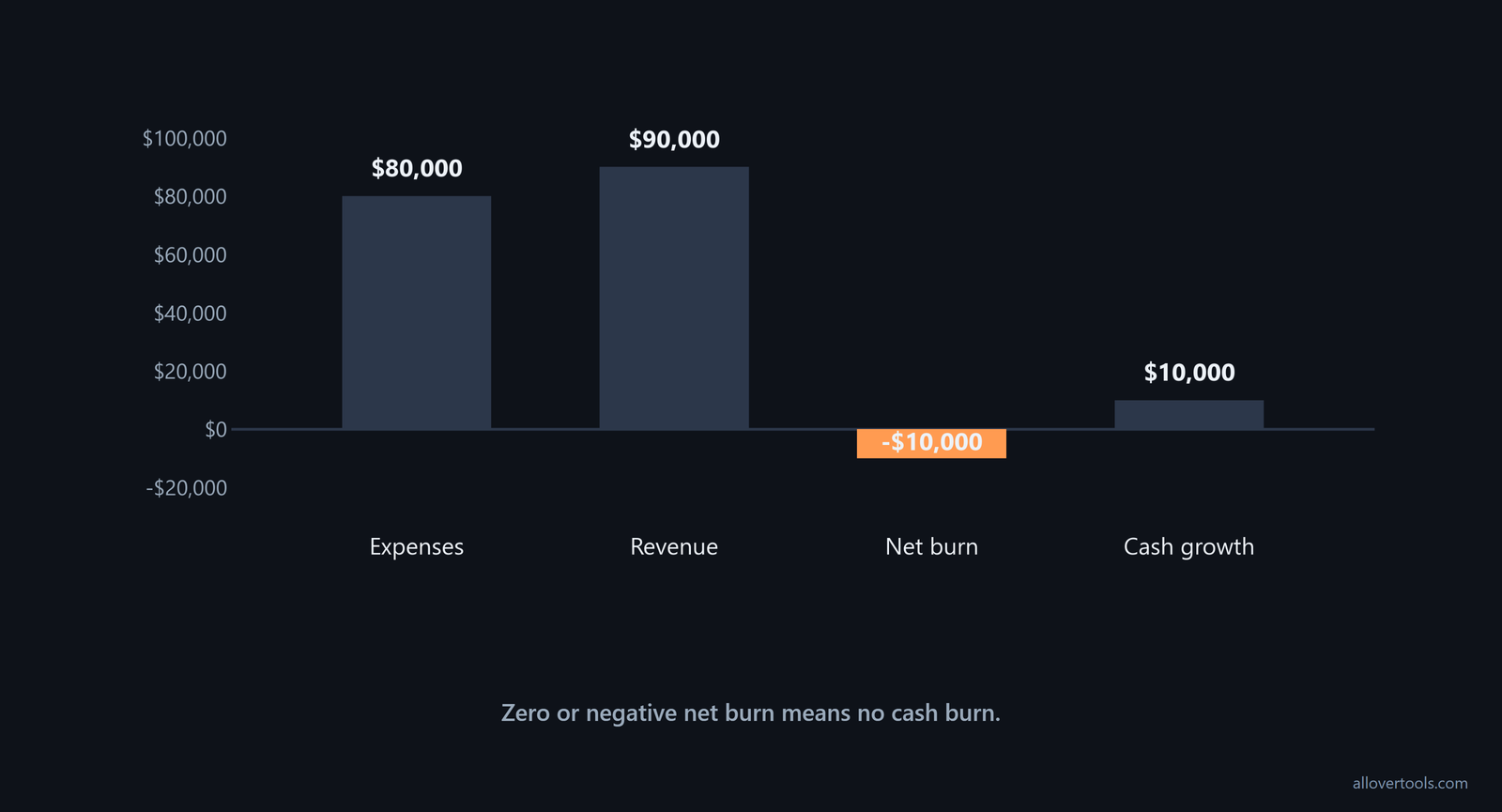
Gross burn = $80,000
Net burn = $80,000 − $90,000 = −$10,000
The negative net burn corresponds to +$10,000 of cash growth under the signed cash-change view. Dividing cash by a negative burn would produce a negative runway, so the calculator does not show a finite runway in that case. When net burn is zero or negative, it reports that the business is not burning cash.
Treat negative net burn as cash generation, not a broken input. A profitable company that is generating cash can have "negative Net Burn" because its operations are adding to cash reserves rather than consuming them, as this metric definition states. In that case, a dashboard can suppress runway or use the same inputs to show months of growth at the current cash-generation rate. It should not turn the result into a positive-burn label.
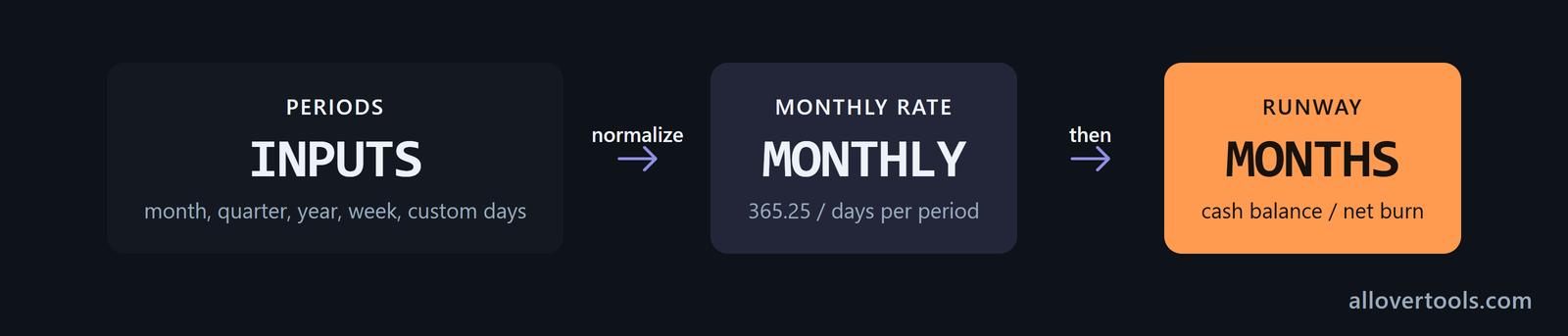
The Burn Rate Calculator converts monthly, quarterly, annual, weekly, and custom-day inputs to monthly values. For a custom period, it uses 365.25 ÷ days per period periods per year. Its runway equation is cash balance ÷ net burn, and the result is expressed in months.
Net burn can increase when revenue falls even if costs stay unchanged. Before treating a one-month spike as a structural cost problem, control for revenue variability: average net burn over several months, add a trailing-twelve-month view, and pair it with gross burn or cohort revenue metrics. A fall in revenue with no change in costs can produce a higher burn rate, as the revenue-variability warning makes clear.
How to convert between burn rate conventions
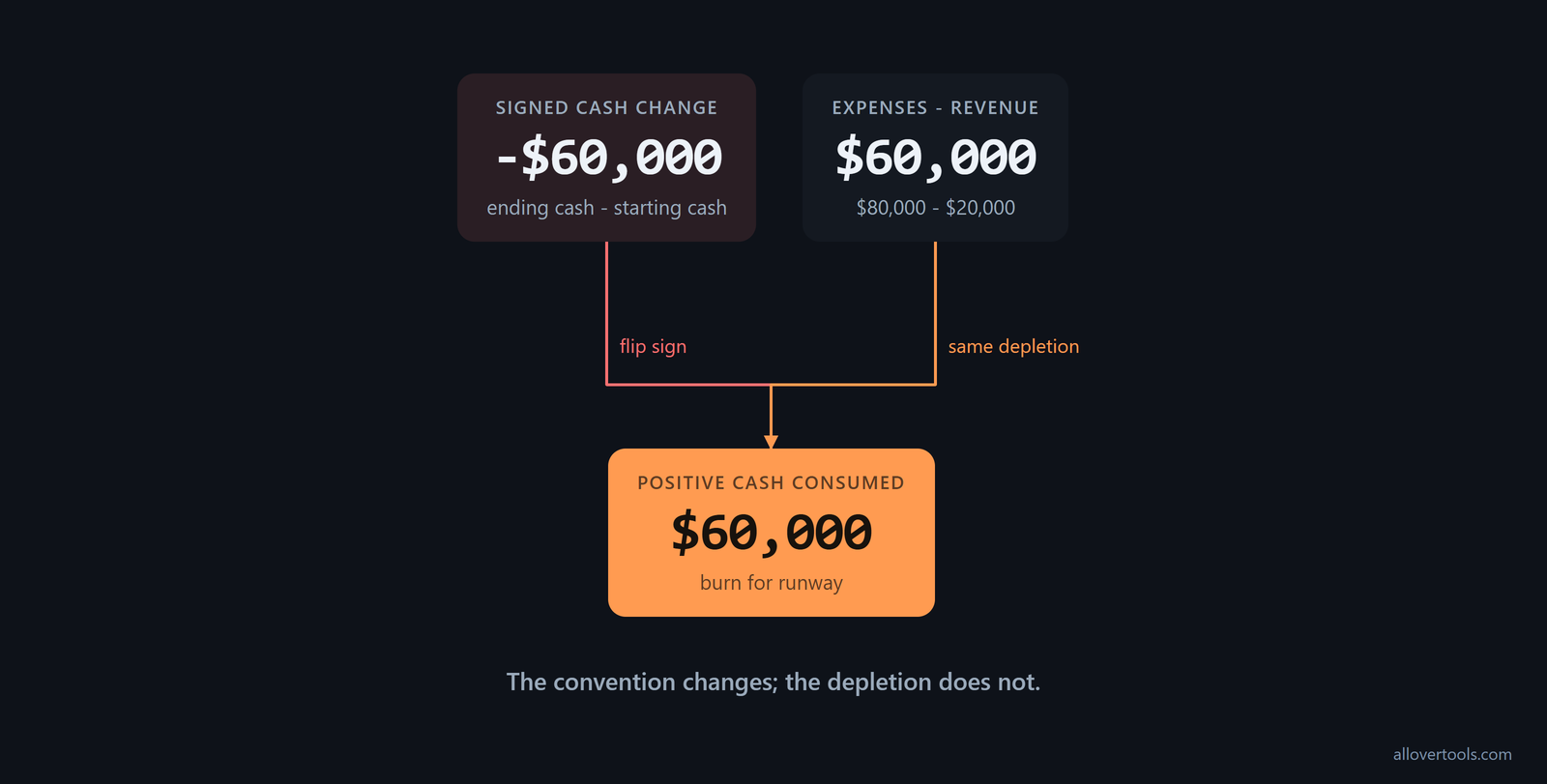
Conversion changes the sign or the label, not the underlying cash movement:
- Positive cash consumed = -(ending cash - starting cash).
- Signed cash change = -positive cash consumed.
- Expenses-minus-revenue net burn is the positive depletion equivalent when the operating inputs explain the cash movement.
For the $60,000 example, the same depletion appears as:
A three-line reconciliation
Signed cash change: −$60,000
Positive cash consumed: $60,000
Expenses − revenue: $80,000 − $20,000 = $60,000
These figures match only when they cover the same period and cash scope. Financing, one-time charges, timing differences, and other cash movements can leave a gap between the balance change and the operating calculation.
Check the comparison in this order:
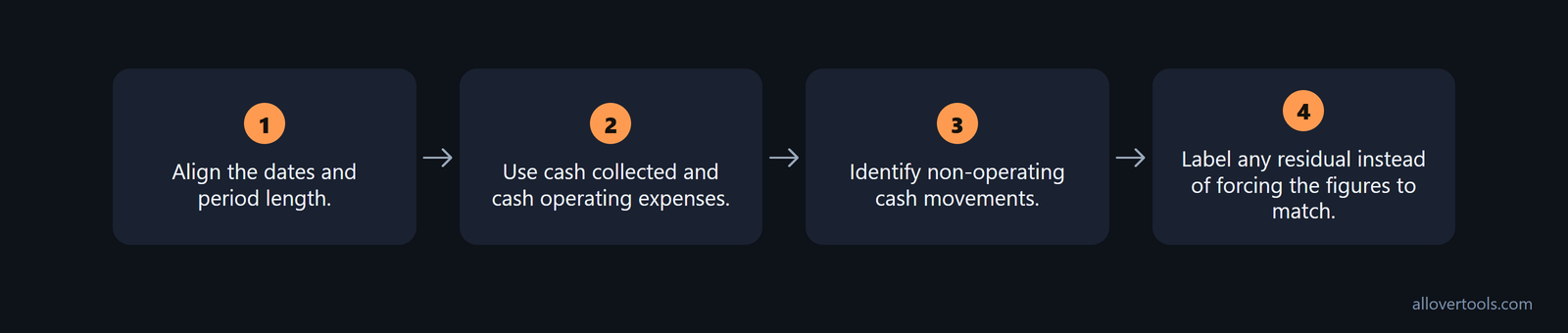
- Align the dates and period length.
- Use cash collected and cash operating expenses.
- Identify non-operating cash movements.
- Label any residual instead of forcing the figures to match.
Which burn convention should a founder use?
Pick one internal convention and keep it unchanged. Positive net cash consumed works well for runway and planning. Signed cash change is useful for showing the direction of the bank or ledger balance. Show gross burn beside net burn when the spending load matters too.
A dashboard and report naming standard
Give each number a label that explains its sign:
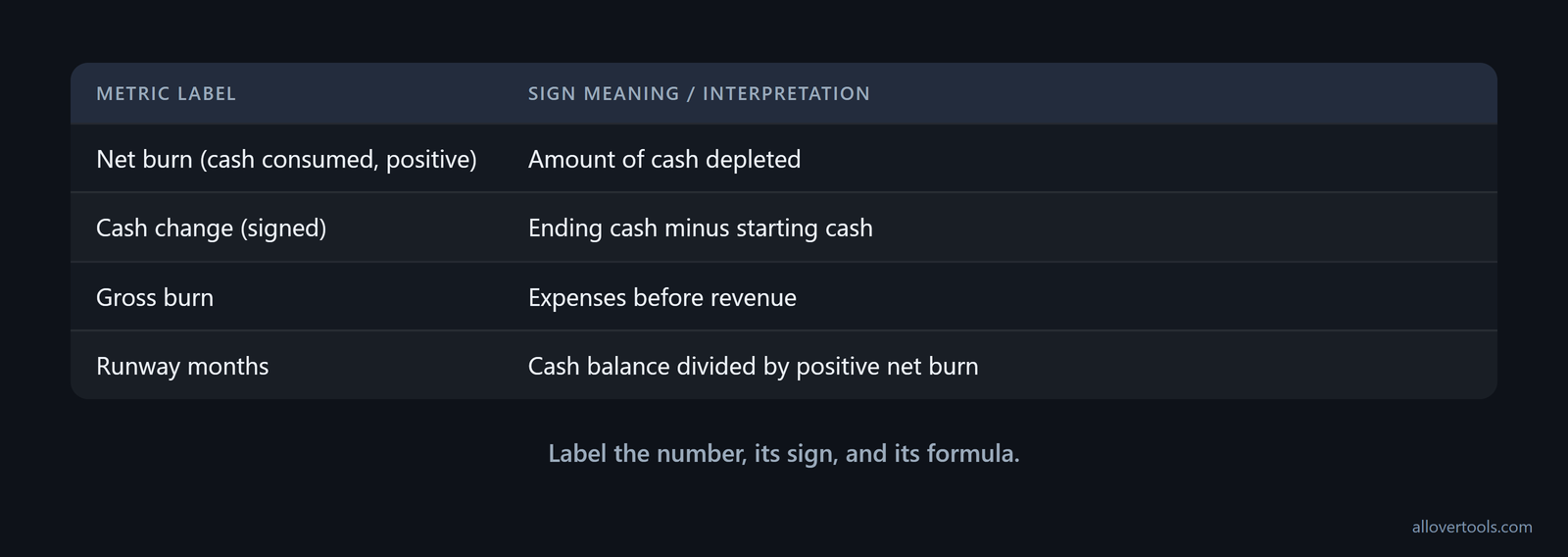
Net burn (cash consumed, positive)means the amount of cash depleted.Cash change (signed)means ending cash minus starting cash.Gross burnmeans expenses before revenue.Runway monthsmeans cash balance divided by positive net burn.
Use the same names in investor reports. If readers may expect the other convention, show the paired signed cash change so they can convert it immediately. A sign flip can look like a change in performance, so put the formula and period next to the number.
What to record in the team method note
Record the details another teammate would need to reproduce the result:
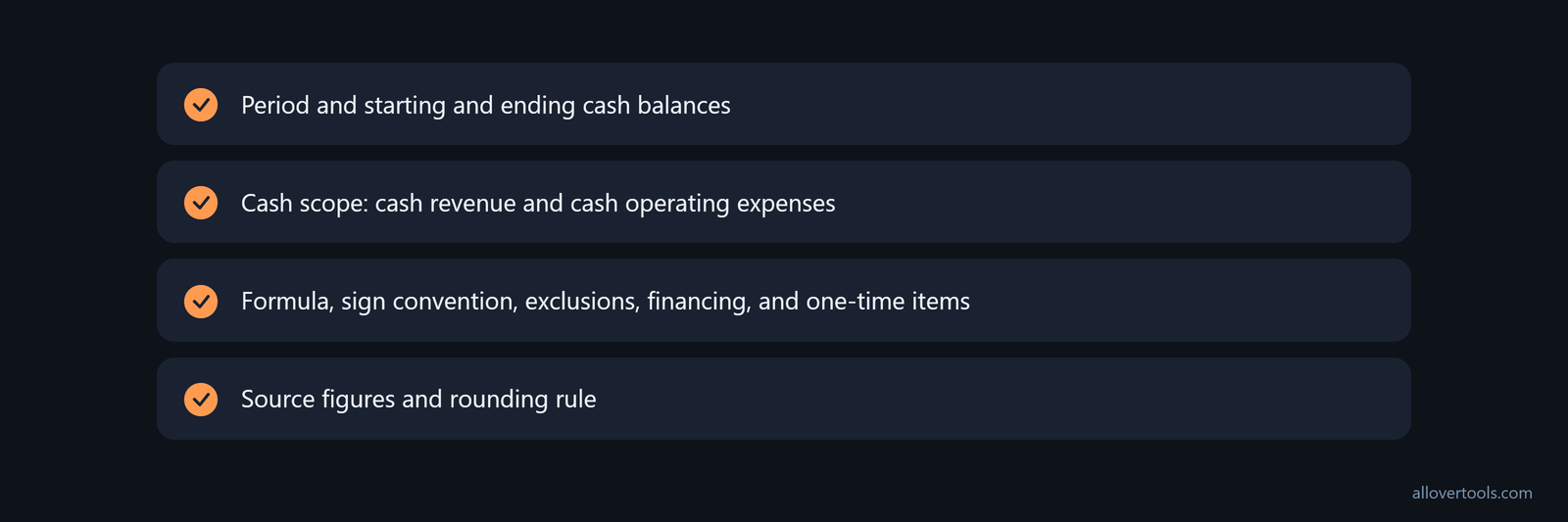
- The period and the starting and ending cash balances.
- The cash scope, including what counts as cash revenue and cash operating expenses.
- The formula, sign convention, exclusions, and treatment of financing and one-time items.
- The source figures and rounding rule.
Use the Burn Rate Calculator as an arithmetic check. Its Currency symbol control changes displayed labels only. Copy result and Download result (.txt) preserve the entered figures and formulas in the result. The calculation uses numbers entered in the browser; the source contains no fetch, XMLHttpRequest, sendBeacon, or form post for visitor data.
Burn multiple can mean two different things
Print the formula beside any burn-derived ratio. "Burn multiple" refers to two different calculations. The capital-efficiency version is Net Burn / Net New ARR. SaaS metric sources use net burn as cash spent beyond what came in and use the ratio to show how many dollars of burn are required to add one dollar of new recurring revenue. Another published usage calls Cash Balance / Burn Rate "burn multiple" and uses it to show how many months of operations a company can sustain; the comparison of definitions shows why the formula needs to be named.
These ratios are not interchangeable. The first measures capital efficiency. The second is a runway-like ratio that gives runway another name. A board packet that says only "burn multiple" does not tell the reader whether a lower ratio means less burn per dollar of new recurring revenue or whether the number represents months of cash support. Print the numerator, denominator, period, and sign convention with the ratio. If the underlying net burn is expenses minus revenue, show that positive-depletion convention. If a source uses cash spent beyond cash received, show how its cash scope maps to the internal figure.
Specialist SaaS metric sources consistently use the net-burn-divided-by-net-new-ARR definition to measure how many dollars of burn are needed to add a dollar of recurring revenue. Stripe's usage instead answers how long the current cash balance can support operations. Use the first when reviewing capital efficiency. Use the second only when the report explicitly intends a runway measure. Naming the formula prevents a ratio from appearing to show a performance change when only the definition changed.
The cash scope changes with company stage
Formula detail usually increases as a company grows. Early-stage teams may use a simple expenses-minus-revenue calculation. Growth-stage SaaS companies may refine net burn to match investor benchmarks and capital-efficiency ratios such as burn multiple. A 2026 stage-benchmark discussion defines burn multiple as net burn divided by net new ARR. It also notes that some practitioners exclude asset sales, capital injections, and interest income as non-operational, as the SaaS stage benchmark notes. Set the scope to fit the decision. A simple internal runway check can use the team's consistent operating definition. A benchmark comparison needs the tighter exclusions and formula used by the benchmark.
Frequently asked questions
What is the simplest burn rate formula?
Net burn is expenses minus cash revenue for the same period. A cash-ledger version is starting cash minus ending cash when positive depletion is wanted. Label the method because signed cash change uses the opposite sign.
Should burn rate be positive or negative?
Use positive cash consumed for runway and planning. Keep negative signed cash change when reporting the direction of the bank balance. A negative expenses-minus-revenue result means revenue exceeds expenses and cash is growing.
What is the difference between gross burn and net burn?
Gross burn is expenses before revenue; net burn is expenses minus revenue. With $80,000 of expenses and $20,000 of revenue, gross burn is $80,000 and net burn is $60,000.
Why does my cash-change burn not equal expenses minus revenue?
The periods or cash scopes may differ. Financing, one-time items, timing differences, and other cash movements may also be in the balance change but outside the operating inputs. Align the dates and definitions, then document the residual.
How should burn rate appear on a dashboard?
Show labeled Net burn (cash consumed, positive), signed Cash change, Gross burn, and Runway months, with the period and formula documented. Do not rely on a bare positive or negative number.