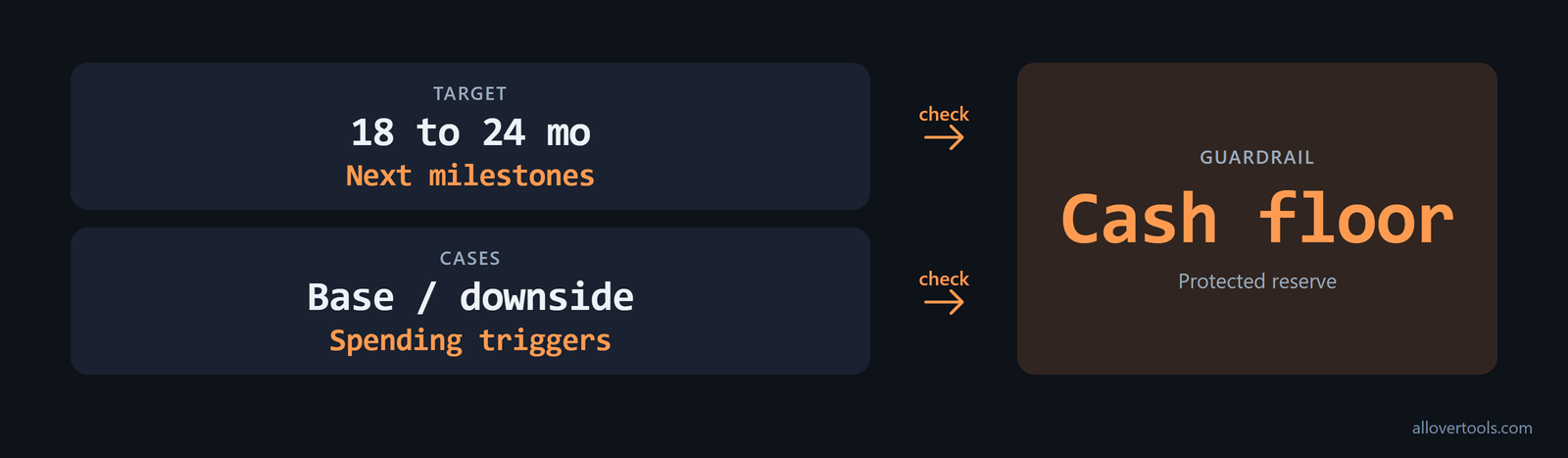
The runway after funding round is a spending plan tied to the next milestone, not just a month count. An 18 to 24 month target is useful guidance, not a rule. Check it against burn, collected revenue, hiring, marketing, and a protected cash floor before approving new commitments.
What runway should you target after a funding round?
Post-raise runway is how long the company can operate at its planned net burn. An 18 to 24 month target is the planning guidance used here. It is not a guarantee or a universal rule. The target needs to last long enough to reach the next milestone set, such as product readiness, repeatable acquisition, or stronger retention evidence.
Before approving new spending, record the target, the milestone it pays for, the cash floor, and the conditions that would slow spending. A planned hire might depend on product readiness. A marketing commitment might wait for evidence that acquisition is repeatable.
Those assumptions also explain the runway expectations investors may have. Show the base case, the downside case, and the point at which the plan changes. A month count without those decisions does not say how the cash will be managed.
For a venture-backed startup dealing with slower fundraising cycles and more investor scrutiny, plan for 24 to 36 months after a round. In a tighter fundraising environment, that more conservative range is now more frequently recommended in J.P. Morgan's guidance.
The range depends on the stage. Set the target from the round that has just closed, as Escalon's stage guidance shows:
| Round stage | Runway investors want to see |
|---|---|
| Seed | 18 to 24 months |
| Series A | 18 months |
| Series B and beyond | 12 to 18 months |
A single runway number does not fit every company. Stage, capital requirements, industry, business model, and existing investors all affect the required length. A deep-tech or hardware company with a long development cycle may need significantly more runway than a low-burn SaaS startup, according to J.P. Morgan's context.
Compare the target with the time between rounds. Carta data shows a median gap of 696 days (about 23 months) between primary rounds across stages, 774 days (about 25 months) from seed to Series A, and 732 days (about 24 months) from Series A to B. Add a six-month buffer and the suggested targets are about 29, 31, and 30 months respectively, as the round-gap table sets out.
Bootstrapped companies need a different endpoint. A venture-backed startup plans 18 to 24 months or more after a raise. A bootstrapped startup plans to reach profitability: use the month when revenue overtakes burn as the target and add extra cash to survive if that month slips by a quarter or two, following this runway distinction.
The post-round target is separate from the warning floors. Plan for 24 to 36 months after a round, then use the thresholds summarized in the runway floor guidance:
| Runway level | What it signals |
|---|---|
| 12 months | Going-concern test at audit |
| Less than 6 months | Much closer investor scrutiny |
| Under 2 months | Y Combinator's practical point of no return |
How to set your initial burn plan after the raise
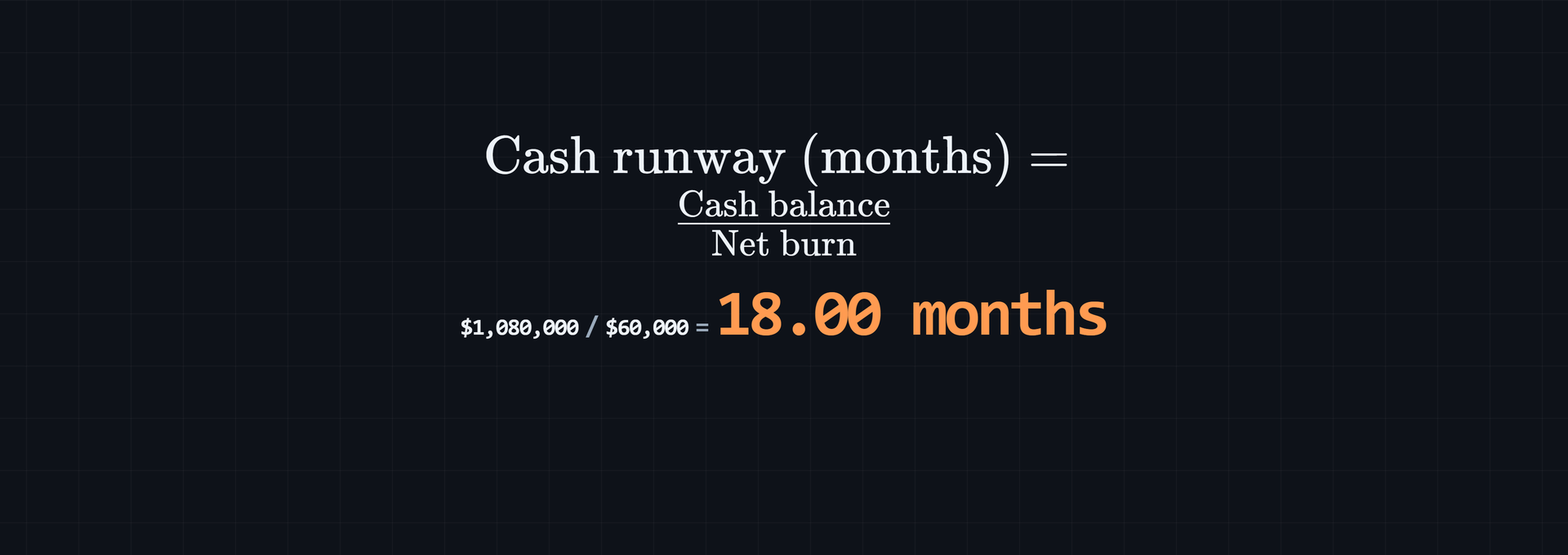
Begin with the first month as the baseline. Gross burn is monthly expenses. Net burn is monthly expenses minus monthly revenue. When net burn is positive, divide the cash balance by net burn to get a flat runway in months. Use cash and cash equivalents for cash, cash collected for revenue, and cash operating expenses for expenses. Revenue and expenses must cover the same period.
Start with cash that is immediately accessible, or can be accessed within a reasonable time frame, typically 30 days, to cover expenses. Leave anticipated fundraising and other uncertain capital infusions out of available cash; J.P. Morgan's cash definition treats current cash balance as bank cash and other liquid assets convertible within about 30 days.
When one month's P&L is volatile, look at cash movement across several months. Average monthly net burn can be calculated as (opening cash - closing cash + equity or loans received in the period) divided by the number of months. Another method is (starting cash - ending cash) divided by the months in the window. A three- to six-month average smooths volatility, as the multi-month burn method recommends.
These are chosen values for a flat-rate example:
Current cash balance: $1,500,000
Revenue for this period: $30,000
Total expenses for this period: $90,000
Period for revenue & expenses below: Monthly

Gross burn: $90,000
Net burn: $90,000 - $30,000 = $60,000
Flat runway: $1,500,000 / $60,000 = 25.00 months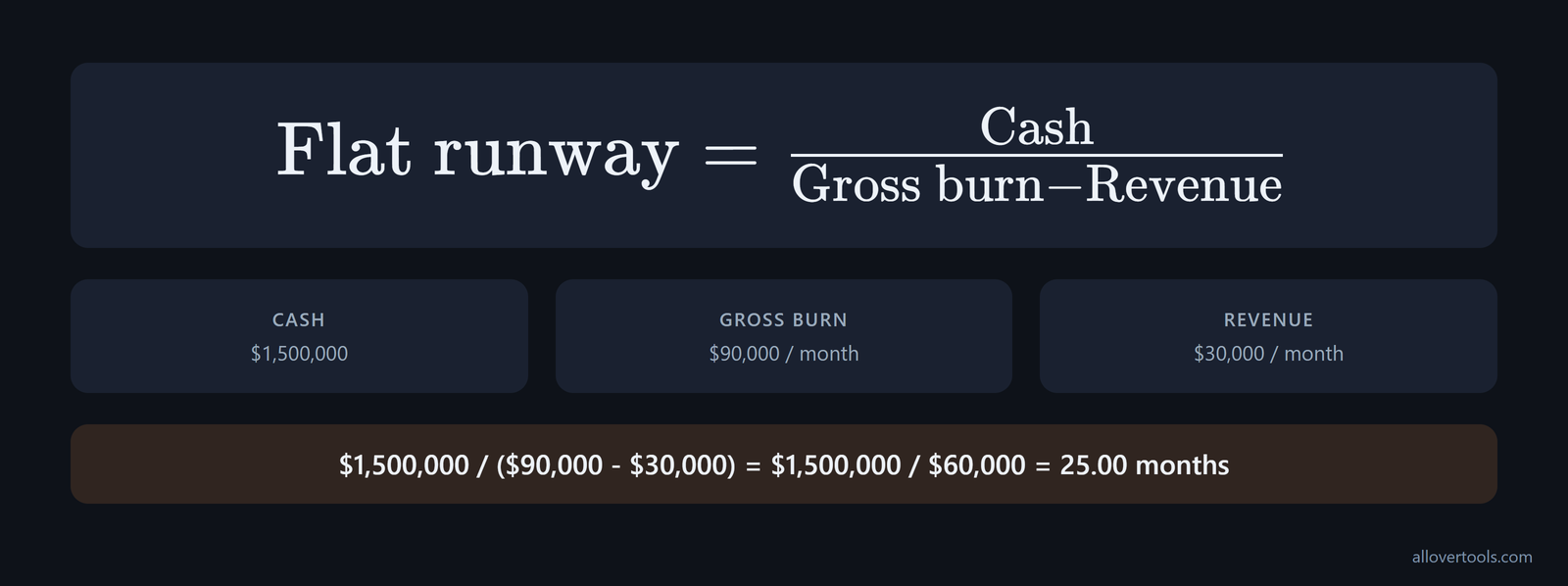
Hold back a deliberately chosen three months of baseline net burn before assigning the rest to planned operations:
Protected reserve: $60,000 × 3 = $180,000
Deployable cash: $1,500,000 - $180,000 = $1,320,000
Runway after reserve: $1,320,000 / $60,000 = 22.00 months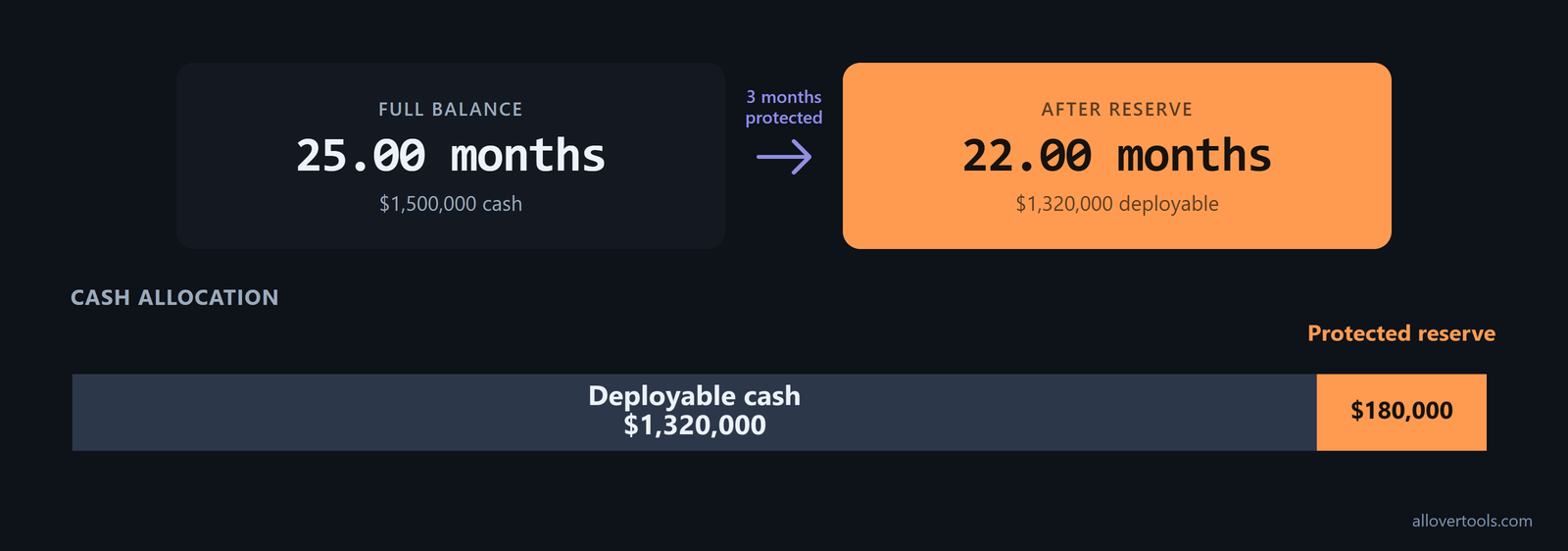
If the plan also sets the round size, use round size = target runway in months x planned average monthly net burn - usable cash at close + any top-up to the wind-down reserve. The amount raised then follows from the target and burn instead of being an arbitrary number, using the round-sizing formula.
To reproduce the example, enter Current cash balance, Revenue for this period, Total expenses for this period, and Period for revenue & expenses below in the Burn Rate Calculator. The calculator uses the entered values, runs in the browser, and does not send visitor content over the network. The currency symbol labels the output; it does not convert the amount. Rebuild the plan when the period, cash balance, collected revenue, or expense assumptions change. This gives a working spend rate after the capital raise instead of a one-time calculation.
Separate baseline burn from committed new spend
Record the current operating base first. List each proposed recurring cost separately so a hire, campaign, or vendor commitment can be switched on or off in the model. Keep recurring cash expenses separate from one-time uses of funds. The target depends on net burn, not the funding amount by itself.
How hiring and marketing change your runway
Start with the same baseline values: cash of $1,500,000 and monthly revenue of $30,000. Baseline expenses of $90,000 produce $60,000 of net burn and 25.00 months of flat runway. The values below are chosen for this example, not benchmarks.
Use market reference points to check the plan, but keep the company's own cash model as the decision record. These seed-stage benchmarks show:
- At seed, teams often run lean, with burn under $80,000 per month and the founders plus three to five hires.
- Seed-stage raises of $2M-$5M often support burn of $150k-$300k+ per month for teams of 10-20 including go-to-market hires.
- Seed-stage startups typically burn $75-100K per month, with personnel representing 60-70% of total burn.
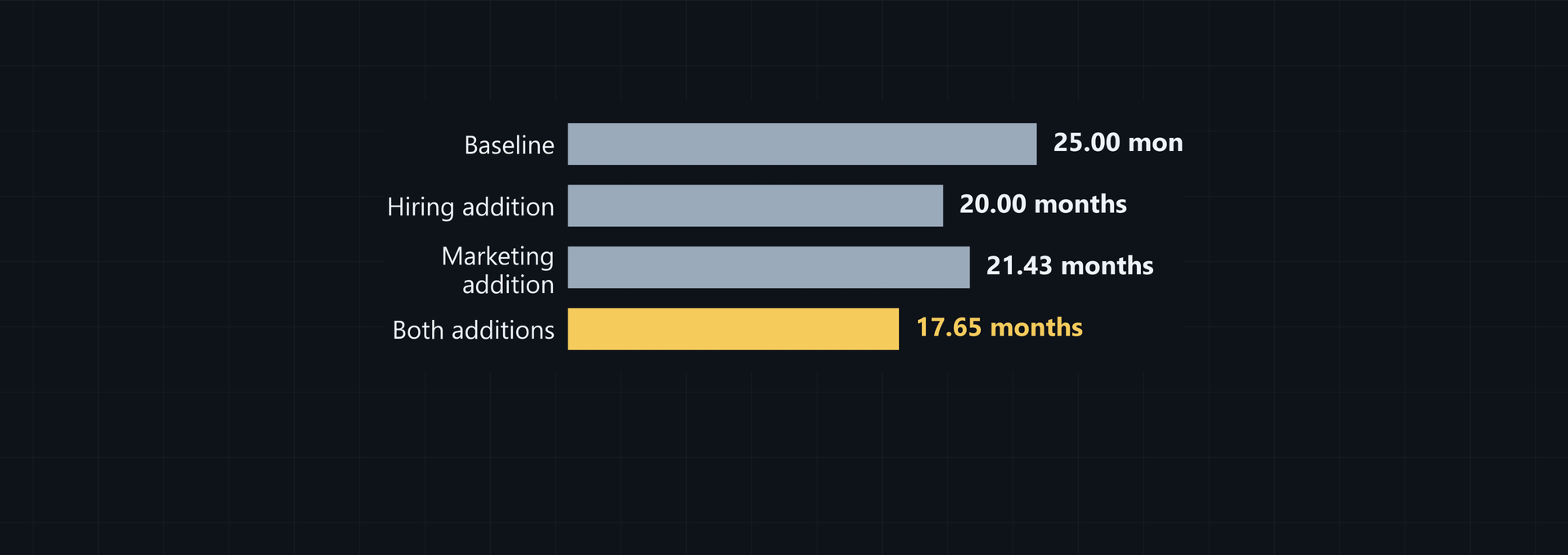
Case                  Expenses     Net burn     Flat runway
Baseline              $90,000      $60,000      25.00 months
Hiring addition       $105,000     $75,000      20.00 months
Marketing addition    $100,000     $70,000      21.43 months
Both additions        $115,000     $85,000      17.65 months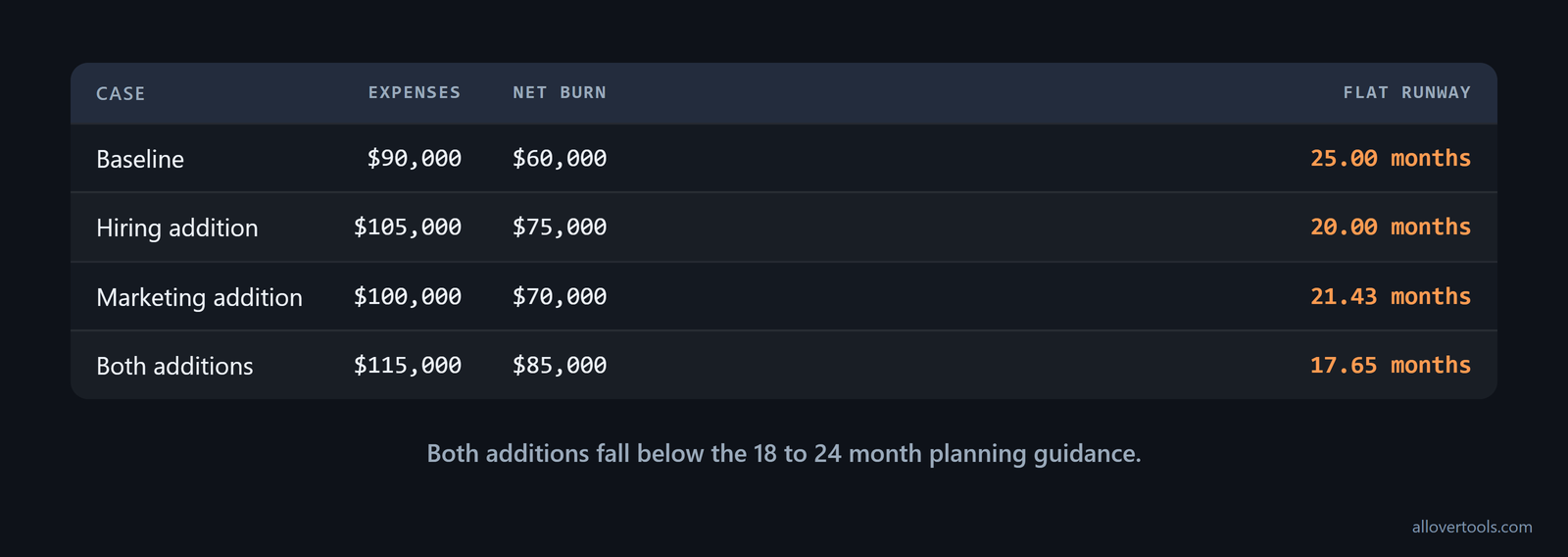
The hiring case adds a chosen $15,000 per month to expenses. The marketing case adds a chosen $10,000 per month. Treat both as planning assumptions. Give each decision an owner, a start condition, an expected cash effect, and a stop or review condition.
Approve the spend only if the downside case still protects the target and the chosen buffer. If it does not, phase the spend so the next milestone is funded before the full cost begins. A delayed start or staged role changes when the $15,000 monthly commitment enters the cash plan. Include hiring costs beyond salary when they are real cash expenses. Treat marketing as a cash outlay, not as expected revenue.
Model the hire as an incremental monthly cost
With the chosen $15,000 monthly addition, expenses become $105,000. Net burn is $105,000 - $30,000 = $75,000, and flat runway is $1,500,000 / $75,000 = 20.00 months. Compare that result with the target before setting a start date. A later start or staged role keeps earlier months at the baseline expense level.
Model marketing before the spend starts
With the chosen $10,000 monthly addition, expenses become $100,000. Net burn is $100,000 - $30,000 = $70,000, and flat runway is $1,500,000 / $70,000 = 21.43 months. Test this case with the hire before approving both the campaign and the role. Together, the chosen additions produce $115,000 of expenses, $85,000 of net burn, and 17.65 months.
Track whether the added burn is buying growth efficiently, not just how many months remain. The standard burn multiple is net burn divided by net new annual recurring revenue over the same period. A lower burn multiple indicates more efficient growth and is closely watched by investors, particularly for SaaS and other subscription businesses, according to the burn multiple definition.
How to reserve a buffer for unexpected shocks
Target runway and usable operating runway are different when some cash is protected. In the example, the three-month reserve is a planning assumption, not a universal benchmark. The $180,000 reserve covers a delayed collection, an unplanned cash bill, an early start date, or a campaign that needs to stop. It leaves $1,320,000 for planned operations, which gives 22.00 months at the baseline $60,000 net burn.
Make the buffer a decision rule. Do not use it for ordinary commitments. Define what can release it, then restore it after a shock. If net burn is zero or negative, cash divided by burn is not a useful flat-rate runway result. If cash is zero while positive net burn remains, runway is zero.
A flat-rate result leaves out seasonality, one-time charges, financing events, and changing revenue or spend. The buffer cannot replace scenarios. It protects the plan while those scenarios are reviewed.
What to do when revenue underperforms
Compare collected cash revenue and actual expenses with the plan. Update the downside case. Then decide which commitments pause, shrink, or move. Set an observable trigger before the miss, such as actual net burn exceeding the approved case or the protected cash floor being approached, and pair it with a specific action.
For a changing month-by-month case, enter Current cash balance, Monthly revenue (month 1), Monthly expenses / burn (month 1), Monthly revenue growth rate (optional), Monthly expense growth rate (optional), and Months to show in projection table, then select Calculate runway in the Cash Runway Calculator.
These are chosen scenario values:
Starting cash: $1,500,000
Month-one revenue: $15,000
Month-one expenses: $95,000
Revenue growth: -5% per month
Expense growth: 3% per month

Month-one net burn: $95,000 - $15,000 = $80,000
Interpolated estimated runway: 14.22 months
First month ending cash at or below zero: month 15
The simulation compounds revenue and expenses each month. Ending cash equals the prior month's cash minus that month's net burn. When cash runs out during a month, the calculator interpolates the fractional runway within that month. With these inputs, month-one net burn is $80,000, the estimate is 14.22 months, and cash first reaches zero or below in month 15.
When revenue compounds, runway is no longer just a countdown. With $600,000 of cash, $50,000 of monthly spend, and $15,000 of revenue, flat runway is 17.1 months. If revenue grows 5% a month, the same company never runs out of cash and breaks even in month 26, as this revenue-growth scenario shows.
A blank growth field means 0%. The calculator can simulate up to 600 months, so the result is a scenario based on the entered assumptions. Respond by protecting the buffer, stopping optional commitments, changing the order of hiring and marketing, finding lower-cost options, and updating the milestone plan.
Set an action trigger before the miss
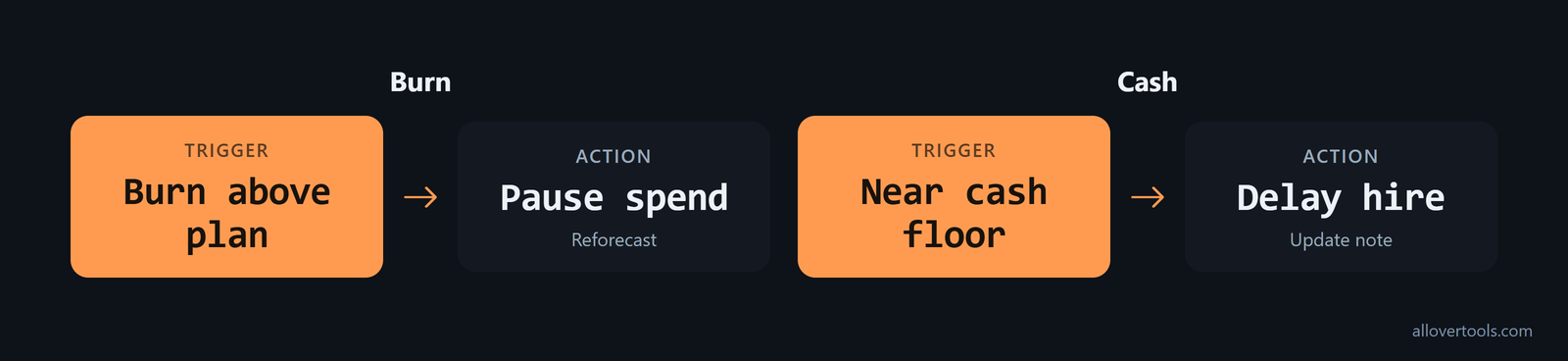
Write the trigger and action into the plan before revenue slips. If actual net burn exceeds the approved case, pause a discretionary commitment and reforecast. If cash approaches the protected floor, move the next hiring start and update the investor note. The trigger should point to a decision the team can take.
Use runway zones to decide how urgently to act: 18+ months is the Safe Zone, 9-12 months is the Caution Zone, and below 9 months requires immediate planning to cut burn or raise more capital, following the runway-zone guidance.
| Runway | Action zone |
|---|---|
| 18+ months | Safe Zone |
| 9-12 months | Caution Zone |
| Below 9 months | Immediate planning to cut burn or raise more capital |
How to link runway to milestones and investor updates
Set a regular review cycle for the model. Each week, compare cash collected, cash paid, and the protected floor. Each month, update revenue, expenses, hiring starts, marketing commitments, net burn, and months remaining.

For investors, report starting cash, current gross and net burn, base and downside runway, the buffer, the next milestone set, changed assumptions, and the action already taken. Tie each proposed spend to a milestone and state what evidence would unlock the next spend. If the target is no longer reachable, show the revised milestone sequence.
Review the calculator outputs on the same schedule and keep the assumptions recorded internally. Check the cash balance, collected revenue, total expenses, recurring commitments, runway, buffer, milestone status, and investor update owner.
Begin fundraising when 9-12 months of runway remain. The process typically takes 3-6 months, so starting in that range is intended to leave at least 18 months when the round closes, according to Valuefy's fundraising timing.
Treat 6-12 months of runway before the next raise as a documented investor expectation. In a 2024 survey of 110 venture capitalists, 53.7% advised their portfolio companies to maintain that range, as reported in the 2024 VC survey.
What to include in the investor update
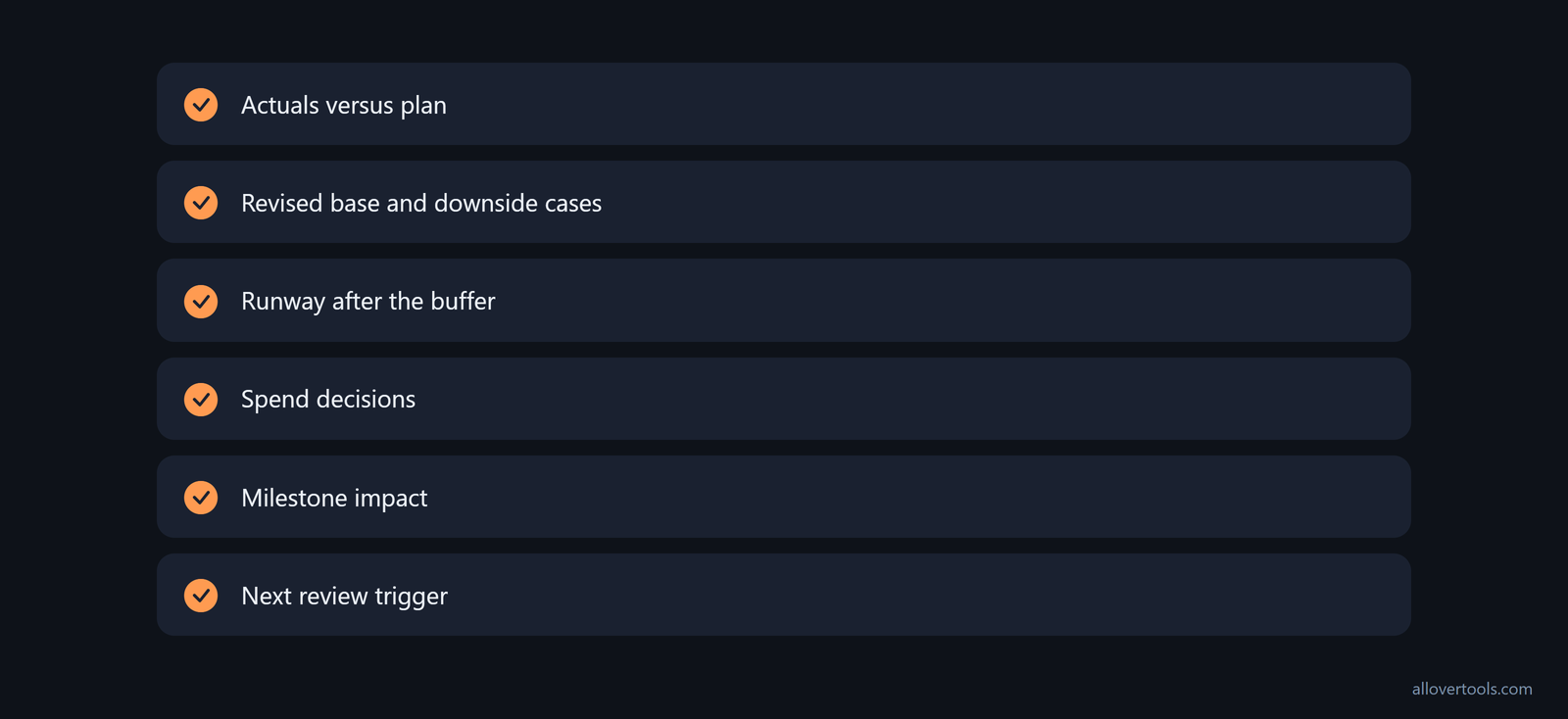
Use a compact update: actuals versus plan, revised base and downside cases, runway after the buffer, spend decisions, milestone impact, and the next review trigger. Clear assumptions make a shorter runway easier to act on because the change is tied to a decision and a revised milestone sequence.
Frequently asked questions
How much runway should a startup have after raising money?
Use 18 to 24 months as planning guidance, then test whether it reaches the next milestone after a chosen buffer. The target depends on burn, revenue collection, commitments, and the downside case.
How do I calculate runway after a funding round?
Put revenue and expenses on the same period, calculate net burn as expenses minus revenue, then divide current cash by positive net burn. Use a month-by-month projection when revenue or expenses change instead of a flat rate.
Should I hire or increase marketing immediately after a raise?
Model each recurring cost separately and together using chosen values for added monthly spend. Approve it only when the base and downside cases protect the target, buffer, and milestone plan.
What should I tell investors if my runway is shorter than planned?
Show actual cash, revenue, expenses, revised net burn, base and downside runway, the buffer, and the actions already taken. Explain which milestone changes and what trigger will prompt the next update.