
Cash burn vs loss compares two different views of a business. Cash burn is the cash the business uses during a period. Accounting loss is negative net income under accrual accounting. Burn shows liquidity, while net income shows P&L performance. Gross burn counts operating cash paid before receipts; net burn subtracts cash collected. Positive net burn reduces cash.
What is cash burn vs accounting loss?
Cash burn follows money moving in and out of the business. Accounting loss is negative net income for the reporting period. The two figures answer different questions, so neither replaces the other. Gross burn is operating cash outflows before receipts. Net burn is operating cash outflows minus cash collected. Zero or negative net burn means the period did not consume cash. That is why burn rate vs net income can produce different figures.
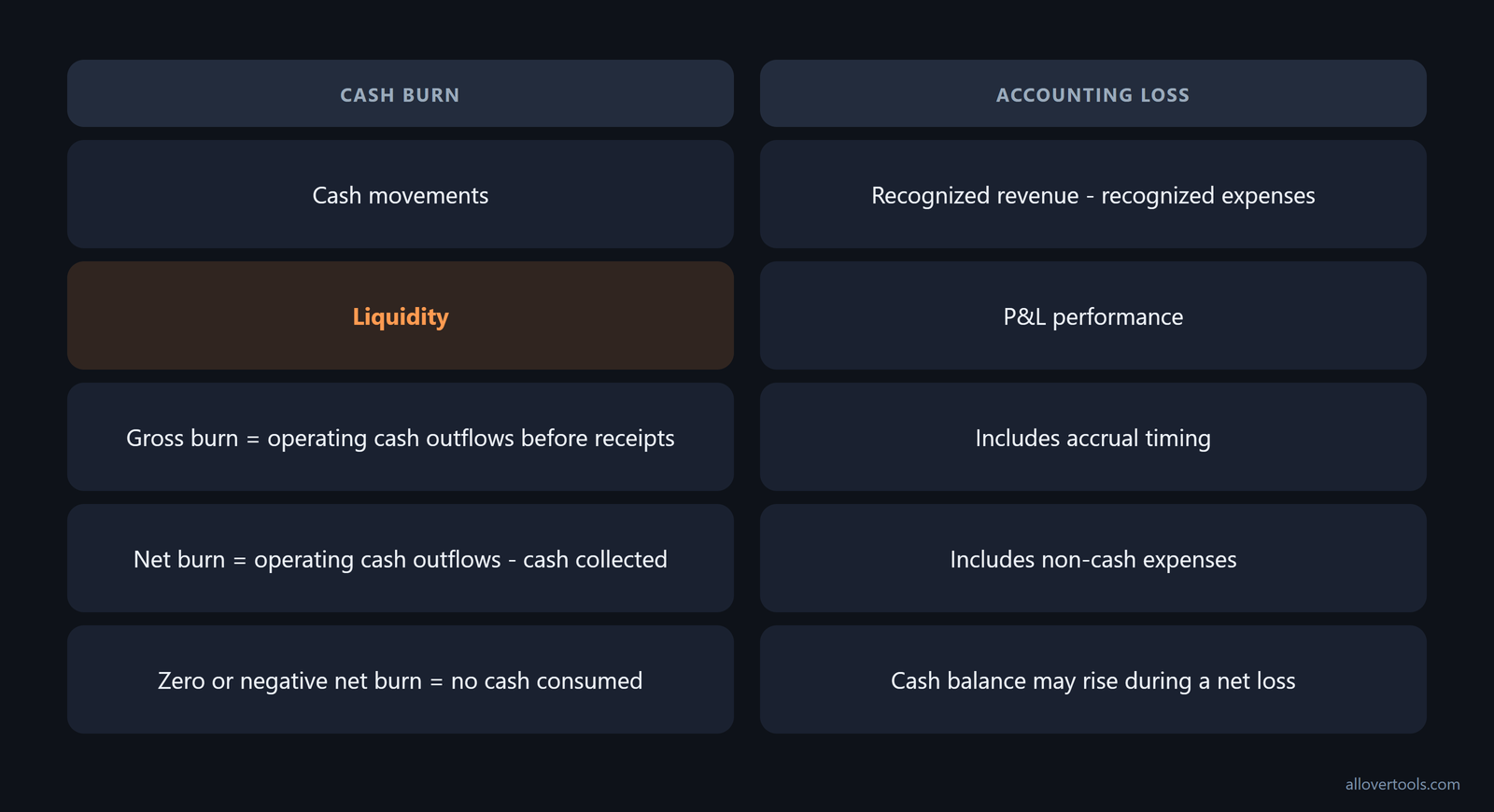
Cash burn tracks liquidity
A recurring burn calculation uses actual cash receipts and cash payments. Gross burn is the operating cash paid during the period. Net burn removes cash collected from that amount. Runway starts with cash on hand, not total assets or revenue recorded on the P&L.
Cash burn can also be measured directly from the bank balance: Cash Burn (monthly) = (Cash at Period Start - Cash at Period End) / Number of Months. The result does not depend on the P&L; it shows how much cash the business actually lost during the period, as shown by this cash-burn formula. That is why a company can look profitable while slow collections reduce cash, or report a loss while annual customer prepayments leave the account full.
Net income tracks accounting performance
Net income is recognized revenue minus recognized expenses for the reporting period. The result includes accrual timing and may include non-cash expenses. A company can report a net loss while its cash balance rises, or report a profit while cash falls. The P&L does not show when each customer paid or when each supplier was paid.
Why P&L loss and cash burn do not match
The difference usually comes from non-cash expenses, revenue timing, and working capital. A cash flow vs P&L comparison therefore needs cash-only inputs for burn. Using invoiced revenue or all P&L expenses in a cash calculation changes the question being answered.
Non-cash expenses change loss, not cash today
Depreciation spreads the cost of an earlier asset purchase across reporting periods. It lowers accounting income in the month recorded, but it does not represent a payment from the bank account in that month. Add depreciation back when estimating operating cash flow from net income. Amortisation works the same way. This is the non cash expenses effect: a P&L loss can be larger than the period's cash outflow.
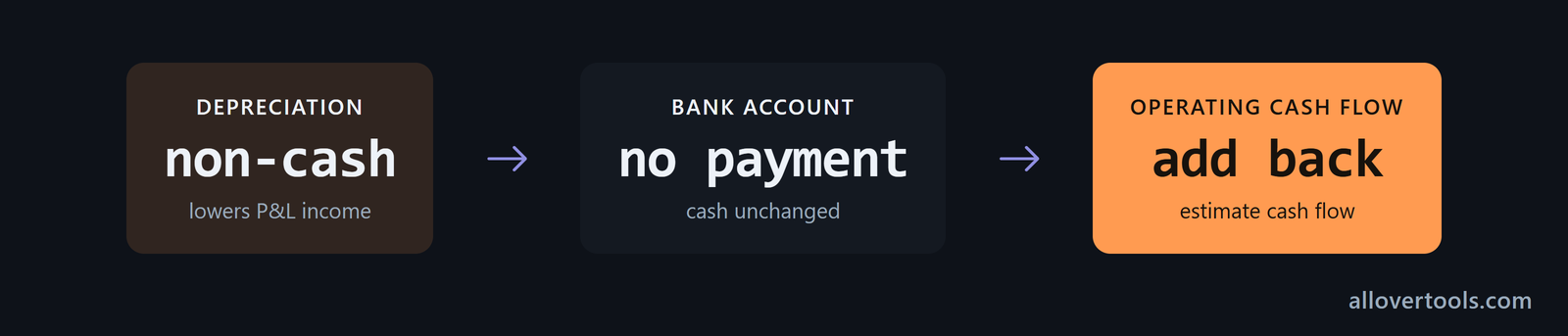
Revenue recognition and working capital change timing
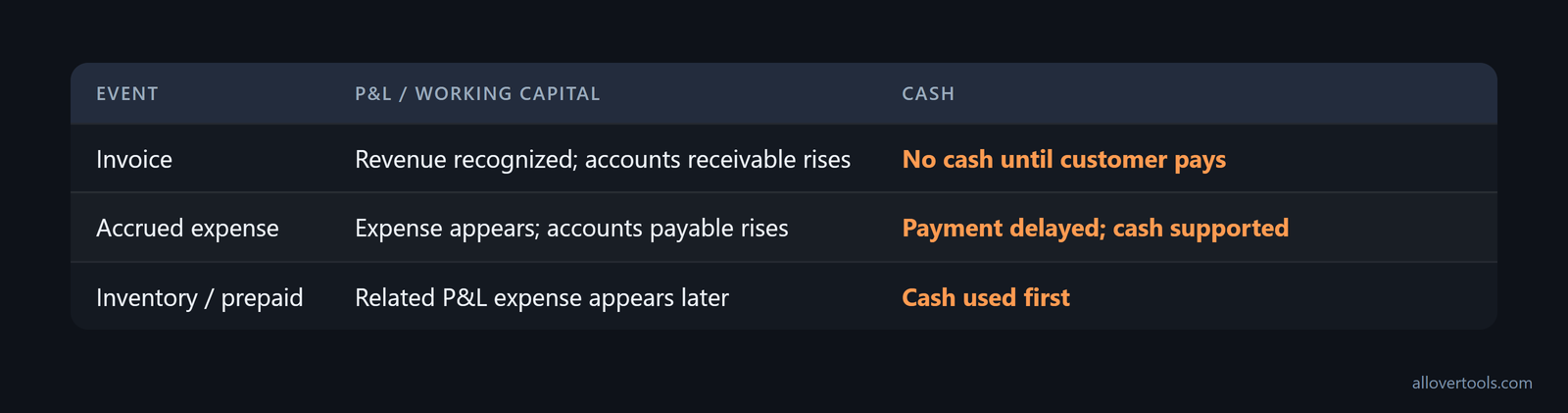
Recognized revenue and cash collected may fall in different periods. For example, an invoice can count as revenue before the customer pays. Accounts receivable then rises, but cash does not. An increase in accounts receivable is a cash use in the reconciliation.
Accrued expenses create the opposite timing difference. An expense can appear before the business pays it, while an increase in accounts payable delays the payment and supports cash for the period. Inventory and prepaid costs can also use cash before the related P&L expense appears.
How to calculate cash burn and runway
Use cash collected and cash operating payments from the same period. The calculation uses operating cash outflows only:
Gross burn = monthly cash operating expenses
Net burn = monthly cash operating expenses - monthly cash revenue collected
Runway (months) = current cash balance / positive net burn
For a board or investor view, calculate bank-delta burn over a trailing three-month period. Subtract ending total cash from starting total cash, then divide by the number of months. The three-month window smooths month-to-month noise and captures capital expenditures, debt service, prepayments, and the gap between recognized revenue and collected cash, according to this runway guidance. Keep the operating-only method for unit economics and controllable spend. Use the bank-delta view when every cash movement matters.
Runway uses cash burn because it asks how long the available cash can last. Net income does not show when cash is collected or paid. If net burn is zero or negative, the business is not burning cash, so the calculation does not produce a finite runway.
Gross burn, net burn, and runway formulas
Monthly cash operating expenses are the operating payments for the period after normalization. Monthly cash revenue collected is money received during that same period. Current cash balance is cash available now, not total assets or reported revenue. A finite runway requires positive net burn.
For the runway numerator, use net cash instead of the raw bank balance. Subtract drawn credit lines, credit card balances, and other near-term obligations from cash on hand. They reduce the cash cushion available to you; the runway guidance spells out this adjustment.
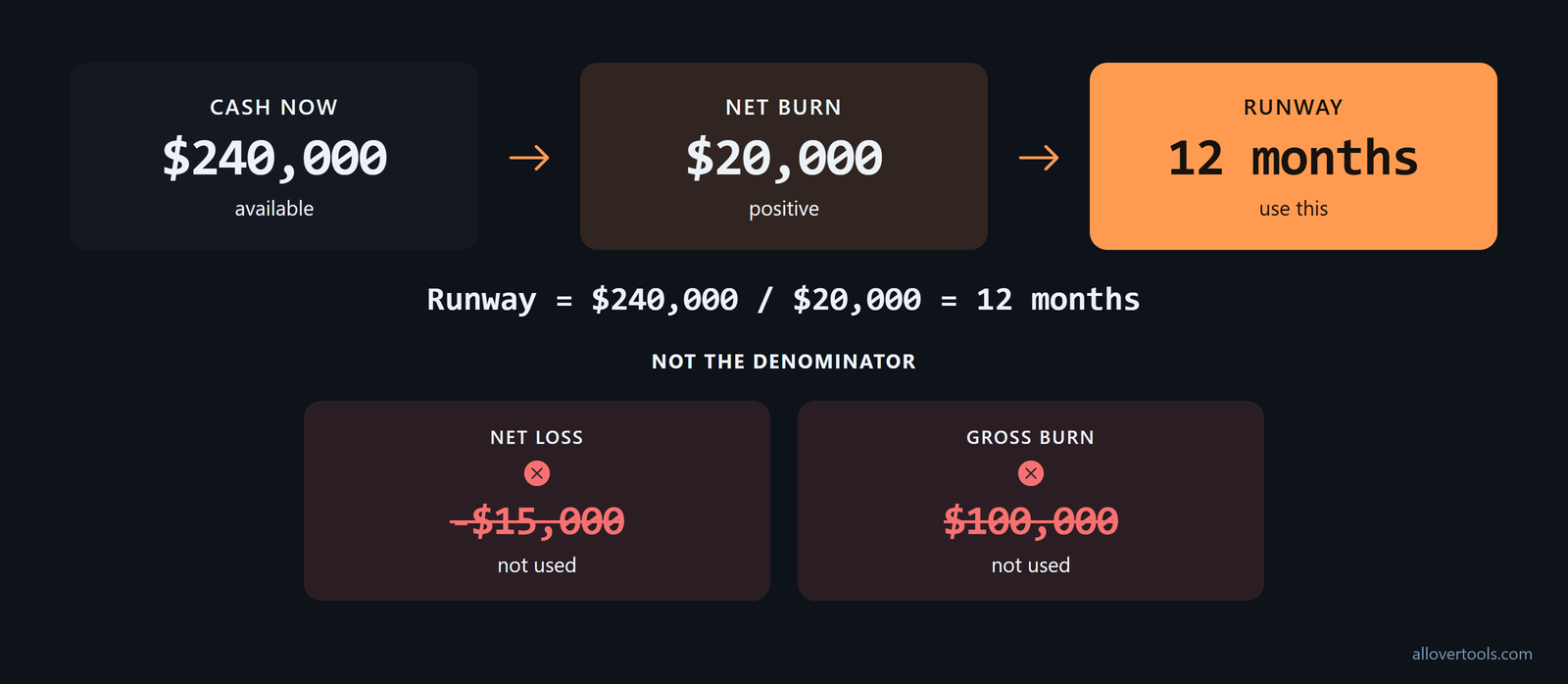
Net loss is not the runway denominator. Gross burn is also the wrong denominator when recurring cash receipts offset operating payments. The remaining cash outflow, after those receipts, is the amount used for runway.
When a company has not started collecting revenue, gross burn and net burn are the same because there is no cash inflow to subtract. Calculate runway by dividing net cash by average monthly expenses. There is no need to force a separate net-burn figure into the formula. For a pre-revenue company, runway is cash available after near-term obligations divided by average monthly operating expense. Once collections start, recalculate net burn from cash revenue collected in the matching period, as set out in this burn-and-runway guidance.
Use matching cash periods in the calculator
In the Burn Rate Calculator, enter Current cash balance, Revenue for this period, and Total expenses for this period. Choose Monthly (12 periods/year), Quarterly (4 periods/year), Annual (1 period/year), Weekly (52 periods/year), or Custom period length…. For the custom option, enter Days per period. Keep revenue and expenses within the same period, then select Calculate burn rate.
The calculator converts the selected period to monthly values and shows gross burn, net burn, runway, formulas, assumptions, intermediate values, and the conversion factor. It accepts non-negative numeric inputs. A custom period must be a whole number of at least one day. A currency symbol changes labels but does not convert values. When net burn is zero or negative, the result says "Not burning cash (revenue covers or exceeds expenses)" instead of showing a finite runway. The code makes no network request with entered values, so the arithmetic stays in the browser.
Average a fluctuating quarter before using it for runway. Operating expenses are £100,000 in January, £115,000 in February, and £125,000 in March, or £340,000 for the quarter. Revenue is £75,000, £80,000, and £95,000, or £250,000 over three months. The result is a £90,000 quarterly loss and average monthly net burn of £30,000. Divide the quarterly difference by three, as this burn-rate example demonstrates. This stops one unusually high or low month from setting the entire runway estimate.
Worked example: reconcile a P&L loss to cash burn
These monthly values are selected for illustration, not used as a benchmark. The P&L uses recognized amounts. The burn calculation uses cash collected and cash paid.
Chosen monthly P&L and cash figures
| Chosen input | Amount | Use |
|---|---|---|
| Recognized revenue | $100,000 | P&L revenue |
| Cash collected | $80,000 | Cash receipt |
| Accrued cash operating expenses | $105,000 | P&L operating expense before depreciation |
| Depreciation | $10,000 | Non-cash P&L expense |
| Cash operating expenses paid | $100,000 | Operating cash payment |
| Increase in accounts receivable | $20,000 | Working-capital cash use |
| Increase in accounts payable | $5,000 | Working-capital cash support |
| Current cash balance | $240,000 | Cash available for runway |
| Capital expenditure | $15,000 | Separate cash-planning item |
The selected P&L values produce this result:
P&L net income = $100,000 - ($105,000 + $10,000)
P&L net income = -$15,000 loss
Adjust net income to estimate operating burn
Start with net income, then adjust for depreciation and the working-capital movements:
Check the definition before using a net-burn figure from another source. One published formula defines gross burn as total monthly spending and net burn as (Monthly Revenue - Cost of Goods Sold) - Gross Burn Rate; this burn-rate definition uses that P&L-style approach. If the timing differs, adjust for working capital, capital expenditure, and financing flows before using recognized revenue and expenses in place of cash collected and paid.

Net income                                      -$15,000
Add back depreciation                            $10,000
Subtract increase in accounts receivable       -$20,000
Add increase in accounts payable                  $5,000
Estimated operating cash flow                   -$20,000
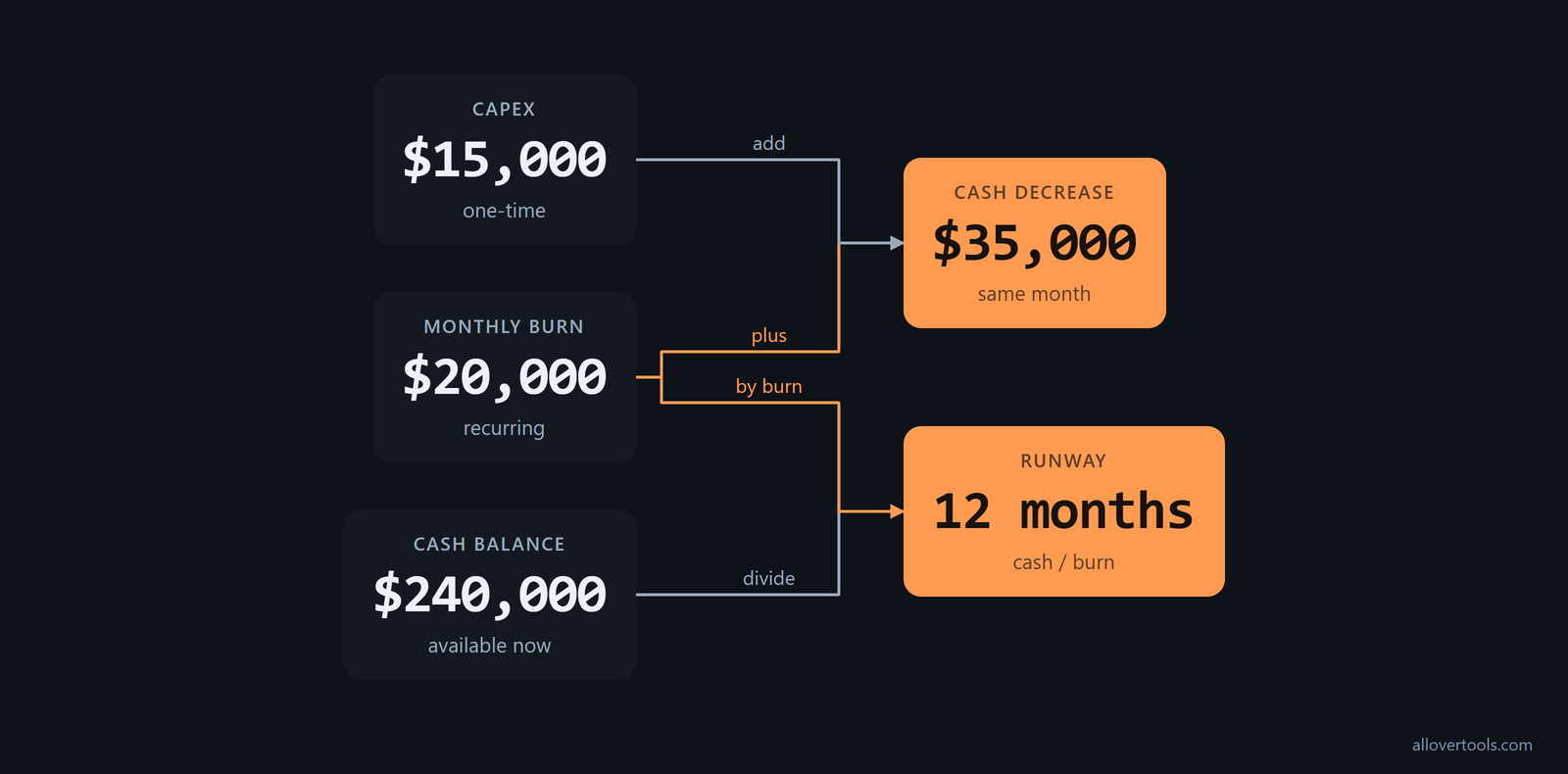
The direct cash view gives the same result: $80,000 collected minus $100,000 paid equals -$20,000 of operating cash flow. The separate $15,000 capital expenditure is outside recurring operating burn. If it is paid in the same month, total cash decreases by $20,000 + $15,000 = $35,000.
Enter Current cash balance $240,000, Revenue for this period $80,000, Total expenses for this period $100,000, and Monthly in the burn calculation:
Gross burn = $100,000 per month
Net burn = $100,000 - $80,000 = $20,000 per month
Runway = $240,000 / $20,000 = 12 months
The 12-month runway uses recurring net operating burn. The capital expenditure still belongs in the cash forecast for the month it is paid.
For the P&L step, use the Business Profit Calculator, select Net profit margin mode, and enter Revenue $100,000, Cost of goods sold (COGS) $0, Operating expenses / overhead $115,000, with Estimated tax rate % (optional) blank. It returns net profit of -$15,000 because $100,000 - ($0 + $115,000) = -$15,000. Both tools calculate from entered values in the browser, and the Business Profit Calculator does not make a network request with those values.
How to explain burn and loss to investors
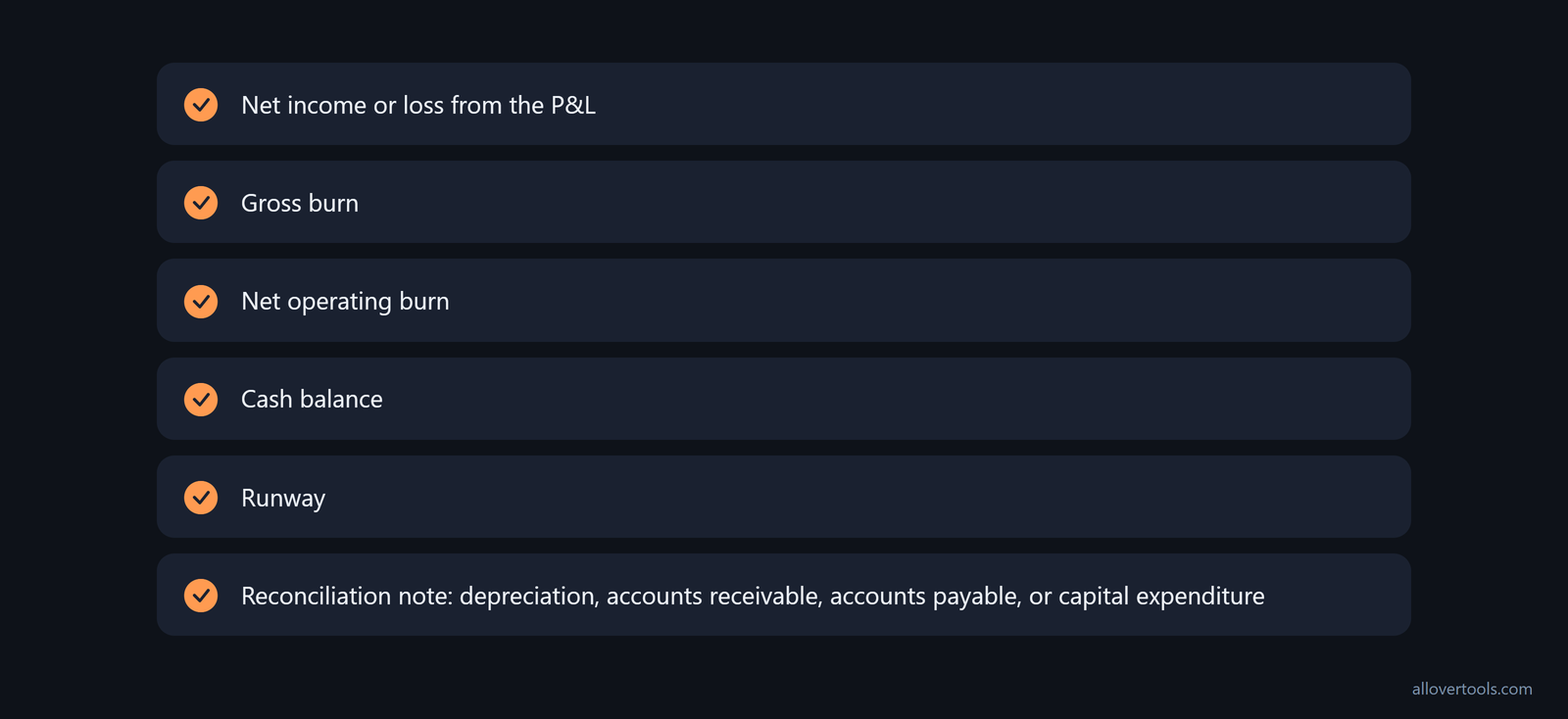
Put both metrics in the same monthly update. Label net income or loss from the P&L, gross burn, net operating burn, cash balance, and runway separately.
Add a short note about the largest timing or non-cash adjustments, such as depreciation, accounts receivable, accounts payable, or capital expenditure. This gives investors the P&L result, the liquidity position, and the reason the figures differ.
Avoid calling net loss "burn," leaving out the period, mixing cash collected with invoiced revenue, or presenting runway without stating the assumed burn and cash balance.
Why cash burn alone is not enough
A constant-burn runway is only a simple estimate. It can miss seasonality, planned hiring, one-time costs, capital expenditure, debt or financing movements, tax payments, collection delays, and changes in revenue.
Subtract a known one-time payment from starting cash before calculating runway. A large legal settlement or hardware purchase is an immediate cash outflow. Removing it first gives the runway a post-payment starting point instead of an inflated pre-payment balance, following this one-time-cost rule.

Gross burn can hide improving cash receipts. Net burn can hide an expense base that is difficult to reduce. Use P&L loss to understand accounting performance, a cash-flow reconciliation to explain the gap, and a cash forecast with scenarios for planning.
Model runway as revenue and expenses grow
Use a month-by-month cash schedule when revenue or spending is expected to change. Start with the opening revenue and expense values, then apply a revenue growth rate g and an expense growth rate e each month. The calculation is: Revenue(n) = Revenue(0) x (1 + g)^n; Expenses(n) = Expenses(0) x (1 + e)^n; Net burn(n) = Expenses(n) - Revenue(n); and Cash(n) = Cash(n-1) - Net burn(n).
In a spreadsheet, calculate those four lines for each month. Runway is the largest n for which Cash(n) > 0. Test different hiring or sales assumptions instead of treating today's burn as permanent; this scenario method turns the estimate into a model that shows when the cash balance reaches zero.
Frequently asked questions
Can a company have a net loss but positive cash flow?
Yes. Depreciation and other non-cash expenses can reduce net income without a current cash payment, while collections or payables can increase operating cash. Financing can also increase cash, but that is a financing movement rather than operating cash flow.
Is cash burn the same as net loss?
No. Net loss follows recognized revenue and expenses on the P&L. Cash burn follows cash collected and cash paid. Reconcile the two before using either figure for the other purpose.
Should depreciation be included in cash burn?
Not as a current-period cash operating payment. Depreciation belongs in the P&L loss, then is added back when estimating operating cash flow. Consider the related asset purchase separately in cash planning.
What burn rate should I use to calculate runway?
Use positive net cash burn based on cash operating expenses and cash collected for the same period, divided into current cash. Adjust the forecast for known changes, one-time outflows, and working-capital timing.