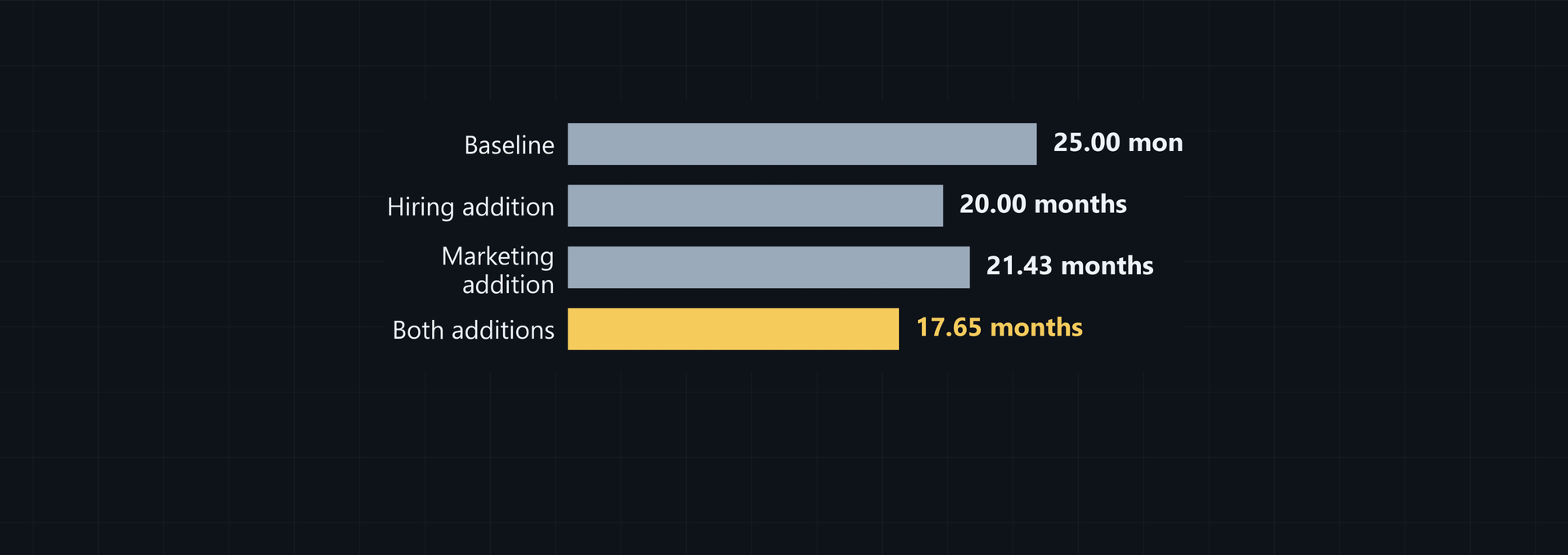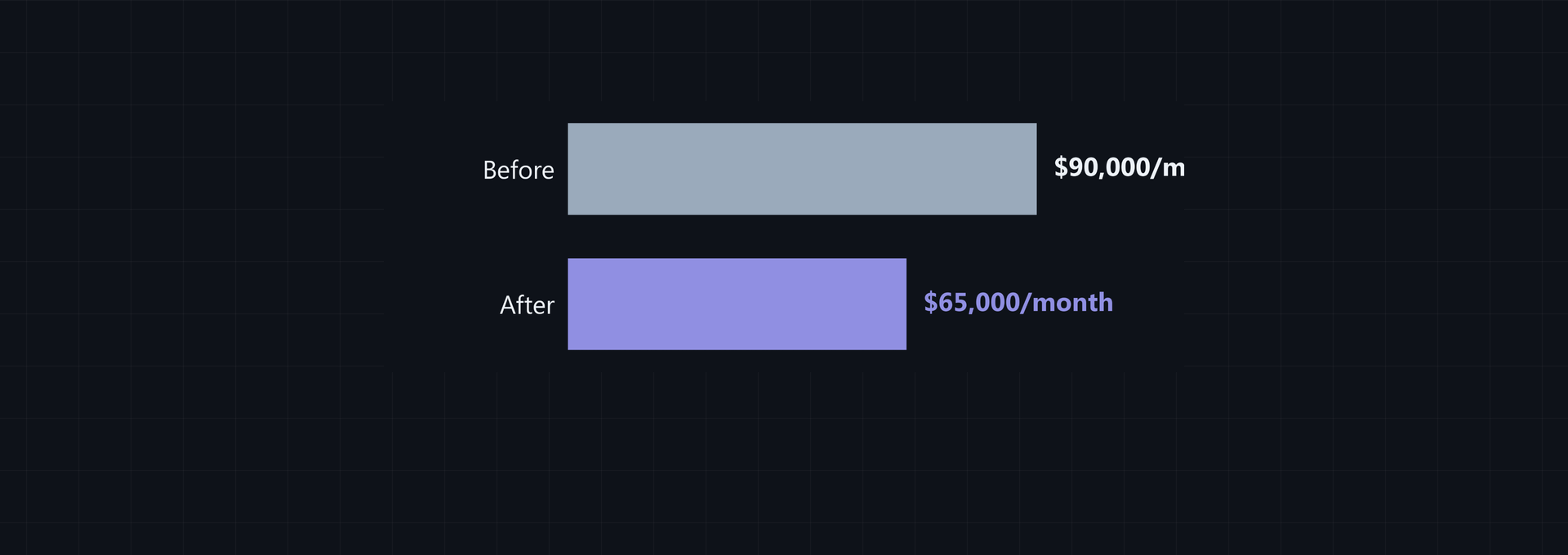
The cash runway formula estimates how many months current cash can cover operations at the current monthly net burn. It is a planning estimate, not a promise. For an early-stage startup, that number links cash on hand to operating losses and the timing of decisions. The sections below show the calculation, what it means, and how to update it.
What cash runway means for a startup
Cash runway is the estimated number of months current cash can cover operations before reaching zero at the current net burn. It uses the latest cash, revenue, and expense figures, so it describes one set of assumptions rather than a guaranteed path.
Early-stage startups use the estimate to connect cash on hand with operating losses and upcoming decisions. A short runway leaves less time to cut spending, increase revenue, or secure funding. A long runway leaves more time to choose among those actions. There is no universal month threshold that makes a result good or bad, and a longer result still requires regular checks of cash movements.
Cash runway formula: cash balance divided by net burn
Use positive net burn as the denominator:

Cash runway (months) = current cash balance ÷ monthly net burnUse the cash that can pay operating bills, not the biggest balance shown on the balance sheet. Count only unrestricted cash and equivalents that the business can realistically use. Leave out restricted balances, debt reserves, escrow accounts, and cash trapped in foreign entities with repatriation constraints, as Numeric's cash guidance explains.
Before you divide, add the cash in every account. Then subtract outstanding credit card balances, payroll obligations, and other startup liabilities due in the next month or two. The result is cash on hand minus the near-term obligations that will soon use it, following this founder checklist.
Gross burn is monthly cash operating expenses. Net burn is monthly expenses minus cash revenue collected in the same period. Net burn measures the cash reduction after revenue, while gross burn shows the full spending load. With a steady monthly burn, this is the standard formula for estimating runway.
Keep gross burn as a separate downside check. It counts total outflows only, so it shows the fixed cash commitments if revenue disappeared tomorrow. Compare it with the net-burn runway to see how much the estimate depends on continued collections, as this cash-runway analysis explains.
Example values:
Current cash balance: $360,000
Revenue: $30,000 per month
Expenses: $75,000 per month
Gross burn: $75,000 per month
Net burn: $75,000 - $30,000 = $45,000 per month
Cash runway: $360,000 ÷ $45,000 = 8.00 months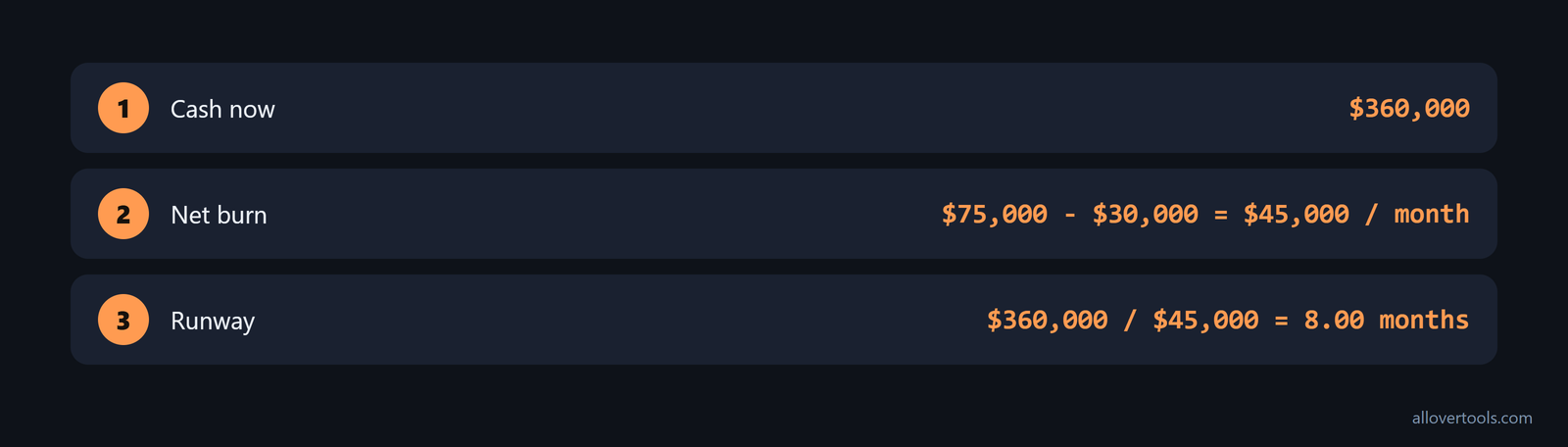
To repeat this cash runway calculation, enter the same inputs in the Cash Runway Calculator. It also projects the balance month by month.
Use net burn, not gross burn
Gross burn shows $75,000 of expenses. Net burn shows the $45,000 monthly cash reduction after $30,000 of revenue. If net burn is zero or negative, runway is not a depletion estimate. Do not divide by zero or report a negative number of months.
How to calculate runway from quarterly or custom figures
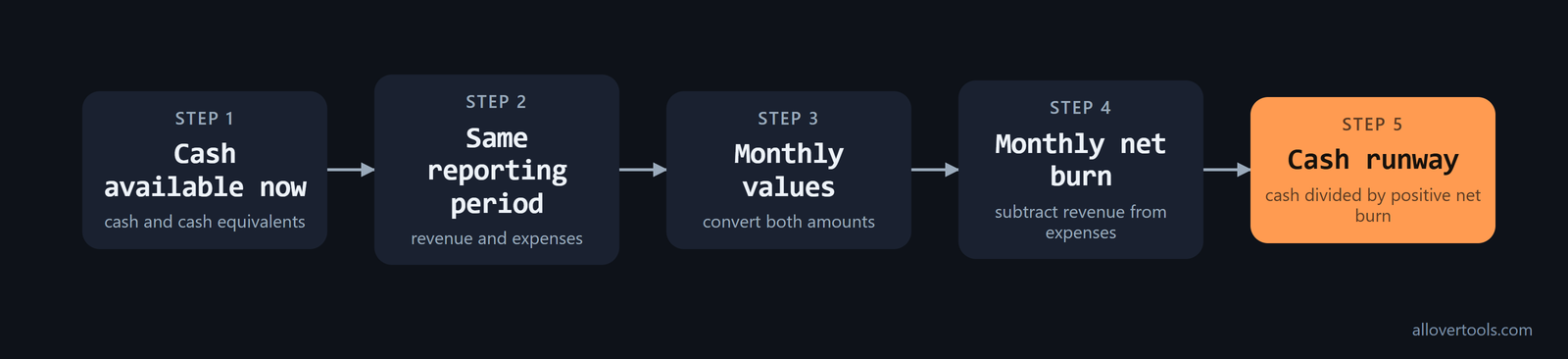
Keep the cash balance available now separate from the period figures. Normalize revenue and expenses before applying the formula:
- Identify cash and cash equivalents available now.
- Use revenue and expenses from the same reporting period.
- Convert both amounts to monthly values.
- Subtract monthly revenue from monthly expenses.
- Divide cash by positive monthly net burn.
In the Burn Rate Calculator, enter Current cash balance, choose Period for revenue & expenses below, enter Revenue for this period and Total expenses for this period, then select Calculate burn rate. The period choices are Monthly (12 periods/year), Quarterly (4 periods/year), Annual (1 period/year), Weekly (52 periods/year), and Custom period length…. A custom period also asks for Days per period.
For a custom period, periods per year = 365.25 ÷ days per period. Each monthly amount = entered amount × periods per year ÷ 12. The currency symbol labels the result; it does not convert currencies.
Example quarterly values:
Cash: $300,000
Quarterly revenue: $45,000
Quarterly expenses: $180,000
Monthly revenue: $45,000 × 4 ÷ 12 = $15,000
Monthly expenses: $180,000 × 4 ÷ 12 = $60,000
Monthly net burn: $60,000 - $15,000 = $45,000
Cash runway: $300,000 ÷ $45,000 = 6.67 months
Use the Burn Rate Calculator to normalize those quarterly inputs before reading the runway result.
Keep the period and cash basis consistent
Use cash revenue collected and cash operating expenses from the same period. Do not mix monthly revenue with quarterly costs or total assets with cash. The calculator accepts non-negative amounts and normalizes the selected period before applying the runway formula.
How changing burn changes runway months remaining
Recalculate runway when cash, revenue, or expenses change. In the Cash Runway Calculator, enter Current cash balance, Monthly revenue (month 1), and Monthly expenses / burn (month 1). The optional fields are Monthly revenue growth rate (optional) and Monthly expense growth rate (optional). Choose Months to show in projection table, then select Calculate runway.
Pick the denominator that fits the decision. One method divides current cash by average monthly net burn; another uses projected future monthly burn. Use the historical average when the company is relatively stable. Use projected future burn when planned hiring, investments, or cost cuts will change the cost structure. These are the two common runway methods.
When burn jumps around, average net burn over the last three to six months instead of relying on one month. This smooths out one-time items and seasonal variation, giving you a steadier denominator, according to this burn-rate guidance.
Use a three-month trend to turn three noisy burn figures into one runway input:
| Month | Net burn |
|---|---|
| Month 1 | $700k |
| Month 2 | $750k |
| Month 3 | $800k |
| Average net burn | $750k |
| Runway input | $20 million ÷ $750k = about 26 months |
Here, the three-month average of $750k is the denominator for $20 million in cash, which gives about 26 months of runway. The figures come from the runway trend example.
The flat example starts with $360,000 cash, $30,000 revenue, and $75,000 expenses. Month-1 net burn is $45,000, so the flat estimate is 8.00 months. If revenue growth is 0% and expense growth is 5%, the result changes:
Month 1: expenses $75,000, net burn $45,000, ending cash $315,000
Month 6: expenses $95,721.12, net burn $65,721.12, ending cash $29,856.54
Month 7: expenses $100,507.17, net burn $70,507.17, ending cash -$40,650.63
Interpolated runway: 6 + ($29,856.54 ÷ $70,507.17) = 6.42 months
The calculator compounds expenses each month. It uses Net burn in month m = expenses in month m - revenue in month m, then Cash in month m = prior cash - net burn. It finds the first month at or below zero and interpolates within that month. These are example values.
The entered values stay in the browser. The tool code makes no fetch, XMLHttpRequest, sendBeacon, or form post carrying those figures, and it does not connect to a bank or accounting system. Run the changing-burn example in the Cash Runway Calculator.
Refresh the estimate after a real operating change
- A cash payment or financing event changes the balance.
- A hiring decision or cost cut changes expenses.
- Collected revenue changes the amount offsetting expenses.
Rerun the calculation with the latest consistent figures and compare the new result with the previous estimate.
To extend runway, name the operating lever instead of treating "cut costs" as one catch-all action:
- Lower burn by implementing cost-cutting initiatives.
- Remove weak spend by shutting down underperforming business units.
- Improve cash timing by switching to cash payment only, with no accounts receivable.
- Raise cash by liquidating non-core inventory.
These last-resort actions either reduce the denominator or increase the cash available in the numerator, as this runway playbook describes.
What short or long runway means for funding
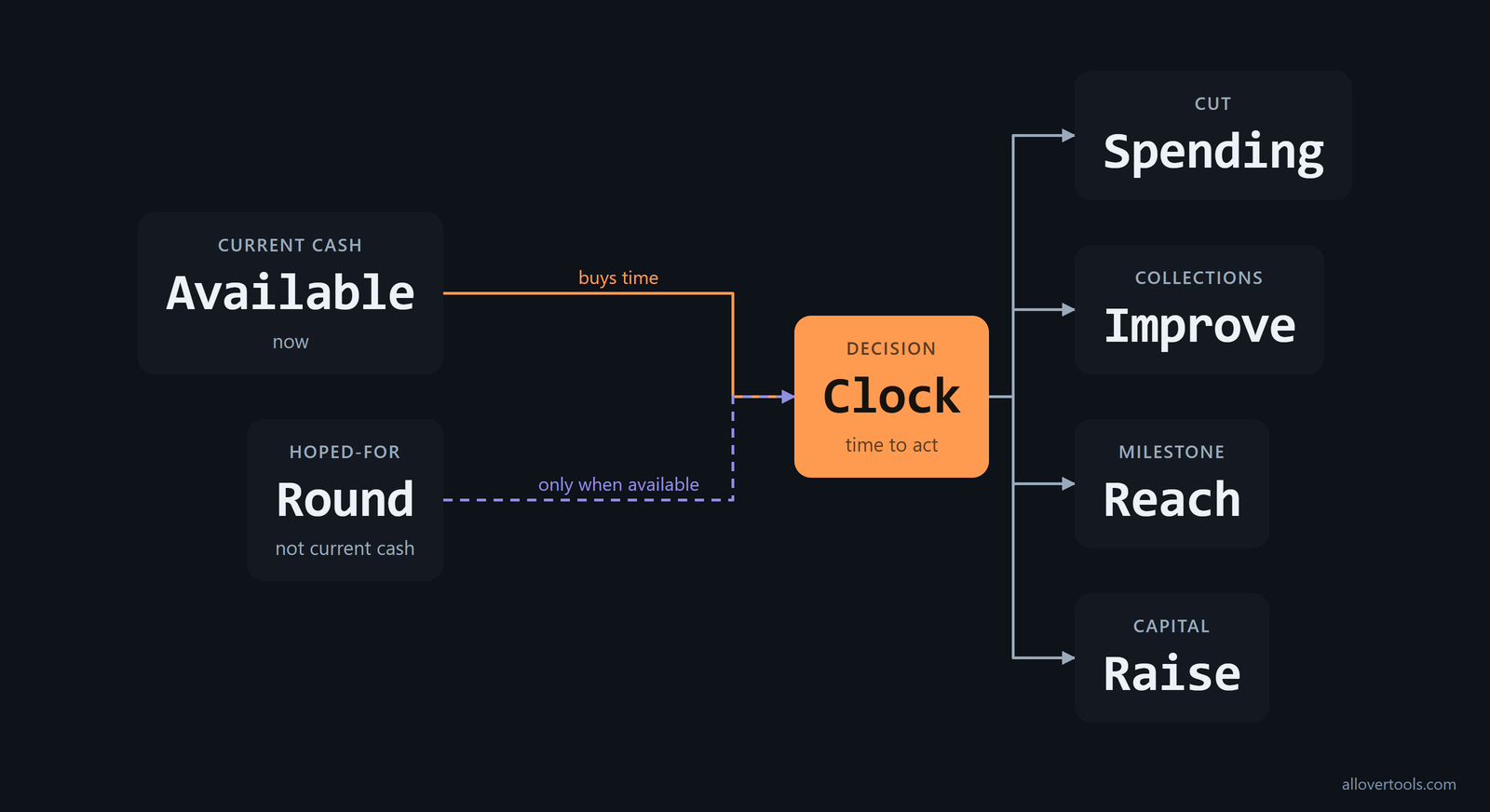
A short runway leaves less time to cut spending, improve collections, reach a milestone, or raise capital. A longer runway leaves more time for those changes. The useful amount depends on the startup's spending plan, revenue uncertainty, milestones, and the time needed for funding or other changes.
Runway targets by funding stage
Use the funding stage as a reference when judging whether current runway supports the next milestone. The general expectation is 18 to 24 months at seed, 18 months after Series A, and 12 to 18 months at Series B and beyond. Compare the result with the range for the company's stage, then let the funding plan reflect the gap. Do not change the arithmetic. The ranges are stated in this startup runway guidance.
| Funding stage | General runway expectation |
|---|---|
| Seed | 18 to 24 months |
| After Series A | 18 months |
| Series B and beyond | 12 to 18 months |
Targets also move with the market. Early-stage startups could get by with 15-18 months after their first fundraise, but during a market downturn investors view best-in-class companies as having closer to 25+ months of runway. Recalibrate the target when funding conditions tighten, using the market-cycle guidance.
Runway affects governance before cash reaches zero. Most boards begin serious budget reviews at 18 months, move to emergency planning at 12 months, and treat anything below six months as survival mode. At that point, every operating decision has to extend runway or shorten the path to revenue, according to this board threshold guidance.
Month count also tells you what the remaining choices may cost. At eighteen months, the problem is manageable and the solutions are good. At six months, it is a crisis and the solutions get expensive. At four months, it is survival mode; someone else starts making decisions for you. Use those thresholds to identify how much decision room remains, as this founder runway analysis describes.
Start fundraising before runway turns into a crisis. Safe runway is typically 18-24 months: six months for growth, six months for a fundraise, and a six-month safety buffer. The standard rule is to begin when runway reaches 12+ months, as this runway calculator guidance sets out.
Default alive or default dead
Runway counts down to zero, but it also tests survival. Assuming expenses stay roughly constant and revenue keeps growing at the rate it has been, ask whether profitability arrives before cash runs out. If it does, the startup is default alive. If it does not, it is default dead. Use the runway calculation as the cash boundary, then compare it with the expected profitability point. This shows whether the current trajectory reaches profitability before cash hits zero. Default alive companies can negotiate funding from a stronger position, as this founder analysis explains.
Funding can extend runway by adding cash, but count it in the cash balance only when the money is available. A hoped-for round is not current cash. Work backward from the time needed for fundraising and operational changes, then keep checking runway as a decision clock.
One cash-positive example looks like this:
Cash: $200,000
Monthly revenue: $50,000
Monthly expenses: $42,000
Signed net burn: $42,000 - $50,000 = -$8,000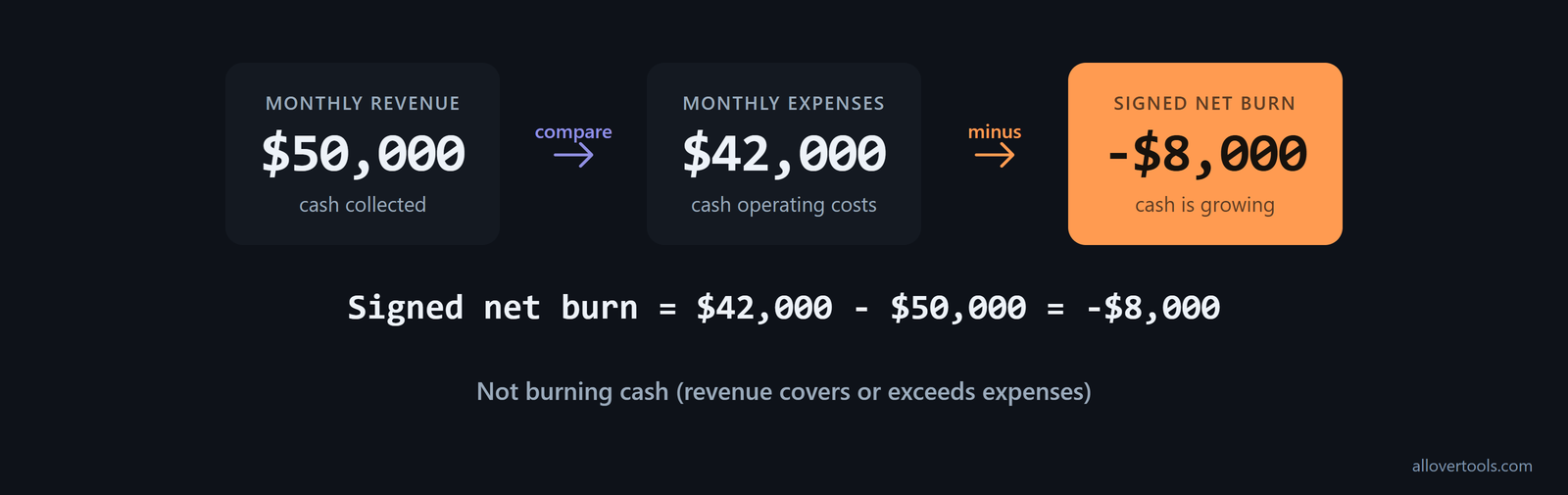
Because revenue covers expenses, the tool reports Not burning cash (revenue covers or exceeds expenses) rather than a negative runway. A cash-positive company still tracks cash because future spending or revenue changes can make depletion relevant.
When runway is not a depletion metric
Zero net burn means revenue matches expenses under the entered assumptions. Negative net burn means cash is growing. In either case, do not divide by zero or present a negative number of months. Report that the business is not currently burning cash, then track cash generation, reserves, and future changes.
Limits of a straight-line runway estimate
Cash balance ÷ net burn assumes the monthly cash reduction stays constant. That leaves out or simplifies seasonality, one-time charges, financing events, later changes in spending or revenue, collection timing, and changing growth.
The straight-line formula is useful for a first estimate. A month-by-month projection fits better when revenue or expenses change. Compare the flat calculation with the 5% expense-growth example above, keep the assumptions visible, and rerun the estimate when they change. The result is arithmetic from entered figures, not financial, accounting, tax, or investment advice. Use the Cash Runway Calculator when you need its projection table.
Frequently asked questions
How do you calculate cash runway from burn rate?
Divide current cash balance by positive monthly net burn, where net burn is monthly expenses minus monthly cash revenue. The result is months of coverage under steady assumptions.
What is a good cash runway for an early-stage startup?
There is no universal number. The useful amount depends on the startup's spending plan, revenue uncertainty, milestones, and time needed for funding or other changes. A longer runway generally gives more decision time, while a short one requires faster action.
Should runway use gross burn or net burn?
Use net burn for months until cash is depleted because it subtracts cash revenue from expenses. Gross burn is still useful for examining the full expense load before revenue.
What happens when revenue is higher than expenses?
Net burn is negative, so the company is cash positive under those inputs and a depletion runway is not applicable. Track the cash balance and rerun the estimate if revenue or spending later changes.
Does cash runway stay the same when expenses change?
No. Update the cash, revenue, and expense inputs after a material change. A month-by-month projection can also apply growth assumptions and show a different depletion month.