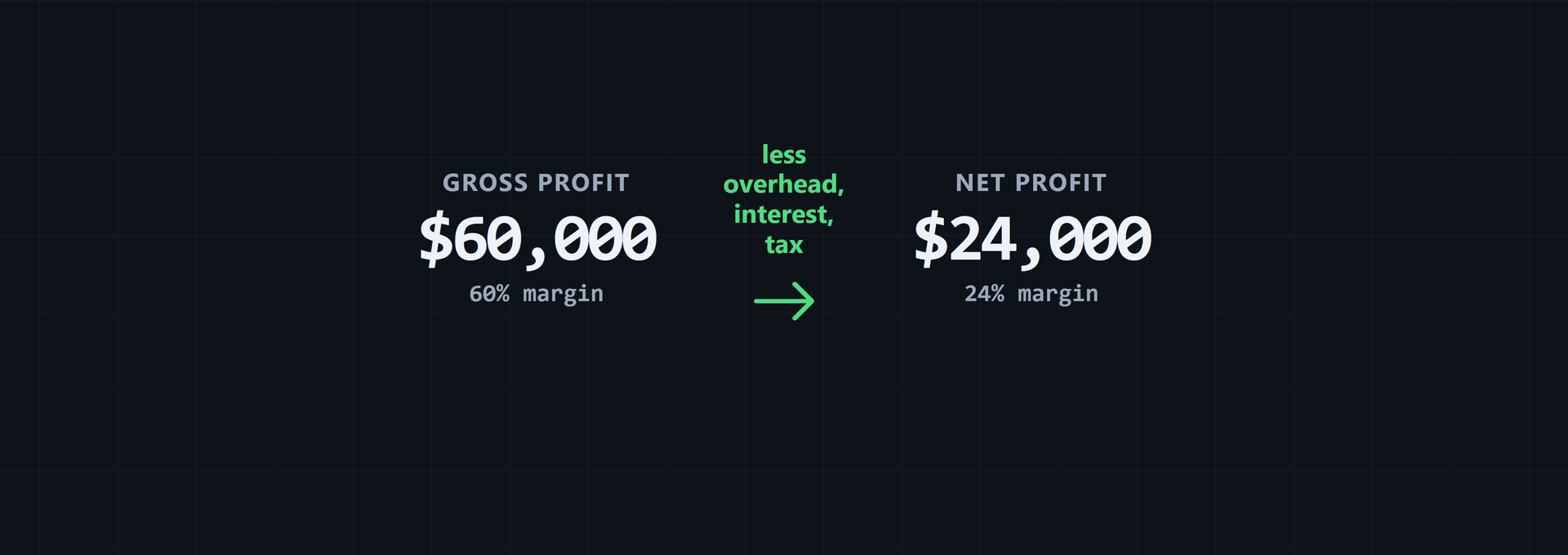
For a small business, gross profit vs net profit answers two different questions. Gross profit is what remains after costs tied directly to sales; net profit is what remains after the wider deductions included in the calculation. Use the same revenue period and currency basis for both. This example uses chosen values of $50,000 revenue and $30,000 COGS.
Gross profit vs net profit: what is the difference?
Costs traceable to what was sold are direct expenses. They include materials, direct labor, and other costs assigned to a sale. Total expenses are the wider deductions used in the calculation, which can include overhead, interest, and tax.
The first figure stops at the direct-cost layer. The second goes further and subtracts the other costs included in the chosen method. Both need the same revenue period and currency basis, such as monthly dollars.
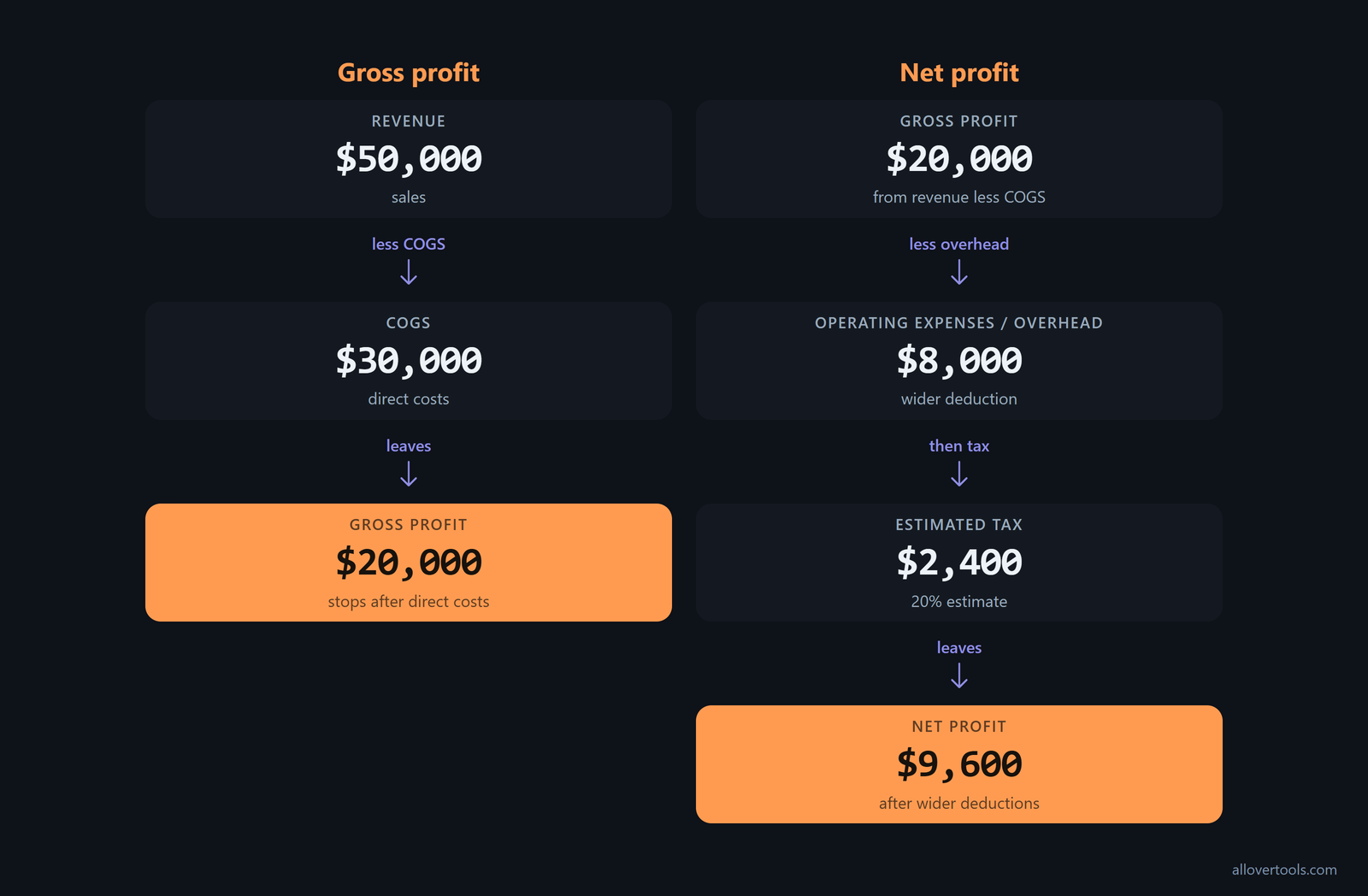
Enter the chosen values in the Business Profit Calculator to compare both results from one revenue and cost set.
How to calculate gross profit and gross margin
COGS covers materials, direct labor, and other costs directly tied to what was sold. The amount left after COGS shows the economics of the sale before overhead, interest, or tax. It helps check whether the selling price covers its direct cost.
Using Revenue $50,000 and COGS $30,000:
Gross profit = $50,000 - $30,000 = $20,000
Gross margin = $20,000 / $50,000 x 100 = 40%
The Gross Margin Calculator handles this revenue and direct-cost check. The Business Profit Calculator gives the same result in its gross-profit mode.
Gross profit formula
Revenue is the sales amount for the period. COGS is the direct-cost layer, not every bill the business pays.
Gross profit = Revenue - COGS
Gross profit = $50,000 - $30,000 = $20,000
At this stage, overhead and the other wider deductions are outside the calculation.
Gross margin formula
A margin puts the dollar result on a revenue basis:
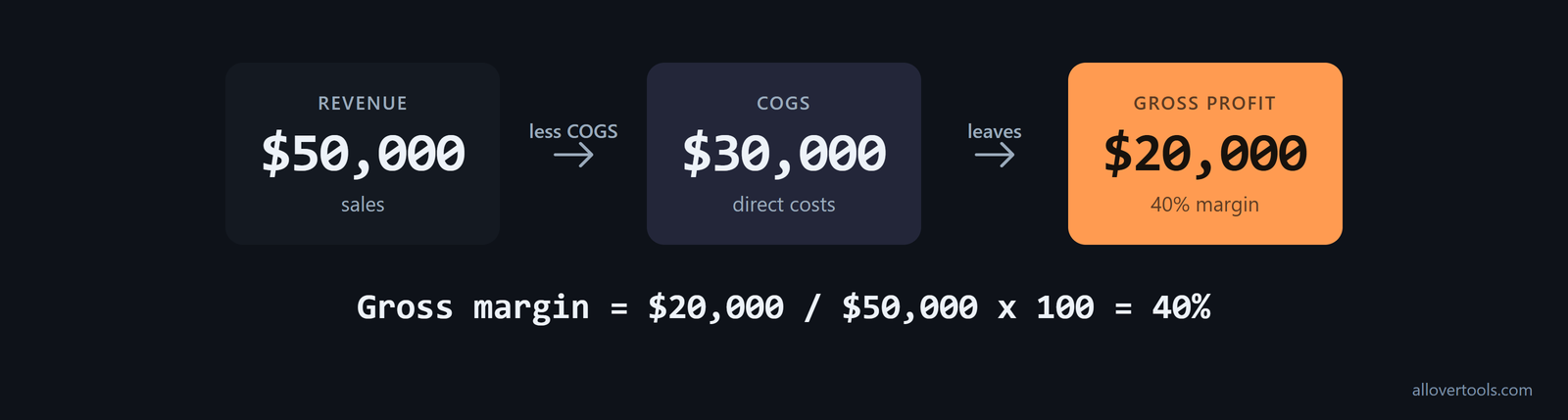
Gross margin % = Gross profit / Revenue x 100
Gross margin % = $20,000 / $50,000 x 100 = 40%
The dollar figure shows the amount left. The percentage shows that amount as a share of revenue. The period label does not convert the inputs, so revenue and COGS must use one basis.
How to calculate net profit after overhead
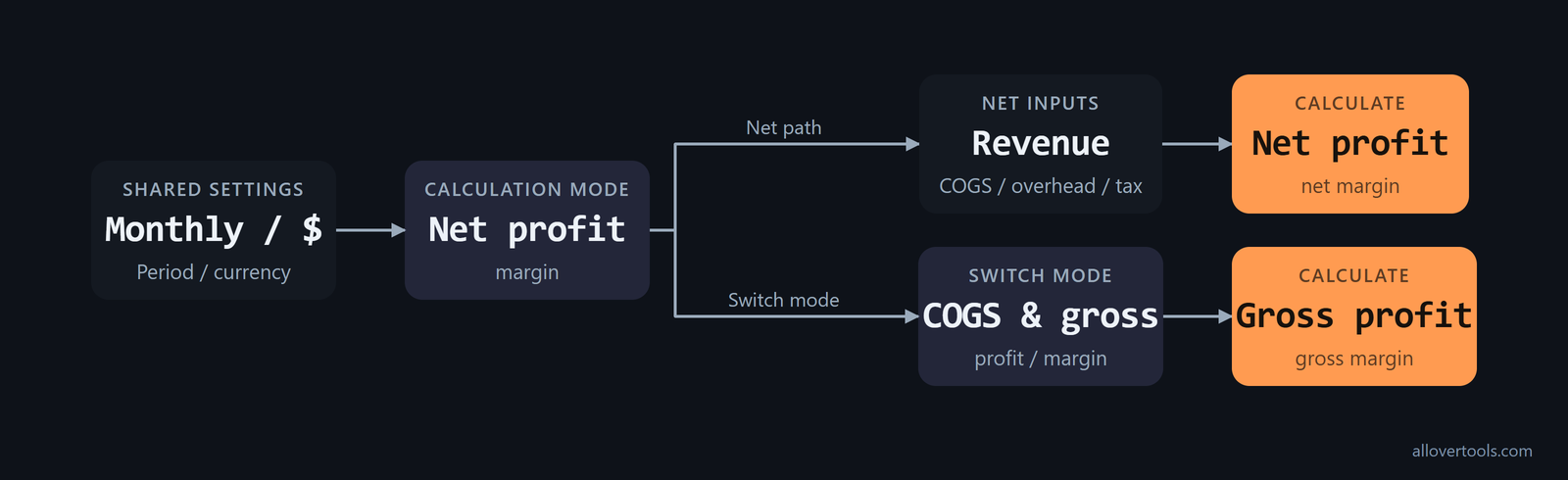
The bottom-line figure depends on the deductions included in the selected reporting method. In the Business Profit Calculator net mode, the calculation follows this order:
Gross profit = Revenue - COGS
Operating profit = Gross profit - Operating expenses / overhead
Estimated tax = Operating profit x tax rate when operating profit is positive
Net profit = Operating profit - estimated tax
Net margin = Net profit / Revenue x 100
This example adds Operating expenses / overhead of $8,000 and an Estimated tax rate of 20%.
Net profit formula in the worked example
Using Revenue $50,000, COGS $30,000, Operating expenses / overhead $8,000, and Estimated tax rate 20% gives:
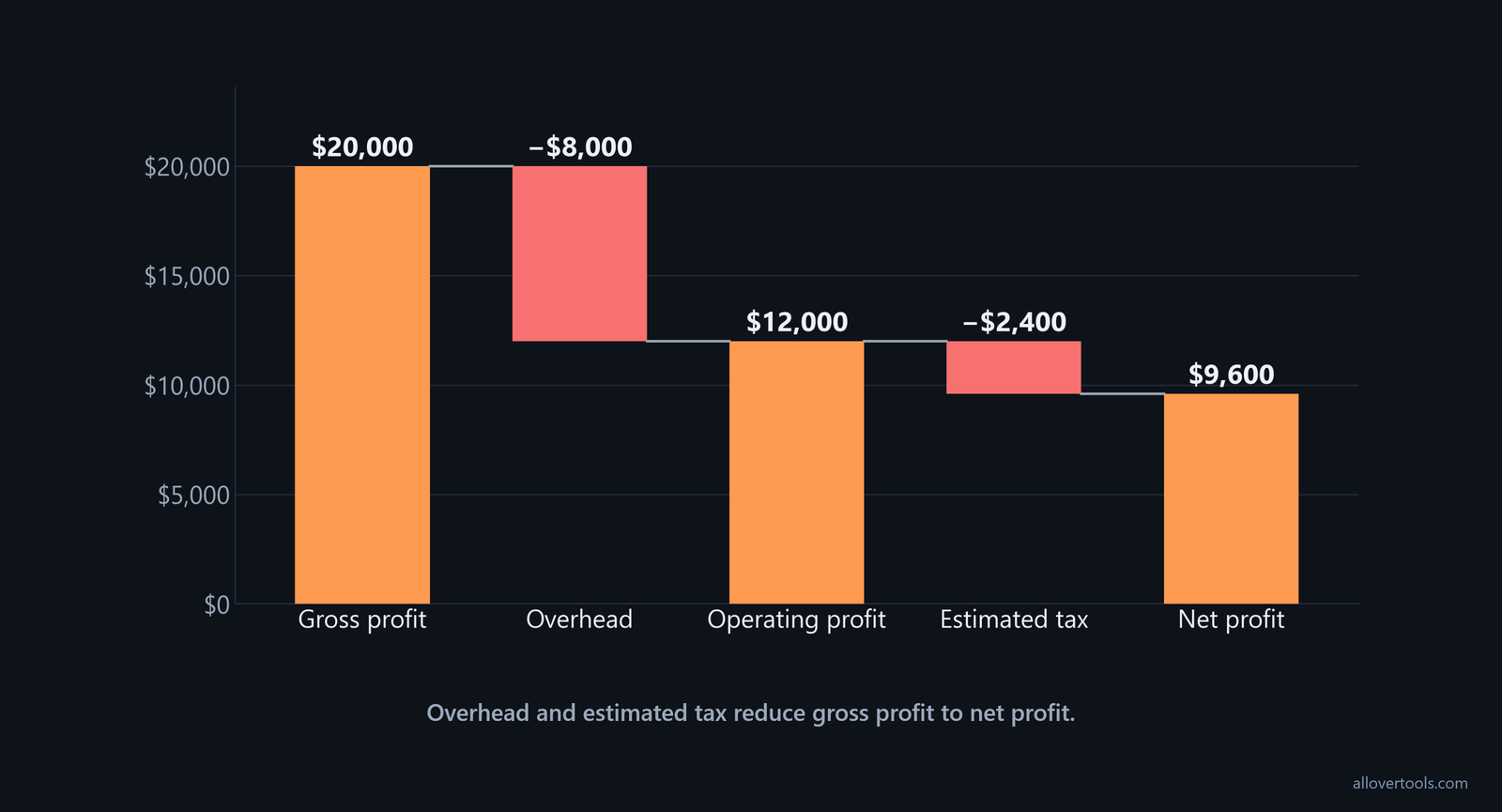
Gross profit = $50,000 - $30,000 = $20,000
Operating profit = $20,000 - $8,000 = $12,000
Estimated tax = $12,000 x 20% = $2,400
Net profit = $12,000 - $2,400 = $9,600
Net margin = $9,600 / $50,000 x 100 = 19.2%
The tax field is a flat-rate estimate, not a tax liability. When statement lines need separate entries, the Net Profit Margin Calculator has controls for Operating expenses, Interest expense, and Tax expense.
Run the comparison in Business Profit Calculator
- Choose Calculation mode =
Net profit margin. - Leave Period =
Monthlyas the shared label, and choose Currency symbol =$. - Enter Revenue, Cost of goods sold (COGS), Operating expenses / overhead, and Estimated tax rate % (optional).
- Select
Calculate.
For the direct-cost result, switch Calculation mode to COGS & gross profit / margin, enter Revenue and Cost of goods sold (COGS), and select Calculate. The browser uses the values entered in the form. The tool code has no fetch, XMLHttpRequest, sendBeacon, or form post.
Why gross margin and net margin are different
These percentages use the same revenue denominator, but their profit figures stop at different points:
Gross margin = Gross profit / Revenue x 100
Net margin = Net profit / Revenue x 100
With the chosen values, gross margin is 40% and net margin is 19.2%. The difference is 20.8 percentage points:
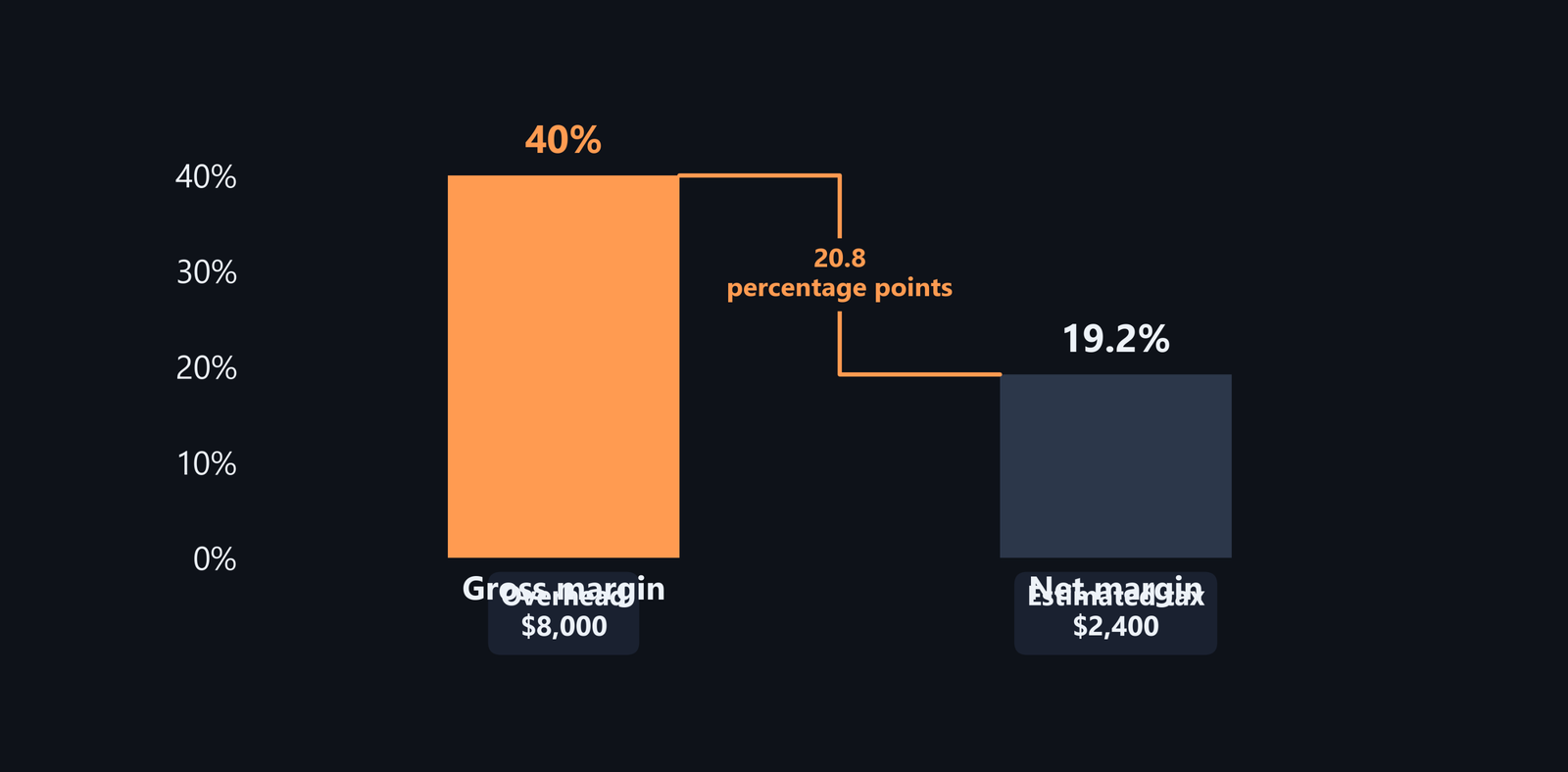
40% - 19.2% = 20.8 percentage pointsThe gap comes from $8,000 in overhead and $2,400 in estimated tax against $50,000 in revenue. If overhead pushes operating profit below zero, profit and margin can both be negative. Estimated tax is set to zero when operating profit is not positive.
The Gross Margin Calculator fits a direct-cost check. The Net Profit Margin Calculator accepts separate operating, interest, and tax expense inputs.
Which profit figure should a small business use?
The right figure depends on the decision. Gross profit and gross margin describe the economics of a product or service. Net profit and net margin show what the wider business keeps after the deductions in the calculation.
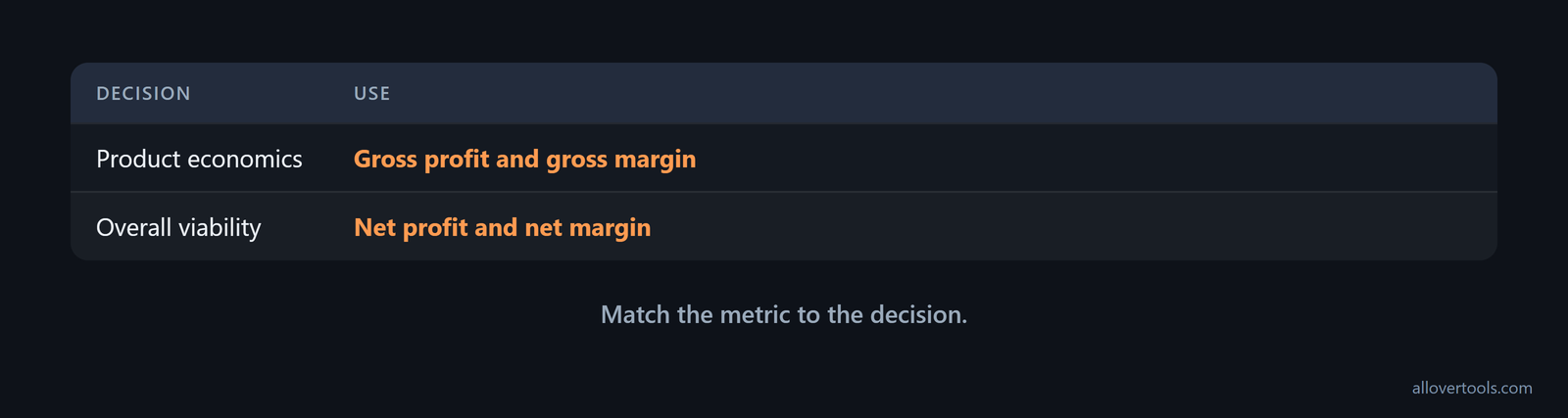
Use gross profit for product decisions
Start with the item's or period's revenue, list COGS, and calculate both gross profit and gross margin. Then test a price or direct-cost change. Materials, direct labor, purchasing, waste, and delivery assumptions affect this layer because they are close to the sale.
This figure does not show whether the business can take on more overhead. Shared costs need a separate check.
Use net profit for long-term planning
For longer-term planning, start with the first result, subtract recurring overhead and other included deductions, and calculate net margin. Then test whether the amount left can support a planned fixed-cost commitment. This is the layer to check for budget capacity, hiring, fixed costs, and overall viability.
Shared overhead can make a single product look less or more profitable than its direct economics. Compare like-for-like periods, apply the same cost classification each time, and label estimates clearly.
How gross and net profit appear in financial statements
Financial statements show revenue first. Direct costs such as COGS are deducted to reach gross profit, then operating expenses are deducted to reach operating profit. Interest and tax may be deducted before net profit.
The exact layout depends on the statement and accounting policy. Treat the calculator as a planning model, not a replacement for accounting records. The chosen example runs through the statement layers like this:
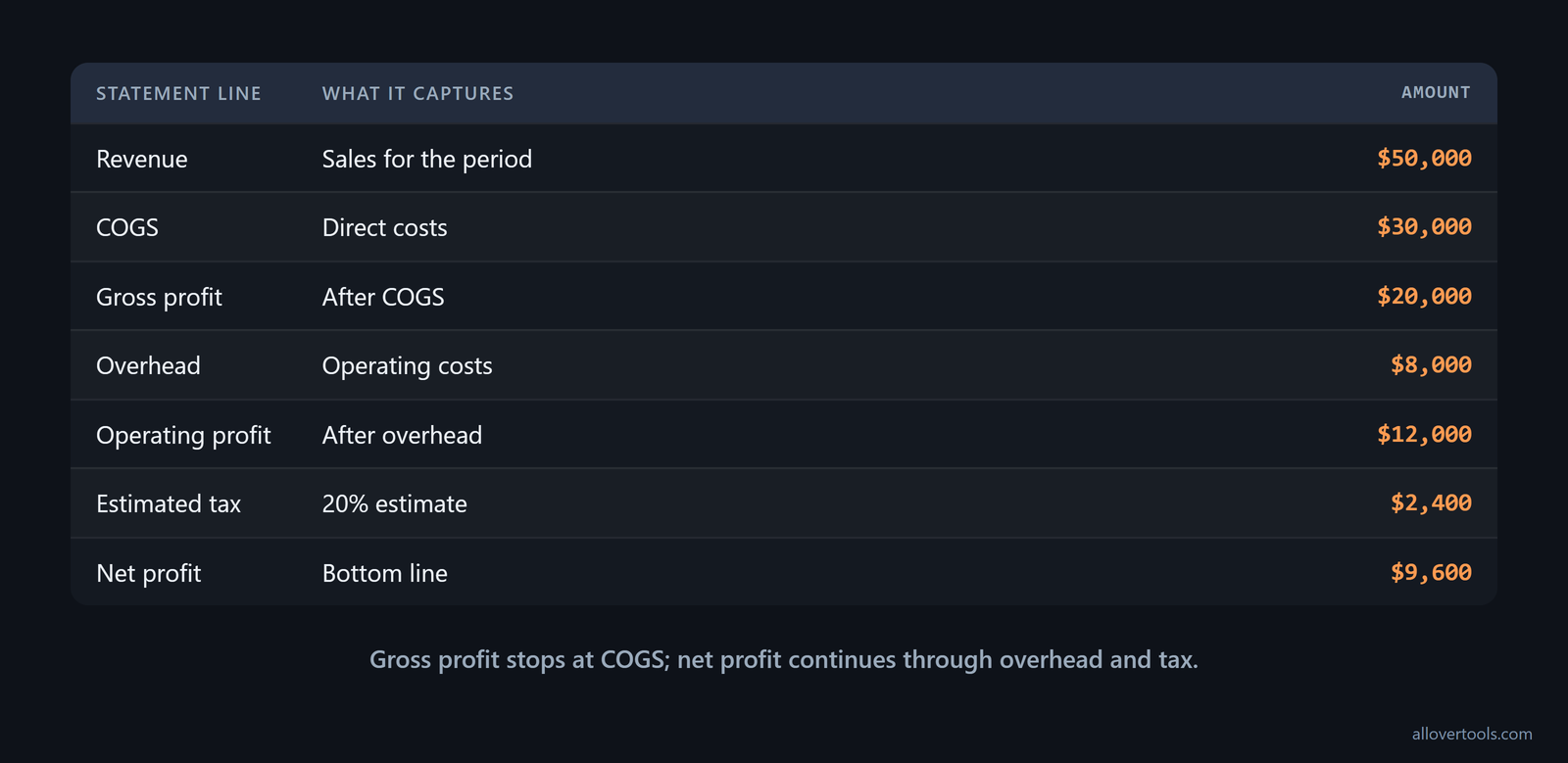
Revenue: $50,000
COGS: $30,000
Gross profit: $20,000
Overhead: $8,000
Operating profit: $12,000
Estimated tax: $2,400
Net profit: $9,600
The Net Profit Margin Calculator helps when Operating expenses, Interest expense, and Tax expense need separate statement inputs. Keep every figure on the same period. Monthly revenue should not be compared with annual costs.
Common misunderstandings about gross and net profit
A few common mistakes change the meaning of the result. Take-home money is not the same as the first profit figure because overhead and other deductions still have to be covered. Subtracting overhead twice understates the result. Margin is not markup: margin uses revenue as its base, while markup uses cost.
Keep dollar profit separate from percentage margin. Keep periods and currencies consistent. Positive gross profit does not guarantee positive net profit if wider deductions exceed it. An estimated tax field is not a tax return, and profit is not the same as cash in the bank.
The calculator processes only the values entered. It does not replace accounting records or determine tax liability. Use this checklist:
- Classify direct costs consistently.
- Include relevant overhead.
- Label estimates.
- Calculate both margins.
- Use the figure that matches the decision.
Frequently asked questions
Is gross profit the same as net profit?
No. Gross profit subtracts COGS from revenue. Net profit subtracts the additional expenses included in the calculation, such as overhead and tax. Interest may also appear in a fuller statement calculation.
Can a business have positive gross profit but negative net profit?
Yes. Overhead and other included deductions can exceed gross profit, leaving operating profit or net profit below zero even when each sale contributes positive gross profit.
Should I use gross profit or net profit to set prices?
Use gross profit and gross margin to check whether a price covers the direct economics of a product or service. Then use net profit to check whether the wider business remains viable after overhead and other deductions.
What is the difference between gross margin and net margin?
Gross margin is gross profit divided by revenue. Net margin is net profit divided by revenue. Net margin is lower when overhead, interest, tax, or other included deductions reduce the profit remaining.
Does the Business Profit Calculator calculate net profit?
Its Net profit margin mode calculates gross profit, operating profit, an optional positive-operating-profit tax estimate, net profit, and net margin from the entered values. It is a planning calculation, not accounting records or a determination of tax liability.