A seed stage burn example works best when the cash expenses, revenue collected, and cash balance all refer to the same month. This one uses $84,000 in expenses, $24,000 in collected revenue, and $720,000 in cash. It calculates gross burn, net burn, and runway, then tests changes to hiring, revenue, and spending. The figures are for illustration, not a market benchmark.
What belongs in a seed-stage monthly burn budget
Monthly burn is the cash spent to operate during a period. In this seed startup monthly burn budget, the expenses cover payroll, product delivery, go-to-market work, and overhead. The table then sets that spending beside cash collected and the current cash balance.
| Expense line | Monthly amount | Cost area |
|---|---|---|
| Founder salaries | $16,000 | Payroll, 2 founders × $8,000 |
| Engineering/product payroll | $34,000 | Product delivery |
| Sales/customer success payroll | $10,000 | Go-to-market |
| Cloud and software | $7,000 | Product delivery and tools |
| Contractors/marketing | $12,000 | Go-to-market and delivery |
| Rent/insurance/admin | $5,000 | Overhead |
| Total expenses | $84,000 | All six cash expense lines |
Cash collected revenue is $24,000 for the month, and the cash balance is $720,000. These are separate from the expense total. Revenue reduces net burn only when the company collects it in the same period.
How this example compares with seed-stage data
This example has $84,000 in gross burn and $60,000 in net burn, both within several reported seed-stage ranges. Its 12-month runway is shorter than many post-raise targets. One 2026 benchmark puts seed companies at 4 to 10 people, with monthly gross burn of $50,000 to $200,000, monthly net burn of $40,000 to $150,000, typical capital raised of $1 million to $4 million, and a target runway after the raise of 18 to 24 months, as the 2026 seed benchmark reports. A separate summary of Kruze Consulting's 2025 data puts median seed-stage burn at $87,000 per month and the top quartile above $140,000 per month. The figures come from a portfolio of over 800 VC-backed startups, according to Kruze portfolio data.
| Comparison point | Reported figure | Use with this budget |
|---|---|---|
| Seed companies with 5 to 12 people and early revenue | $40,000 to $85,000 average gross burn; $58,000 median gross burn | The $84,000 example is near the top of that range, as the seed gross-burn guide shows. |
| Pre-seed compared with seed | Pre-seed or idea-stage: $10,000 to $40,000 burn, 2 to 5 people, 12 to 18 months runway; seed: $40,000 to $150,000 burn, 5 to 15 people, 18 to 24 months runway | Check that the headcount and runway target fit the stage, using the stage benchmark table. |
| Median burn by stage | Carta's 2025 data: pre-seed $25,000; seed $80,000; Series A $350,000 per month | The $60,000 net-burn case is below the reported seed median, as the Carta stage medians show. |
| Named operator snapshot | Yury Zabella's 2026 table: $75,000 average monthly burn, 6 to 12 full-time equivalent employees, and 18 months average runway at seed | Compare the cash draw and staffing plan with the operator's 2026 table. |
At $60,000, this case is below the $100,000 monthly level described as efficient at seed and below the top-quartile threshold of under $80,000 per month. The same benchmark puts median seed-stage net burn at $100,000 to $120,000 per month. Top-quartile companies show a burn multiple under 2.0× and a minimum runway target of 18 months, according to the efficiency thresholds. That does not make $60,000 a universal target. Compare it with team size, capital raised, and the runway needed for the next milestone.
Seed-stage burn ranges by team and growth plan
Published ranges are guides, not a single spending rule. One guide lists $10,000 to $30,000 per month for pre-seed and $30,000 to $80,000 per month for seed, with a seed runway target of 15 to 20 months. It explicitly calls these figures ranges rather than rules in the non-prescriptive ranges. A different benchmark labels seed net burn under $80,000 per month as disciplined, $80,000 to $200,000 as typical, and above $200,000 as aggressive. It also lists under $50,000 as disciplined at pre-seed, $200,000 to $500,000 as typical at Series A, and $500,000 to $1.5 million at Series B and later, in the efficiency bands.
Inspect the spend plan because a higher number may be funding a defined growth experiment. Another benchmark lists pre-seed burn at $20,000 to $50,000, seed burn at $50,000 to $150,000, and Series A burn at $150,000 to $500,000 per month. It says seed spending rises to between $50,000 and $150,000 as companies hire core engineering talent and start repeatable sales experiments, while advising founders to aim for 18+ months of runway, as the seed growth guide explains. Name the milestone each additional dollar is meant to fund before judging the figure as lean or aggressive.
The chosen expense mix
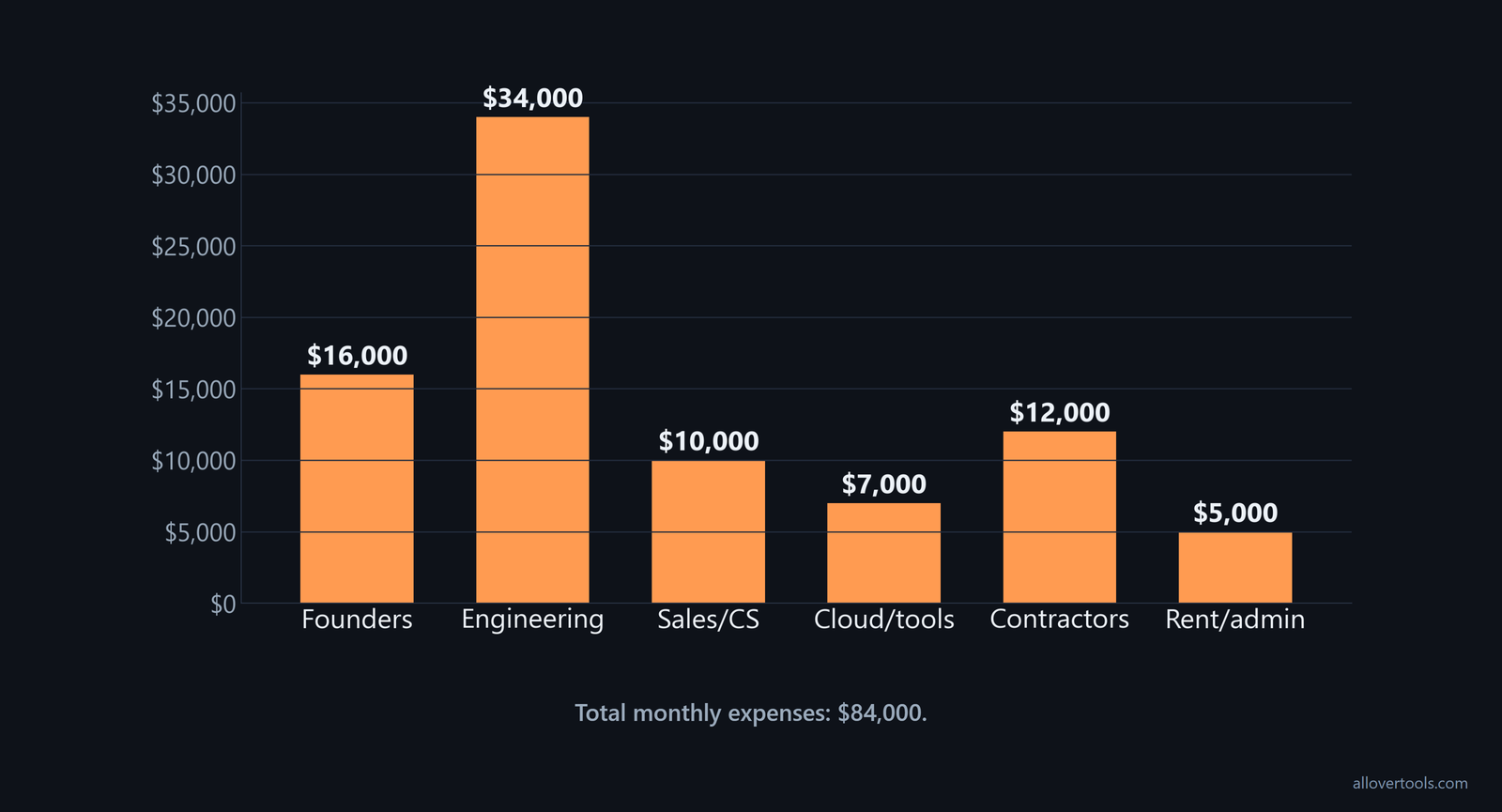
The six rows cover the cash costs in this example. Founder salaries, engineering/product payroll, and sales/customer success payroll are payroll. Cloud and software pay for product delivery and tools. Contractors/marketing covers delivery and go-to-market work, while rent/insurance/admin is overhead. The rows add up to $16,000 + $34,000 + $10,000 + $7,000 + $12,000 + $5,000 = $84,000.
How to set founder salaries in the example
The two $8,000 salaries are cash expenses, so they belong in burn. Salary is cash compensation; ownership is separate. Record the actual cash cost in the same way as other payroll instead of assigning founder work a zero salary. The amount should fit a sustainable personal salary, the company's milestone plan, and the payroll treatment used for the rest of the team. It is an assumption for this example, not a universal salary benchmark.
Gross burn vs net burn: the formulas with numbers
Gross burn is the full monthly cash expense load before revenue. Net burn is the monthly decrease in cash after collected revenue. This burn rate worked example uses the same monthly inputs for both calculations, which makes the gross and net burn walkthrough straightforward.
Use these formulas:
Gross burn = monthly expenses
Net burn = monthly expenses − monthly revenue
Cash runway in months = cash balance ÷ positive net burn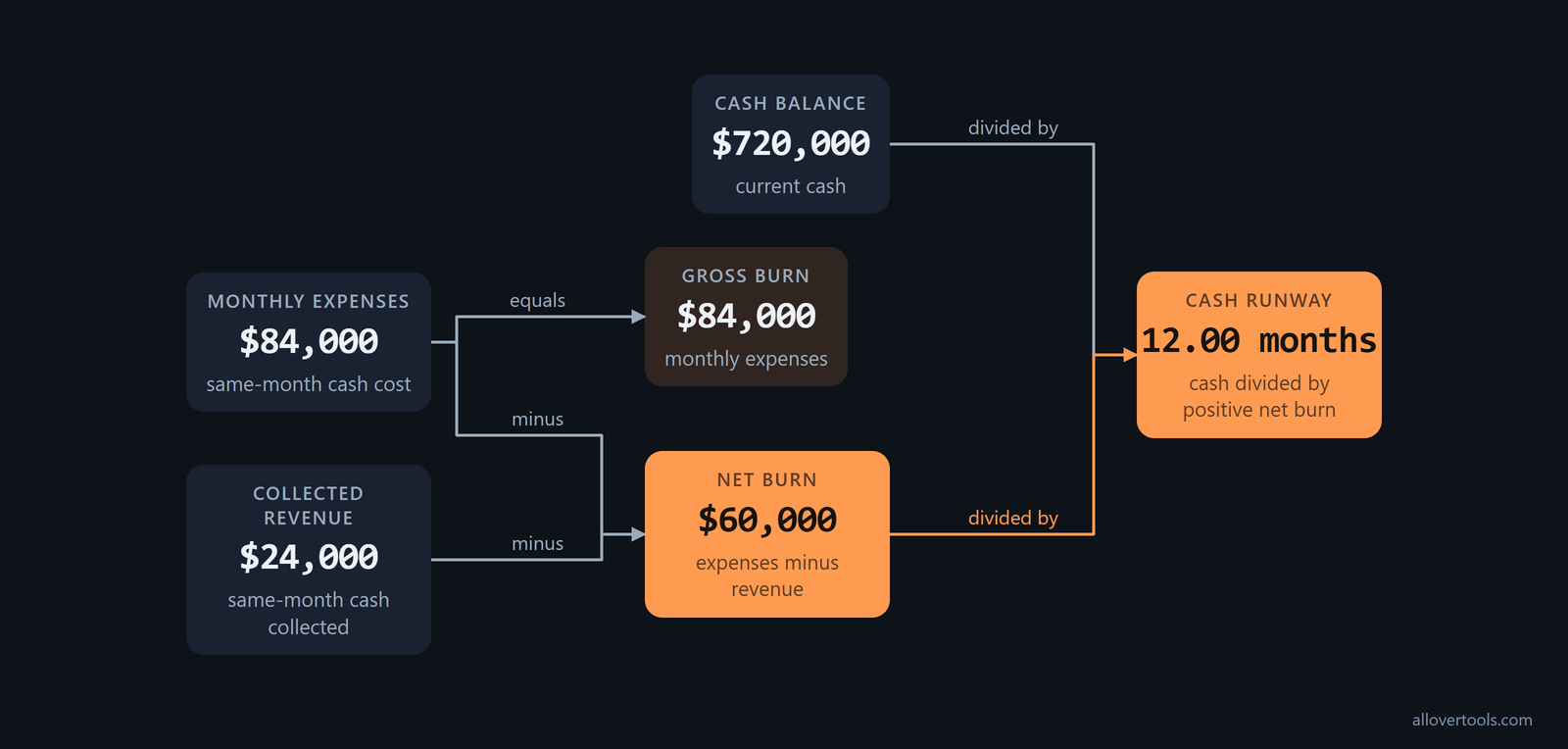
The Burn Rate Calculator accepts these values and shows the formulas and assumptions. It calculates from entered values in the browser. It does not send visitor content through fetch, XMLHttpRequest, sendBeacon, or a form post.
The base-case calculation
- Gross burn = $84,000.
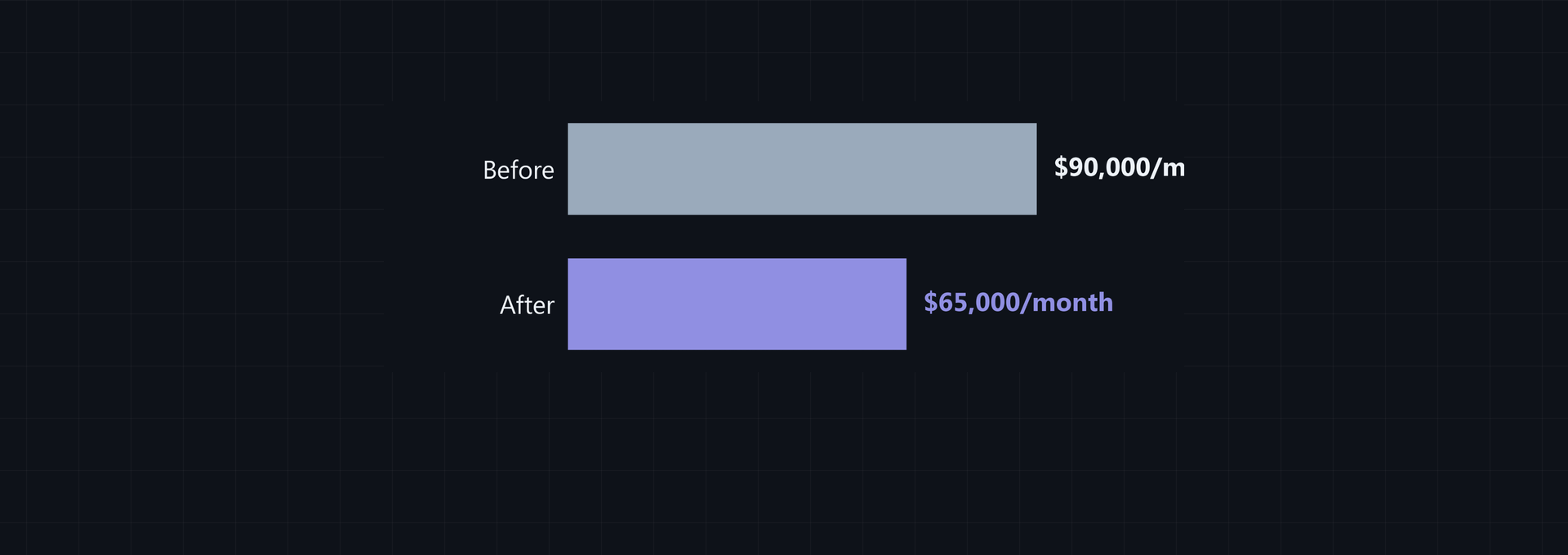
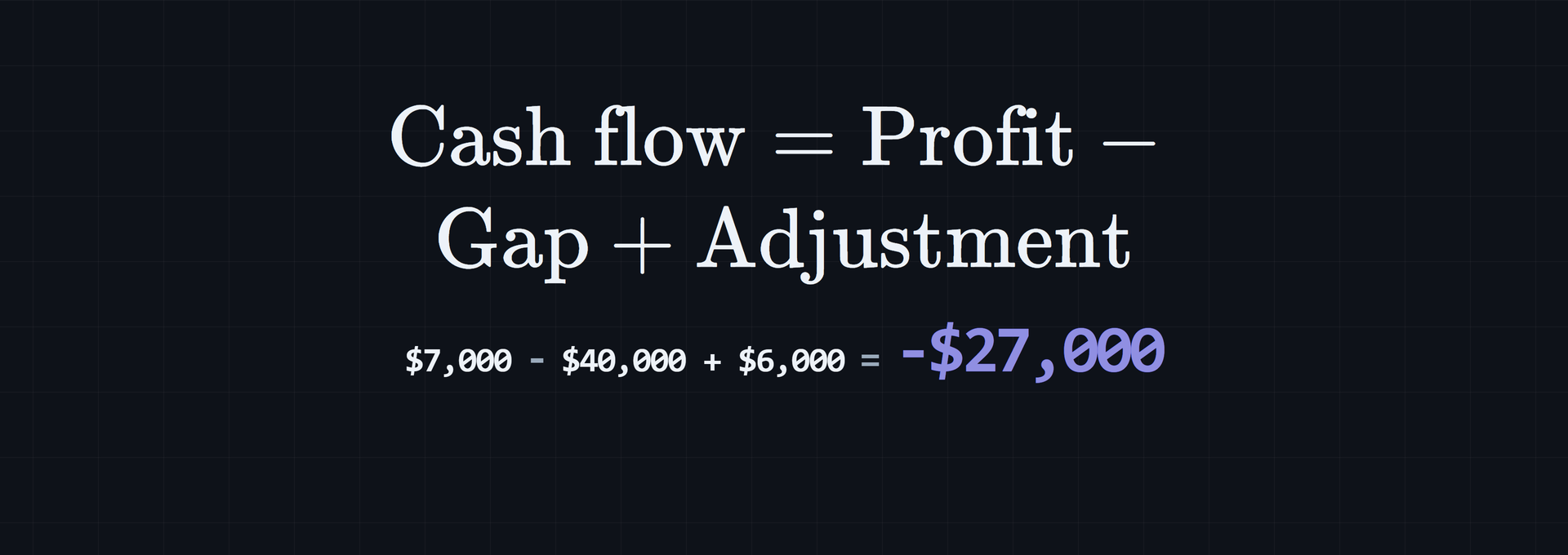
- Net burn = $84,000 − $24,000 = $60,000.
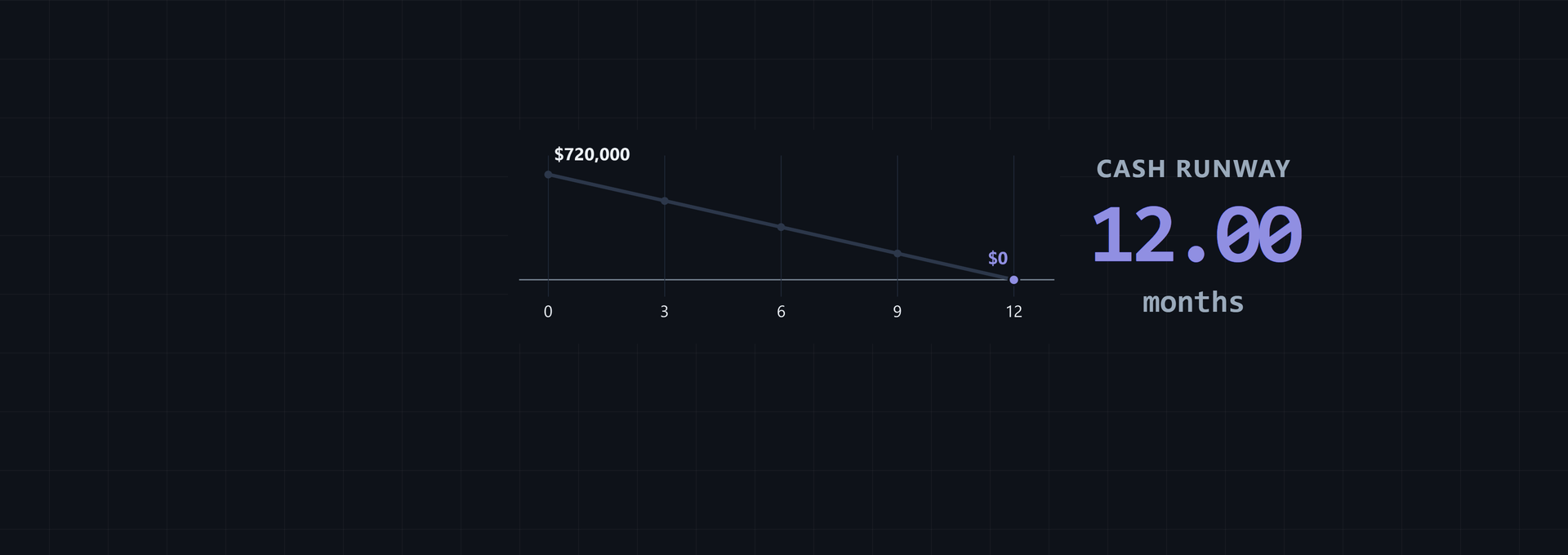
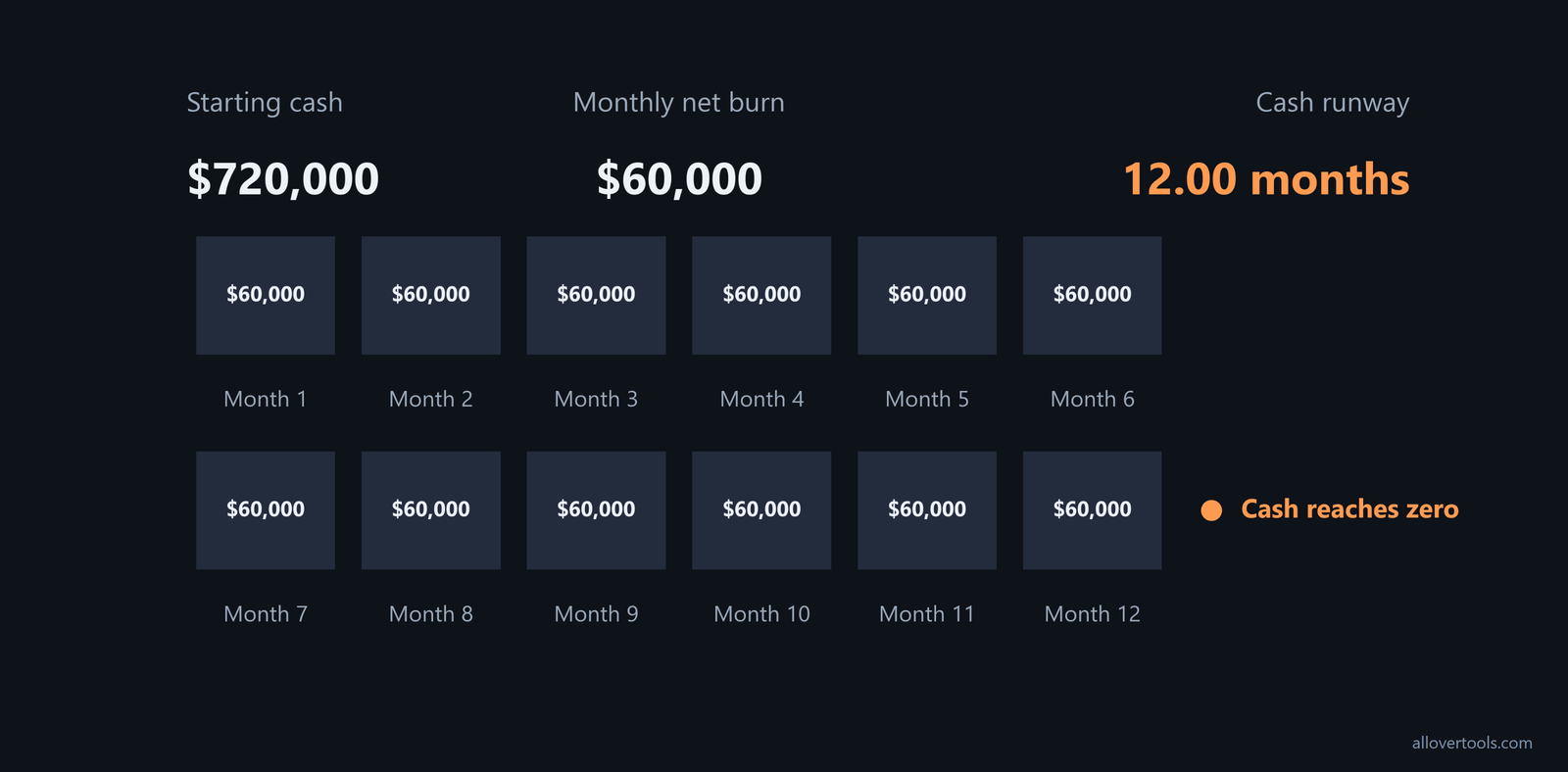
- Cash runway = $720,000 ÷ $60,000 = 12.00 months.
The $60,000 figure is the cash consumed per month in this scenario. Revenue and expenses must refer to the same month. This is a calculation from selected inputs, not a forecast. If revenue covers expenses, net burn is zero or negative, so the simple depletion runway does not apply.
Before comparing this result with a product-company finance report, check which definition it uses. Some finance sources deduct cost of goods sold from revenue before subtracting gross burn: (Monthly Revenue − Cost of Goods Sold) − Gross Burn Rate = Net Burn Rate. In the cited example, a technology startup with $30,000 gross burn, $20,000 monthly revenue, and $10,000 monthly cost of goods sold has net burn of −$20,000. It loses $20,000 monthly despite spending $30,000, as the alternate net-burn definition states. Keep that treatment separate from this article's cash-in-minus-cash-out calculation when checking figures in another model or calculator.
How to enter the example in the Burn Rate Calculator
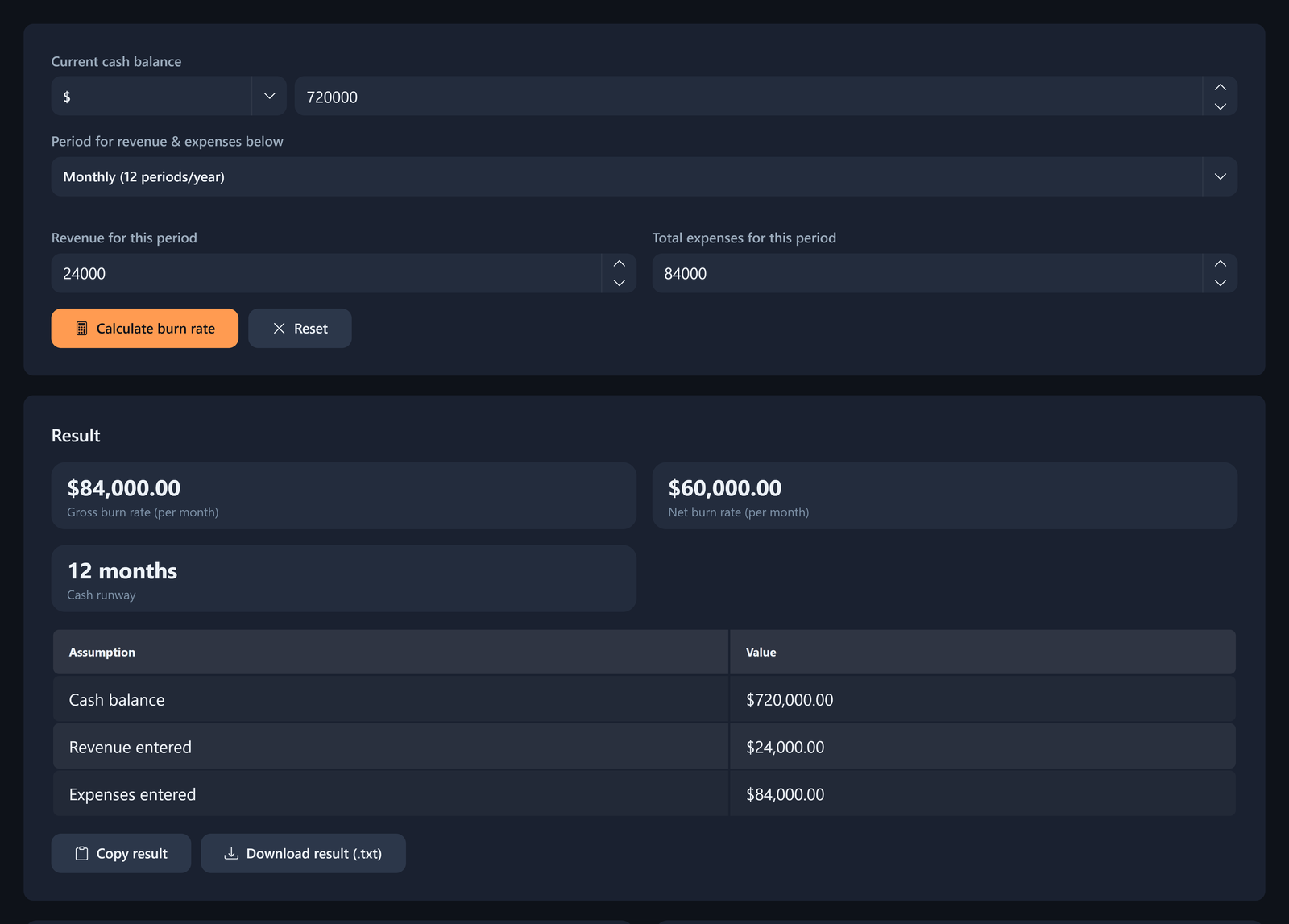
Open the Burn Rate Calculator to enter the figures and review the normalized monthly values and assumptions together.
- Enter Current cash balance as
720000. - Leave Currency symbol at
$. - Choose Monthly (12 periods/year) for Period for revenue & expenses below.
- Enter Revenue for this period as
24000. - Enter Total expenses for this period as
84000. - Select Calculate burn rate.
The result should show Gross burn rate (per month) = $84,000.00, Net burn rate (per month) = $60,000.00, and Cash runway = 12 months. Check the assumptions table for the selected period and monthly revenue and expense values. After calculation, the tool also offers Copy result and Download result (.txt).
Quarterly, Annual, Weekly, and Custom period length… convert same-period revenue and expenses to monthly values. For Custom, enter Days per period as a whole number of at least 1. The revenue and expense amounts must cover the same selected period.
Check the assumptions before trusting the result
Confirm that the selected period applies to both revenue and expenses. Confirm that Current cash balance means current cash and cash equivalents, not total assets. The Currency symbol labels the result; it does not convert the values.
How much runway should a seed startup target?
Runway is the time until cash reaches zero under stated assumptions. It is not a promise that the company will survive for that long. In this runway months example, the planning floor is 12 months because $720,000 ÷ $60,000 = 12.00 months. That floor belongs to this scenario and its next product, revenue, or financing milestone; it is not a universal seed-stage rule.
Review the number against timing risk, hiring commitments, fundraising lead time, and a cash buffer. The Cash Runway Calculator provides a month-by-month view using Current cash balance, Monthly revenue (month 1), Monthly expenses / burn (month 1), optional Monthly revenue growth rate (optional), optional Monthly expense growth rate (optional), and Months to show in projection table.
A target is a decision threshold, not a benchmark
The 12-month floor is selected for this scenario. An internal warning point is the month when the company must slow spending, raise capital, or reach the next milestone. Constant-burn runway and changing-burn runway answer different questions, so use the assumptions that match the decision at hand.
When to start the next fundraise
Start fundraising before runway turns into a short-term survival calculation. Standard practice is to keep runway above 12 months and to start fundraising when a projection crosses that 12-month line, according to the 12-month trigger. A 10-month result can already be an emergency: a seed startup burning $80,000 per month with $800,000 in the bank has 10 months of runway, which the fundraising guidance calls a fundraising emergency, regardless of how modest the absolute burn looks.
The 12-month floor in this article is an internal planning line, not a standard every investor uses. A benchmark report says Y Combinator recommends 18 months of runway as the default target before and after each funding round, while most venture investors expect at least 12 to 15 months at any given time, as the investor runway guidance reports. General startup guidance can be much shorter: one recommendation is three to six months of expenses on hand. With $100,000 in the bank, that source gives $33,334 per month for three months or $16,667 per month for six months as a good burn range, in the cash reserve guidance. Do not use that short-horizon rule to plan a venture-backed seed raise without checking which operating context it describes.
| Fundraising point | Reported runway or timing | What to monitor |
|---|---|---|
| At seed-round close | 18.4 months median runway | Cash at close should support the next milestone, not just the next few expenses. |
| When the next raise starts | 6.2 months median runway remaining | Start while the model still leaves time for delays. |
| When the next raise completes | 2.8 months median runway remaining | A late process leaves little room for a failed or delayed round. |
| From starting a raise to a term sheet | 4.4 months median | Compare this timing with the runway in the current burn case. |
The same reported statistics show that startups typically begin the next raise at 6.2 months of runway, complete the next fundraise with 2.8 months left, and take a median 4.4 months from starting a raise to receiving a term sheet. The median runway at seed close is 18.4 months, as the fundraising timing data shows. Apply that timing by checking the projected runway every month. Waiting until the displayed number is close to the cash-out date leaves no time for the raise itself.
What happens when seed-stage burn changes
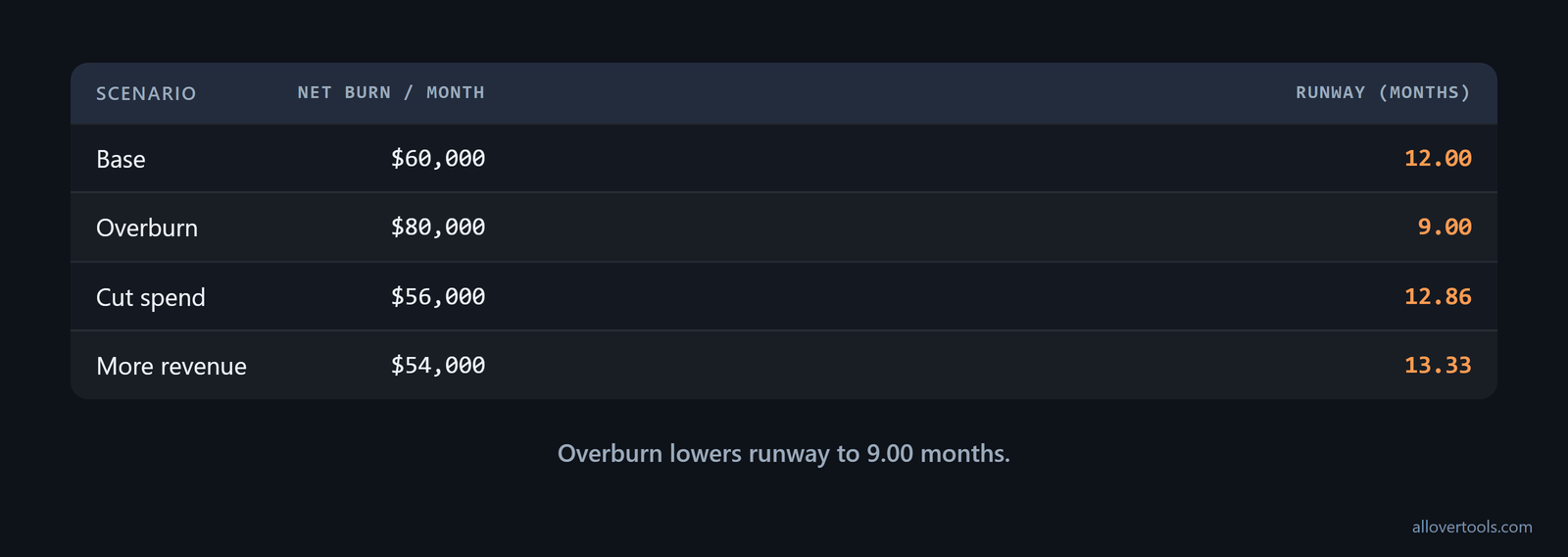
The base case has $60,000 in net burn and 12.00 months of runway. The cases below show how the decision window changes when spending or collected revenue changes. These figures are selected examples, not an external benchmark range.
The overburn warning sign
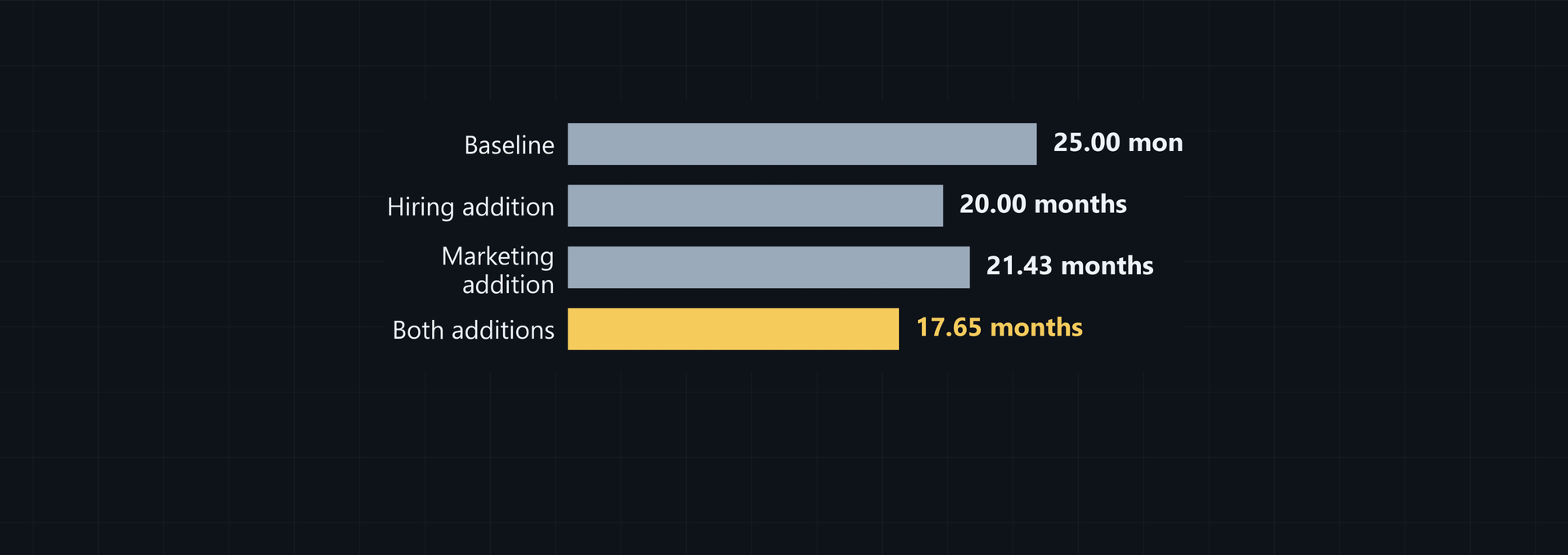
Adding $20,000 of monthly hiring or other committed spending raises gross expenses to $104,000. Net burn becomes $104,000 − $24,000 = $80,000, and runway becomes $720,000 ÷ $80,000 = 9.00 months. The risk is the shorter decision window before the new commitment produces its intended milestone.
Hiring can erase months of runway
An engineering hire adds more than the salary line. At a seed-stage startup in a major tech hub, one engineering hire adds $15,000 to $22,000 to monthly burn after salary, taxes, benefits, and equipment are counted. A founding team of three that hires five engineers therefore takes on a $75,000 to $110,000 per month commitment before any other growth investment, according to the per-engineer estimate. Use the full loaded amount when testing a hiring decision in the calculator.
A larger SaaS case shows the same effect in its line items: 12 people, $2 million raised at seed, $110,000 monthly payroll, $15,000 for software and infrastructure, and $20,000 for marketing produce $145,000 gross burn. With $35,000 monthly subscription revenue, net burn is $110,000 and runway is about 18 months from $2,000,000 ÷ $110,000, in the larger SaaS case.
Rerun the hiring plan before making the offer. Hiring two more engineers the next quarter raises net burn to $145,000 per month and compresses runway to 13.8 months. The result remains above a 12-month floor, but the trend is deteriorating, as the hiring scenario demonstrates. A model that still shows more than 12 months can therefore be moving in the wrong direction.
Two adjustments move the number in the other direction. Reducing total expenses to $80,000 gives $80,000 − $24,000 = $56,000 net burn and $720,000 ÷ $56,000 = 12.86 months. Increasing collected revenue to $30,000 while expenses stay at $84,000 gives $84,000 − $30,000 = $54,000 net burn and $720,000 ÷ $54,000 = 13.33 months. The $54,000 to $80,000 range is illustrative and comes only from these selected cases.
High burn can be a deliberate growth plan rather than an error, but the round size and milestones must support it. For seed-stage rounds of $2 million to $5 million, burn often increases to $150,000 to $300,000 or more per month for teams of 10 to 20 people, including first go-to-market hires, as founders try to build a repeatable growth engine, according to the higher-burn band. That is a different operating choice from this $84,000 budget. Compare the planned burn with the cash raised and the milestone schedule before treating it as a simple cost cut.
A growth projection can still consume cash
For a changing-input case, enter $720,000 cash, $24,000 month-one revenue, $84,000 month-one expenses, 3% monthly revenue growth, 1% monthly expense growth, and 12 months shown in the Cash Runway Calculator. The month-12 results are:
Revenue: $24,000 × 1.03^11 = $33,221.61
Expenses: $84,000 × 1.01^11 = $93,716.14
Net burn: $93,716.14 − $33,221.61 = $60,494.53
Ending cash: -$4,721.54
First depletion: month 12
Interpolated runway: 11.92 months
Rising revenue does not automatically improve cash position when expenses also compound. Overburn can shorten runway before a new hire or revenue plan reaches its intended milestone. This projection is a scenario using growth assumptions, not a forecast.
Ways to extend runway without hiding the burn
Separate committed payroll from discretionary spending first. Delay or stage hiring against a measurable milestone. Review founder salary and contractor scope while keeping necessary cash compensation in the budget. Cut tools, campaigns, or overhead that do not support the next milestone. Improve collections so revenue means cash collected in the same period.
Measure burn from cash movement over three months
Use bank movement to check whether the line-item budget matches the cash actually leaving the business. Take total cash across all accounts at the start of a period, subtract the balance at the end, and divide by the number of months. A company that starts a quarter with $1.8 million and ends with $1.5 million has average net burn of $100,000 per month. Use a three-month average, not one month, because one-time payments such as annual software renewals or quarterly tax bills can distort a single-month figure, as the cash-balance method advises. That smoothed number gives the runway calculation a steadier input for a recurring review.
Rerun the budget monthly with base, downside, and improvement cases. Use the Burn Rate Calculator for the recurring monthly check and the Cash Runway Calculator when revenue or expenses change over time. The calculators do not model seasonality, one-time charges, financing events, or future changes unless a growth scenario is entered. A 12.00-month result should start a review, not end one.
Runway also needs an efficiency check when the company is adding recurring revenue. One benchmark's rule of thumb is to hold 18 to 24 months of runway after each raise and spend no more than $2 for every $1 of net new annual recurring revenue added. That implies a burn multiple under 2.0×, according to the burn-multiple guidance. Compare that measure with the $60,000 monthly net burn instead of treating runway alone as proof that the spending is working.
The monthly review checklist
- Check the current cash balance.
- Check cash revenue collected.
- Check total cash expenses.
- Compare gross burn with net burn.
- Measure months to the chosen milestone.
Investigate any change in net burn before treating the runway number as stable.
Frequently asked questions
What is a good burn rate for a seed startup?
There is no universal rate. In this example, $84,000 gross burn minus $24,000 collected revenue produces $60,000 net burn and 12.00 months from $720,000 cash. Judge the number against cash, milestones, and commitments rather than an outside benchmark.
How do I calculate seed-stage runway?
Divide current cash by positive monthly net burn: $720,000 ÷ ($84,000 − $24,000) = 12.00 months in the example. A changing-growth scenario needs a month-by-month projection because monthly burn is no longer constant.
Should founder salaries be included in burn rate?
Yes. Cash founder salaries are operating expenses and should be included consistently with other payroll. This example includes two $8,000 salaries in its $84,000 monthly expense budget.
What is the difference between gross burn and net burn?
Gross burn is total monthly expenses before revenue. Net burn subtracts cash revenue collected in the same period, so this example has $84,000 gross burn and $60,000 net burn.
How can a seed startup extend its runway?
Reduce or stage discretionary spending, tie hiring to milestones, review salary and contractor commitments, improve cash collection, and rerun downside cases monthly. Lowering expenses to $80,000 reduces net burn to $56,000 and raises the chosen runway to 12.86 months.