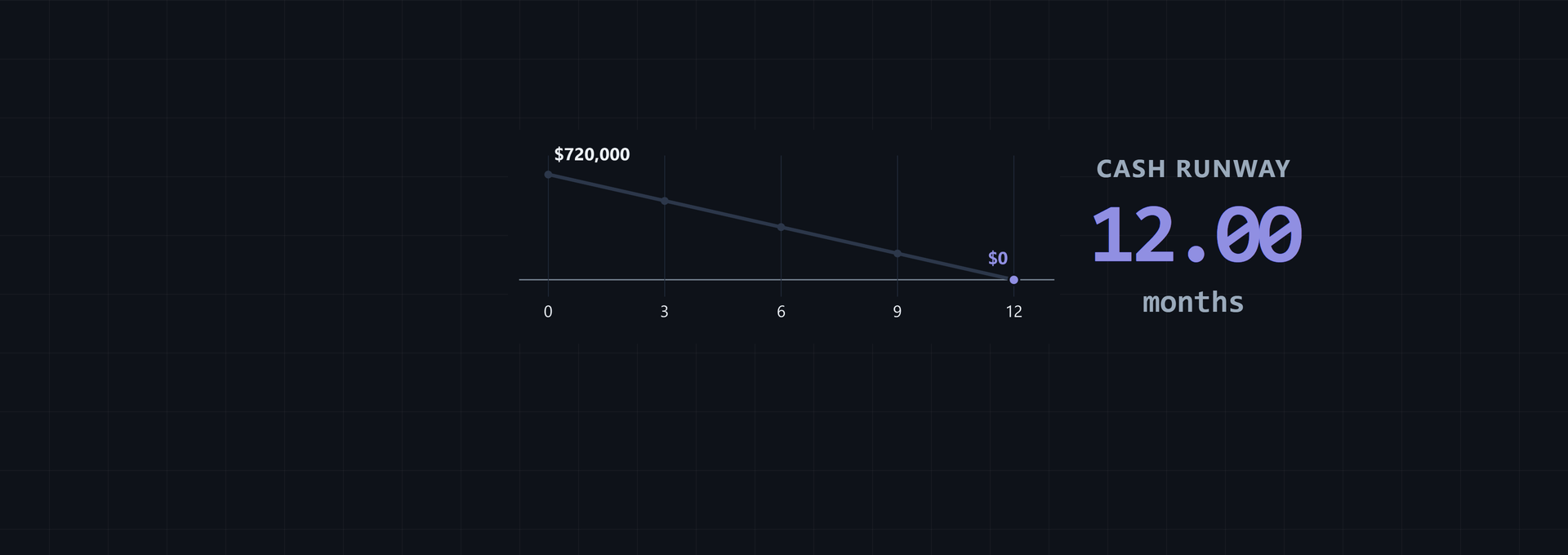
Startup burn rate is how quickly a startup uses cash to operate, usually measured each month. A practical answer to "what is burn rate?" is the startup cash spend per month after the chosen period is normalized to one month. The burn rate definition separates gross burn, net burn, and runway. It tracks cash use, not profit, growth, or business quality.
What is startup burn rate?
One month is the usual reporting unit. Startup cash spend per month means the cash operating expenses paid or incurred during a selected period, converted to a monthly amount. This shows how much cash operations use in a typical month for that period.
Read together, gross burn is the full monthly expense total before revenue is deducted. Net burn is what remains after cash revenue is subtracted. Runway uses the current cash balance and positive net burn to estimate how long operations can continue. None of these figures, on its own, measures profit, growth, or business quality.

Gross burn vs net burn: what is the difference?
Both measures use the same monthly unit. Gross burn equals monthly expenses, so it captures the full cash operating spend before revenue offsets any of it. Net burn equals monthly expenses minus monthly revenue. When expenses are higher than cash revenue, net burn is the amount by which cash falls.
People often use "burn rate" and "net burn" as if they mean the same thing, but they do not. Burn rate usually means the total cash spent in a period before revenue is deducted. Net burn is the cash actually lost after revenue. If a board or investor uses the word "burn," confirm which measure they mean before comparing the number. The difference is set out in this metric distinction.
Some finance glossaries use a broader definition of gross burn than cash operating expenses alone. It includes all operating expenses, capital expenditures, and other cash outflows, including interest and taxes, before incoming revenue is counted. If an investor report uses that definition while the calculator uses cash operating expenses, label the definitions clearly so the figures are not compared as though they were identical. The distinction is described in this gross-burn guide.
Sources do not all define net burn the same way. One published formula starts with gross margin: Net burn = (Monthly Revenue - Cost of Goods Sold) - Gross Burn Rate. That can produce a different result from the simpler cash-in-minus-cash-out calculation used here. Check whether a report includes COGS or uses total cash revenue before reconciling two net-burn figures. One approach appears in this burn-rate definition.
Revenue changes net burn, not gross burn. A pre-revenue company with chosen expenses of 70,000 and revenue of 0 has this monthly burn rate:
Gross burn = 70,000/month
Net burn = 70,000 - 0 = 70,000/month
At the revenue stage, use these chosen values:
Monthly expenses = 90,000
Monthly revenue = 30,000
Gross burn = 90,000/month
Net burn = 90,000 - 30,000 = 60,000/month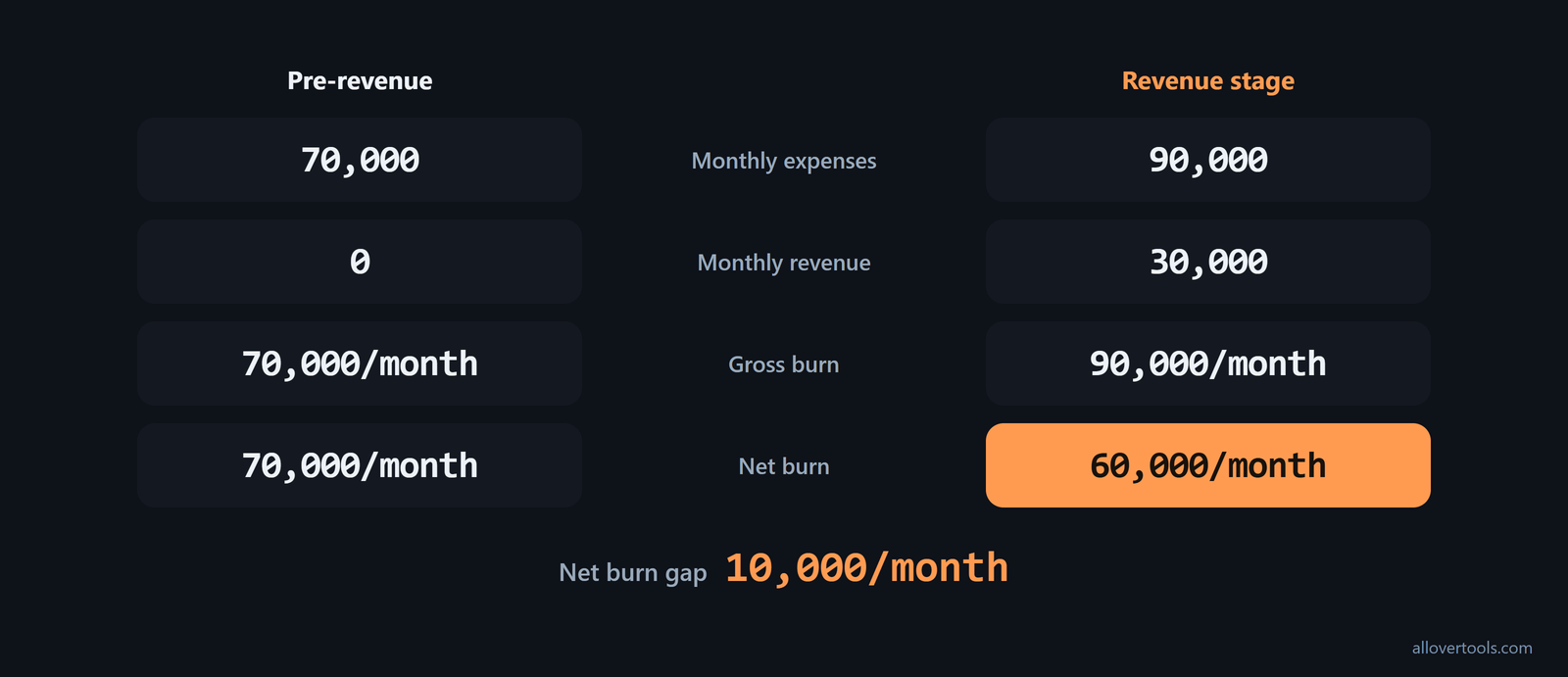
The measure you choose changes the runway conclusion. With spending of $100,000 per month and revenue of $40,000, gross burn is $100,000 and net burn is $60,000. Gross burn alone makes runway appear to be six months; net burn shows ten months. Use gross burn for the full cost commitment and net burn for cash consumption after recurring revenue. The difference appears in this runway example.
If revenue is higher than expenses, net burn is negative. Cash is increasing instead of being depleted. The calculator shows the absolute amount followed by "(net positive)" and reports "Not burning cash (revenue covers or exceeds expenses)." These are chosen values, not benchmarks.
Pre-revenue and revenue-stage startups
Before revenue starts, gross burn and net burn are the same number because revenue is 0. Once a startup has revenue, it needs both figures. Gross burn shows the total operating spend; net burn shows the cash use left after revenue is collected.
How to calculate monthly burn rate
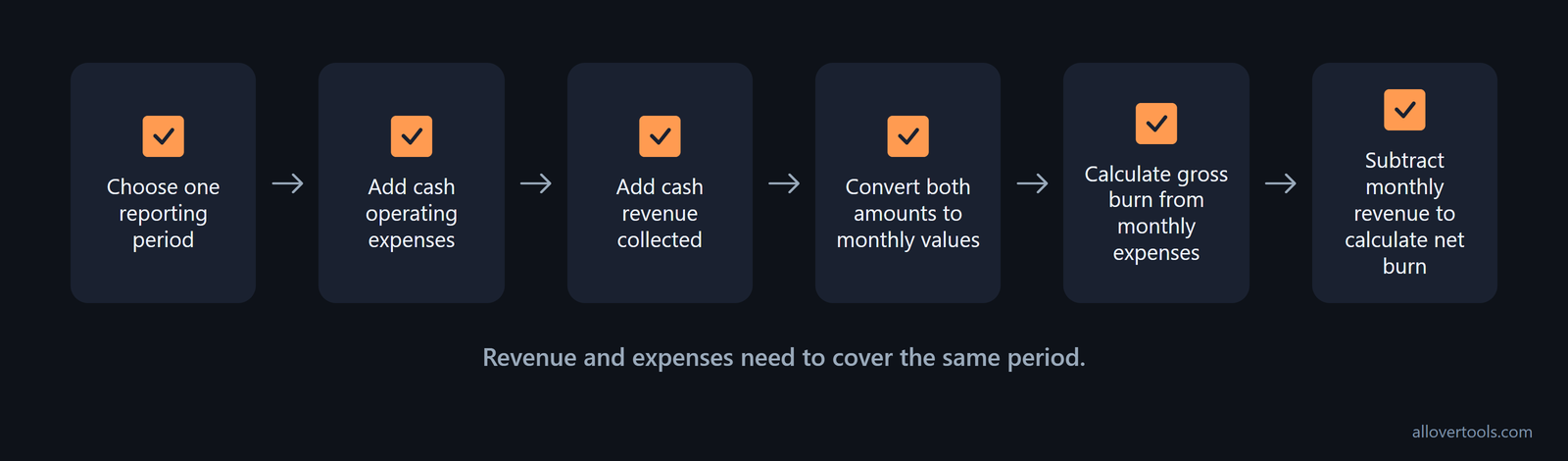
Start with the Burn Rate Calculator, or do the calculation by hand:
- Choose one reporting period.
- Add the cash operating expenses for that period.
- Add the cash revenue collected during the same period.
- Convert both amounts to monthly values if the period is not monthly.
- Use monthly expenses to calculate gross burn.
- Subtract monthly revenue from monthly expenses to calculate net burn.
Revenue and expenses need to cover the same period. Pairing one month of revenue with one quarter of expenses gives a mismatched result before either formula is applied.
When an expense report is hard to access, you can reconcile net burn from the cash balance. Net burn can equal monthly gross burn minus monthly revenue, or the cash balance at the start of the month minus the balance at the end. A negative result means the company generated more cash than it spent. Compare that balance change with the operating calculation before treating it as burn. See this net-burn formula guide for the same comparison.
Use operating cash flows as the boundary for this reconciliation. Remove bank transfers and financing activities before calculating net burn, then keep operating inflows and outflows. That means excluding equity raises, loan drawdowns, deposits between the company's own accounts, and investment transactions from the burn figure. The boundary is specified by the operating-cash rule.
For automated tracking, use posted cash movements with consistent signs and classify each item as operating, financing, or investing activity. Gross burn is the sum of operating cash outflows; net burn is operating outflows minus operating inflows. Check those classifications in the accounting or BI data before trusting a dashboard. An unclassified financing inflow can make a month look less burned without changing operations. The classification is explained in this data guide.
Worked example with chosen values
These are chosen values for one startup's monthly period:
Payroll:    55,000
Rent:        8,000
Software:    7,000
Marketing:  20,000
--------------------
Total expenses: 90,000
Cash revenue:   30,000
Cash balance:  360,000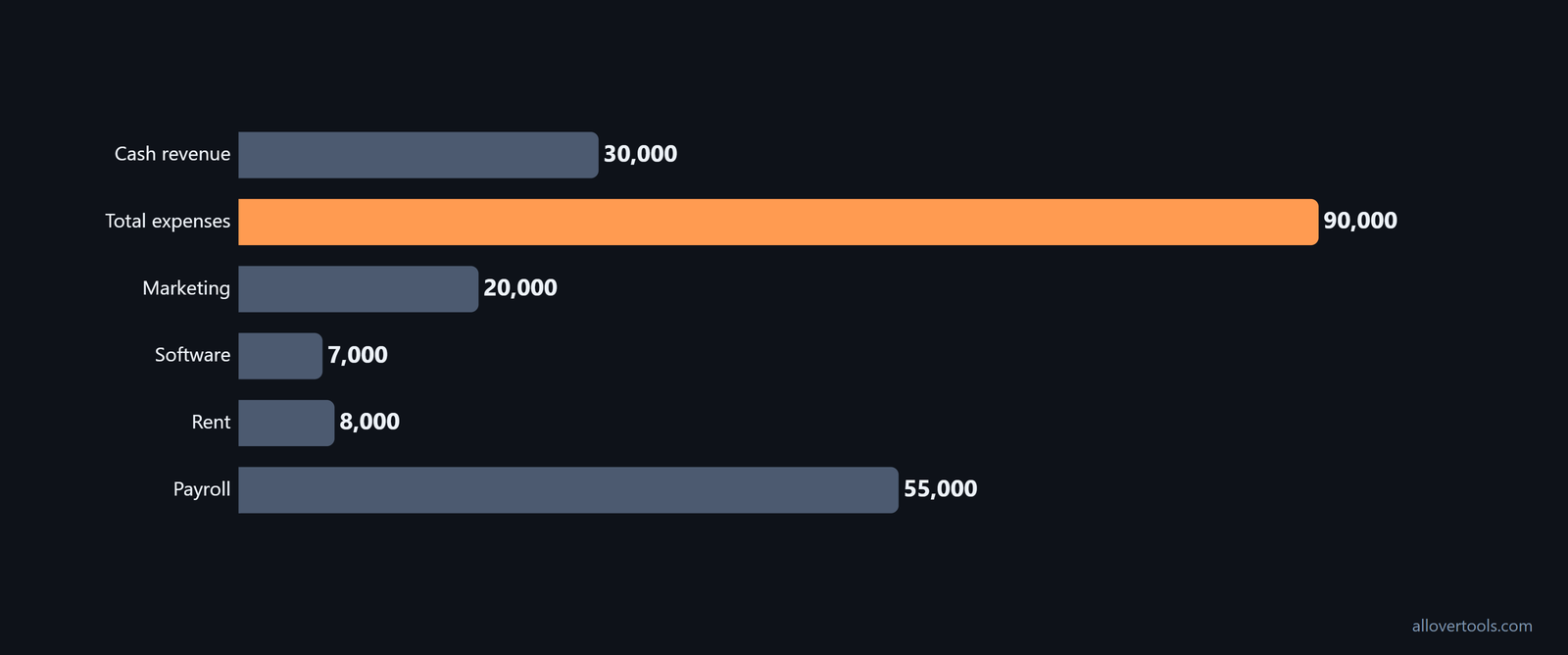
The expense total is:
55,000 + 8,000 + 7,000 + 20,000 = 90,000That gives a gross burn of 90,000 per month. Subtract the chosen cash revenue to get net burn:
90,000 - 30,000 = 60,000/monthKeep the 360,000 cash balance for the runway calculation in the next section.
When the reporting period is not monthly
Keep revenue and expenses on the same reporting basis, then choose the matching value in Period for revenue & expenses below. Monthly, Quarterly, Annual, and Weekly use 12, 4, 1, and 52 periods per year. The calculator converts each entered amount with:

Monthly amount = entered amount x periods per year / 12Custom period length… requires a whole-number Days per period. It calculates periods per year as 365.25 / days per period, then applies periods per year divided by 12 to each entered amount. Currency symbol changes the display labels only; it does not convert currencies.
Enter Current cash balance, Revenue for this period, and Total expenses for this period, choose the period, and select Calculate burn rate. The Result shows Gross burn rate (per month), Net burn rate (per month), and Cash runway, along with the formula, assumptions, and intermediate monthly values. The visible controls are Copy result, Download result (.txt), and Reset.
The script contains no fetch, XMLHttpRequest, sendBeacon, or form post. The browser calculates the entered values locally, and the values are not uploaded.
How burn rate connects to cash runway
Cash runway estimates how many months the current cash balance can fund operations at the current net burn. The formula is:
Cash runway (months) = cash balance / net burnUsing the chosen values above:
360,000 / 60,000 = 6 months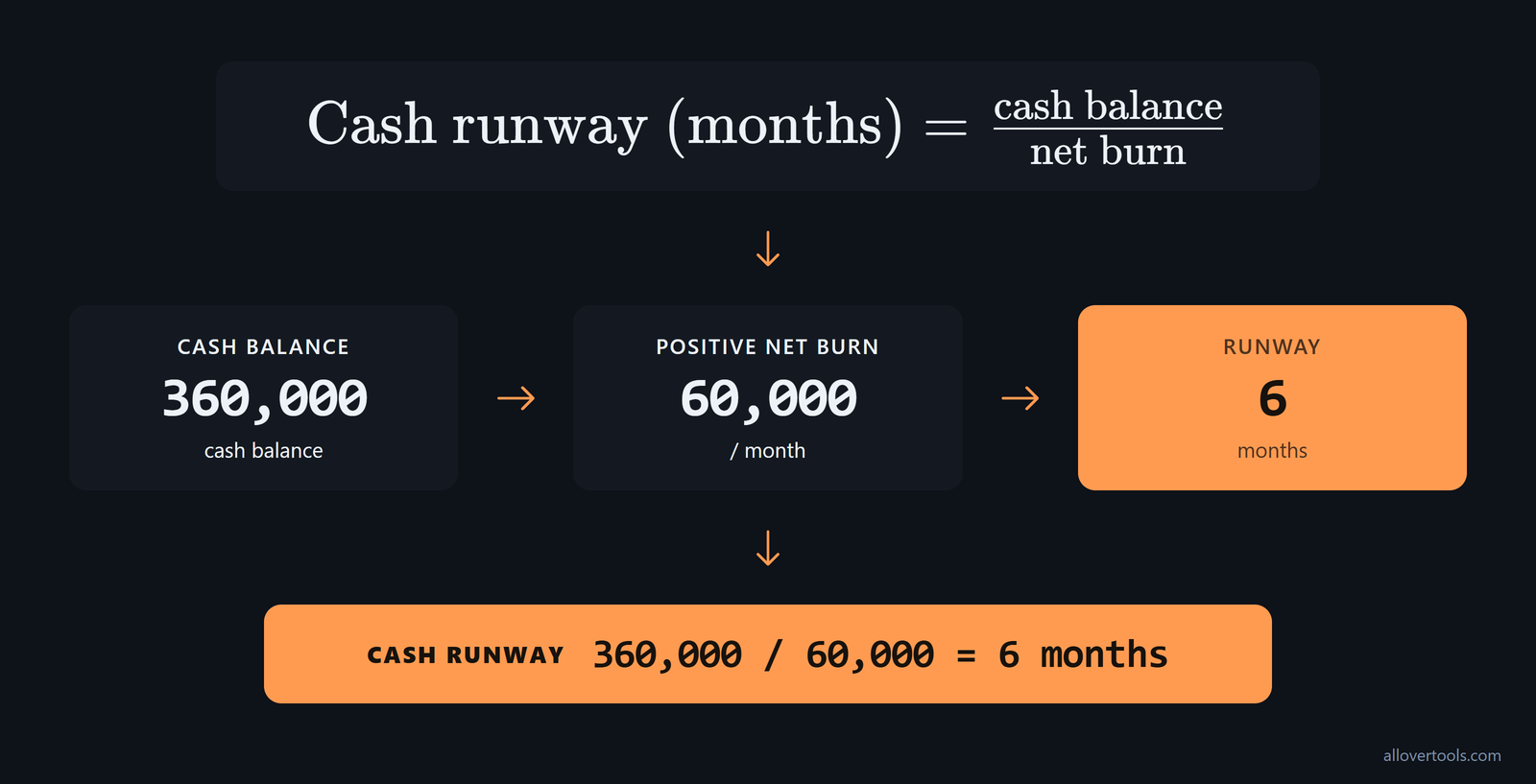
A net burn of 0 or below is shown as "Not burning cash (revenue covers or exceeds expenses)." A cash balance of 0 with positive net burn produces 0.00 months.
A commonly cited historical runway guideline is 12 to 18 months of cash reserves. Treat that range as a planning reference, not a universal rule. Compare the calculated runway with the target, then adjust spending or revenue assumptions if the operating plan does not reach it. The same approach appears in this runway guidance.
Judge runway by the burn trend, not by one noisy month. Plot gross burn and net burn together by month. The gap between the lines represents operating cash coming in, and if both lines drift downward, that shows spending discipline. A one-month spike may come from an annual insurance or audit payment, so use a trailing average, often three to six months for the planning view, instead of that single month when calculating runway. The method is outlined in this burn-chart method.
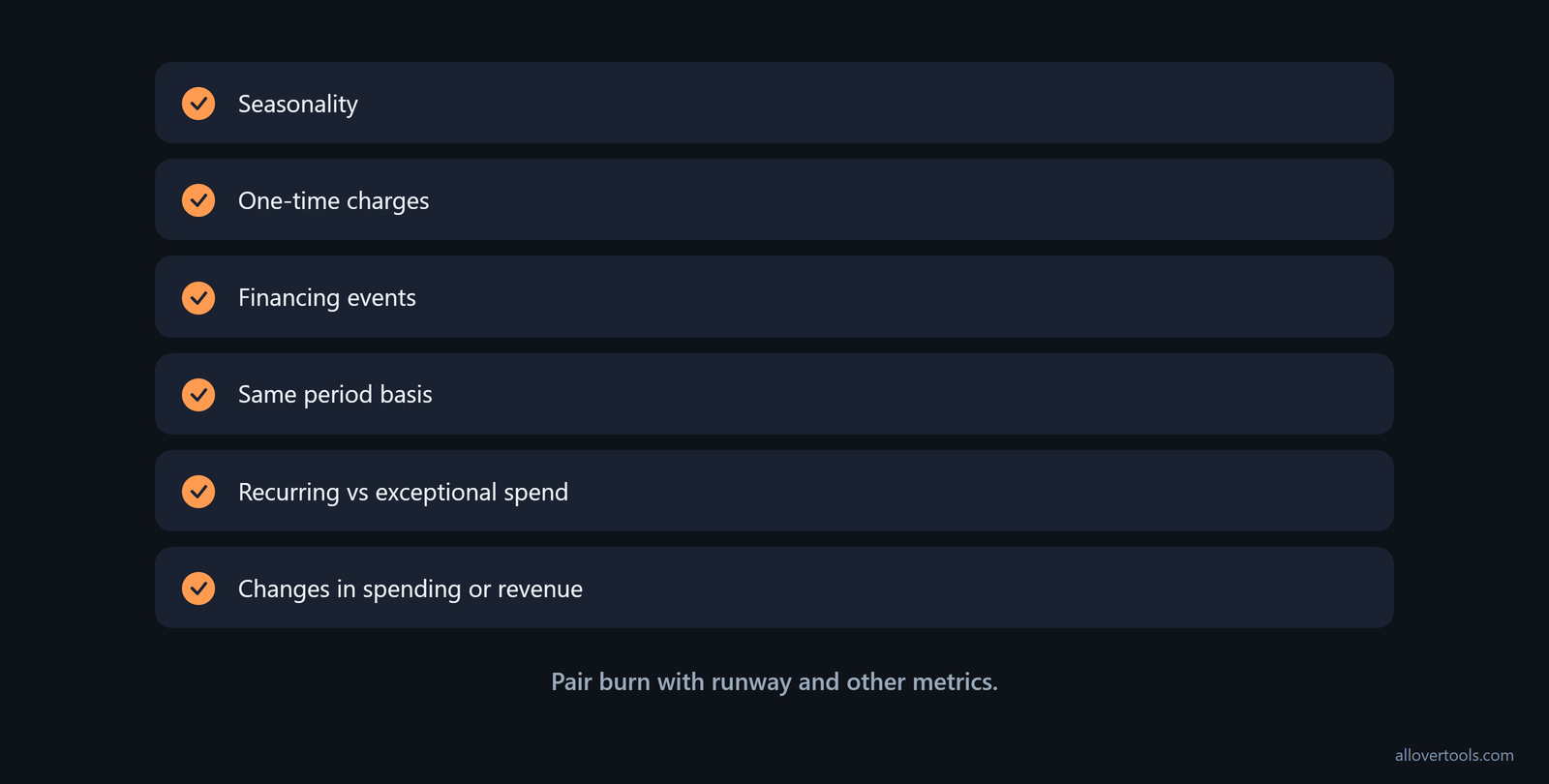
This calculation assumes normalized revenue and expenses stay constant. It does not account for seasonality, one-time charges, financing events, or later changes in spending or revenue. To build a month-by-month projection, use the Cash Runway Calculator with its visible inputs Monthly revenue (month 1), Monthly expenses / burn (month 1), and optional growth-rate fields.
Why founders and investors track burn rate
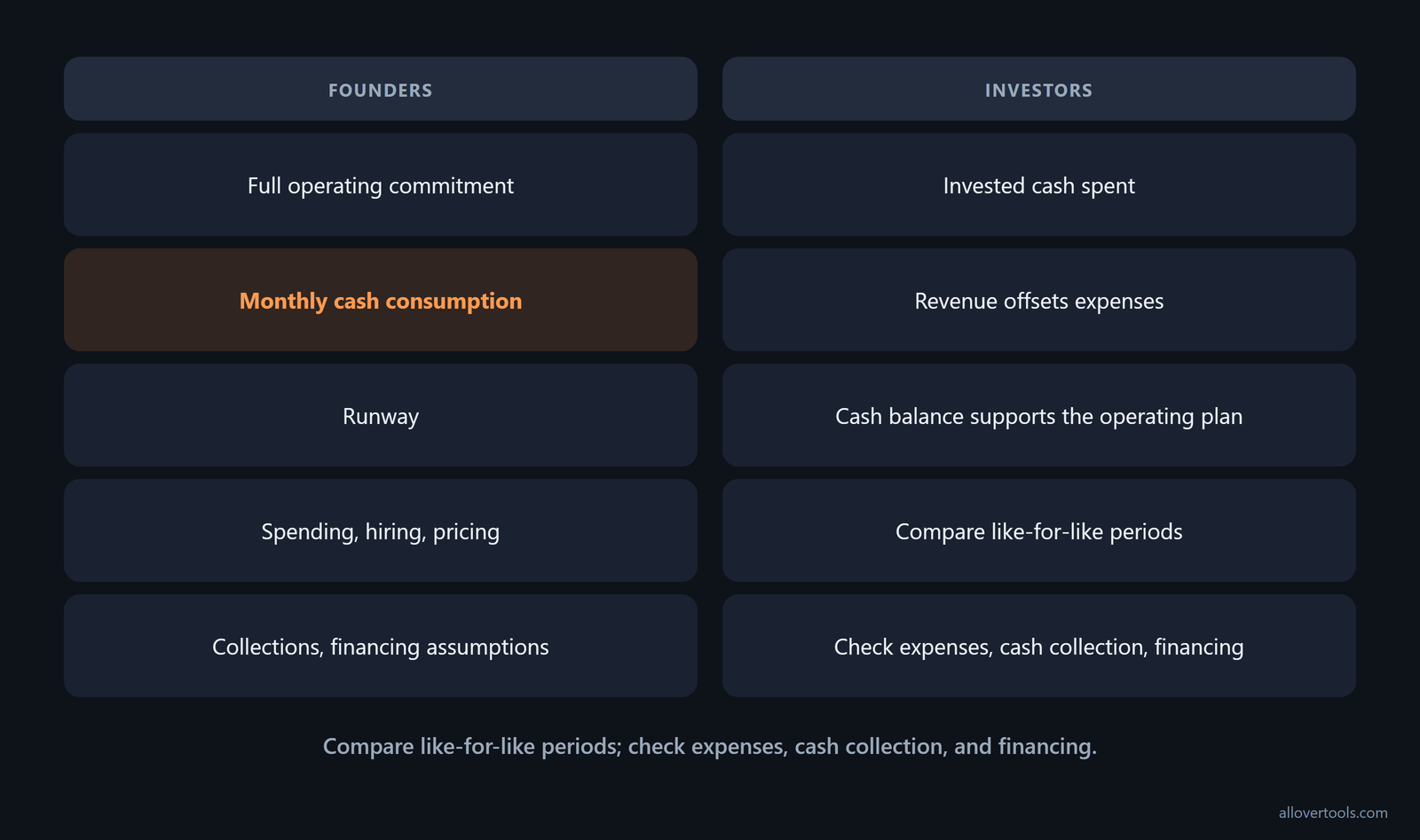
Founders use gross burn to see the full operating commitment. They use net burn to see monthly cash consumption, then compare the result with runway when reviewing spending, hiring, pricing, collections, or financing assumptions.
Investors use the same figures to see how quickly invested cash is being spent, how much revenue offsets expenses, and whether the stated cash balance supports the operating plan. One period is only a snapshot. Compare like-for-like periods and check what changed in expenses, cash collection, or financing before drawing a conclusion.
In external reporting, net burn is the primary figure for runway calculations and investor or board updates because it reflects cash lost after revenue. Gross burn answers a different question: what is the cost base the operating team can examine and potentially reduce? Keep both figures in the update, but lead with net burn when the question is runway or stakeholder reporting, as this reporting distinction explains.
Burn discipline means finding a workable spending level, not chasing the lowest possible number. Overspending shortens runway and raises failure risk. Underspending can starve growth and reduce the chance of success. The level of spending is a critical factor in whether a startup succeeds or fails, so use gross and net burn together to test whether the operating plan is funded at a balanced level, according to this startup research.
Burn rate per employee
Dividing total monthly spend by headcount makes comparisons across startups easier. For example, $300,000 of monthly spend across five employees is $60,000 per employee. The industry widely uses this figure to compare whether startups are burning too much or too little for their team size. Add headcount beside monthly burn in an internal review, then investigate a high or low result instead of treating total burn alone as the benchmark. A balanced level of spending per employee is critical for startup survival, as Wharton's analysis notes.
A SaaS company that tracks burn alongside recurring revenue, churn, and runway can use the SaaS Metrics Calculator. Its verified burn inputs include Total cash operating expenses (period) and Cash collected from customers (period). Its burn outputs include Gross burn, Net burn, and Cash runway.
What startup burn rate does not tell you
Burn rate does not show profitability, recurring revenue quality, customer economics, product progress, or whether spending is producing the intended result. Gross burn can overstate cash risk when revenue is meaningful. Net burn can hide timing problems when cash collection is delayed or a period contains an unusual receipt.
A single period can also be distorted by seasonality, one-time charges, financing events, or a later change in spending or revenue. Keep revenue and expenses on the same period basis. When reviewing the trend, separate recurring operating spend from exceptional items, and pair burn with runway and other metrics instead of looking for a universal "good" burn rate.
Gross burn is a downside stress test. If revenue suddenly stops because of churn, a market shock, or a payment freeze, gross burn is the monthly cash requirement the company still faces. It shows how quickly cash on hand would be consumed if all revenue stopped tomorrow. Review gross burn before deciding whether a net-burn runway is safe under a revenue shock, as this gross-burn explanation makes clear.
There is no universal "good" gross burn. One named set of guidelines provides a stage-based comparison for internet startups. Treat these as indicative ceilings, not targets that apply across every company:
| Stage | Gross burn per month |
|---|---|
| Building Product | Up to $50,000 |
| Building Usage | Up to $100,000 |
| Building the Business | Up to $250,000 |
Use these figures only as a comparison point. Account for industry, geography, and the current funding climate before judging the result. The stage labels and ceilings are reproduced from an influential set of guidelines cited by this stage-benchmark article.
Use the calculator for transparent arithmetic and its stated assumptions. Its result is based on the figures entered; it is not a forecast or financial advice.
Frequently asked questions
Is burn rate the same as monthly expenses?
The normalized monthly expense total is gross burn, so it can match monthly expenses. Net burn is different because it subtracts cash revenue from monthly expenses.
How do you calculate burn rate for a pre-revenue startup?
Set revenue to 0 and use the monthly cash operating expenses. Gross burn and net burn are then equal. With the chosen 70,000 expense example, both measures are 70,000 per month.
What is a good startup burn rate?
There is no universal target. Interpret burn against cash on hand, runway, stage, operating plan, and what the spending is meant to achieve. A number is not good or bad by itself.
What happens when revenue is higher than expenses?
Net burn becomes negative because revenue exceeds monthly expenses, so cash is not being depleted. The calculator reports this as not burning cash and marks the displayed amount as net positive.
Can burn rate predict when a startup will run out of cash?
Only as a constant-rate estimate: cash balance divided by positive net burn gives runway in months. Seasonality, one-time items, financing, and changing revenue or expenses can make the estimate wrong, so variable assumptions need a projection.