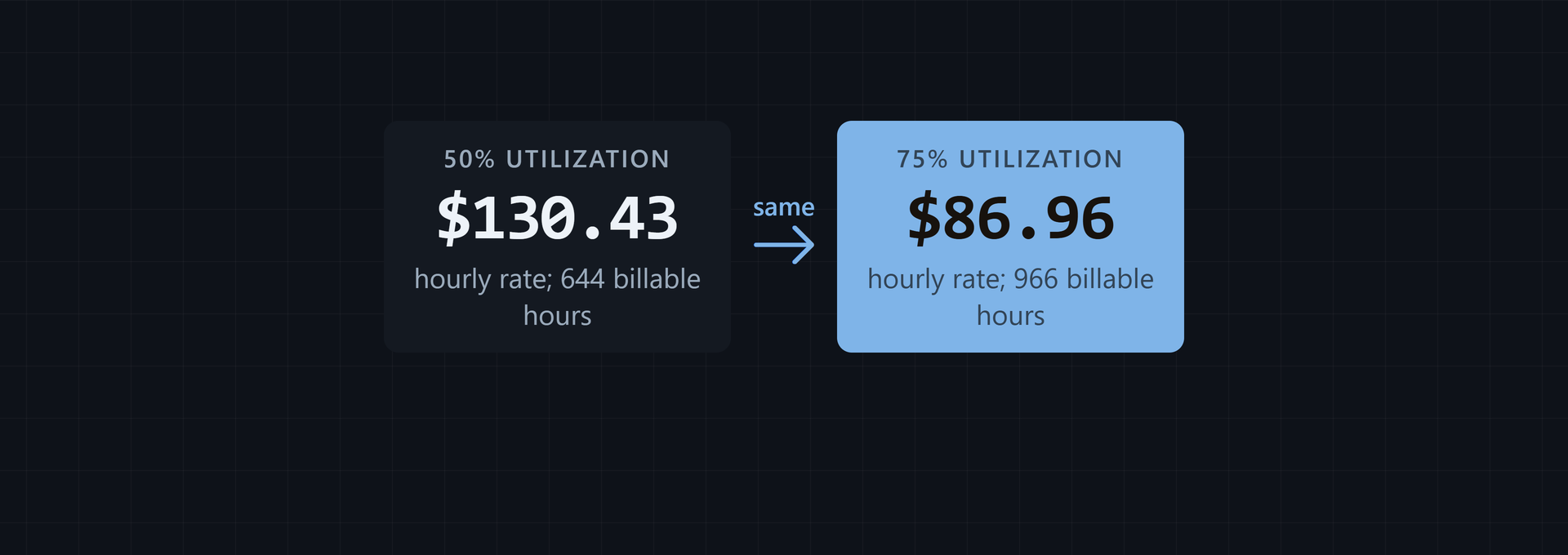
Annual billable hours planning starts with the time you can actually work. From there, remove vacation, downtime, and the work that cannot be invoiced. In this full-time example, 50 working weeks at 40 hours gives 2,000 total working hours. At 60% utilization, the plan allows for 1,200 billable hours, which can then feed an hourly rate calculation.
How many working hours can you plan for each year?
Total work hours are not billable hours
Start with the calendar. In this freelancer example, 52 calendar weeks minus 2 weeks for vacation or downtime leaves 50 working weeks:
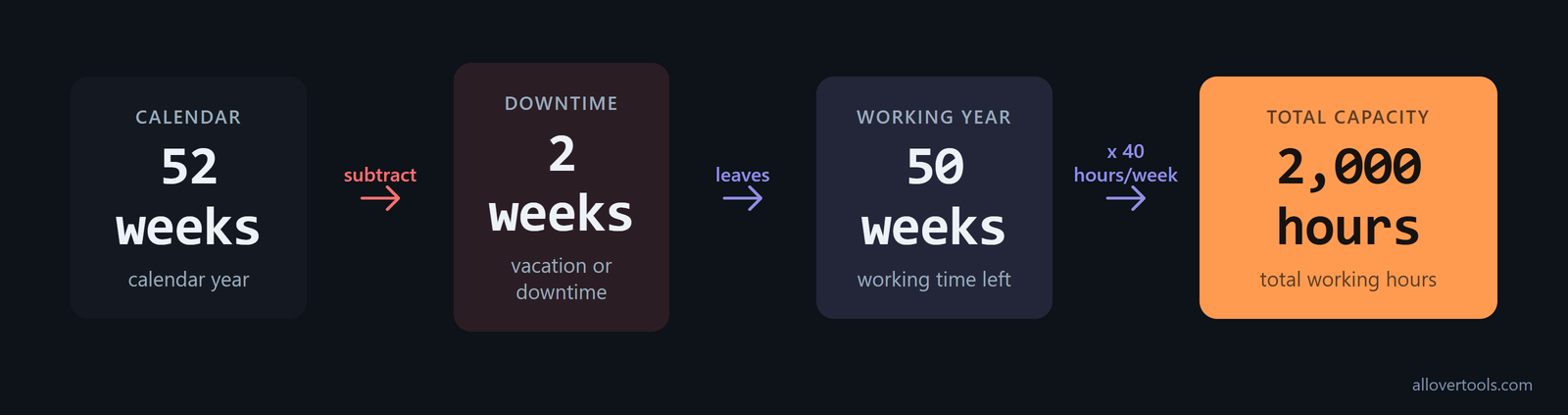
50 working weeks x 40 hours per week = 2,000 total working hoursFor an agency employee, plan on about 1,800–1,900 net available hours per year after statutory holidays and approved leave, according to this agency benchmark. At 70% utilization, 1,900 available hours yield 1,330 billable hours. Using 2,080 instead would imply 1,456, or more than three typical work-weeks of client time.
The 2,000 hours cover client delivery and the work around it: admin, sales, marketing, learning, coordination, and buffer time. Billable hours are the hours that can be invoiced to a client. Multiplying 40 hours by all 52 calendar weeks gives 2,080 scheduled hours, but that treats every week as available for invoiced work and leaves out the time needed to run the business.
Start with 2,080 as a gross work-year, not as net client capacity. U.S. firms often use 40 weekly hours, or 2,080 annual gross hours, because federal overtime rules require covered employees to receive overtime pay for hours over 40 in a fixed 168-hour workweek, according to this utilization guidance. Subtract the leave and holidays in the schedule before setting the billable target.
Plan freelancers and agencies by role
A freelancer plans around one person's full schedule. An agency needs a separate schedule for each delivery role. Management, sales, internal review, bench time, and coordination sit outside a delivery role's billable hours; they should not disappear inside one team-wide percentage.
For one agency delivery role, 48 working weeks at 35 hours per week gives:
48 x 35 = 1,680 total hours per person
1,680 x 0.60 = 1,008 billable hours per person
3 x 1,008 = 3,024 billable hours for three identical delivery roles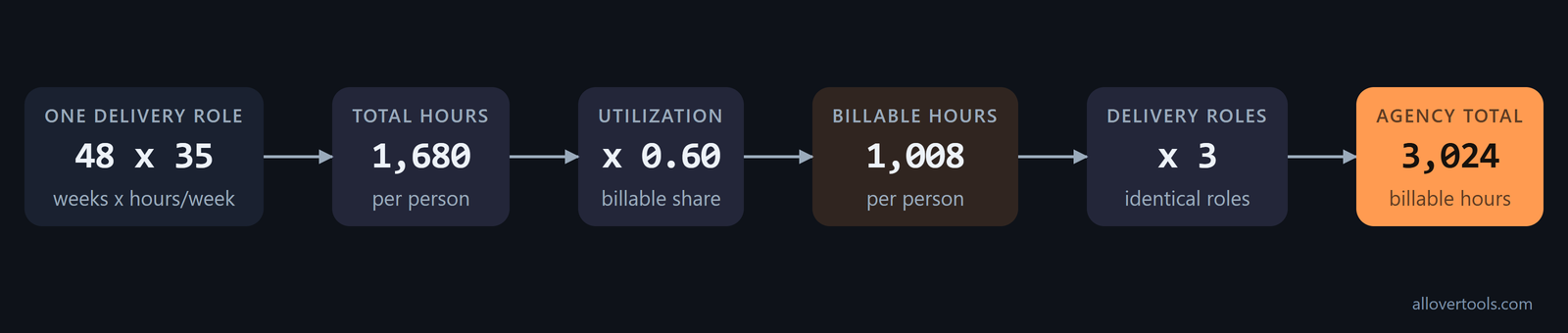
These are planning values, not freelancer or agency benchmarks. The three-role result covers only the delivery capacity in this example. The percentages and examples below are also planning assumptions, not external market statistics.
These agency figures put 50–60% utilization below the 66.4% average reported for 2025 across 509 professional services organizations. A 75.0% target matches high-performing firms; 81.2% matches top-maturity firms. The 2026 benchmark covers organizations with a combined $63 billion in services revenue, so use it to calibrate an agency or consultancy, not a solo freelancer's target.
Team size changes the comparison point. TMetric's agency data gives these typical utilization ranges:
| Agency size | Typical billable utilization |
|---|---|
| 1–10 people | 70–85% |
| 11–50 people | 60–75% |
| More than 50 people | 65–70% |
Use the range for the firm's size. Do not copy a percentage from an agency with a different structure. The size-specific data reflects higher hands-on founder delivery in very small shops, more management and coordination in mid-size firms, and stabilized overhead in larger agencies.
For a consulting firm, 70–80% is a common firm-level target band. About 75% is a useful calibration point when available hours already exclude time off and public holidays. At 1,800 available hours, 75% gives 1,350 billable hours per delivery employee; applying 75% to 2,080 would instead imply 1,560. Use the firm-level benchmark with the net denominator, not the theoretical work year.
How do you calculate annual billable hours?
Start with a weekly schedule
Use this formula:
Billable hours per year = total working hours per year x utilization rate as a decimalAt 60% utilization, a 40-hour week contains 24 billable hours and 16 non-billable hours. This allocation shows where those 16 hours go:
Admin:                 4 hours
Sales:                 3 hours
Marketing:             2 hours
Delivery coordination: 3 hours
Learning:              2 hours
Buffer:                2 hours
Total non-billable:   16 hours
Billable delivery:    24 hours
Total week:           40 hours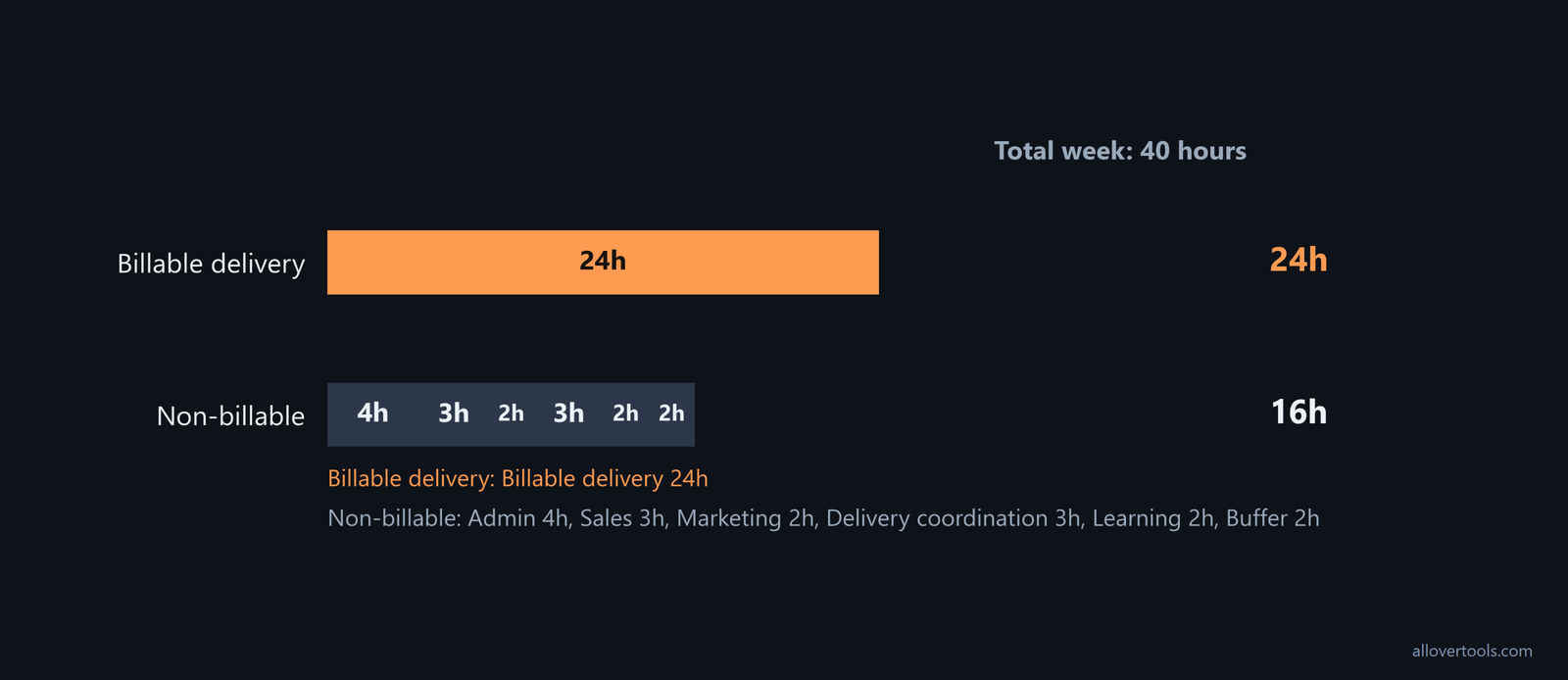
The split leaves room for the work required to win and deliver projects. Remove vacation and downtime before applying utilization; do not count them as billable time.
A solo freelancer often lands around 1,000–1,300 billable hours a year, not 2,080. One detailed model starts with about 1,840 working hours. It leaves about 1,290 billable hours when admin and sales take 30%, or near 1,100 when they take 40%. Use that freelance analysis to test whether the weekly schedule leaves enough client time.
- A $90,000 gross-income target at a $75 hourly rate, over 46 working weeks, needs 1,200 billable hours.
- That works out to about 26 billable hours per week and 5.2 billable hours per day in a five-day week.
- Track time for a month before treating the estimate as dependable annual capacity.
Another full-time freelancer benchmark puts typical annual billing at 1,200–1,400 hours. In a 40-hour week, only about 25–30 hours are probably billable; the rest goes to admin, client communication, marketing, and business development. If 2,080 hours are used as the rate denominator anyway, the hourly rate looks lower than it should and can cause undercharging; include the freelancer rate warning when checking the result.
Some freelancers should plan below 1,200 hours. Industry data puts the most variable group at 800–1,200 hours with 40–55% utilization. Admin, invoicing, client acquisition, and lack of support staff reduce billable time. A project-based or feast-and-famine business can use the lower freelancer band and protect its economics through a rate that reflects the lost capacity.
Treat the 60% weekly example as an operating pattern: about 24 billable hours and 16 non-billable hours in a standard 40-hour week. Prospecting, sales calls, contracts, invoicing, bookkeeping, email, marketing, and skill-building sit on the non-billable side. The weekly pricing pattern also expresses this as roughly 1,200 billable hours out of a standard 2,000-hour year.
Convert working weeks into a yearly target
Apply that weekly schedule to the 50 available working weeks:
52 calendar weeks - 2 weeks vacation or downtime = 50 working weeks
50 x 40 = 2,000 total working hours
50 x 24 = 1,200 billable hours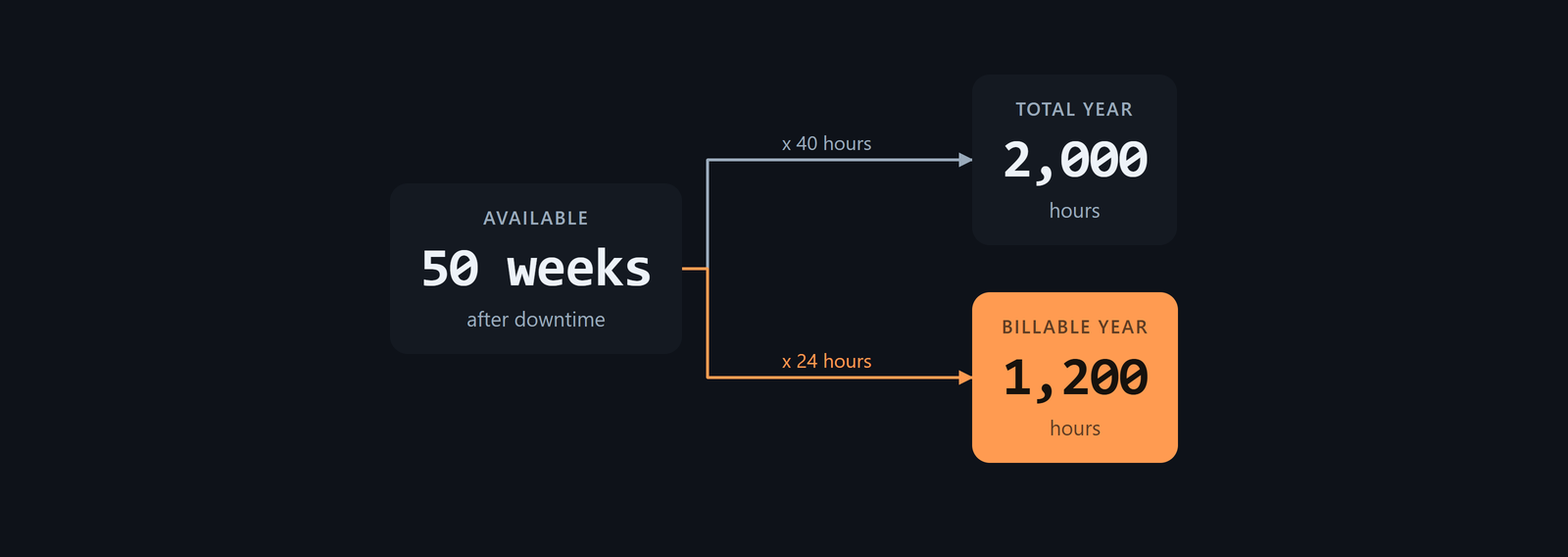
For an actual date range, the Business Days Calculator can replace the 50-week assumption. Enter Start date and End date, keep Mon, Tue, Wed, Thu, and Fri selected or change those controls, add dates under Holidays to exclude, and click Calculate business days. The tool removes only the holidays entered there.
If the schedule needs weekday settings, shift rows, breaks, or weekly grouping, the Date and Work Time Calculator has Business Days and Work Hours & Timesheet modes.
What is a realistic billable-hours target for freelancers and agencies?
Three chosen freelancer planning scenarios
A realistic target comes from the available schedule and the non-billable work it must carry. This comparison uses the same 2,000 total working hours. The labels show planning pressure, not universal freelancer or agency benchmarks.
| Planning scenario | Utilization | Total working hours | Billable hours |
|---|---|---|---|
| Conservative | 50% | 2,000 | 1,000 |
| Baseline | 60% | 2,000 | 1,200 |
| Aggressive | 70% | 2,000 | 1,400 |
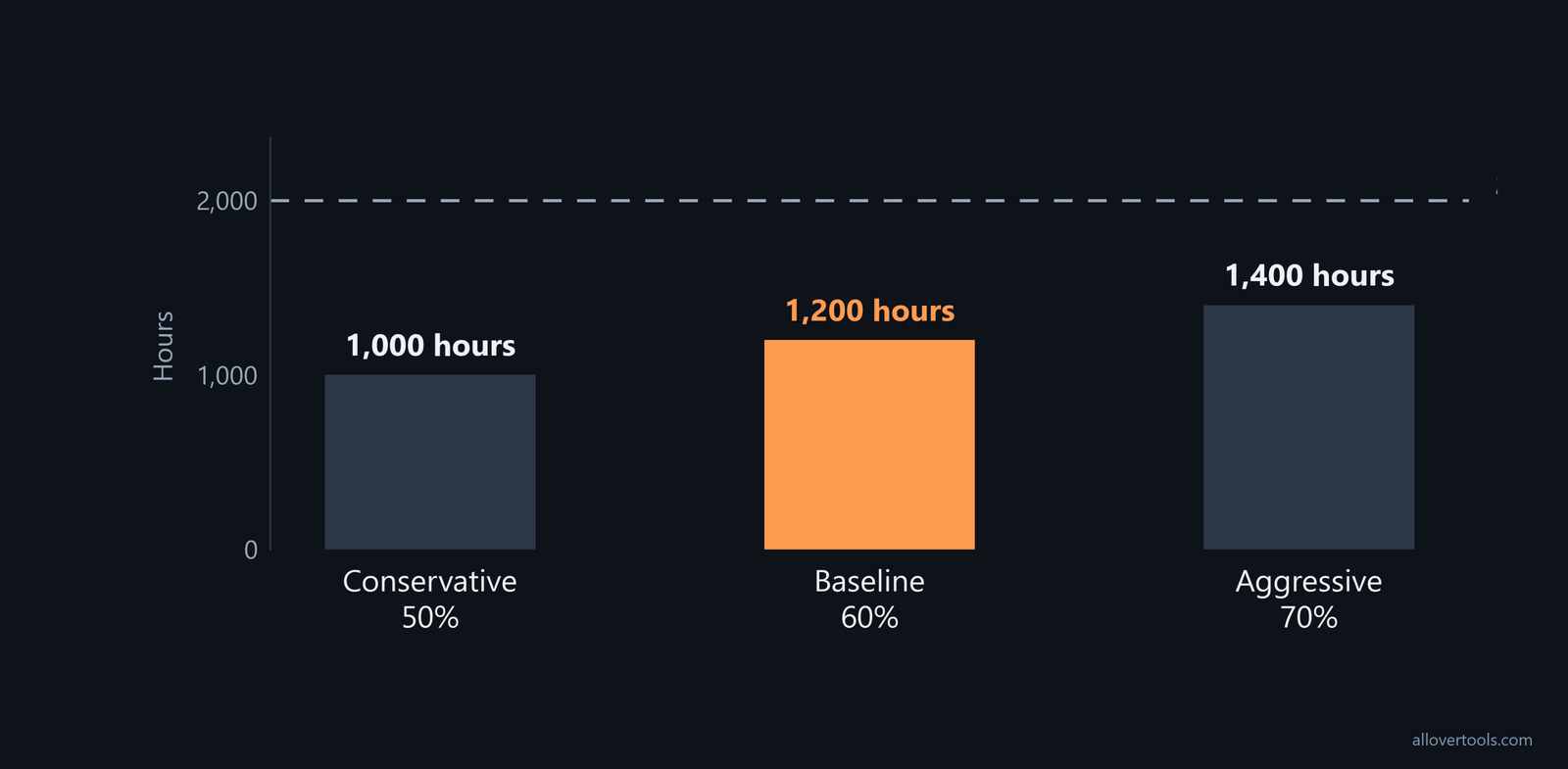
Replace these percentages with tracked capacity. Lower the target when the schedule has recurring gaps, seasonal work, proposal-heavy periods, or a large internal workload.
Keep production targets within a sustainable band. Agency guidance puts 70–80% billable utilization in the generally healthy range for direct production roles. Above 80–85% raises burnout and quality risk; below about 65% can indicate over-staffing against the current pipeline. Project management and account roles typically run at 60–70%, and agency leadership at 40–60%. Put the utilization guardrails in the role-level plan.
Why an agency needs role-level capacity planning
An agency team target is the sum of each role's billable capacity. It is not headcount multiplied by a freelancer's utilization assumption. In the delivery-role example, 48 working weeks at 35 hours gives 1,680 total hours for one person. At 60% utilization, that becomes 1,008 billable hours. Other roles may spend more or less time on internal work.
Keep internal review, management, sales, training, hiring, bench time, and coordination visible. Add delivery hours only after those duties have been included in each role's schedule.
Give each agency role its own target. BenchPress 2023 data on independent UK agencies puts firm-wide utilization around 65%, junior production staff near 75%, and directors around 33%. The role benchmark reflects the time leadership spends on management, sales, and strategy.
Consulting targets also vary by seniority. Use these as role checks, not one percentage for the whole team:
| Role | Typical utilization target |
|---|---|
| Junior consultants/analysts | 80–90% |
| Mid-level consultants | 75–85% |
| Senior consultants/architects | 65–80% |
| Practice leaders/managers | 50–70% |
| Partners/executives | 30–50% |
The seniority benchmark explains why an 80% target means more billable hours for a junior consultant than for a partner whose work includes sales, relationships, and firm management.
Define the categories before comparing firms. Billing 32 hours out of a 40-hour week equals 80% only when those 32 hours meet the firm's billable rules. Approved client work can include analysis, meetings, interviews, research, project management, workshops, slide development, and implementation support charged to an engagement code. Document whether travel, internal meetings, project management, approved PTO, and other categories count as billable or available under the firm's definitions.
How do annual billable hours change your hourly rate?
The formula that connects capacity and rate
The rate calculation is:
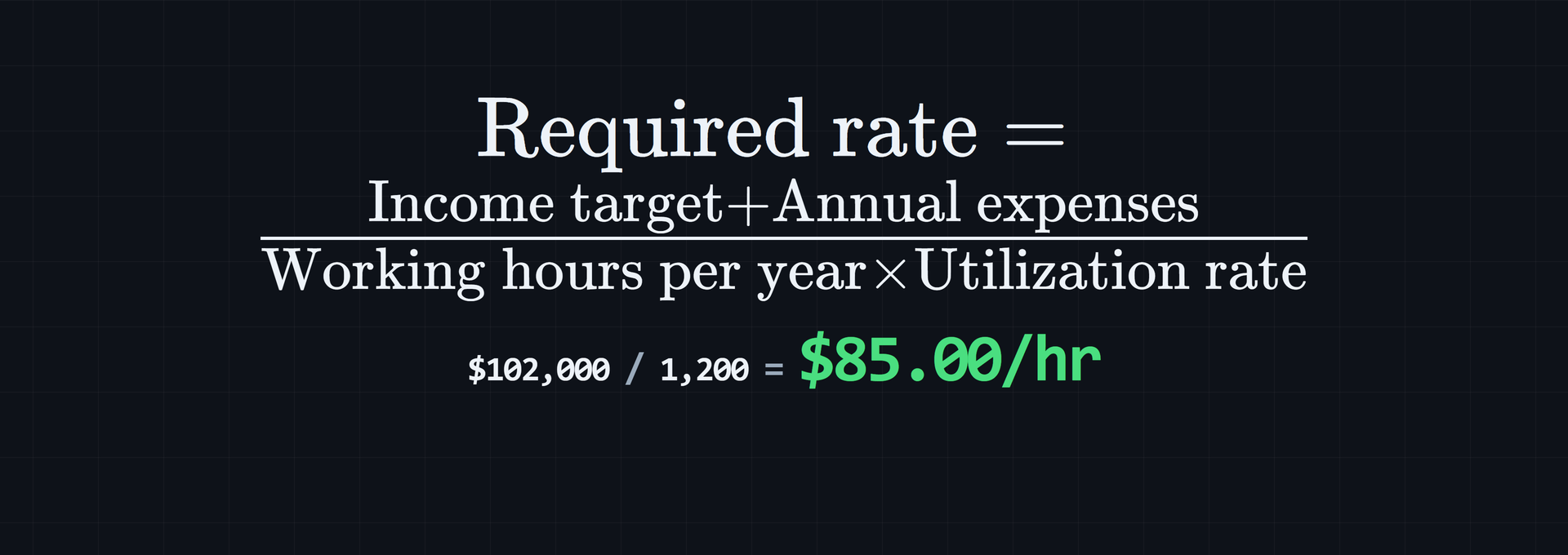
Required rate = (Income target + Annual expenses)
                / (Working hours per year x Utilization rate)
Income target is the yearly amount to earn before business expenses. Annual business expenses are the overhead amount. Total working hours per year includes billable and non-billable time. Utilization rate is the share of those hours that can be billed.
For a freelancer, the numerator may need to cover more than income and ordinary overhead. Use target income plus overhead, a substitute for employee benefits, and a tax reserve, then divide by billable hours. Planning around 1,200–1,500 billable hours leaves room for sales, proposals, bookkeeping, training, sick days, and unpaid time off; apply the complete rate formula before deciding that a low calculated rate is affordable.
With a $90,000 annual income target, $12,000 in annual business expenses, 2,000 total working hours, and 60% utilization:
$90,000 + $12,000 = $102,000 total revenue required
2,000 x 0.60 = 1,200 billable hours
$102,000 / 1,200 = $85.00/hr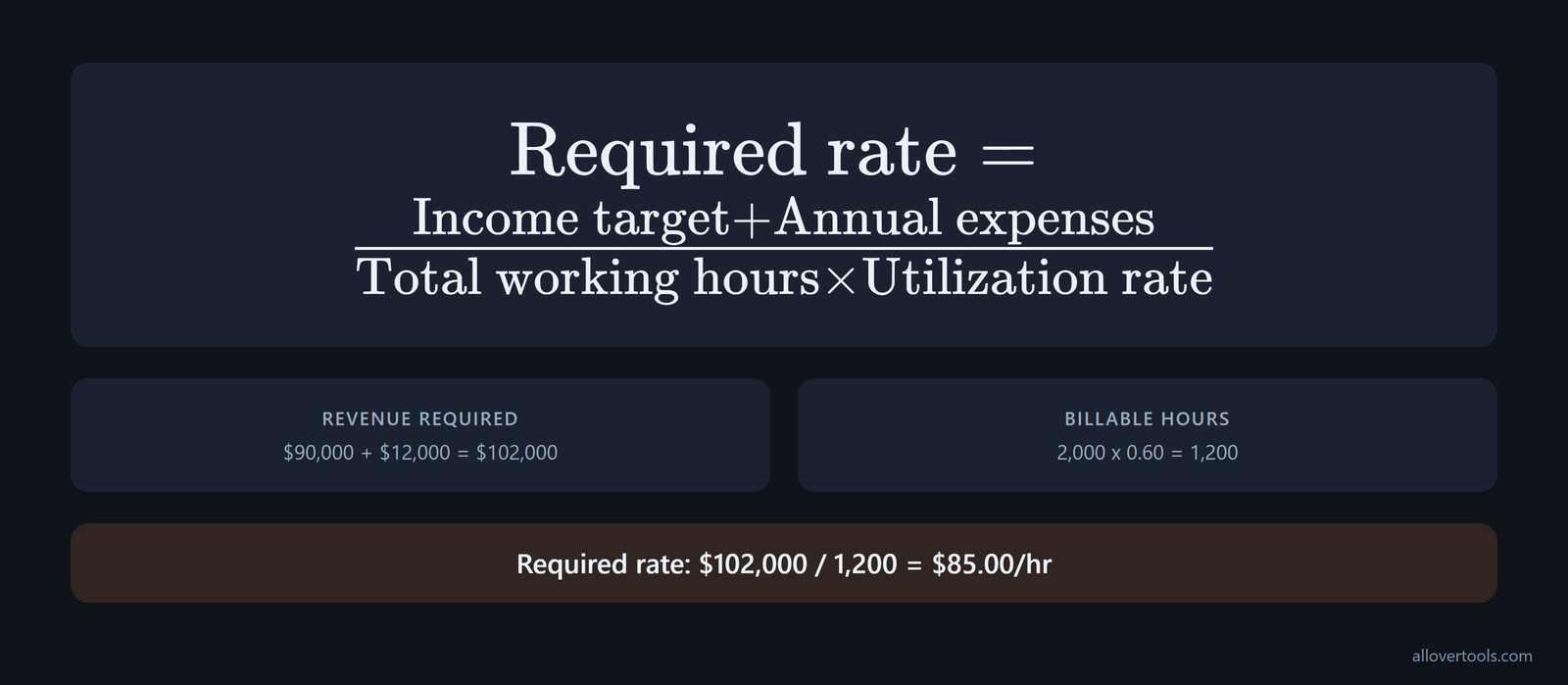
In the Billable Hourly Rate Calculator, enter Annual income target, Annual business expenses, Total working hours per year, and Utilization rate (%), then select Calculate rate. The result includes Required billable hourly rate, Billable hours per year, Total revenue required per year, the formula, and an assumptions table.
Conservative versus aggressive rate scenarios
With $102,000 in revenue required, the results are:
| Utilization | Billable hours | Required hourly rate |
|---|---|---|
| 50% | 2,000 x 0.50 = 1,000 | $102,000 / 1,000 = $102.00/hr |
| 60% | 2,000 x 0.60 = 1,200 | $102,000 / 1,200 = $85.00/hr |
| 70% | 2,000 x 0.70 = 1,400 | $102,000 / 1,400 = $72.86/hr |
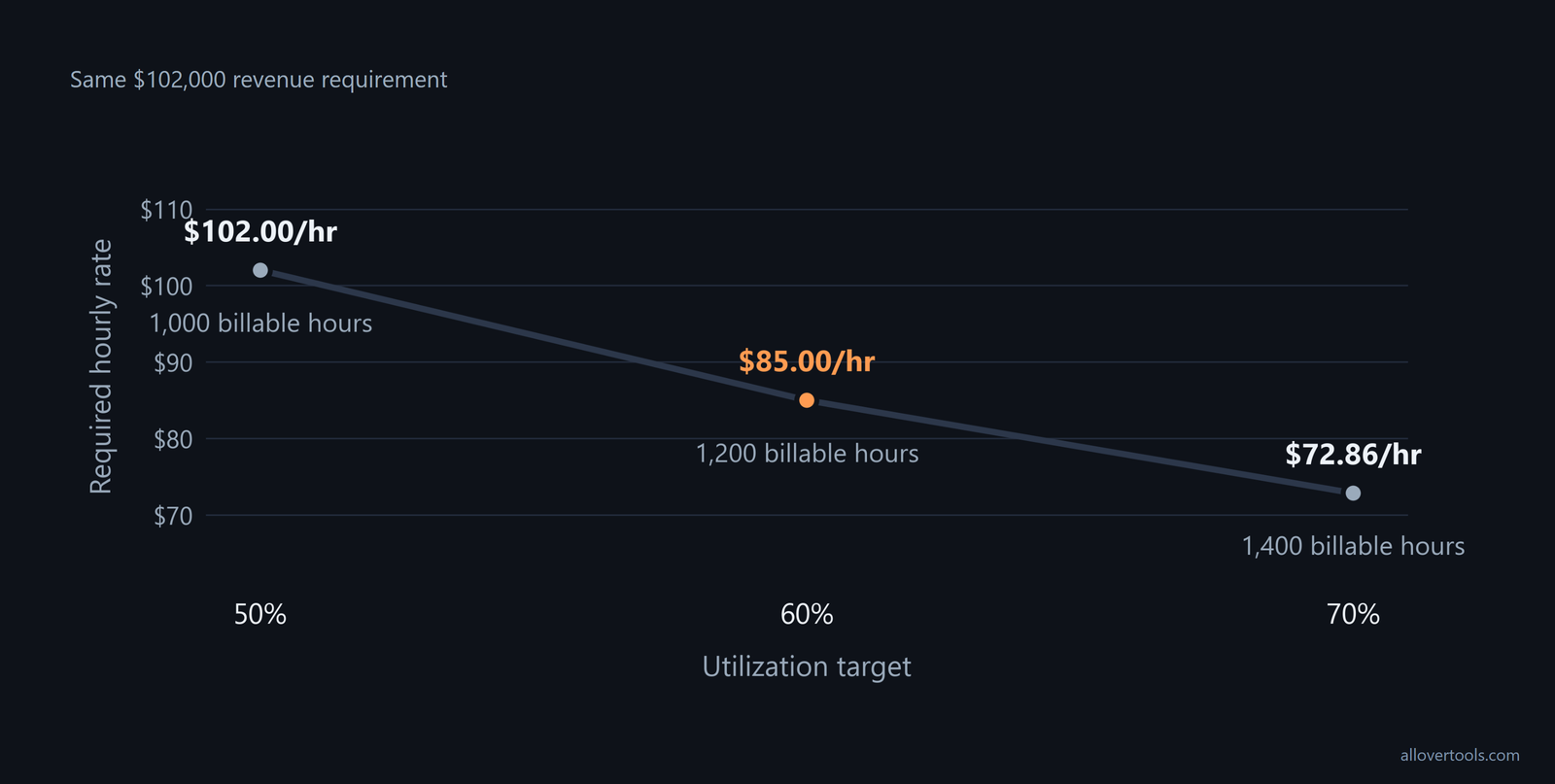
A higher utilization lowers the required rate only if the higher billable-hours target is achieved. The 70% result depends on delivering 1,400 billable hours while still covering non-billable work and downtime. The calculator uses entered values only. Its code has no fetch, XMLHttpRequest, sendBeacon, or form post carrying visitor inputs, so the entered content stays in the browser. Copy result, Download result (.txt), and Reset are local result actions.
High utilization does not guarantee high realized revenue. Most agencies run at 55–65% utilization. The best-run agencies reach 70–80% and keep realization above 85%. Realization measures how much scheduled or billed time becomes recognized revenue after write-downs and discounts. Pair the billable-hours target with a realization target in an agency rate plan, using these agency benchmarks.
How can you avoid an overoptimistic billable-hours target?
Capacity checks before you commit to a target
Check the plan in this order:
- Count the actual work weeks available.
- Reserve planned vacation and downtime.
- List the recurring non-billable categories and their weekly allocation.
- Model duties specific to each agency role.
- Estimate utilization from recorded work rather than a desired percentage.
- Keep a visible buffer for gaps, rework, illness, sales cycles, and unexpected internal work.
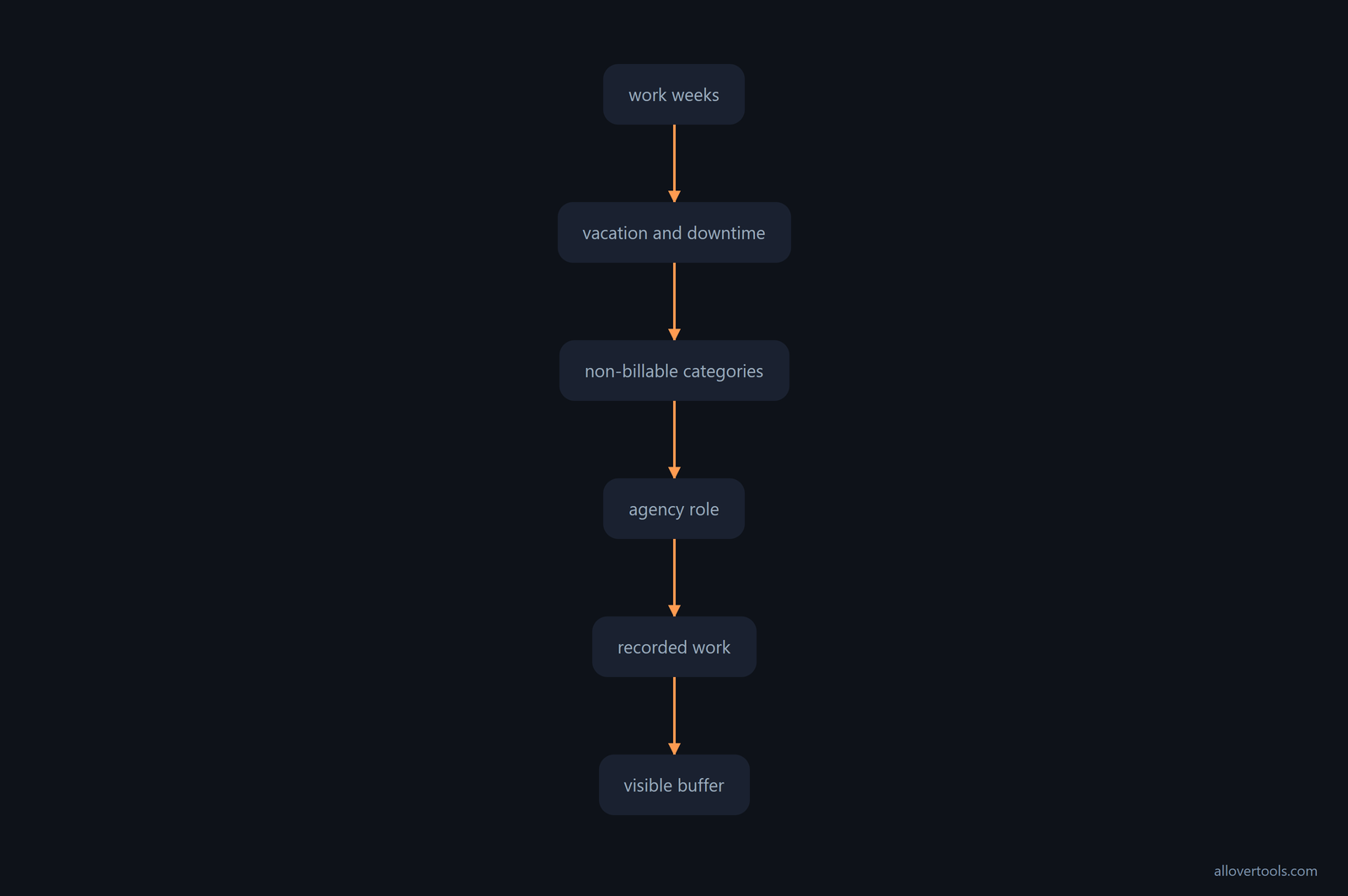
Lower the target when the schedule cannot show where the billable hours will come from. Keep the buffer visible instead of folding it into a utilization number that hides the gaps.
Check time capture separately from capacity. A standard consulting assumption is that 10–15% of billable hours can be lost to unrecorded or unbilled preparation, follow-ups, short interactions, and other small pieces of client work. For a firm with $10 million in annual revenue, recovering that 10–15% is roughly $1–$1.5 million in annual revenue without adding consultant time. Review timesheets before raising the utilization target; use the leakage estimate as a capture check.
Mistakes that inflate annual billable hours
- Using 52 x 40 as billable capacity. Remove vacation and downtime first. Then separate billable delivery from the rest of the week.
- Setting utilization at 100%. Admin, sales, learning, coordination, and buffer time still take hours.
- Counting proposals and admin as client hours. Keep work that wins or supports projects in the non-billable allocation unless it is invoiced.
- Applying one freelancer target to every agency role. Model delivery roles separately because their internal duties are different.
- Budgeting from the best month. Use a period that includes ordinary gaps, seasonal work, and proposal-heavy periods.
This plan estimates capacity and the required rate. It does not predict demand, unpaid invoices, taxes, seasonal sales, or whether a client will accept the rate. Compare planned and actual billable hours, revise the next period's target, and keep the conservative and aggressive scenarios separate.
Frequently asked questions
How many billable hours per year should a freelancer plan for?
There is no universal target. Start with available working hours after downtime, then apply a utilization assumption that includes non-billable work. In this example, 2,000 total hours at 60% gives 1,200 billable hours.
What is the difference between working hours and billable hours?
Working hours cover every hour spent running the work. Billable hours are only the hours that can be invoiced to a client. With 2,000 working hours and 60% utilization, the example has 1,200 billable hours and 800 non-billable hours.
How do vacation and downtime affect annual billable hours?
Remove planned vacation and downtime from the available weeks before applying utilization. This schedule subtracts 2 weeks from 52, leaving 50 working weeks and 2,000 total hours at 40 hours per week.
Why does a lower billable-hours target require a higher hourly rate?
The same income target and expenses are divided across fewer billable hours, so the required rate rises. In these scenarios, 50% utilization requires $102.00/hr versus $72.86/hr at 70%.
Should an agency use one utilization target for every employee?
No. Model delivery roles separately because sales, management, coordination, training, and bench time affect each role's billable capacity. Add role-level billable hours only after those non-billable duties are represented.