The choice between hourly vs fixed price contracts depends on how clear the scope is, who pays for extra hours, and how the work will be checked. Hourly billing charges for approved time at a stated rate. Fixed-price billing charges one fee for an agreed deliverable. The right choice follows the uncertainty in the work and the acceptance rules.
Hourly vs fixed-price contracts: what changes
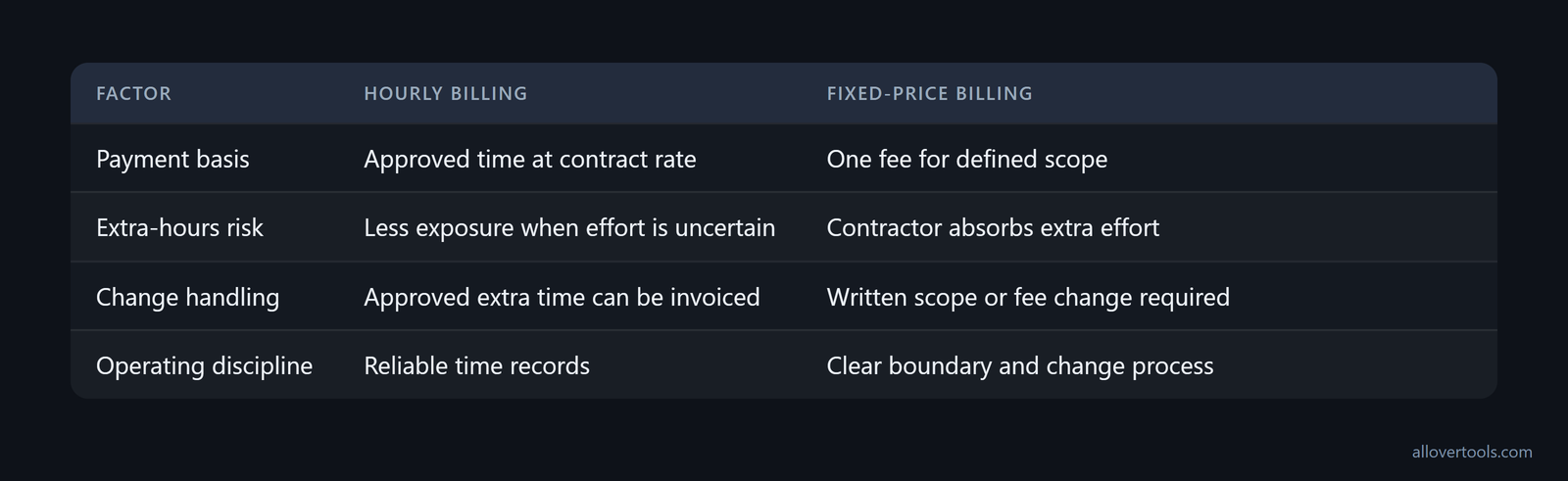
With hourly billing, the client pays for approved time at the contract rate. Invoices follow the time record, either for a period or a milestone. The contractor has less exposure when the effort is uncertain, but must keep clear records and follow any cap or approval rule.
With fixed-price billing, the client pays one fee for a defined deliverable or scope. The invoice can follow delivery or milestones instead of hours. The client knows the fee in advance. If the work takes longer than expected, the contractor absorbs the extra effort unless the scope or fee changes.
Changing requirements show the difference quickly. In an hourly contract, approved extra time can be invoiced when the agreement explains the approval process. In a fixed-price contract, a new request needs a written scope or fee change. If the work starts without one, the original fee remains and the effective rate drops.
This freelance contract types comparison comes down to a tradeoff. Hourly billing covers uncertain effort but needs reliable time records. Fixed price makes the fee predictable but depends on a clear boundary and a workable change process. Choose according to the uncertainty of the work and the quality of its acceptance criteria.
How to calculate the effective hourly rate of a fixed fee
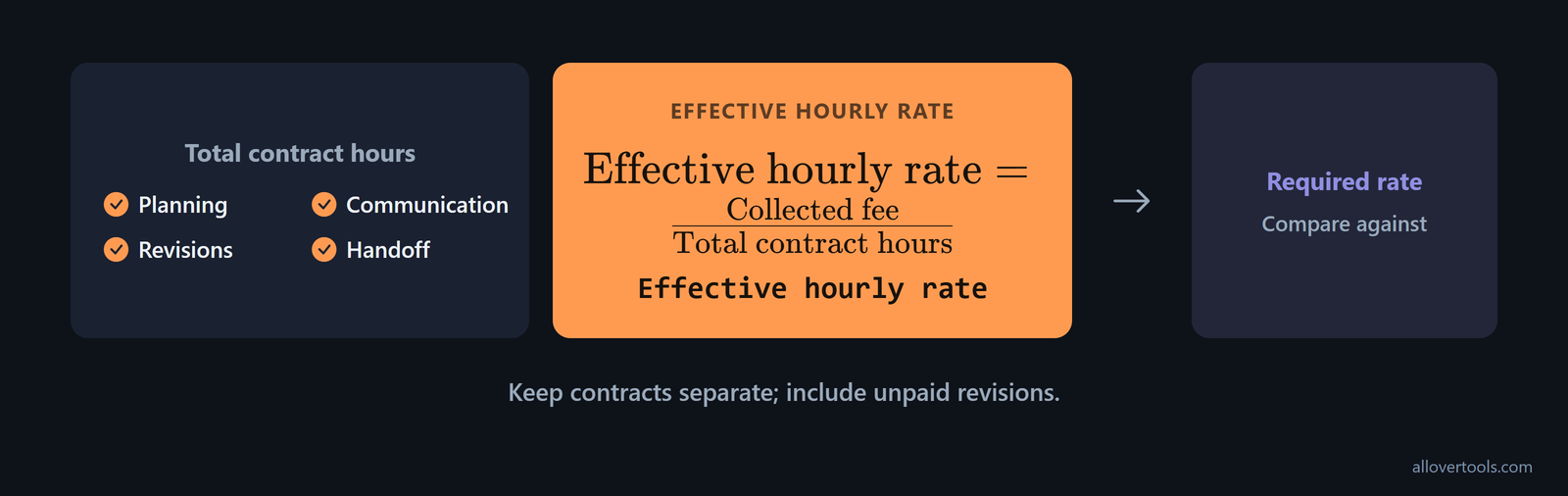
To convert a fixed fee to an effective hourly rate, use Effective hourly rate = fixed fee ÷ actual hours worked. Actual hours include delivery, communication, revisions, project management, and handoff when the contract required them. Quoted hours are an estimate. They do not set the rate the completed contract produced.
The fixed-fee calculation
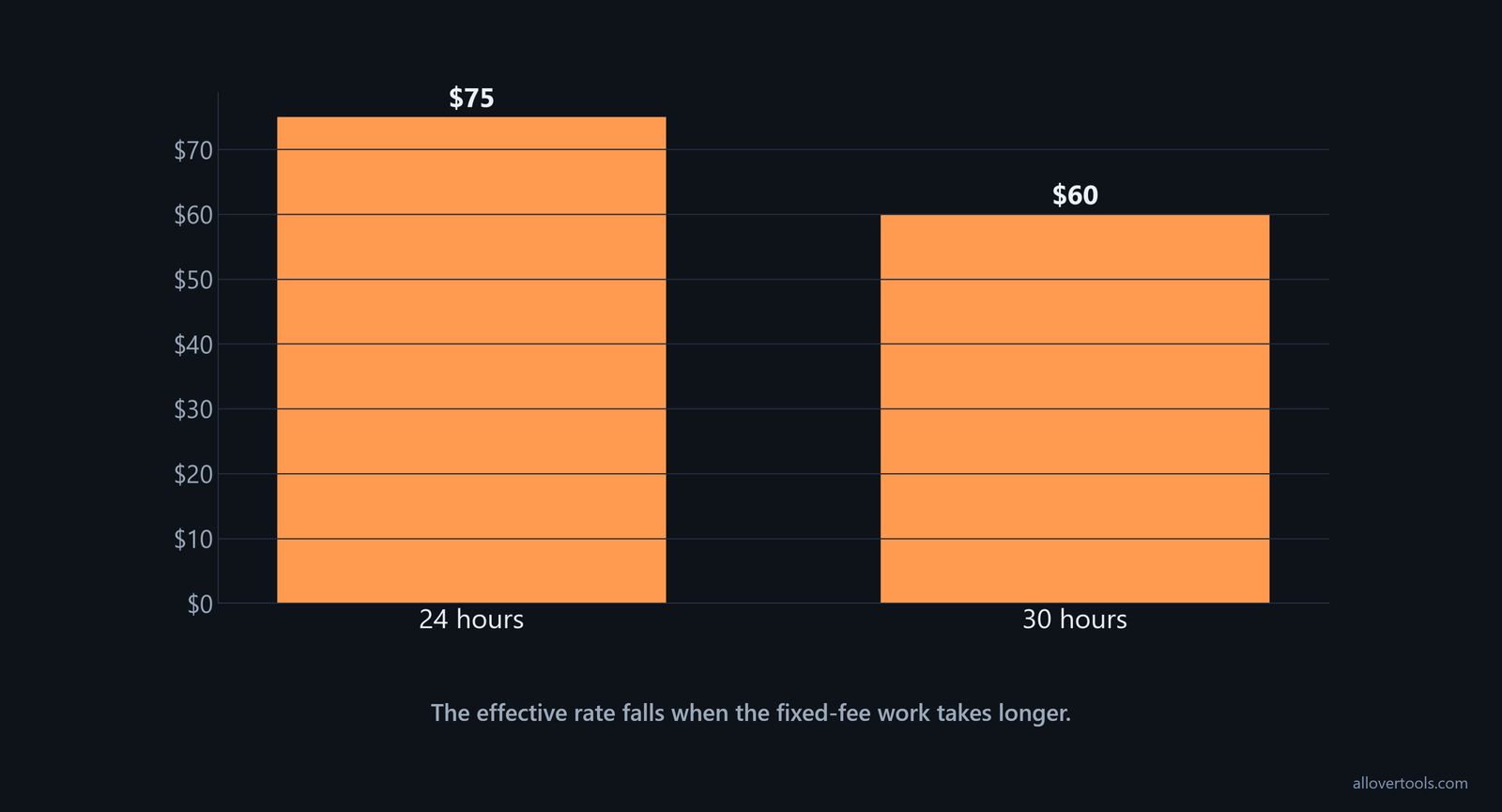
Start with the actual time spent on the contract. A fixed fee of $1,800 divided by 24 hours gives $75 per hour:
$1,800 ÷ 24 hours = $75 per hourIf the same scope takes 30 hours, the result is lower:
$1,800 ÷ 30 hours = $60 per hourThe second figure is the rate the finished contract produced. Include meetings, messages, revisions, coordination, and handoff when the work required them. Leaving out that time makes the result look better than it was.
Use a required rate as a floor for planning
For a planning floor, open the Billable Hourly Rate Calculator. Enter Annual income target of $60,000, Annual business expenses of $12,000, Total working hours per year of 2,000, and Utilization rate (%) of 60%. Then select Calculate rate.
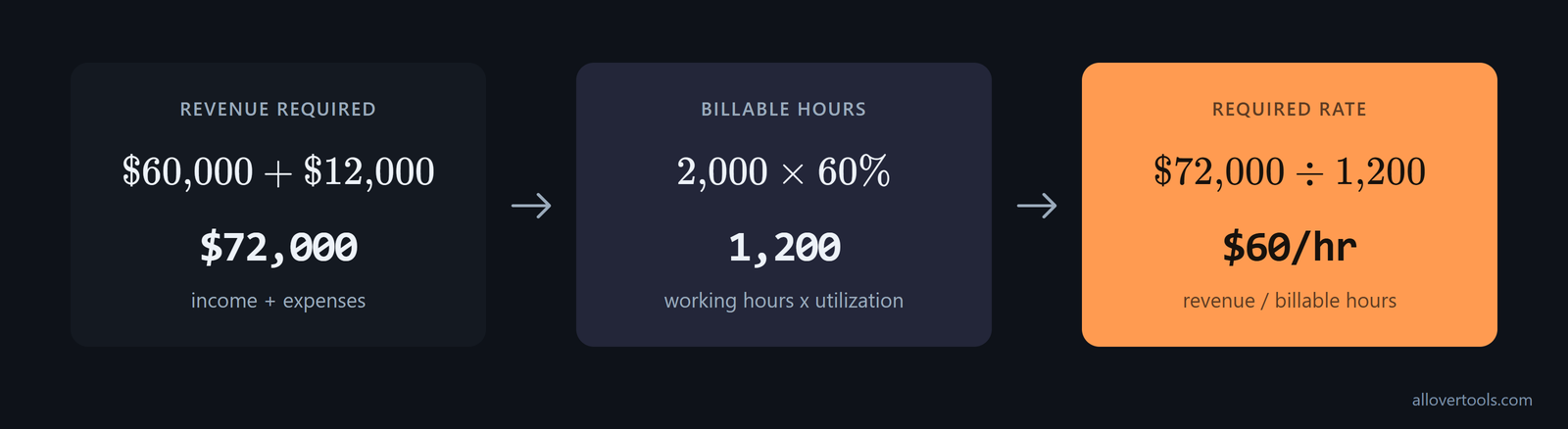
$60,000 + $12,000 = $72,000 total revenue required
2,000 hours × 60% = 1,200 billable hours
$72,000 ÷ 1,200 = $60 required billable hourly rate
The result reports Required billable hourly rate and Billable hours per year. It is a calculation from the entered values, not a market comparison or a promise about future work. The supplied source calculates in the browser and contains no fetch, XMLHttpRequest, sendBeacon, or form submission.
How scope and change requests affect the contract
Scope control is a written boundary around the work. It should say what will be delivered, what is excluded, which assumptions apply, how acceptance works, how many revision rounds are included, what the client must provide, and when the work is complete.
What belongs in a scope boundary
- Deliverables: name the files, outputs, or services to hand over.
- Exclusions: record related work that the fee does not cover.
- Assumptions: state the client inputs, access, formats, or decisions the estimate depends on.
- Acceptance criteria: define the condition that makes the deliverable accepted.
- Revision limits: state the included rounds and what counts as a new request.
- Client inputs and definition of done: set response responsibilities and the point where handoff is complete.
These details keep required hours visible. A vague brief treated as fixed scope, unlimited revisions, forgotten meetings and support, or work that continues after acceptance can all lower the actual rate.

A change request that does not erode the rate
- Record the requested change in the contract log.
- Check whether it changes the deliverable, the effort, or both.
- Estimate the added hours or fixed fee.
- Get approval before starting the extra work.
- Update the remaining scope and deadline.
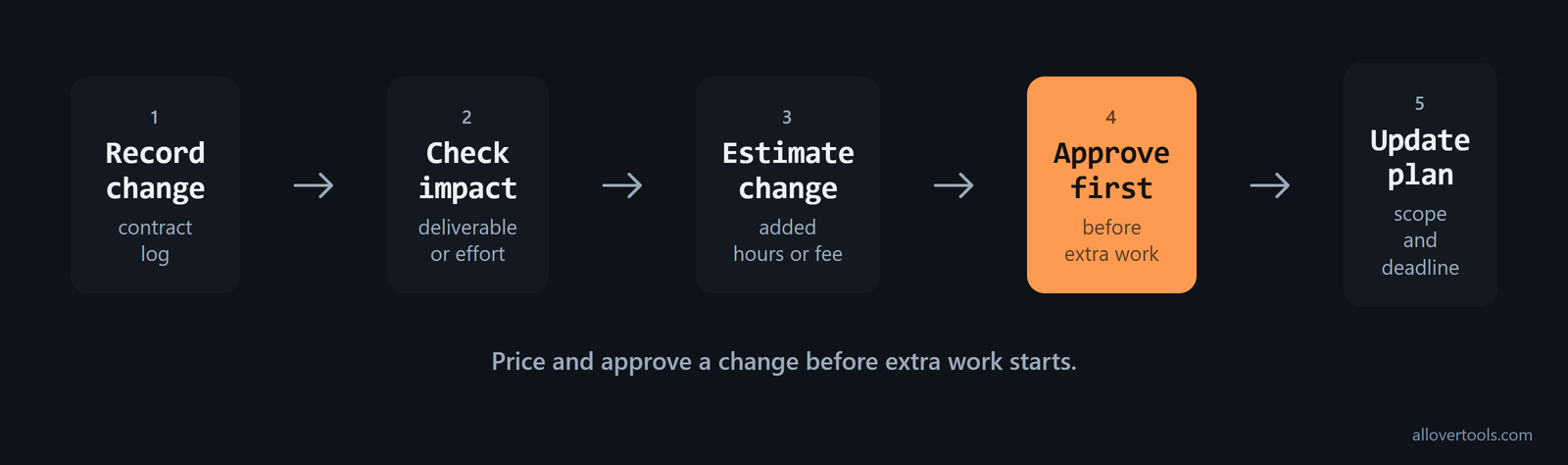
For hourly work, approved extra time can be invoiced, but the client still needs a cap, reporting schedule, or approval rule. For fixed price, the original fee covers the agreed scope; the new request becomes a written fee or scope change. Starting before approval, or continuing after acceptance, shifts the cost to the contractor.
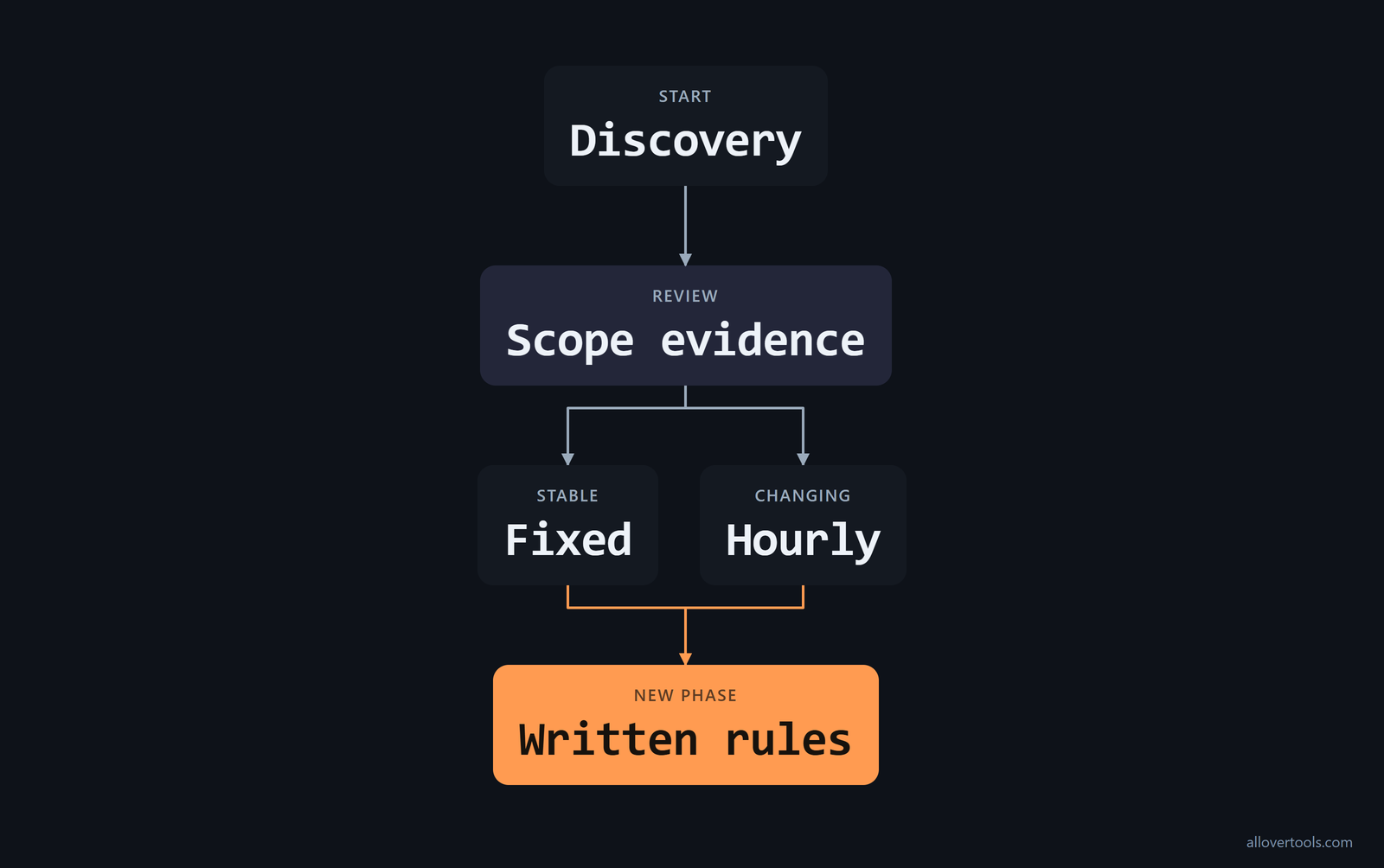
The project scope and pricing model can change by phase. Write a hybrid transition as a new discovery or delivery phase instead of treating it as an exception to the original agreement.
Which contract model fits each project type?
Project type affects how much uncertainty the contract must absorb. A repeatable, specified deliverable can support fixed price. Discovery, troubleshooting, advisory work, or work controlled by client inputs usually needs hourly approval or a capped-time arrangement. That distinction helps determine whether to choose hourly or fixed fee.
A defined deliverable with a fixed fee
Consider a defined deliverable posted through an online freelance platform. The fee is $1,800, the agreed work is 24 hours, the acceptance criteria are clear, and revisions are limited. Fixed price works here because both sides can identify what the fee covers and what counts as delivery. The payment stays predictable only while that boundary holds.
Changing requirements in direct client work
Direct client work may begin with discovery, change as requirements become clearer, and continue through feedback. Hourly billing keeps approval tied to the time the changing scope requires. A phased or hybrid structure fits when discovery must define a later fixed deliverable: price the discovery phase, record what it establishes, and write the next phase separately.
Test the fixed-fee scenario against extra hours
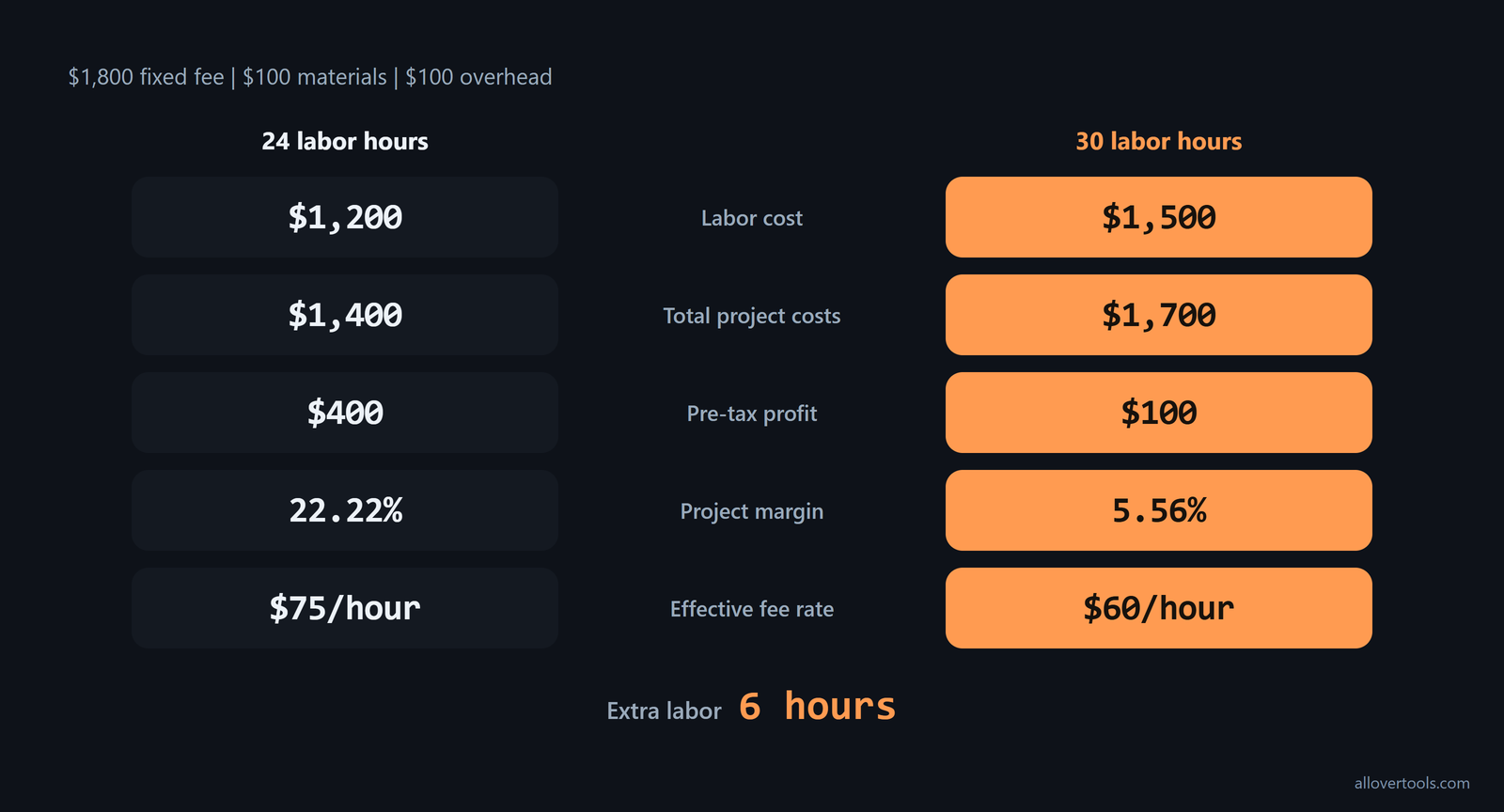
For the fixed-fee scenario, open the Project Profit Calculator. Enter Project revenue $1,800, Materials / direct costs $100, Allocated overhead $100, Labor hours 24, Labor rate per hour $50, leave Estimated tax rate % (optional) blank, and select Calculate project profit.
24 × $50 = $1,200 labor cost
$100 + $1,200 + $100 = $1,400 total project costs
$1,800 − $1,400 = $400 pre-tax/project profit
$400 ÷ $1,800 × 100 = 22.22% project margin
Run the same scenario with 30 labor hours:
30 × $50 = $1,500 labor cost
$100 + $1,500 + $100 = $1,700 total project costs
$1,800 − $1,700 = $100 profit
$100 ÷ $1,800 × 100 = 5.56% project margin
$1,800 ÷ 30 = $60 effective fee rate
The fee stays at $1,800. Six extra hours reduce the profit, margin, and effective fee rate.
How to track effective rates and change models
A simple contract-rate review record
Keep a separate review record for each engagement. Record the agreed fee or hourly rate, approved scope, estimated hours, actual delivery hours, meetings, messages, revisions, waiting or coordination time absorbed by the contractor, amount invoiced, amount collected, and effective hourly rate.
Use collected fee ÷ total contract hours. Compare the result with the required rate from the Billable Hourly Rate Calculator. Count every hour the contract consumed, including planning, communication, revisions, and handoff. Keep contracts separate, include unpaid revisions, and do not compare a gross fee with a net target.
For work recorded with start and end timestamps, open the Time Duration Calculator. Select Between two date-times, enter Start date, Start time, End date, End time, and Time zone, then select Calculate elapsed duration. Use its Total hours (decimal) output in the contract log.
The time tool uses browser time-zone data and the entered values. The review becomes unreliable when hours from different contracts are mixed, waiting time is ignored, or the model changes without new scope and approval rules.
When a relationship justifies a different model
Start with hourly discovery or a small fixed phase. Record where the estimate differed from the work, then propose a later fixed phase when the deliverable and change rules are clear. A stable recurring need can move from fixed deliverables to hourly or capped time when requests keep changing. Base the decision on observed scope stability and written approval rules.
Frequently asked questions
How do I convert a fixed fee to an hourly rate?
Divide the fixed fee by all hours the contract required, including production, communication, revisions, and handoff. In the example, $1,800 ÷ 24 = $75, while $1,800 ÷ 30 = $60.
Should I choose hourly or fixed price for a new project?
Use fixed price when deliverables and acceptance criteria are clear. Use hourly billing when discovery, client inputs, or changing requirements make the effort uncertain. The scope boundary and approval rules determine which model will work.
Can I switch from fixed price to hourly billing?
Yes. Set a documented change point, record completed and remaining scope, and agree the new rate, cap, or estimate before continuing. Treat the switch as a new phase instead of silently changing the original deal.
How do I track my effective hourly rate across contracts?
For each contract, divide the collected fee by total hours, including planning, communication, revisions, and handoff. Compare the result with the required billable rate, and keep each contract's scope and time basis separate.