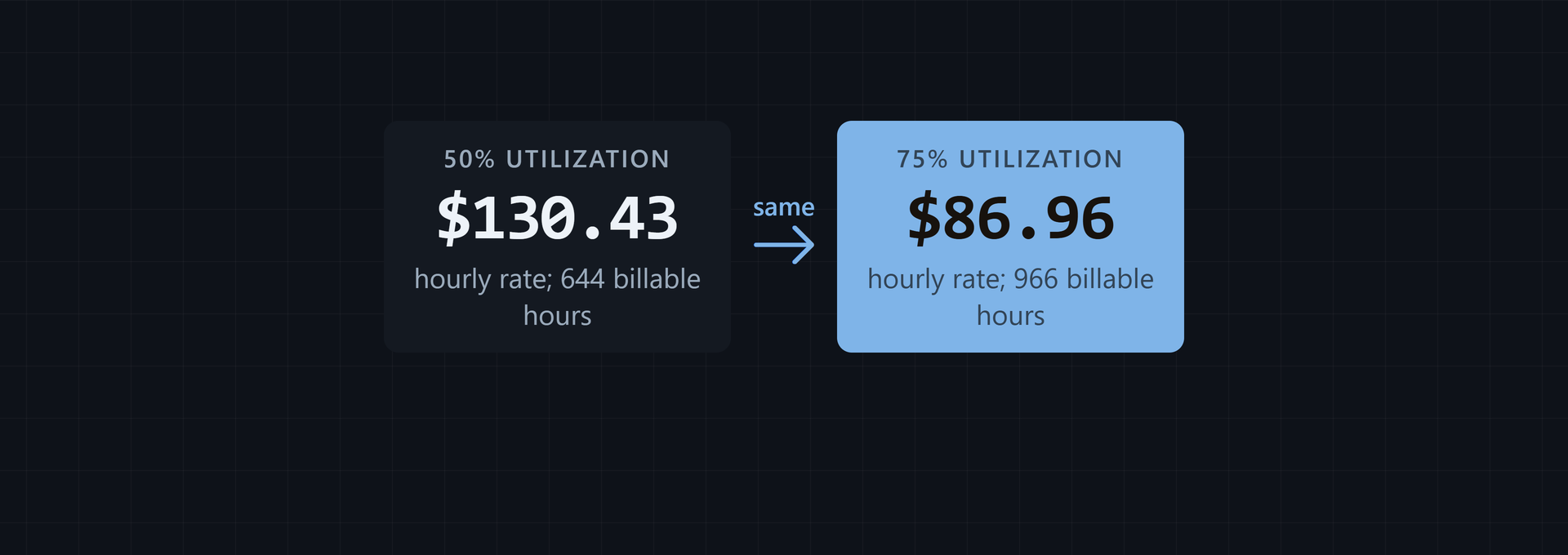
A retainer hourly equivalent shows what a recurring fee produces per hour. Divide the fee for the period by the hours the work is expected to take, then compare that figure with the hours actually used. The comparison can reveal a retainer whose scope or time demand needs review.
What is a retainer hourly equivalent?
A professional services retainer is a recurring fee for an agreed scope, access, availability, or block of work during a set period. The retainer hourly equivalent is an internal calculation: the fee divided by the hours the retainer is expected to consume. It is not automatically the price shown to the client.
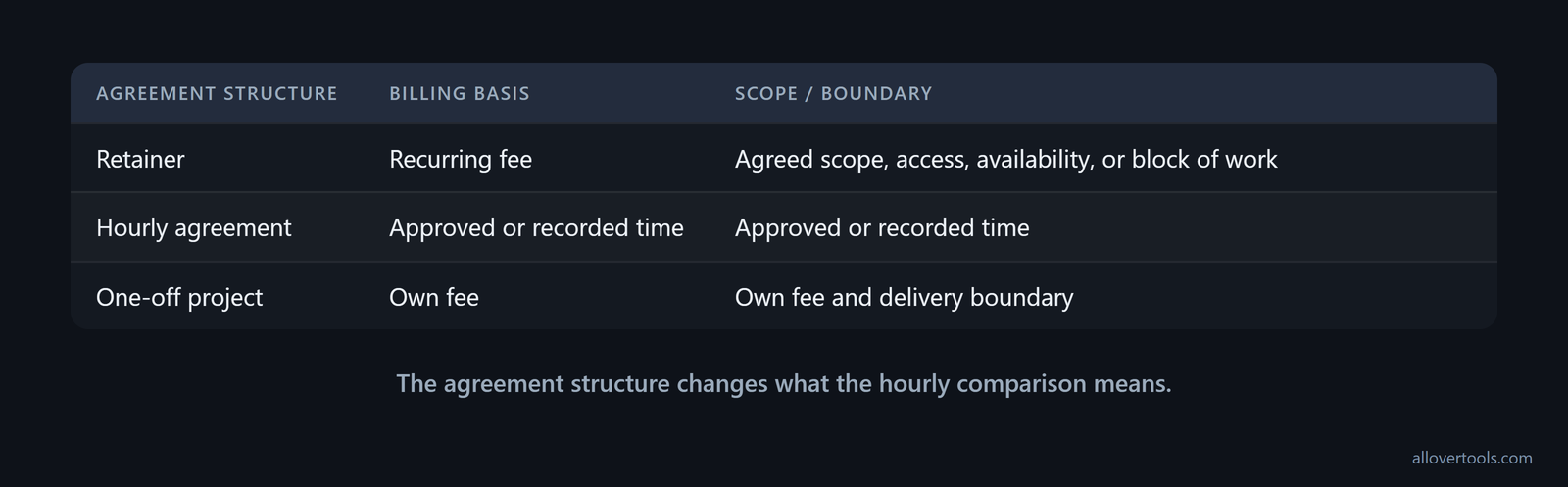
An hourly agreement bills approved or recorded time. A retainer sets recurring terms, while a one-off project has its own fee and delivery boundary. Retainer vs hourly agreements are worth comparing when the scope or time pattern changes.
If the retainer pays for availability or deliverables instead of a fixed block of hours, the calculation still shows how much labor the fee supported. It does not describe the full contract value on its own, because the fee may also cover access, response obligations, or deliverables.
How to calculate a retainer hourly equivalent
Keep the fee and the hours on the same period. The formula is:
Implied hourly rate = Fee for the period / Expected billable hours in that period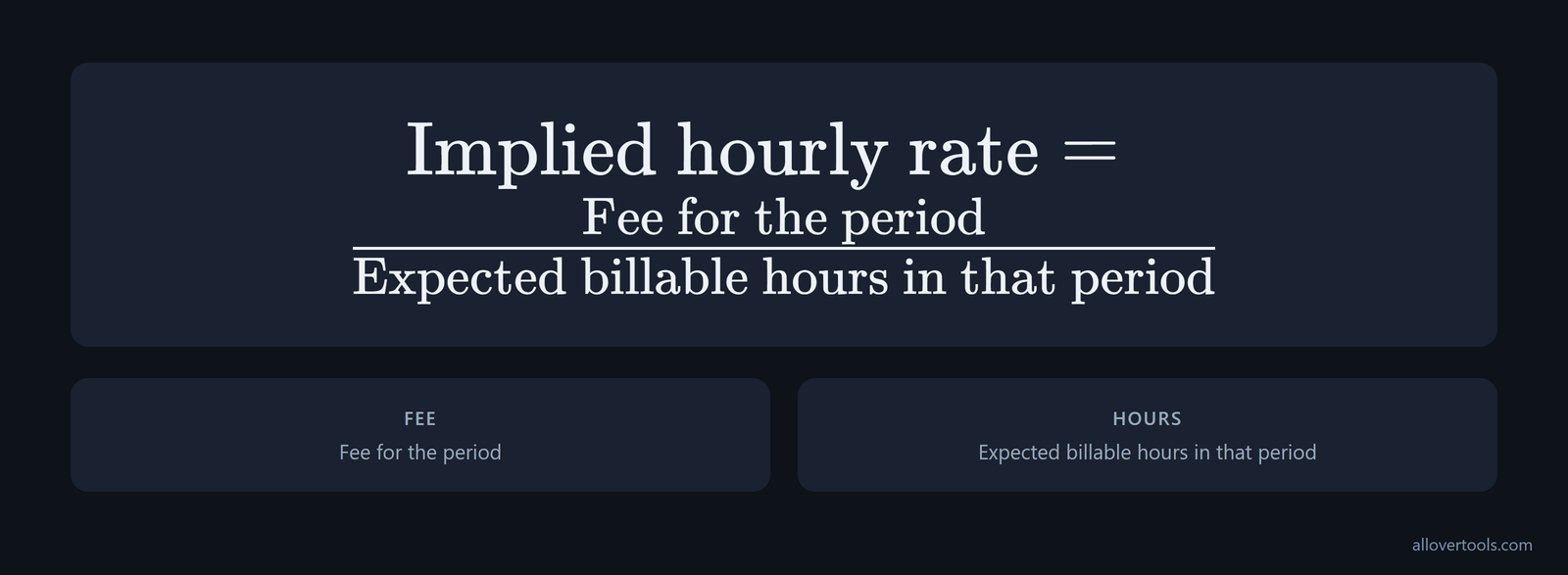
- Identify the fee period, such as monthly or quarterly.
- Determine the hours included or expected for that period.
- Divide the fee by the hours without rounding the intermediate value.
- Round only the displayed hourly rate.
Zero hours cannot provide a valid denominator. Undefined scope, unused-hour carryover, and work outside the included scope need contract rules instead of an invented hourly denominator. The agreement should say whether unused time expires or carries forward, and how extra work is approved.
For a separate required-rate check using income, expenses, total working hours, and utilization, use the Billable Hourly Rate Calculator alongside the retainer calculation.
Set a minimum retainer from cost and margin
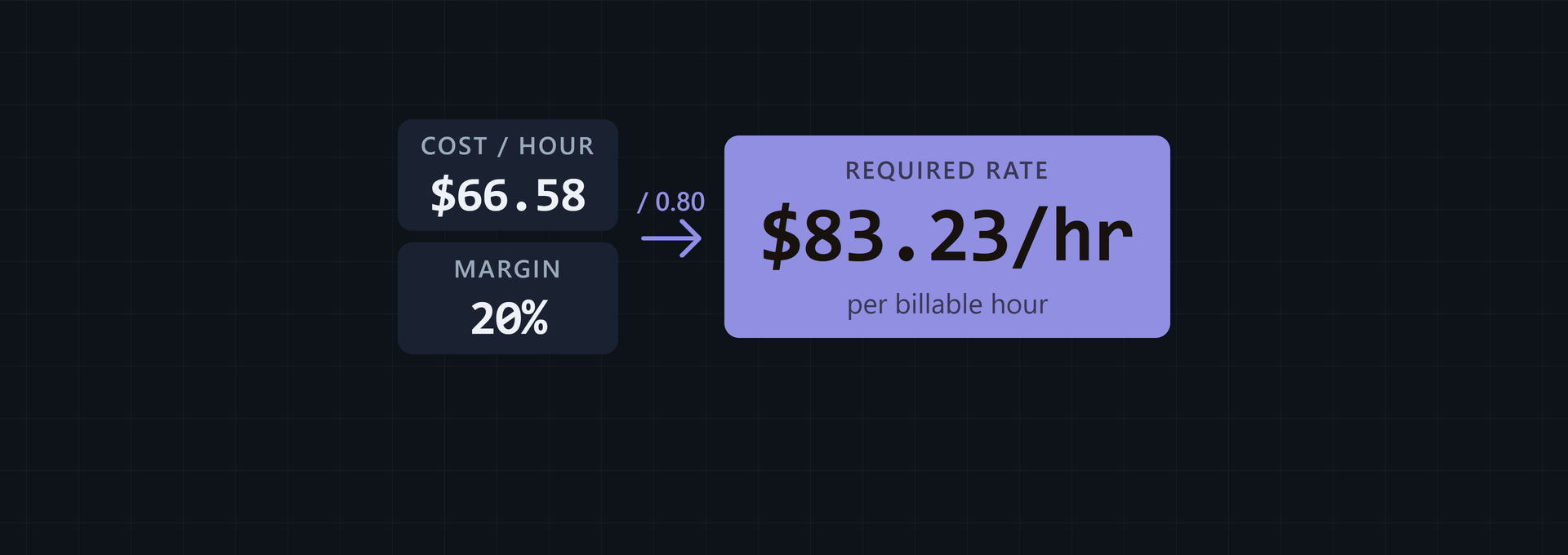
Set the minimum retainer from delivery cost and the target margin, not just from the fee divided by hours. The formula is (Monthly hours x Fully-loaded cost per hour) / (1 - Target margin) x (1 + Value premium), as this retainer formula shows. Check the agreed fee and the effective rate from logged time against that floor. It keeps the stated margin in place before you assess the effective hourly rate.
Apply the same cost-first calculation to the month as a whole. With monthly delivery costs of $1,200 and a target margin of 50%, the floor is $2,400: monthly delivery cost divided by 1 minus the target margin. Include task hours, client-specific tools, and contractors in monthly delivery cost. Follow the cost-first method before deciding whether the fee is viable.
Formula and chosen marketing example
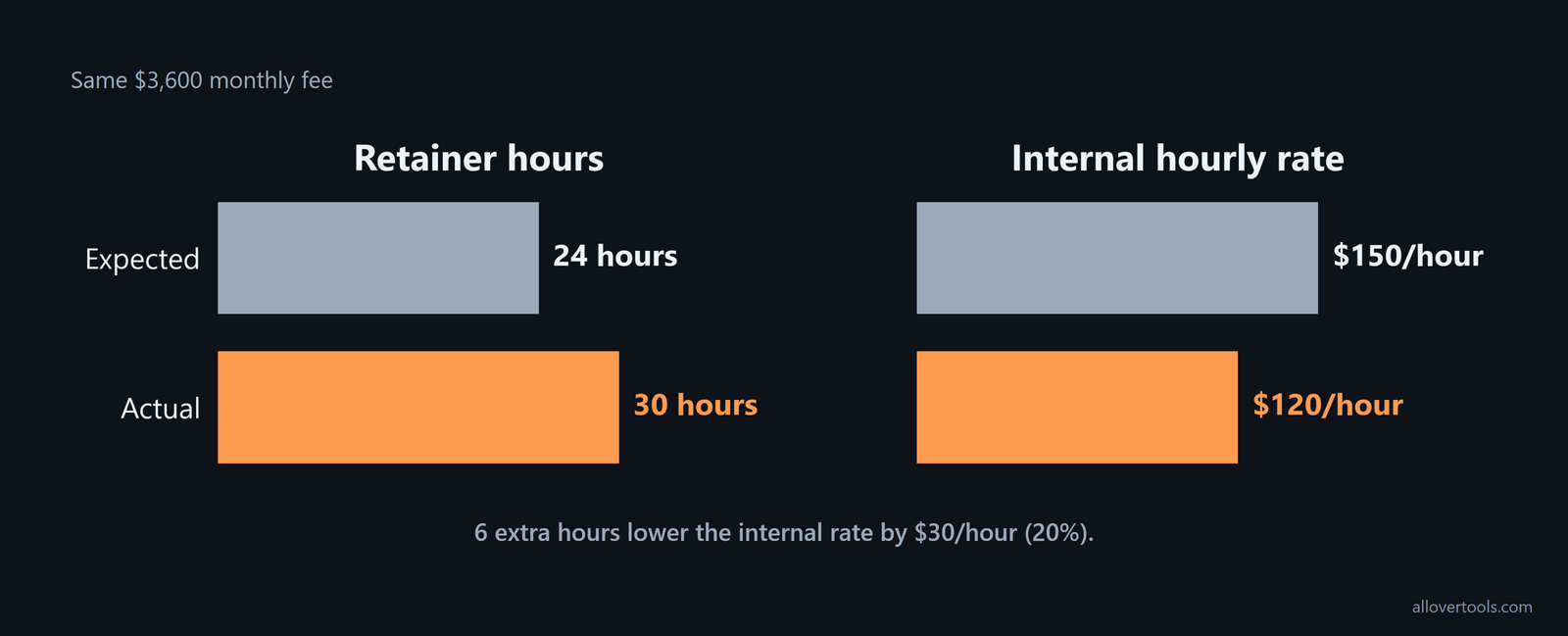
For illustration only, a marketing retainer has a monthly fee of $3,600 and expected hours of 24. These figures are not market pricing:
$3,600 / 24 hours = $150/hourIf the same fee takes 30 actual hours, recalculate it using the time recorded:
$3,600 / 30 hours = $120/hour
$150 - $120 = $30/hour lower
$30 / $150 x 100 = 20% lower
The six extra hours reduce the internal rate from $150 to $120 per hour. The client agreement may still use a fixed fee or deliverables. This calculation only shows what the fee produced against the time consumed.
The planned rate can be lower when the client commits to a retainer, even before the work runs over. One common agency formula multiplies the hourly rate by expected hours per month, then takes off 10% to 15% for the commitment. At $150 per hour for 20 hours, that is $3,000 before the discount and roughly $2,600 after it, as the agency pricing example illustrates. Recheck the discounted fee against actual hours; if the work takes longer than expected, the effective rate may fall below the internal floor.
How to compare expected and actual retainer hours
Track the agreement and the work over the same period. Record the scope and expected hours, log client work by task, include meetings and required account work when the agreement covers them, total the period, then divide the fee by the actual hours.
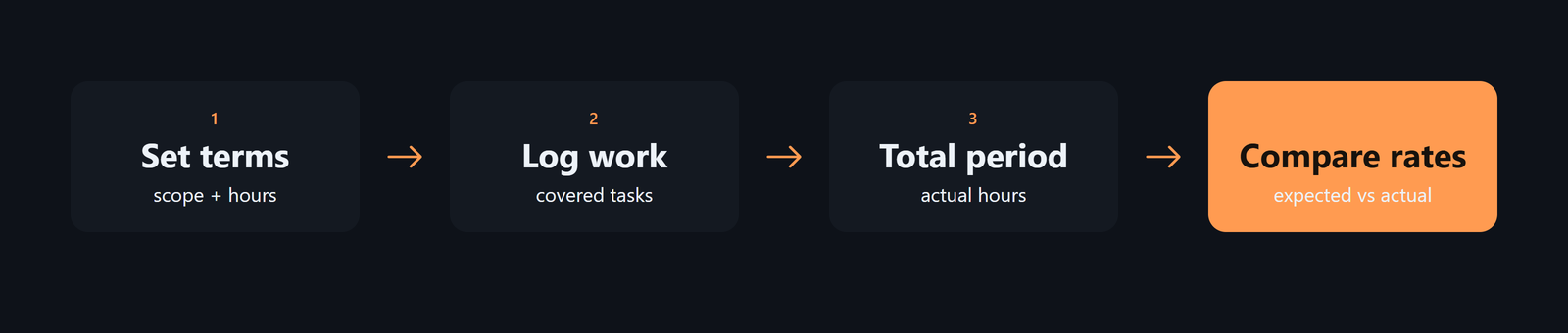
- Record the agreed fee, included work, expected hours, and period.
- Log each covered task, meeting, revision, message, and required account activity.
- Total the recorded hours when the period closes.
- Compare the fee divided by expected hours with the fee divided by actual hours.
Before you accept the planned hours, test the denominator. Retainers typically run 15% to 30% over scope. A 20-hour scope with a 20% buffer means 24 hours of work, so a $2,500 retainer works out to $2,500 / 24 = $104.17 per hour. That compares with $3,000 per month when the same 20 hours are billed at $150 per hour, according to this scope-buffer example. Put overruns, meetings, administration, and revisions in the denominator before comparing the retainer with hourly work.
Include the work that never makes it onto the calendar. Preparation, follow-up, and emails nobody schedules still count toward the retainer, so log them with the covered tasks and meetings. Otherwise, the denominator is incomplete and the effective rate looks higher than the time actually used, as this retainer-hours guidance states.
For an annual comparison, use the client's working weeks in the calculation: monthly retainer x 12 / (hours per week on the client x working weeks per year). If the work runs all 52 weeks, monthly retainer / (hours per week x 4.33) is a shortcut, since 52 / 12 = 4.33. An $8,000 monthly retainer at 8 hours a week over 44 weeks comes to about 29.3 hours a month, or about $273 an hour, using the annualized retainer formula. Use that same working-week assumption when comparing the equivalent with an annual required-rate floor.
One busy period is a signal. Repeated overruns or work that is performed but never recorded support a review of the terms. Keep unused hours, carryover, emergency requests, and separately scoped work visible instead of hiding them in the period total.
Reserved hours in a capacity retainer
A capacity retainer partly pays for availability, so reserved time sets the denominator for its capacity floor. Suppose a client reserves 40 hours, expected delivery is 30 hours, the internal floor is $100, and the fee is $4,200. Across reserved hours, the fee equals $105 per hour; at expected usage, it equals $140 per hour. The $450 difference pays for the ten additional hours kept available. It covers reserved capacity, not a change in the value of the work performed, as the capacity-retainer example explains. Show both rates when reviewing the agreement so you also account for the availability obligation, not just delivered tasks.
Chosen consulting example: planned versus actual
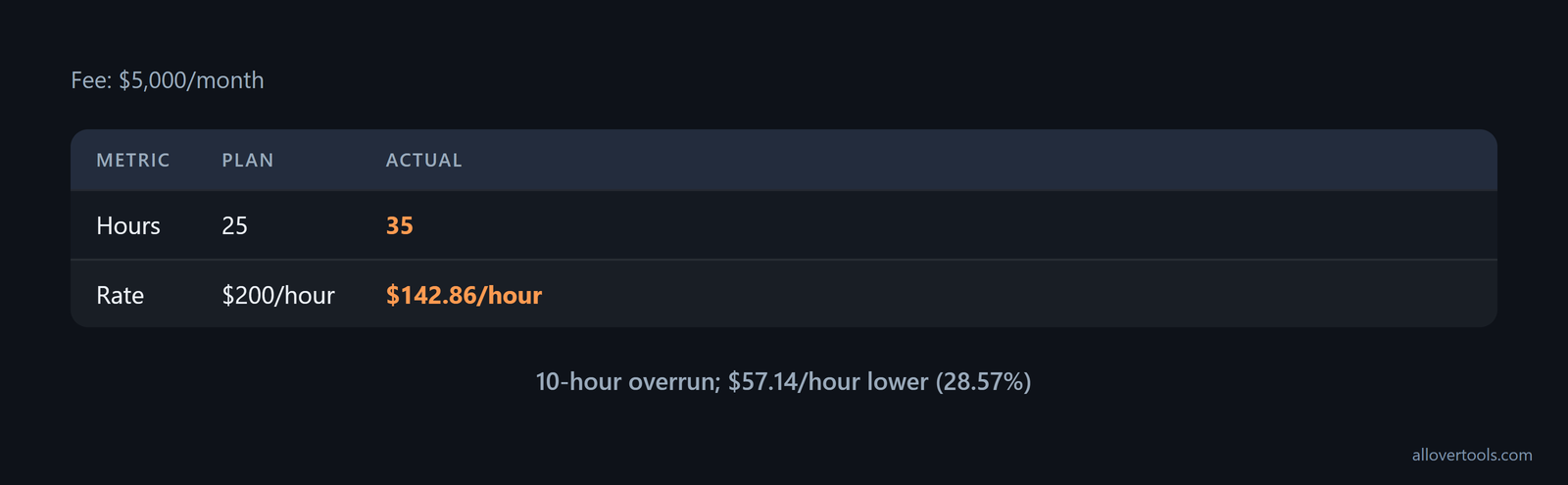
These consulting values are chosen for illustration: a $5,000 monthly fee, 25 expected hours, and 35 actual hours.
Planned equivalent = $5,000 / 25 = $200/hour
Actual equivalent = $5,000 / 35 = $142.857142... = $142.86/hour
Overrun = 35 - 25 = 10 hours
Rate decline = $200 - $142.857142... = $57.142857... = $57.14/hour
Percentage decline = $57.142857... / $200 x 100 = 28.571428...% = 28.57%
The actual equivalent is $57.14 per hour below the planned rate, a 28.57% drop. That figure does not choose the remedy. Check whether the overrun came from unused-hour rules, carryover, emergency requests, or work that should have had a separate scope.
When a task has a recorded start and end time, the Time Duration Calculator converts the span into elapsed hours through its visible Start date, Start time, End date, End time, and Time zone controls. Use the Billable Hourly Rate Calculator when the comparison needs an internal required-rate figure based on the business's own assumptions.
How retainers fit with project work
A business can have recurring retainer work and one-off project work at the same time. Keep each engagement's fee, hours, direct costs, and overhead allocation visible. Retainer revenue is not project profit, and a retainer fee should not be compared with a project quote until both figures use the same basis.
The chosen inputs below go into the Project Profit Calculator. They are illustrative values.
Chosen project-work check
Enter Project revenue of $2,400, Materials / direct costs of $0, Labor hours of 12, Labor rate per hour of $120, and Allocated overhead of $300. Leave Estimated tax rate % (optional) blank.
Labor cost = 12 x $120 = $1,440
Total project costs = $0 + $1,440 + $300 = $1,740
Project profit = $2,400 - $1,740 = $660
Project margin = $660 / $2,400 x 100 = 27.5%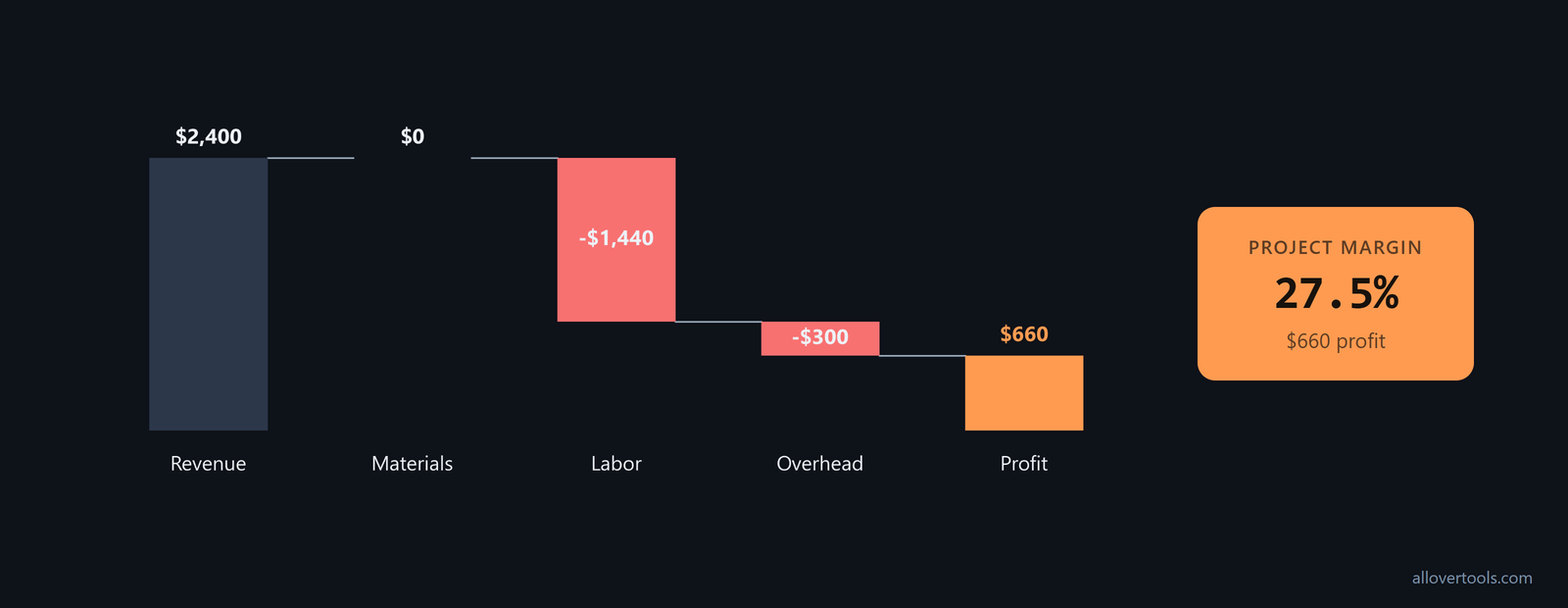
The calculator's Period label changes labels but does not convert figures. Keep revenue, costs, hours, and overhead on the same basis. The $660 profit and 27.5% margin belong to this project scenario, so the project check sits beside retainer-hour tracking.
How to renegotiate an underpriced retainer
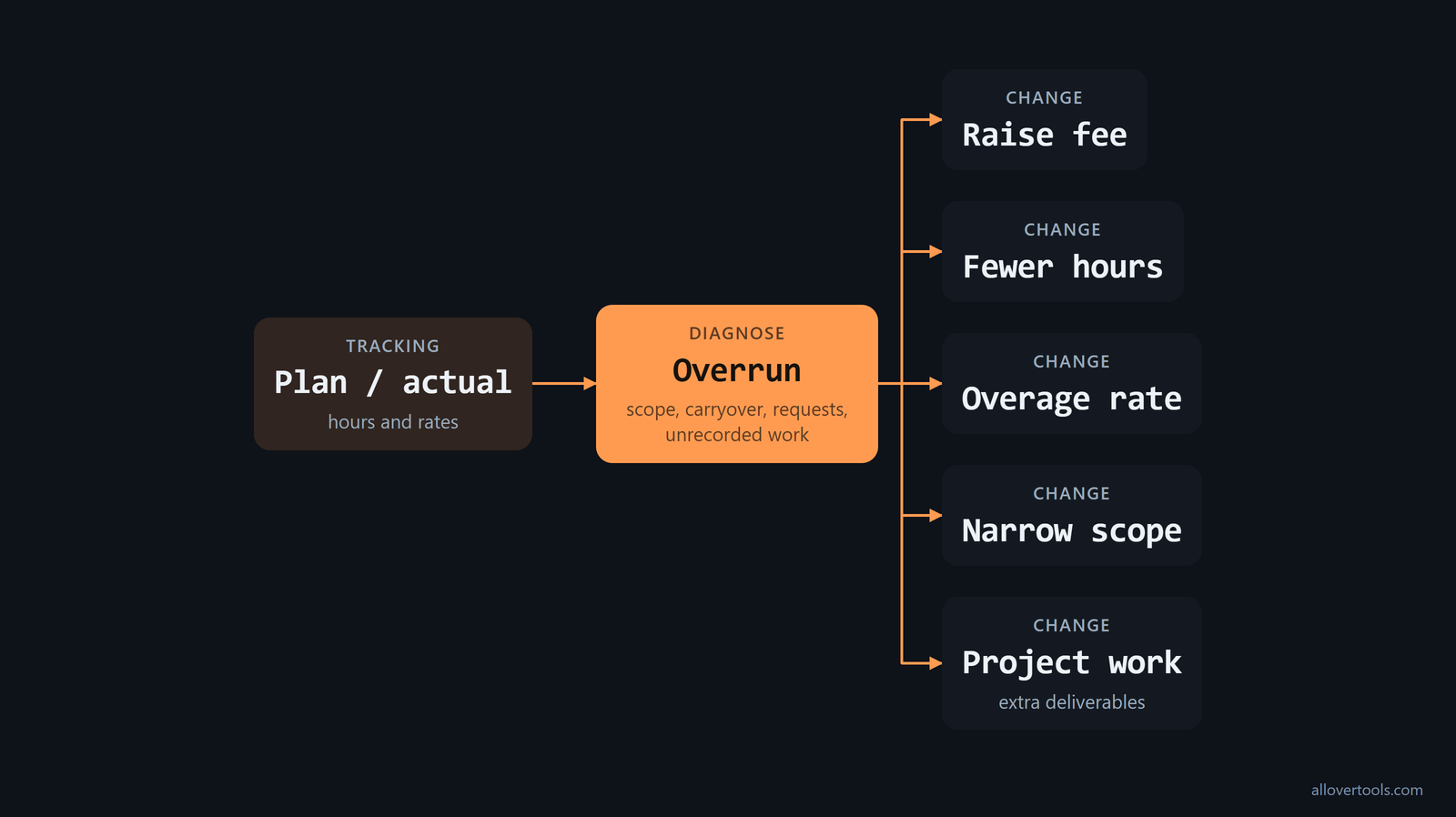
Start with the tracking result and review the terms in writing. Show the agreed scope and expected hours, the actual hours and resulting effective rate, and the recurring source of the overrun. Then choose a change: raise the fee, reduce included hours, define an overage rate, narrow the scope, or move extra deliverables into project work.
Use a keep-or-change test: compare the retainer's effective hourly rate with the normal hourly rate for the same work. Calculate the first as the retainer amount divided by the hours actually worked, including overruns. If it meets or beats the hourly rate, the retainer is better than hourly work. If it falls below that alternative, the retainer is financially worse, even if its cash flow is smoother, according to the retainer decision rule.
- State what counts as included work and how it fits the period.
- Show the logged hours, including covered meetings and account work.
- Show the planned and actual effective rates.
- Propose the fee, hour limit, scope, or overage change that addresses the repeated cause.
- Specify how unused time is handled and when the next review will occur.
Before changing the agreement, calculate the internal rate the business needs. This is a required-rate calculation, not a market benchmark.
Use a blended team rate for agency retainers
A solo consultant uses their own billable hourly rate for a retainer. An agency uses a blended team rate: the weighted average hourly cost of the team members allocated to the account, plus margin for management, tools, benefits, office, business development, overhead, and profit. Work out the team mix before reading the retainer hourly equivalent. Publishing the effective blended rate in the agreement is optional. A client who knows that the retainer equates to $92.60 per hour of agency time can compare it with the market rate for freelance practitioners in each role, as the agency retainer guidance describes.
Scenario-test a revised retainer
For a scenario test, enter these chosen values in the Billable Hourly Rate Calculator: Annual income target $72,000, Annual business expenses $12,000, Total working hours per year 2,000, and Utilization rate (%) 60.
Total revenue required per year = $72,000 + $12,000 = $84,000
Billable hours per year = 2,000 x 60% = 1,200
Required billable hourly rate = $84,000 / 1,200 = $70/hour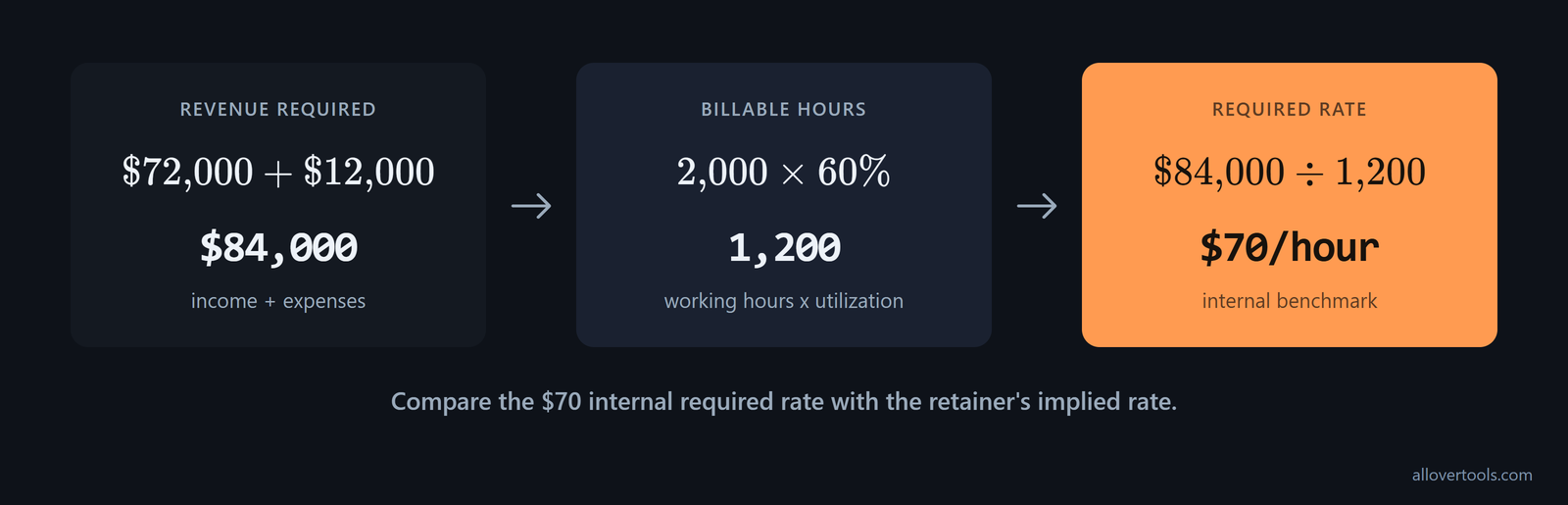
Compare the $70 internal required rate with the retainer's implied rate. The calculator uses entered values only. Its controls are Calculate rate, Reset, Copy result, and Download result (.txt). It does not use fetch, XMLHttpRequest, sendBeacon, or a form-post request carrying those values in the supplied files.
Annual income target and Annual business expenses must be 0 or more. Total working hours per year must be greater than 0, and Utilization rate (%) must be above 0 and no higher than 100. Changing an input or Currency symbol invalidates the old result, so recalculate after changing an assumption.
How to benchmark a retainer hourly equivalent
External benchmarks give you a reference point for comparable agency and advisory work. Across all PR titles, the average hourly billing rate in 2025 was USD 278, up from USD 252 in 2023. The same 2026 statistics page cites Promethean Research's 2024 Digital Agency Industry Report: 65% of digital agencies price hourly services at USD 150 to USD 224, and 30% put their rate at USD 175 to USD 199. It also reports that boutique PR agencies typically charge USD 150 to USD 300 per hour, while large PR agencies may charge USD 300 to USD 500 or more per hour. Compare the retainer's effective rate with the closest agency type and service. Use these PR benchmarks as a cross-check.
Role and region matter when a retainer uses several staff levels. A 4A's Billing Rate Benchmark Survey, summarized in the agency rate guide, analyzed over 36,000 data points across 886 rate cards. Its most common hourly range is $100 to $149; Delaware agencies average $132.04 per hour, and the U.S. national median is $84.40 per hour. The survey gives these role ranges:
| Role | Hourly range |
|---|---|
| Junior staff | $50-$100 |
| Mid-level specialists | $100-$175 |
| Senior strategists | $175-$300 |
| Agency principals | $300-$500+ |
Use the role bands to check whether a generic retainer denominator is subsidizing senior time. A PR retainer typically starts at about $2,500 per month for around 17 to 20 hours of work. The cited range for SEO agencies is $8,000 to $25,500 per month or $75 to $200 per hour, with an average of $7,500 per month, according to the marketing retainer ranges. Put the fee and hours on the same period before comparing the result with these service-specific figures.
Fractional executive work uses a higher benchmark. Fractional executive hourly equivalents generally run $200 to $400 per hour in the U.S. market as of 2026, and the most in-demand C-level operators charge above that for short, high-leverage advisory blocks. Use the fractional executive benchmark when the retainer covers advisory calls, preparation, and strategic oversight rather than a large task volume.
Video production follows a different structure. Clients commit to a minimum number of hours per month, usually 20 or more, at a blended rate. One-person crew and editing work typically runs $50 to $75 per hour. Convert the full retainer using time spent on production, revisions, and client communication, then compare it with the video-retainer ranges.
Marketplace pricing also separates an ongoing commitment from shorter advisory work. Agencies use monthly retainers of $5,000 to $25,000 or more and hourly billing of $100 to $300 for consulting, audits, and advisory. With a retainer, the client pays the same amount whether the agency delivers 20 hours or 100 hours. Track actual hours before treating the monthly fee as an hourly equivalent, using the marketplace pricing overview for comparison.
Frequently asked questions
How do you turn a monthly retainer into an hourly rate?
Divide the monthly fee by the hours the retainer is expected to consume in that month. Recalculate with actual hours to get the effective rate for the period.
What happens when a retainer takes more hours than planned?
The fee divided by actual hours produces a lower effective rate, which can show that the retainer is underpriced or the scope is expanding. Use the logged overrun to decide whether to raise the fee, reduce included work, or bill excess work separately.
Is a retainer better than an hourly agreement?
Neither structure is automatically better. Compare the scope, availability obligation, expected hours, actual hours, and resulting effective rate against the business's required rate.
Can a billable hourly rate calculator evaluate a retainer?
It can calculate an internal required billable rate from an income target, expenses, working hours, and utilization. Compare that output with the retainer hourly equivalent, but remember the tool does not model scope, carryover, or market pricing.