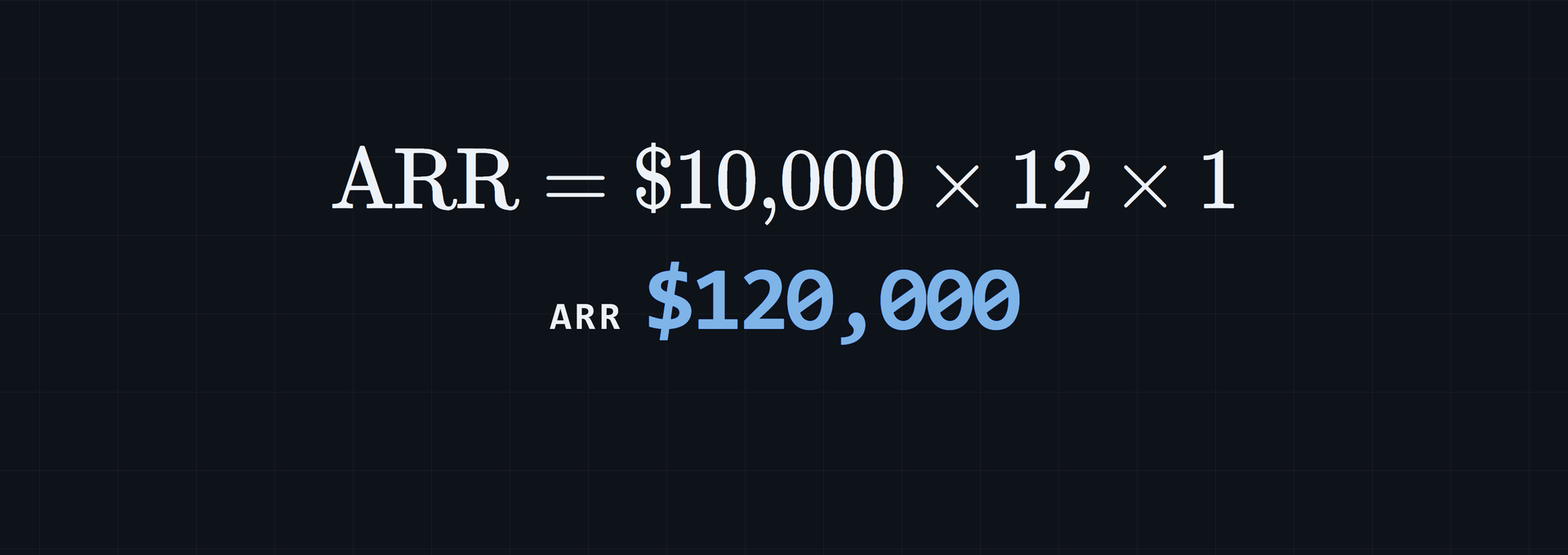
Annual recurring revenue basics start with a simple question: how much recurring subscription revenue does the active customer base represent over one year? ARR annualizes that amount from active contracts. It is not total contract value, cash collected, or all sales. The formula is recurring revenue per billing period x billing periods per year x identical active subscriptions.
What does annual recurring revenue measure?
Active contracts supply the inputs. For one plan, use its recurring charge and active subscription count. For a customer total, use the recurring amount already grouped for that customer. If the portfolio has different plans or billing periods, calculate each group separately and add the results.
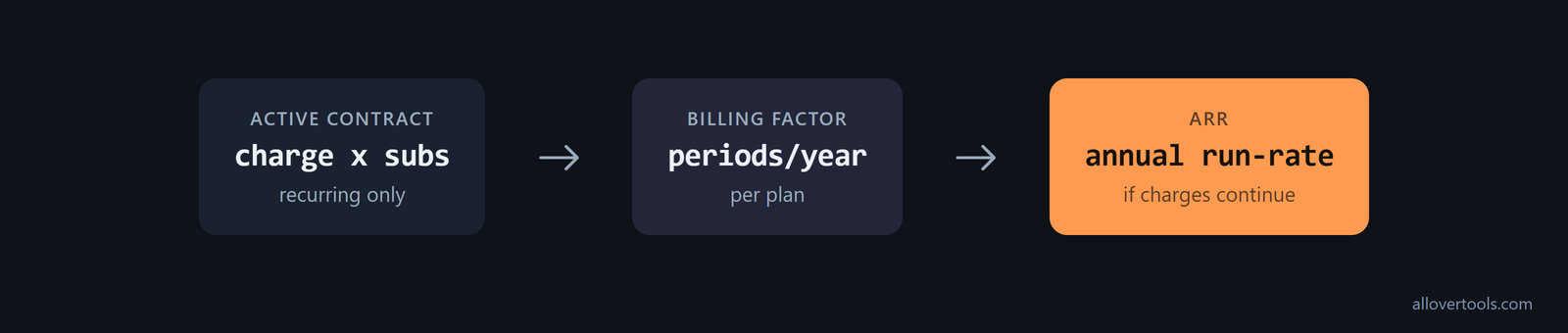
The formula is:
ARR = recurring revenue per billing period x billing periods per year x number of identical subscriptionsThe result is the recurring revenue the current base represents for a year if the included charges continue. It does not promise renewal or show profitability.
Compare two ARR figures only after checking that they use the same inclusion policy. Real companies use four patterns: pure subscription ARR, subscription plus variable ARR, subscription plus managed services ARR, and pure variable ARR. The difference comes down to whether contracted and renewable usage-based, transaction, or managed-services revenue is included, or whether the business has no underlying subscription. Document which revenue streams are in and out before comparing ARR across companies or periods; this ARR definition guide describes the approach.
ARR is a run-rate, not a cash or contract-total measure
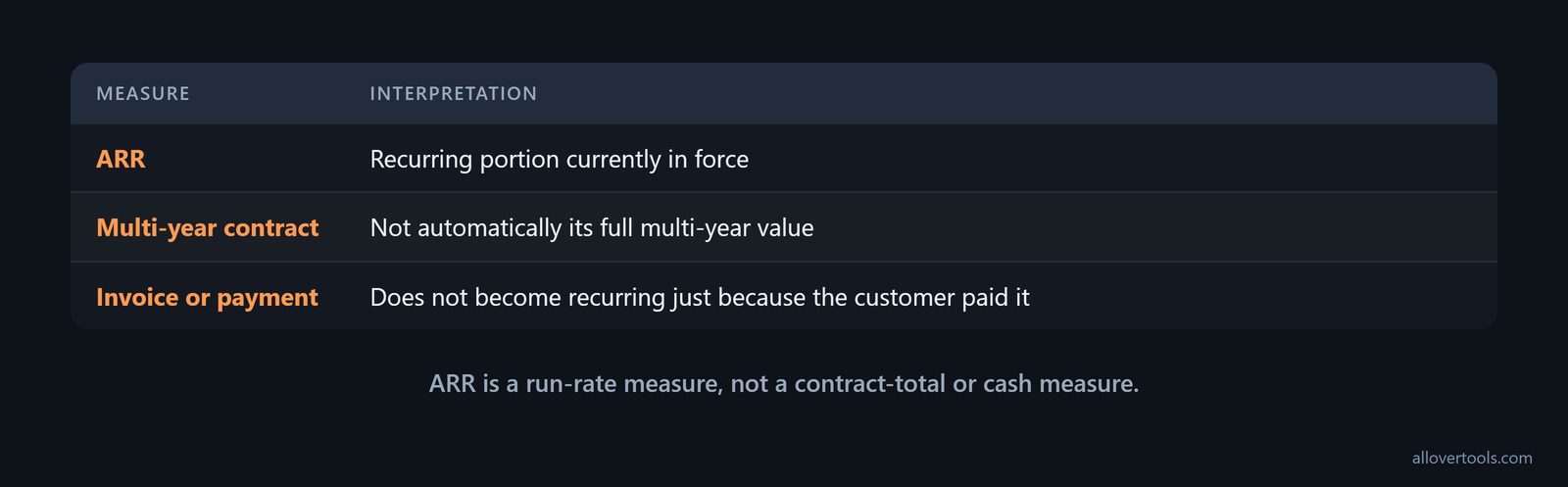
ARR includes the recurring portion that is currently in force. A multi-year contract is not automatically reported as its full multi-year value. An invoice or payment does not become recurring just because the customer paid it.
When billing terms differ, apply the formula to each active plan and then add the plan-level ARR. Keep every input tied to the active contract and its repeating subscription charge.
ARR can use different calculation bases, so put the basis beside the result. Common approaches include:
- MRR x 12: multiply current monthly recurring revenue by 12.
- Annualized value at the measurement date: annualize the recurring value that exists at the snapshot date.
- Annualized contractual value: use the annual amount set by the contract terms.
These methods tie the number to current billings, the value measured at the snapshot, or the contract terms. Use one basis consistently when comparing periods, and make the choice clear to boards or investors, as the calculation guidance sets out.
ARR is used in two different senses. In common SaaS usage, it can mean Annualized Run Rate, calculated as current MRR x 12. Under a stricter Annual Recurring Revenue definition, only contracts with service lengths of 12 months or longer count. Month-to-month and other shorter contracts are excluded, according to the ARR definition guide. State which meaning applies before putting monthly subscriptions into the numerator.
For a strict multi-year calculation, spread the total contract value evenly across the contract term. A three-year subscription contributes its total contract value divided by three. The same strict view excludes a contract with a service length under 12 months. The full multi-year amount therefore does not count as one year's recurring revenue; the contract-length rule gives that treatment.
How to calculate ARR from monthly and annual plans
Start with the recurring charge for one subscription. Select the billing-period factor, then enter the number of identical subscriptions that use that charge.
ARR = Recurring revenue per billing period x Billing periods per year x Number of subscriptionsThe ARR Calculator can run the examples below and shows the formula, assumptions, and intermediate MRR value. Its controls are named Recurring revenue per billing period, Billing period, Number of identical subscriptions (optional), and Calculate ARR.
The visible choices are Monthly (12 periods/year), Quarterly (4 periods/year), Semi-annual (2 periods/year), Annual (1 period/year), Weekly (52 periods/year), and Custom cycle length.... For a custom cycle, periods per year equal 365.25 divided by days per billing cycle. The calculator uses the numbers entered in the form, makes no live-data request, and runs in the browser. After the calculation, Copy result and Download result (.txt) provide the output actions.
Monthly plan example
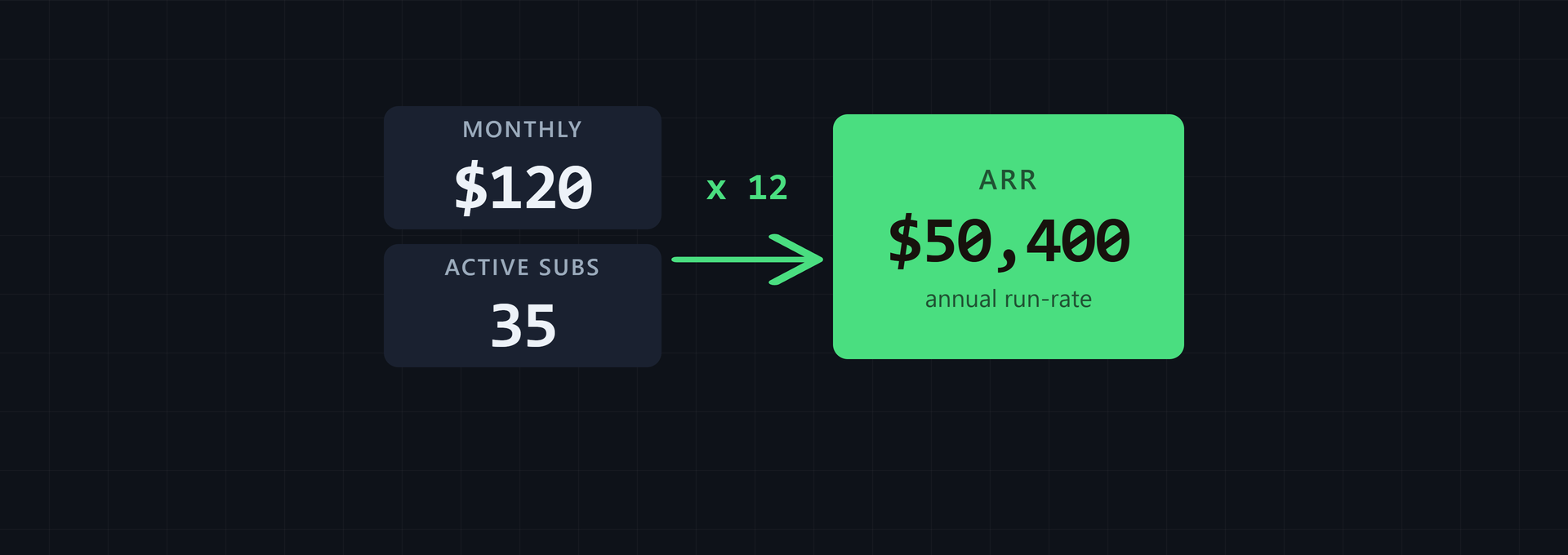
Use a recurring charge of $120 per month and 35 active subscriptions. A monthly plan has 12 billing periods per year.
MRR = $120 x 35
MRR = $4,200

ARR = $120 x 12 x 35
ARR = $50,400
The subscription count multiplies the charge for one subscription. The intermediate MRR provides a quick check: $50,400 / 12 = $4,200.
Annual plan example
Use a recurring charge of $1,800 per year and 18 active subscriptions. An annual plan has one billing period per year.
ARR = $1,800 x 1 x 18
ARR = $32,400

Equivalent MRR = $32,400 / 12
Equivalent MRR = $2,700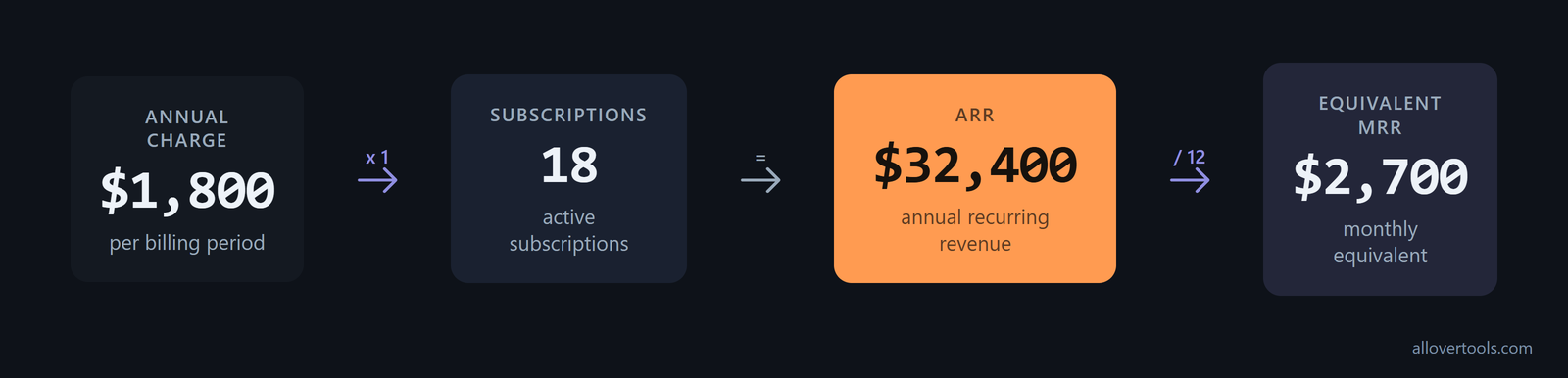
The billing factor is 1 because the entered charge covers one annual period. Do not multiply an annual invoice by 12. The factor is 12 for a monthly charge and 1 for an annual charge.
ARR fits B2B subscription businesses with term-based agreements, particularly multi-year ones. In a business that sells only monthly subscriptions, MRR is usually the primary measure. Use ARR only after deciding whether it means a monthly run rate or the stricter term-contract measure that the SaaS metric guidance distinguishes.
What counts as recurring revenue and what does not?
Separate the steady-state subscription charge from one-time items before using the formula. Include the recurring plan charge for an active customer. Leave setup charges, one-time fees, and non-recurring discounts out because the ARR Calculator asks for the steady-state recurring charge. A cancelled or inactive contract should also be removed from the active-subscription count.
For one active subscription, a $120 monthly charge produces $1,440 in ARR:
Recurring subscription ARR = $120 x 12 x 1 = $1,440
Separate setup fee = $300
Amount included in ARR = $1,440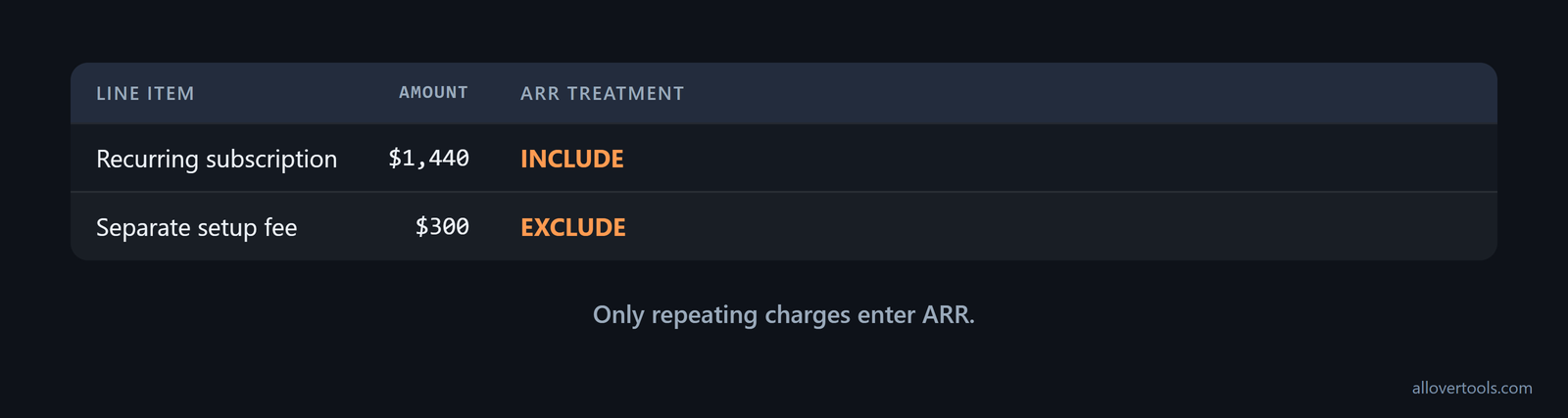
The $300 setup fee stays outside ARR. ARR excludes one time fees. Including it would make the annualized figure describe a different stream and overstate recurring revenue. Classify each line item by whether it is expected to repeat under the subscription arrangement, then annualize only the recurring amount.
A flat subscription price is only one possible recurring input. Recurring usage-based fees and recurring service fees can also be included when they are predictable and tied to the ongoing customer relationship. Treat highly unpredictable usage differently from a contracted, repeatable charge. Apply that distinction before entering a usage or service amount, as the recurring-revenue guidance explains.
An account being active in a system is not enough. ARR excludes highly unpredictable variable usage, free trials, and permanent free tiers, along with the one-time fees separated above. Count paying, predictable revenue, not account totals or unstable usage spikes, according to the exclusion rules.
Enterprise contracts require a separate check for committed usage. Include contracted usage minimums or true-up amounts expected to recur, plus recurring add-ons, and spread multi-year deals across each year. Keep perpetual licenses, non-recurring add-ons, one-time onboarding or implementation, and professional services not tied to the ongoing subscription outside ARR, as Orb's ARR treatment specifies.
Maintenance and support may belong in ARR when they renew as additional ongoing revenue. One worked calculation starts with $10 million of annual subscriptions and $1 million of maintenance revenue, subtracts $200,000 lost to cancellations, and gets $10.8 million ARR. Use that sequence for comparable recurring service components, following the ARR calculation example.
A quick inclusion check before annualizing
Ask these questions before entering a number:
- Is the amount tied to an active subscription?
- Is it part of the ordinary repeating charge?
- Is it separate from setup or other one-time work?
Only amounts that pass the check belong in recurring revenue. Apply the billing-period factor after that classification.
How ARR fits into SaaS metrics, growth, and valuation
ARR is a subscription recurring revenue metric that puts the current recurring base on an annual scale. That base describes predictable subscription revenue, but it can change when contracts are added, expanded, reduced, or cancelled. For SaaS companies, ARR helps track new business, expansion, contraction, and churn. It is also one input for planning and valuation discussions.
ARR alone does not determine value. It leaves out margins, retention, customer concentration, cash needs, and risk. A higher ending ARR may come from new or expanded contracts, while a flat figure may hide new sales that were offset by churn. The snapshot needs movement detail.
Use ARR with movement metrics
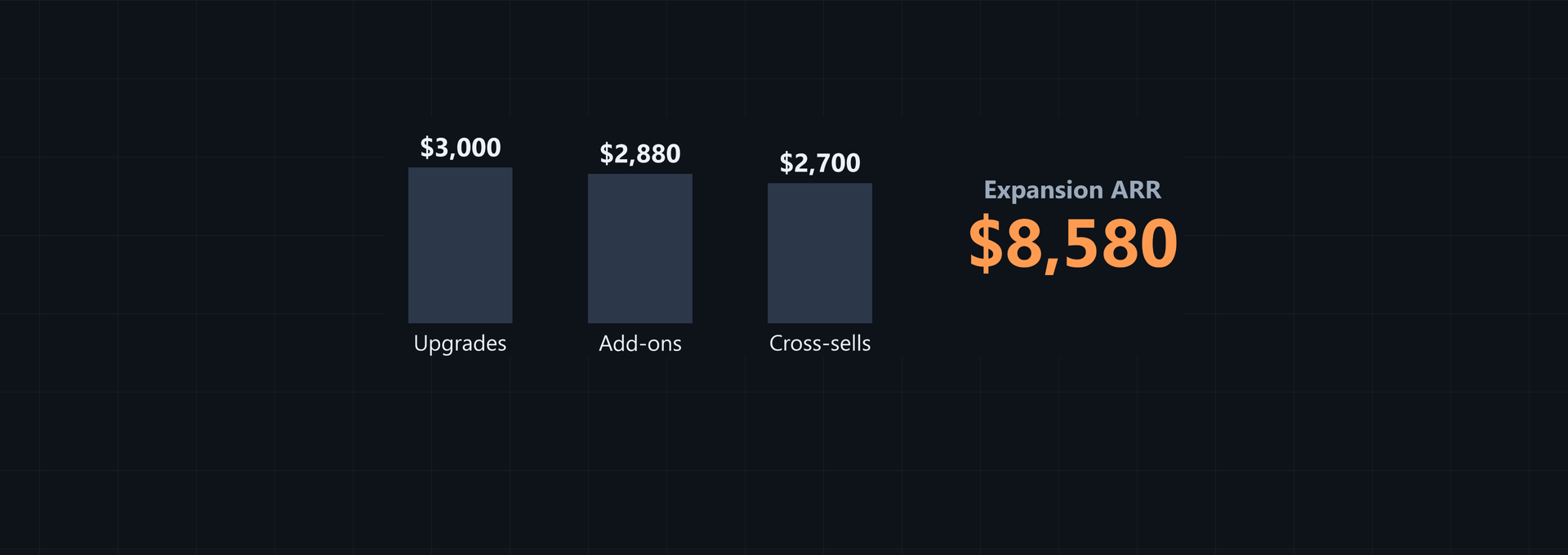
ARR shows where the recurring base stands. MRR movement explains why it changed. New MRR comes from new subscribers. Expansion MRR comes from existing subscribers who add revenue. Contraction MRR comes from existing subscribers who downgrade but remain subscribed. Churned MRR comes from subscribers who cancel.
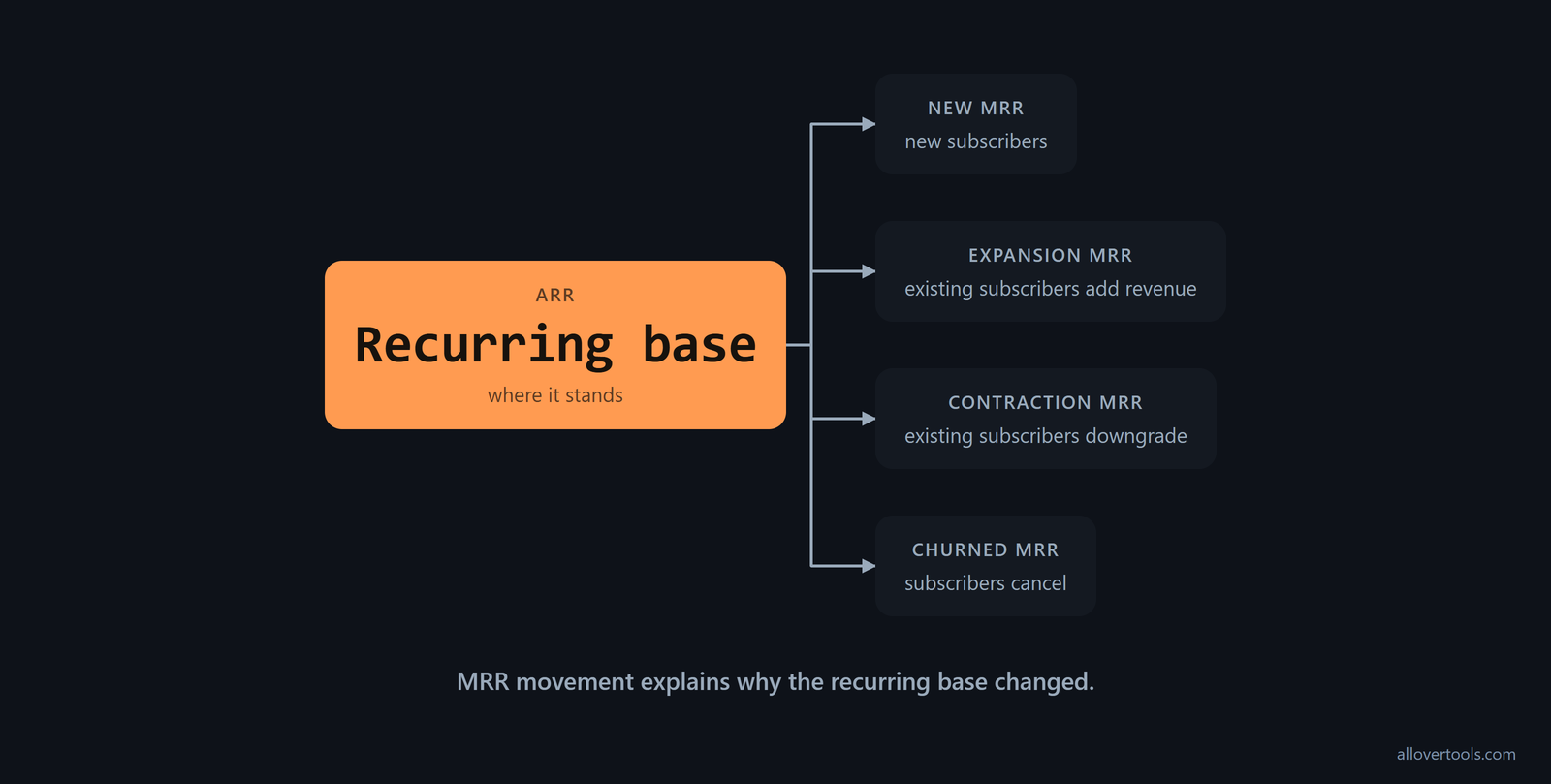
For monthly movement, the MRR Calculator accepts Starting MRR, New MRR, Expansion MRR, Contraction MRR, and Churned MRR for one period. ARR alone cannot show which movement produced the change.
An ARR bridge shows where the change came from: ARR = New ARR + Renewal ARR + Expansion ARR - Churned ARR - Contraction ARR. Some teams also track Reactivation ARR for customers who return after cancelling. These categories show whether ending ARR came from new customers, renewals, upsells, downgrades, cancellations, or reactivations, using Orb's ARR movement framework.
ARR can inform valuation without being a valuation
Investors or operators may use ARR as one input when they evaluate a recurring business. ARR is not a price, and it does not rank a company. Profitability, retention, cash, and contract quality still need separate review.
An ARR multiple makes the relationship explicit in valuation discussions. Divide valuation by ARR to see how much investors are willing to pay for each dollar of annual recurring revenue. The multiple is a valuation metric. It does not replace the ARR calculation or a review of the recurring contracts, as the ARR multiple definition explains.
The SaaS Metrics Calculator combines MRR, ARR, churn, CAC, LTV, burn, runway, and Rule of 40 from entered figures. Both tools calculate from user-entered values without a billing-system connection.
ARR versus GAAP revenue: why the figures differ
ARR is a management run-rate measure. It annualizes recurring subscription commitments from active contracts. GAAP revenue is accounting revenue recognized under applicable recognition rules as goods or services are provided.
Period totals can differ because of timing, contract terms, billing schedules, deferred revenue, discounts, cancellations, and non-recurring items. An annual invoice can affect cash and deferred-revenue balances while ARR describes the recurring annual run-rate.
Use three labels and keep them separate: annual recurring revenue, annual run rate, and GAAP revenue. Annual recurring revenue is contracted recurring revenue normalized to a year. Annual run rate is the latest period x 12; if that period includes one-off fees, the extrapolation can pull them in. GAAP revenue is what accounting rules recognize in the period. That distinction matters because calling the latest-period extrapolation ARR can inflate the recurring figure when one-time items are large, as the three-way comparison shows.
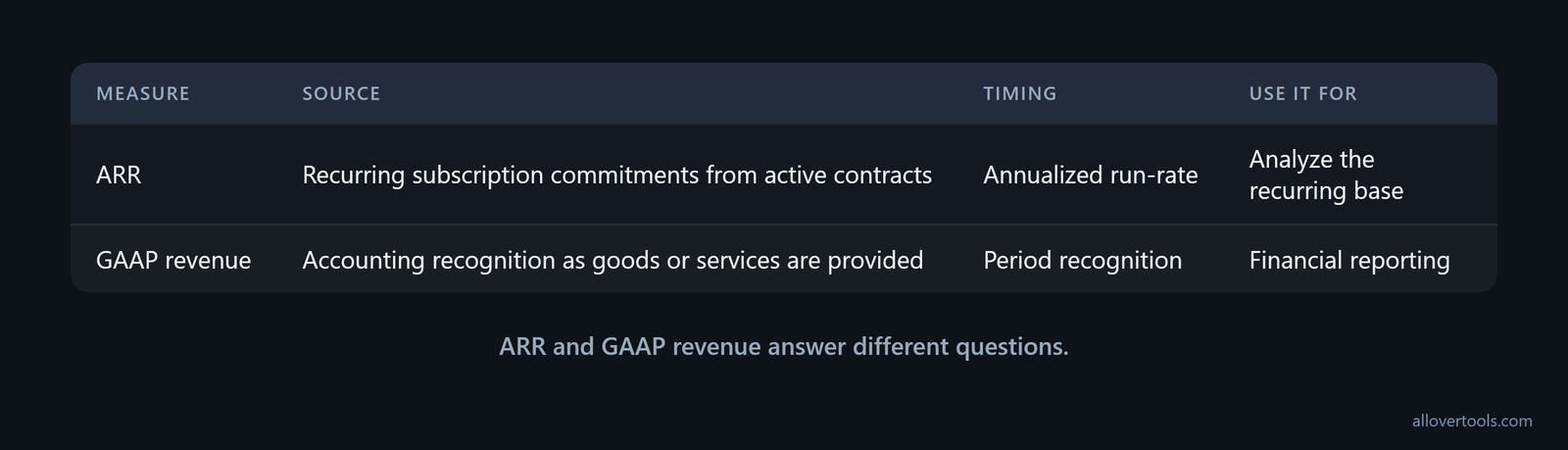
Neither number replaces the other. Use ARR to analyze the recurring base and GAAP revenue for financial reporting. Do not present ARR as GAAP revenue.
What ARR cannot tell you on its own
A current ARR snapshot does not show whether customers renew, how quickly churn or expansion is changing, whether revenue is profitable, when cash arrives, how revenue is recognized, how concentrated the customer base is, or how much of the figure is discounted or contractually uncertain.
Annualizing assumes that the included recurring charges continue. A recent cancellation or temporary promotion can make the snapshot misleading. Check the source of the number before treating it as a complete operating picture.
Treat the snapshot as a projection based on a static customer base. ARR estimates what existing customers can generate over a year if the business acquires no new customers and loses none during that period. Comparing periods turns that snapshot into a growth measure: a move from $1 million ARR to $1.2 million ARR implies 20% growth, as the SaaS metrics guidance illustrates.
For a quick check, a top-down ARR model starts with aggregate figures such as total customers and average annual contract value. A bottom-up model builds the total from contract-level subscriptions, add-ons, upgrades, and churn per customer. Use the top-down view for a headline estimate. Use the bottom-up view when ARR must be audited or support investor due diligence, following the ARR modeling guidance.
A five-question ARR review
- Which contracts are active?
- Which charges truly recur?
- Which billing period applies?
- What changed since the last snapshot?
- Which accounting, cash, and profitability measures must be checked separately?
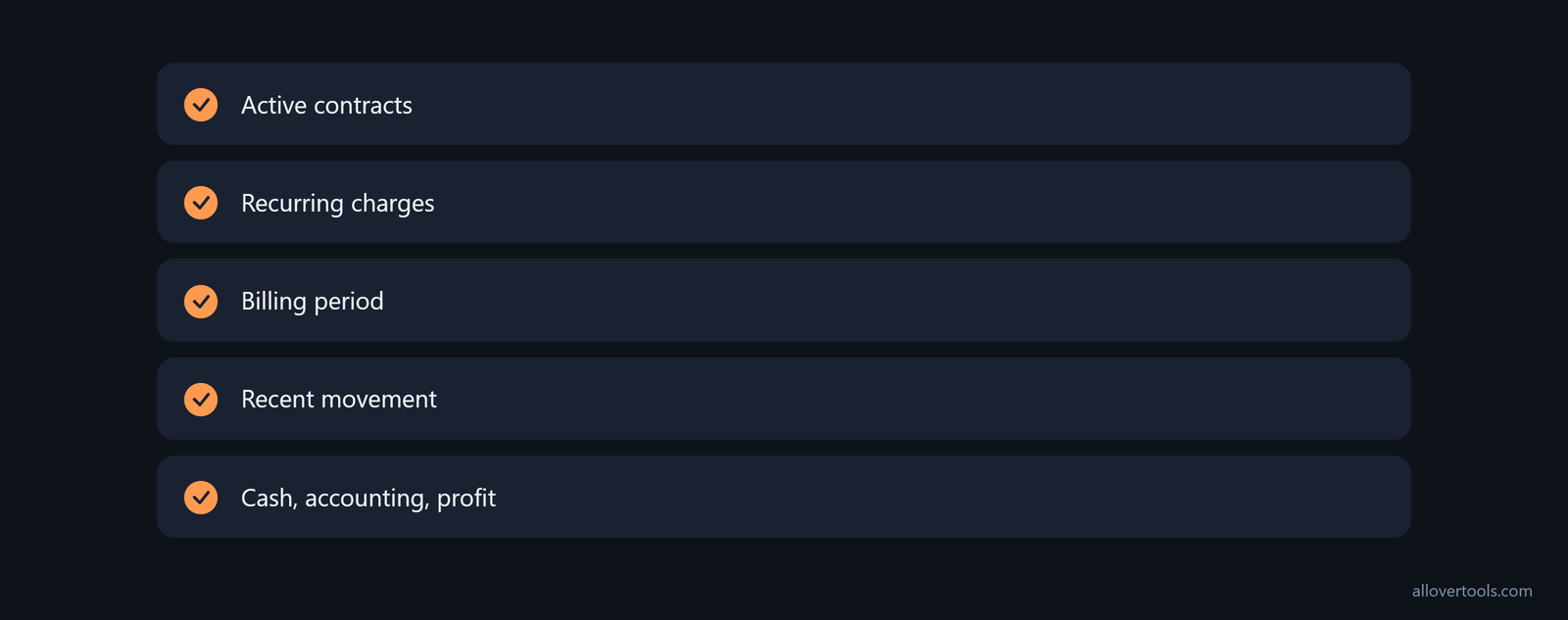
Confirm active contracts, remove one-time and non-recurring amounts, separate monthly and annual billing correctly, compare current ARR with the movement categories, and review cash and accounting measures separately. The ARR Calculator keeps the formula and assumptions visible while you do the arithmetic.
Frequently asked questions
How do you calculate ARR from monthly revenue?
Multiply the recurring monthly charge by 12 and by the number of identical active subscriptions. For the example above, $120 x 12 x 35 = $50,400 ARR.
What should you enter for an annual subscription in an ARR calculator?
Enter the recurring charge for one annual billing period, select Annual (1 period/year), and enter the number of identical subscriptions. For the example above, $1,800 x 1 x 18 = $32,400 ARR.
Does annual recurring revenue include setup fees?
No. Leave setup charges, one-time fees, and non-recurring discounts out. ARR uses the steady-state recurring subscription charge only.
Is ARR the same as GAAP revenue?
No. ARR is an annualized recurring run-rate, while GAAP revenue is recognized under accounting rules as goods or services are provided, so their period totals can differ.
Can ARR grow while the business still has a cash problem?
Yes. ARR describes recurring revenue capacity, not cash timing, expenses, margins, or runway. Review cash and profitability measures separately.