These expansion ARR examples show how to annualize recurring revenue added by customers who already have an active subscription. The calculation separates upgrades, add-ons and cross-sells from new-customer contracts, then keeps contraction and churn outside the gross expansion figure.
What expansion ARR means in SaaS
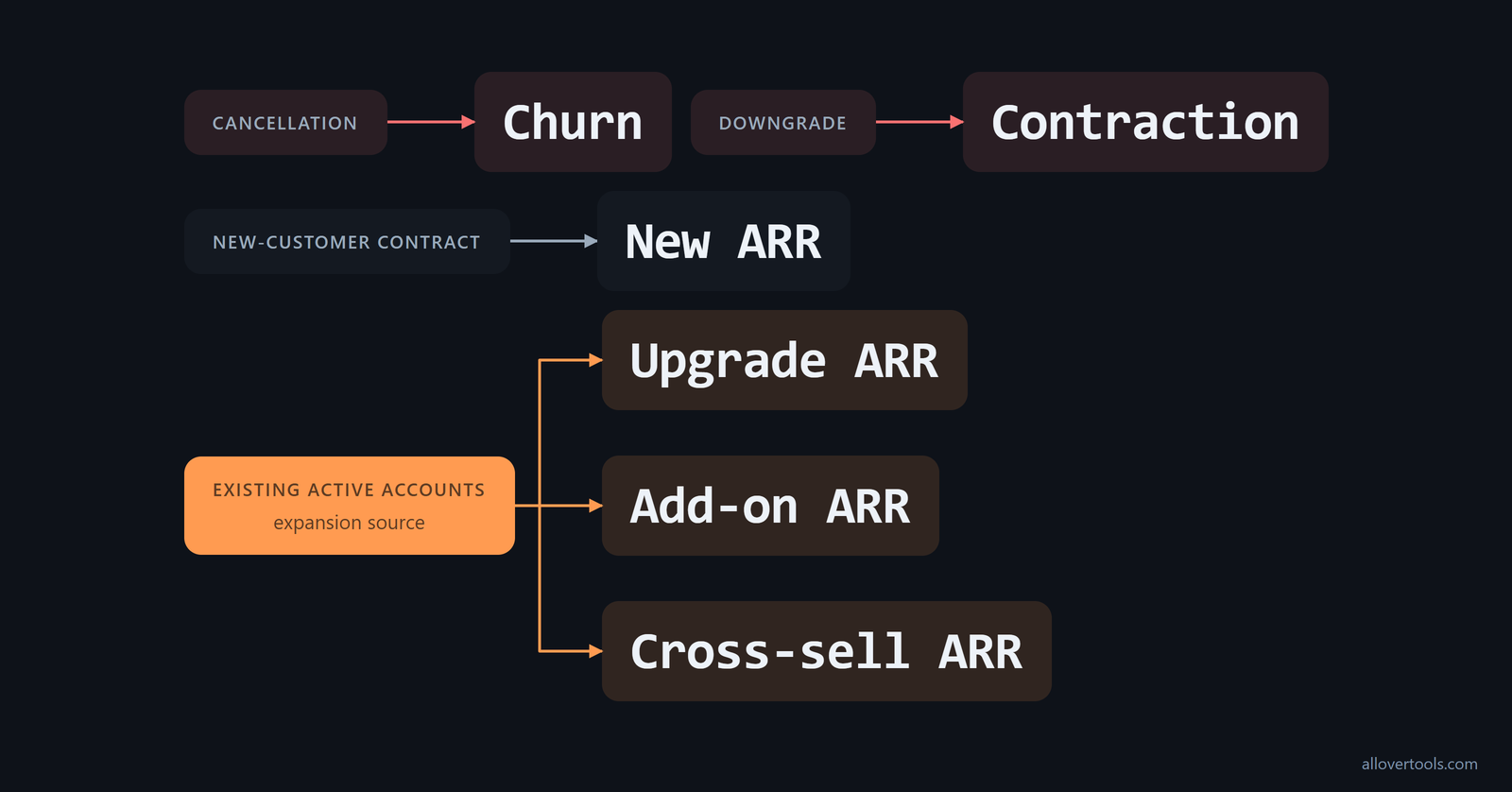
Expansion ARR is the annualized increase from existing active accounts. Its component formula is:
Expansion ARR = upgrade ARR + add-on ARR + cross-sell ARRA new-customer contract belongs in new ARR. A downgrade belongs in contraction, and a cancellation belongs in churn. Keep those movements separate from gross expansion rather than folding them into one number.
One-time setup fees, services and other non-recurring charges are not expansion ARR. The ARR expansion revenue metric is a movement view. Total ARR is the recurring revenue base after all movements are reconciled.
At larger SaaS companies, expansion can make up a substantial share of new ARR. Based on 2024 results, the 2025 benchmark puts Expansion ARR at 40% of Total New ARR, over 50% of Total New ARR in companies greater than $50M ARR, and 67% of Total New ARR for companies above $100M ARR. Compare the business with the company-size band that fits it before deciding whether the expansion line is material.
Expansion's share also rose over time. Benchmarkit data reported by Orb shows a move from a 25% median share of total new ARR in 2022 to 40% in 2024, a 15 percentage-point increase, according to the NRR trend. Keep the measurement period and denominator next to the percentage when comparing the company's own expansion share with this benchmark.
Some billing systems also count other routes back to paid revenue as expansion. Chargebee defines Total Expansion ARR as Expansion MRR multiplied by 12. Its Expansion MRR includes:
- Upgrade MRR
- Free to Paid MRR
- Reactivation MRR
- PAUSE To Paid MRR
Use the categories in the billing metrics definition to reconcile a system report. If you use this article's narrower view of upgrades, add-ons and cross-sells, show the extra categories separately instead of dropping them.
How to calculate expansion ARR from upgrades and add-ons
Start with the added recurring amount and annualize it:
Incremental recurring charge per billing period x billing periods per year x affected subscriptionsFor an existing account, this gives expansion ARR from upgrades. The same calculation applies to ARR growth via add ons.
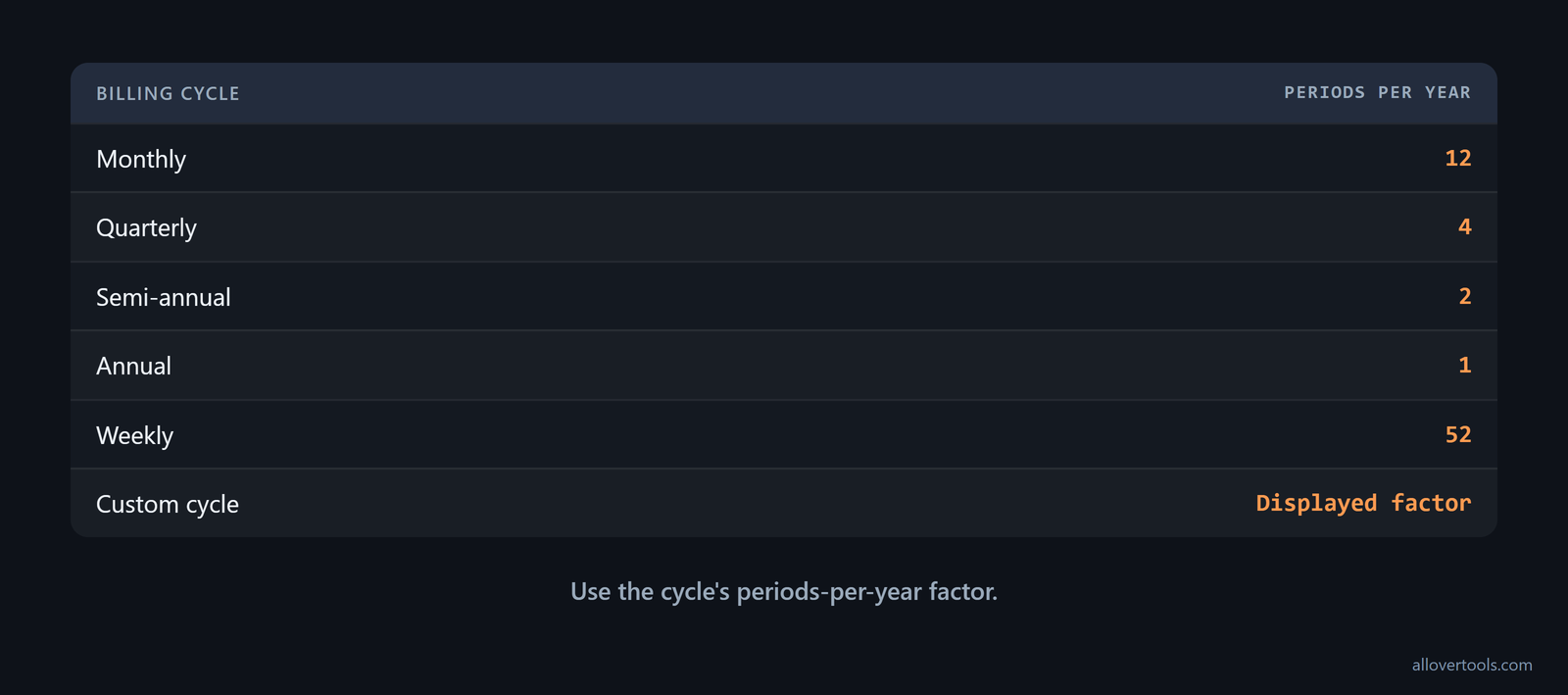
The ARR Calculator annualizes each movement using the controls "Recurring revenue per billing period", "Billing period", "Number of identical subscriptions (optional)" and "Calculate ARR". Monthly uses 12 periods per year. Quarterly uses 4, semi-annual uses 2, annual uses 1, weekly uses 52, and a custom cycle uses its displayed factor.
"Currency symbol" changes the display only. Leave one-time fees, setup charges and non-recurring discounts out. The figures entered in the tool are processed locally in the browser, with no live data connection.
Seat increases and feature upgrades
For a seat increase, calculate the added seats and their recurring price first. For a feature upgrade, use the difference between the old and new recurring charges. The following are chosen values:
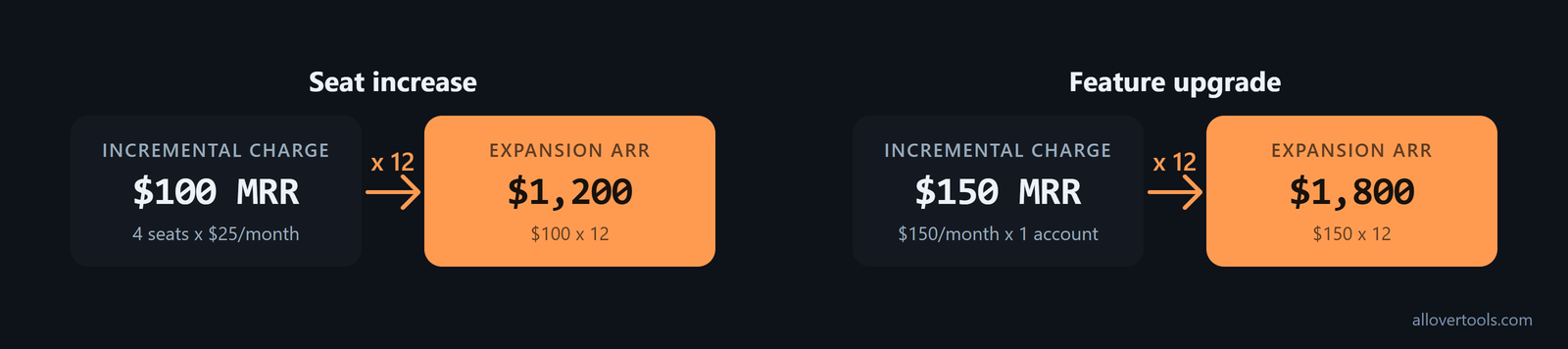
Seat increase: 4 seats x $25 per month = $100 MRR
$100 x 12 = $1,200 expansion ARR

Feature upgrade: $150 per month x 1 account = $150 MRR
$150 x 12 = $1,800 expansion ARR
This is the upsell ARR calculation for the added amount. Do not annualize the customer's full new invoice when only the increase is expansion. The old recurring charge already belongs to the starting base.
Another incremental amount to isolate is a small price change. In Canny's simple example, an existing customer's plan rises by $30 per month and produces $360 expansion ARR. Apply the same calculation to that simple upgrade example: $30 x 12, not the customer's full plan price.
Usage-based expansion ARR
An account can expand through consumption even when its plan and seat count stay the same. In an integration SaaS example, the charge is $1 per 1 million API calls. Monthly usage rises from 1 billion to 2 billion API calls, so the price goes from $1,000 to $2,000 per month. The extra $1,000 in monthly recurring revenue becomes $12,000 in expansion ARR over 12 months, as the Ordway usage example shows. Use that consumption increase as the incremental recurring amount in the same formula as seat and feature uplifts. Do not annualize the starting $1,000 monthly charge a second time.
Add-on bundles and cross-sells
An add-on stays attached to the current product. A cross-sold module or product solves a separate job for an existing customer. The formula is the same in both cases. These are chosen values:
The cross sell ARR impact is the annualized charge for the separate module. An add-on uses the same calculation but remains part of the current product.
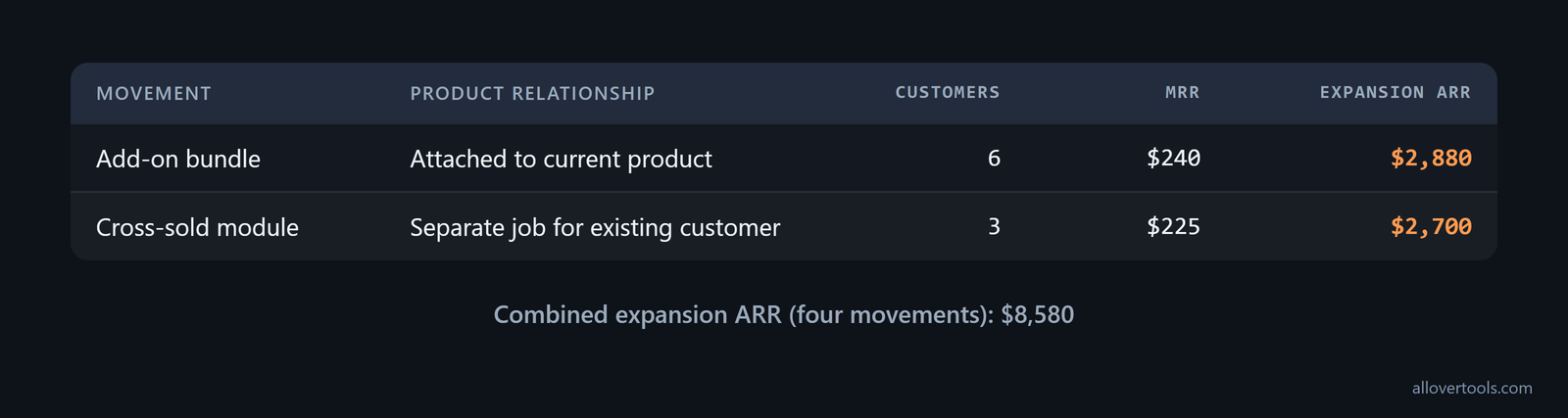
Add-on bundle: 6 customers x $40 per month = $240 MRR
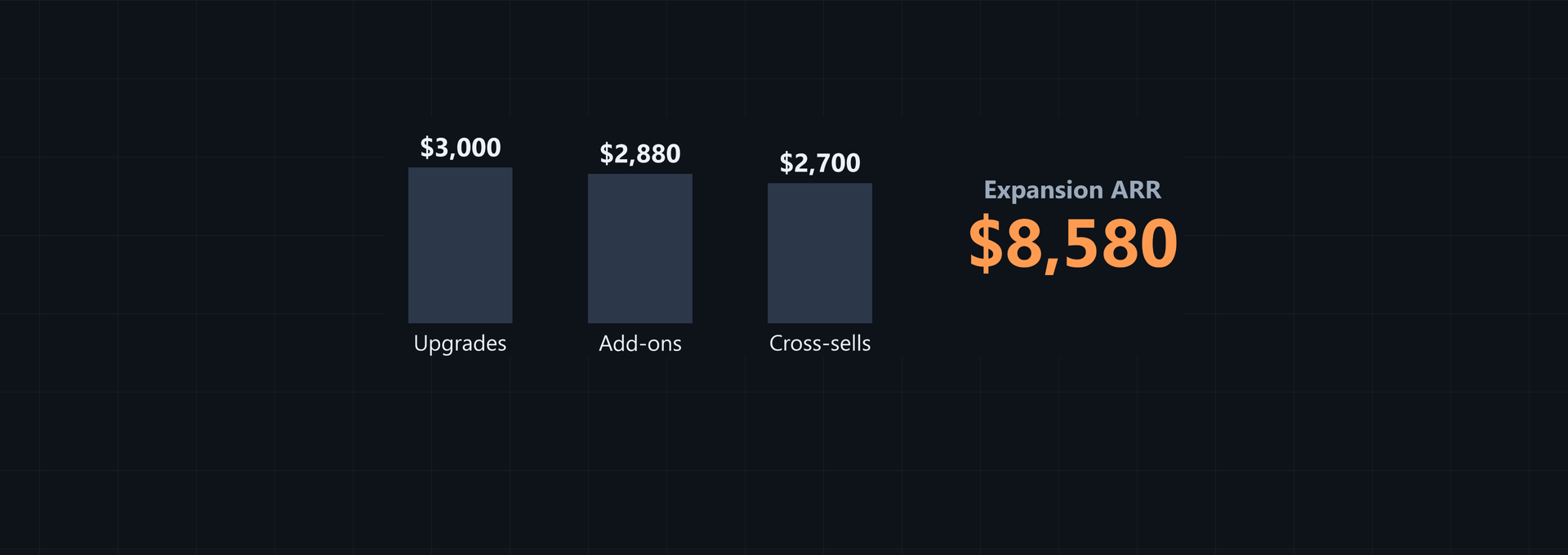
$240 x 12 = $2,880 expansion ARR

Cross-sold module: 3 customers x $75 per month = $225 MRR
$225 x 12 = $2,700 expansion ARR

Combined expansion ARR:
$1,200 + $1,800 + $2,880 + $2,700 = $8,580
The $8,580 is incremental recurring revenue from these four movements. It is not total company ARR.
Fixed-fee and usage-based ARR
With mixed pricing, keep the stable and variable parts on separate lines. Tabs describes a SaaS company with a $10,000 annual platform fee and a variable fee based on API usage. For 50 customers, the fixed platform component is 50 x $10,000 = $500,000. Calculate the usage component from a trailing three-month average of usage revenue, then annualize it. Keep the fixed platform fee on its own ARR line and use that trailing-average method for the variable portion, as the Tabs calculation method sets out. This keeps usage expansion visible when the variable amount changes instead of folding it into the stable fee.
How positive NRR shows expansion is working
Net revenue retention, or NRR, measures recurring revenue retained from the starting customer base. It excludes new-customer revenue:
NRR = (starting recurring revenue + expansion revenue
       - contraction revenue - churned revenue)
      / starting recurring revenue x 100
Expansion can offset contraction and churn, but a positive expansion contribution does not automatically put NRR above 100%. These chosen values keep new business out of both cases:
Case A:
$10,000 + $1,500 - $400 - $600 = $10,500 retained revenue
$10,500 / $10,000 x 100 = 105% NRR

Case B:
$8,000 + $900 - $100 - $200 = $8,600 retained revenue
$8,600 / $8,000 x 100 = 107.5% NRR
In the SaaS Metrics Calculator, enter "Starting recurring revenue", "Expansion recurring revenue", "Contraction recurring revenue" and "Churned recurring revenue" for this starting-base view. Its ending recurring revenue formula also adds "New business recurring revenue", so keep that input separate when reading NRR. "Net revenue churn rate" is a separate output, not another name for NRR.
Cohort NRR and reactivation
NRR is both a cohort ratio and a movement formula. The cohort NRR definition compares MRR today from a customer cohort with MRR from that same cohort a year ago. The equivalent component formula is starting MRR plus expansion and reactivation, minus contraction and churn, divided by starting MRR. New customers stay out of the cohort, while reactivation counts with expansion; Gross Revenue Retention does not count expansion. Keep the cohort boundary and reactivation line visible when reviewing NRR, so new logos do not inflate the starting-base result.
Use the same time base for every input. An MRR-based NRR calculation needs monthly expansion, contraction and churn figures; an ARR-based calculation needs annual figures. Mixing the periods gives a wrong result, as the period warning makes clear. Convert the movement inputs to one period before entering them into the NRR calculation.
How expansion ARR affects customer lifetime value
Expansion can raise an LTV estimate through ARPU. If customer count, gross margin and churn assumptions stay the same, a higher recurring charge raises gross margin per period and the resulting estimate.
The LTV Calculator uses these relationships:
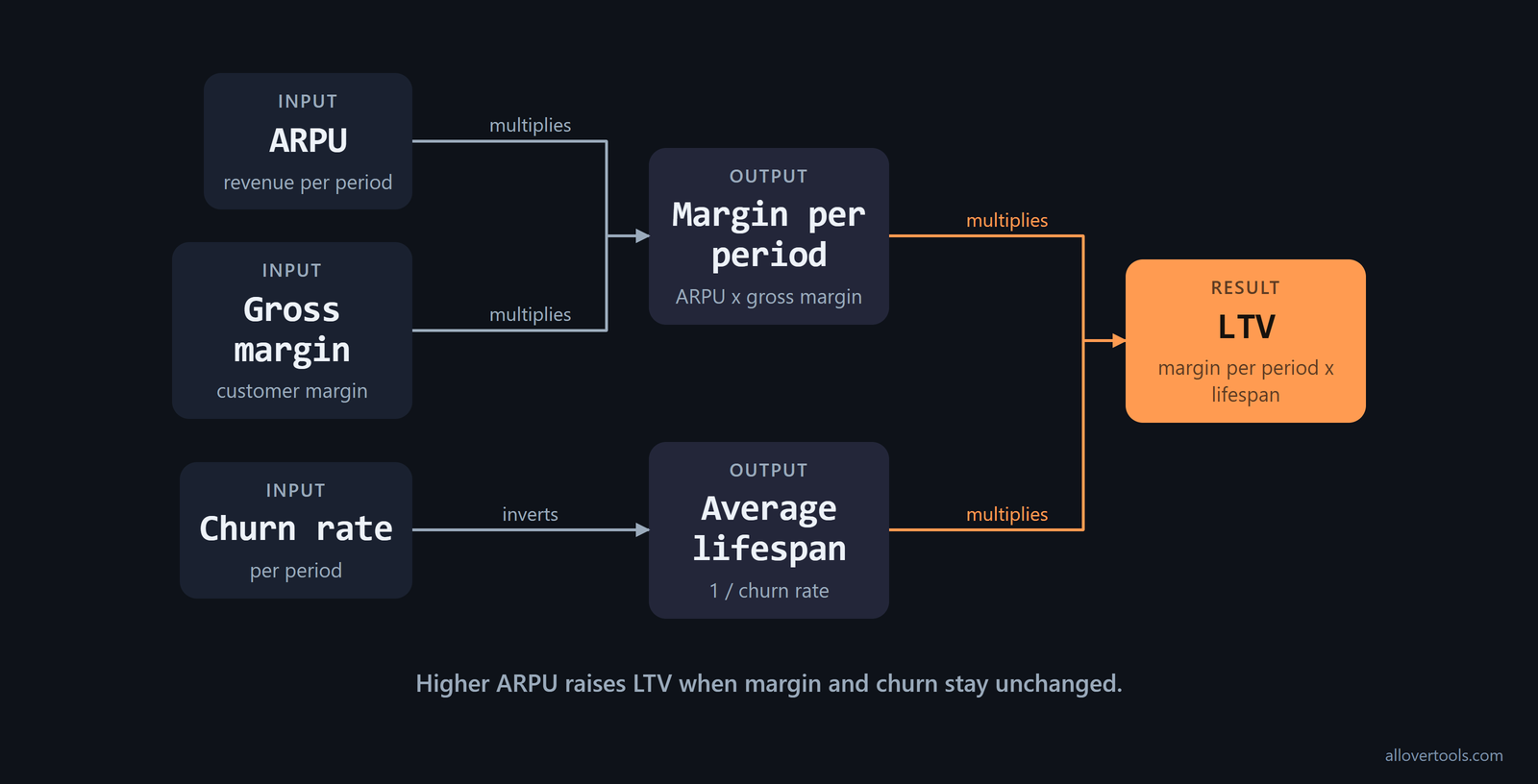
Gross margin per customer per period = ARPU x gross margin
Average customer lifespan = 1 / churn rate
LTV = margin per period x lifespan
Enter "Average revenue per customer (ARPU), per period", "Gross margin (%)" and "Churn rate (% per period)". The optional "Customer acquisition cost (CAC) - optional" field can show LTV:CAC, but it does not turn expansion ARR into profit. The result is a steady-state estimate and does not prove that retention improved.
A worked LTV change from one add-on
These chosen values use a monthly period before and after the add-on, with 80% gross margin and 5% churn in both cases:
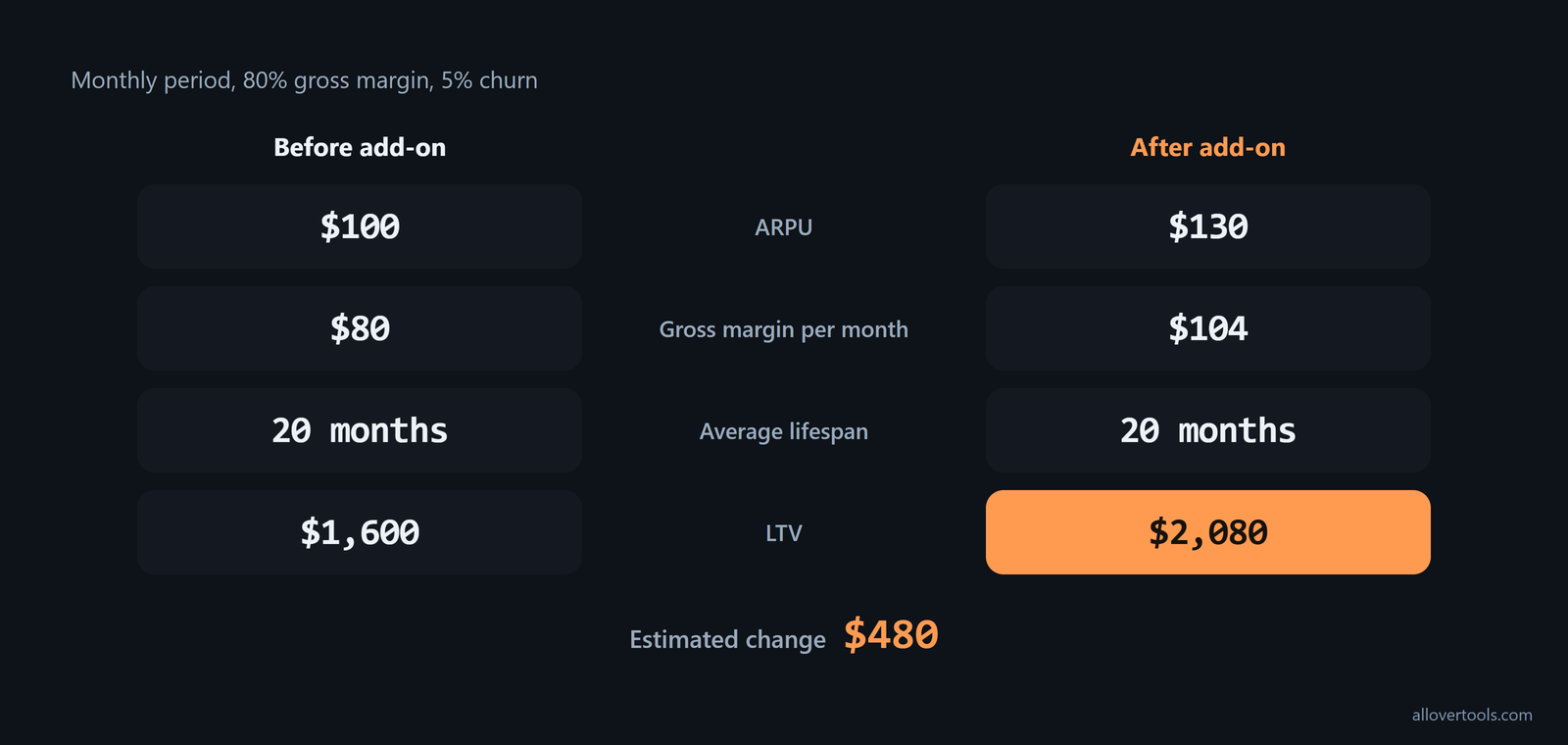
Before add-on:
ARPU = $100
Gross margin per month = $100 x 80% = $80
Average lifespan = 1 / 5% = 20 months
LTV = $80 x 20 = $1,600

After add-on:
ARPU = $130
Gross margin per month = $130 x 80% = $104
Average lifespan = 1 / 5% = 20 months
LTV = $104 x 20 = $2,080

Estimated change:
$2,080 - $1,600 = $480
The $480 difference is an estimate caused by the higher ARPU under unchanged margin and churn assumptions.
Strategies to drive expansion ARR without confusing it with new ARR
Use the existing account as the attribution boundary and follow each movement through its effective date:
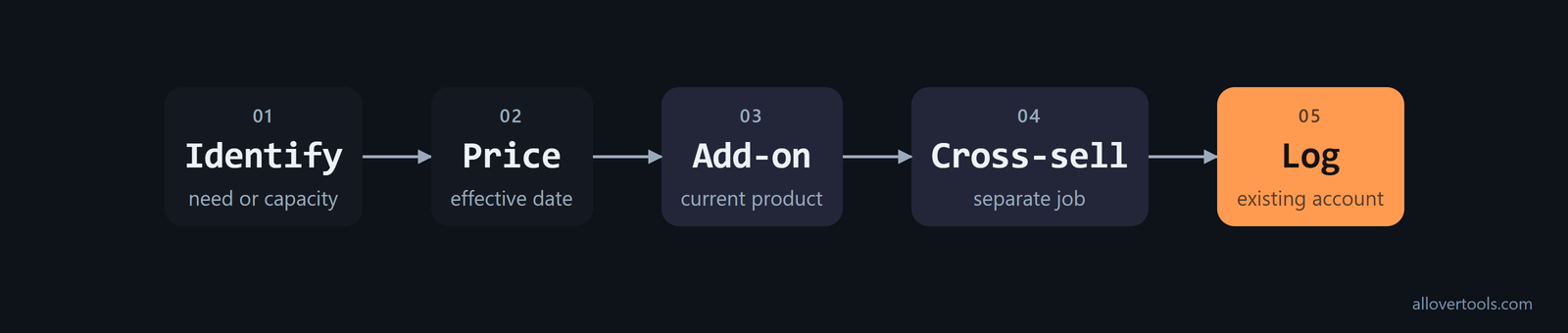
- Identify an account with unused capacity or a clear product need. A seat or plan change is an upgrade.
- Offer the higher recurring price and record the incremental amount with its effective date.
- Package a complementary feature with the current product. That movement is an add-on.
- Present a second module only when it solves a separate job. That movement is a cross-sell.
- Log the movement against the existing account. Keep a new-logo contract in new ARR.
Give existing customers a clear reason to expand and make the next step easy. Zuora's guidance lists four tactics:
- Base premium features on customer feedback.
- Offer discounts on upgrades or add-ons, for example for referrals or annual billing.
- Bundle products or services so upsells and cross-sells are easier to justify.
- Let customers try higher-tier plans for free to encourage upgrades.
Test these Zuora expansion tactics against the existing-account attribution rule. Record each resulting recurring movement under its actual category.
Product-led growth can start expansion inside the same account. A glossary covering Slack, Zoom and Calendly describes viral patterns in which individual users invite teammates. In the example, a free user converts to paid and later adds 10 team members over six months; that is pure expansion revenue. Track the conversion and later seat growth against the existing account in the PLG example. Do not treat each invited teammate as a new logo.
Enterprise expansion depends on rollout as well as pricing. The enterprise example describes customer success teams growing accounts from $50K to $500K+ ARR over 18-24 months, moving from pilot teams to enterprise-wide deployments. It names percentage of departments using the product and active users versus total employees as readiness measures. Put those measures beside the account's expansion events when deciding whether a broader deployment belongs in the forecast.
Usage signals can prompt a commercial action before a customer reaches its plan limit. For CDPs, analytics platforms and API-first products, teams monitor telemetry such as collaboration frequency or API call volume. They can then use upsell prompts or customer success outreach at the right moment to facilitate the tier upgrade while preventing usage throttling. The usage-signal workflow turns rising usage into an expansion event to log; keep the signal and resulting tier change together.
Include a recurring price uplift in the expansion review even when seats and features do not change. Ordway lists an annual 5% increase for the platform fee among five common ways to generate expansion ARR through upsells and cross-sells. Record the uplift as its own recurring movement in the price increase example, so it is not confused with added seats, consumption or a new module.
The effective date determines when expansion appears. If a customer increases seats from 50 to 100 during a renewal negotiation, expansion starts in the first month of the renewed contract. A mid-term price adjustment generates expansion in the sixth month of the contract. Use the renewal timing example to tie each movement to its effective date, rather than putting both events at the contract start.
Expansion ARR is revenue attribution, not profit. Compare campaign or enablement cost separately. In this chosen ROI example, the ROI Calculator separates the cost and return figures:
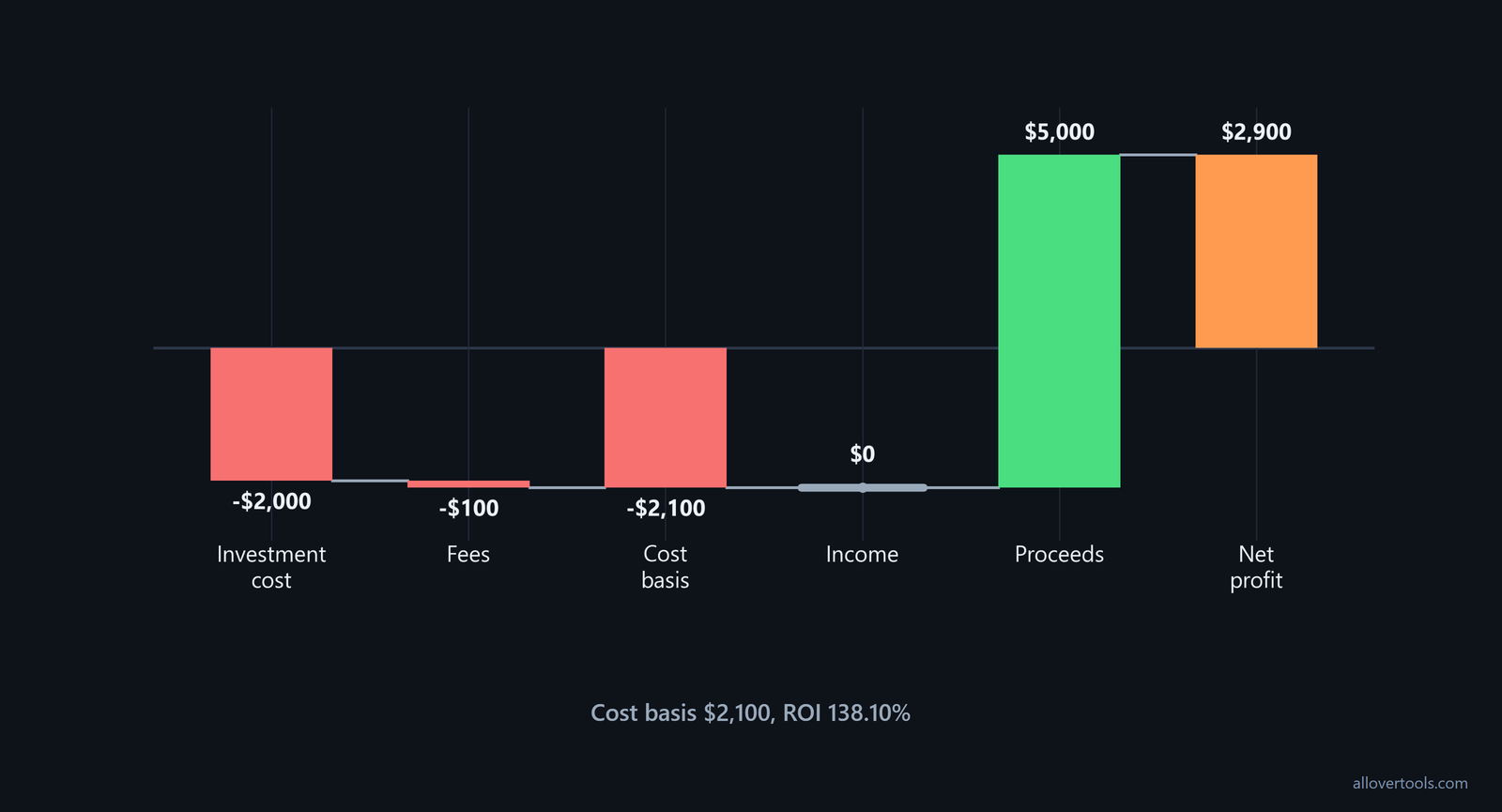
Total cost basis = $2,000 investment cost + $100 fees = $2,100
Net profit = $5,000 proceeds + $0 income - $2,100 = $2,900
ROI = $2,900 / $2,100 x 100 = 138.10%
Do not enter ARR uplift as profit unless the business has defined how to realize and recognize it.
How to report expansion ARR to stakeholders
Use one consistent period and a recurring-revenue bridge. Put new business on its own line before the bridge reaches ending ARR.
Forecast expansion using historical seat behavior
Past seat behavior can provide a forward-looking expansion input. The model multiplies existing customer seat count by average expansion rate; the coefficient comes from historical plan upgrades and additional users. Combine that estimate with new ARR and churn forecasts in the ARR forecast formula. Use the seat forecast model to document the historical basis for the rate. Keep existing customer seat count, average expansion rate and resulting estimate as separate inputs, and keep the estimate separate from later actuals in the revenue bridge. Past upgrades and added users provide the coefficient; current seat count provides the base.
The expansion ARR line in a revenue bridge
Starting ARR
+ New ARR
+ Expansion ARR: upgrades
+ Expansion ARR: add-ons
+ Expansion ARR: cross-sells
- Contraction ARR
- Churned ARR
= Ending ARR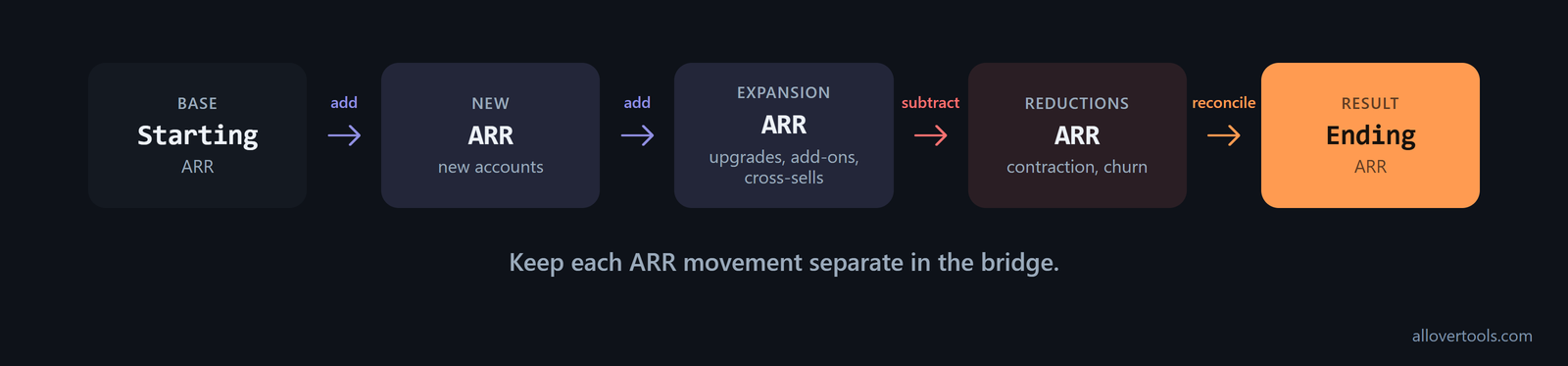
The reconciliation is:
Ending ARR = starting ARR + new ARR + expansion ARR
             - contraction ARR - churned ARR
Each movement is positive when it adds recurring revenue and negative when it reduces the starting base. Report gross expansion separately from NRR, and keep the customer count or account list behind each component so a seat increase is not mistaken for a new logo.
A campaign-level bridge can place expansion and churn next to each other without collapsing them into one unexplained number. In the campaign example, a company with 200 customers and $1M ARR has 10% of its base upgrade by an average of $2,000 per year, while 5% churn at an average of $1,500 per year:
| Movement | Customers | Calculation | ARR effect |
|---|---|---|---|
| Expansion upgrades | 20 | 20 x $2,000/year | $40,000 expansion ARR |
| Churn | 10 | 10 x $1,500/year | Churn loss |
Put $40,000 on the expansion line and the churn loss on the churn line. That keeps the campaign's expansion result visible instead of hiding churn losses in a net figure.
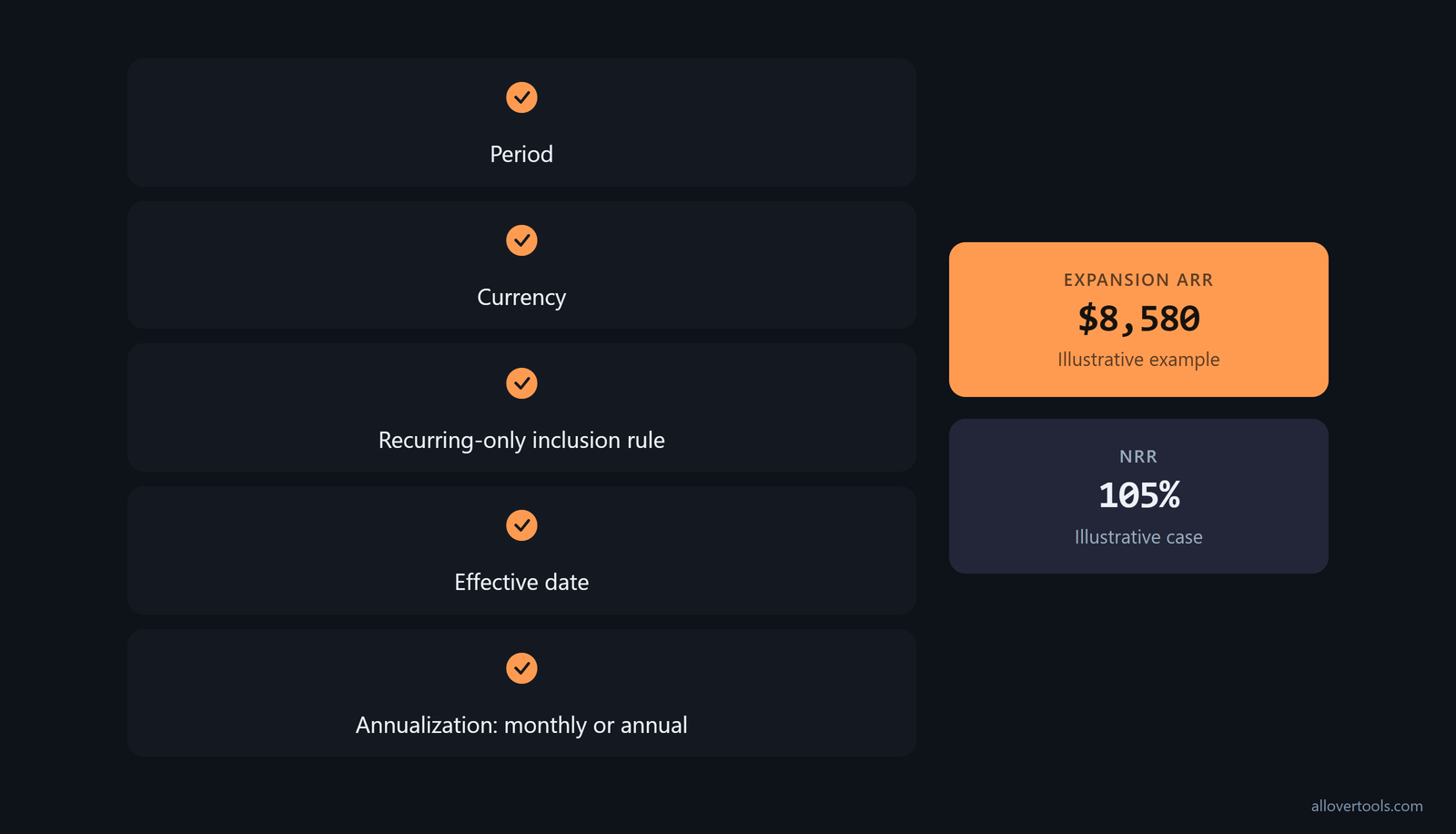
Label the period, currency, recurring-only inclusion rule, effective date, and whether the figure is monthly annualized or already annual. Pair the chosen $8,580 expansion example with the chosen 105% NRR case, and mark both as illustrative. The SaaS Metrics Calculator helps check "Ending recurring revenue", MRR/ARR, expansion, contraction and churn outputs. Its monthly annualized growth warning describes a rough projection, not a forecast.
Frequently asked questions
What is expansion ARR?
It is the annualized recurring revenue increase from existing active customers, including upgrades, add-ons and cross-sells. Exclude new customers, one-time fees, contraction and churn from the gross expansion figure.
How do you calculate expansion ARR from an upgrade?
Multiply the incremental recurring charge per billing period by the number of periods per year and affected subscriptions. For a chosen $150 monthly uplift on one account, $150 x 12 = $1,800 expansion ARR.
Is expansion ARR included in new ARR?
No. New ARR comes from brand-new customers, while expansion ARR comes from customers already in the starting base. Keep both lines separate in the revenue bridge.
Can expansion ARR make NRR positive?
Yes. Expansion can offset contraction and churn, and NRR is above 100% when the retained starting base grows after those movements. New business is excluded from the NRR numerator.
Does expansion ARR increase LTV?
It can raise the LTV estimate when higher ARPU increases gross margin per period and margin and churn assumptions stay unchanged. The result remains an assumption-based estimate, not a guarantee that retention improved.