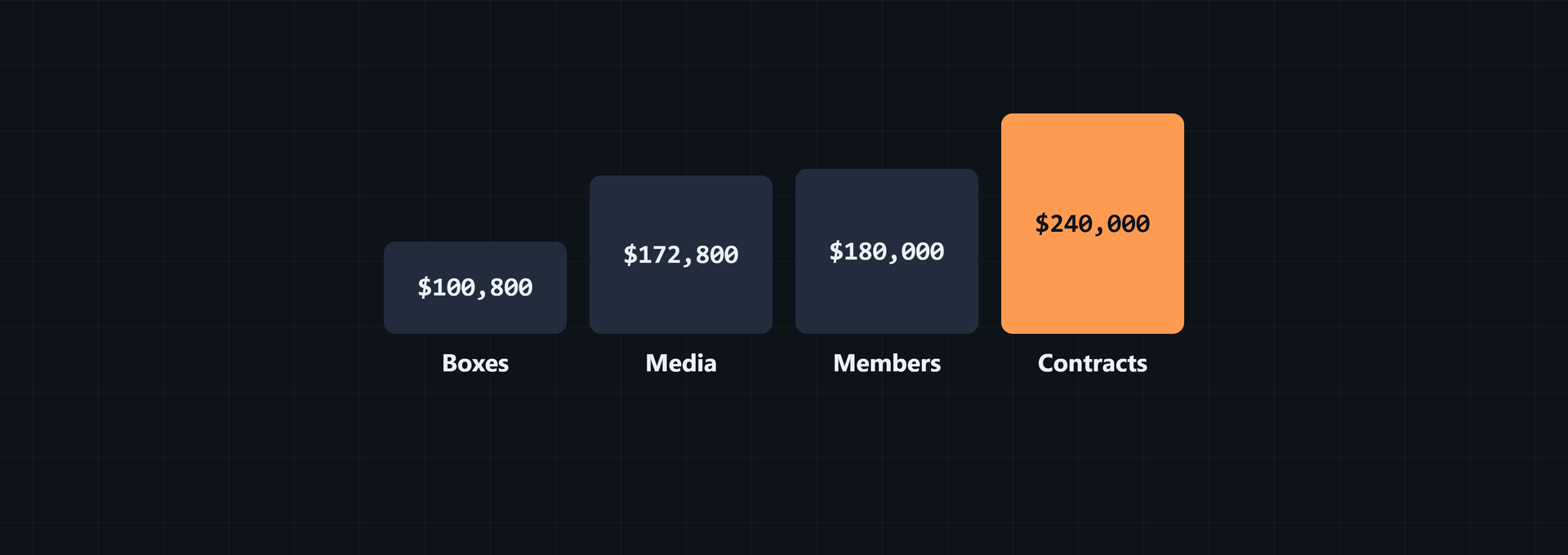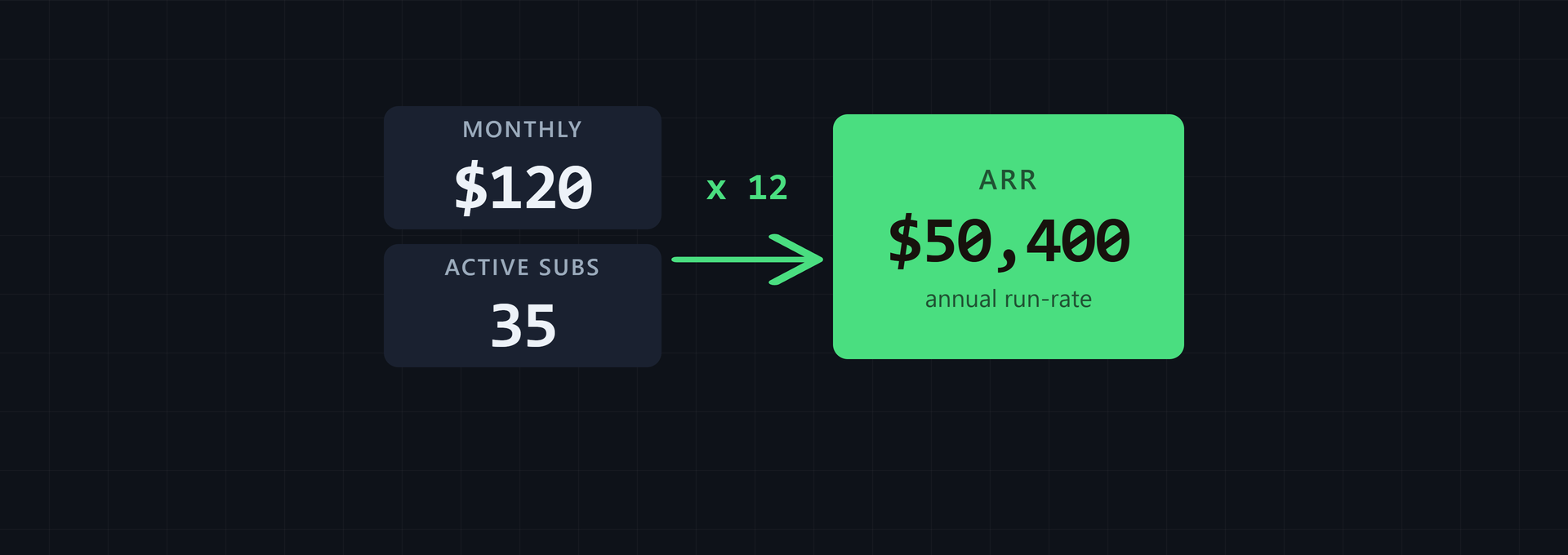
ARR for multi year contracts is the recurring annual run-rate, not the full contract value or cash collected at signing. Divide the recurring contract value by the number of contract years, then leave out setup charges, one-time fees, and non-recurring discounts. The result is the annual figure used for comparison.
How to calculate ARR from a multi-year contract
For a multi-year subscription, divide only the recurring subscription portion across the contracted years. The formula is:
ARR = recurring total contract value / contract yearsAt the reporting date, ARR includes the active annual run-rate, not every future year in a signed contract. One filed definition divides total committed contract value by the number of months in the term and multiplies by 12. That puts one year of a multi-year contract into ARR at a time. Contracts that have not started or have expired are outside the snapshot, according to the SEC definition.
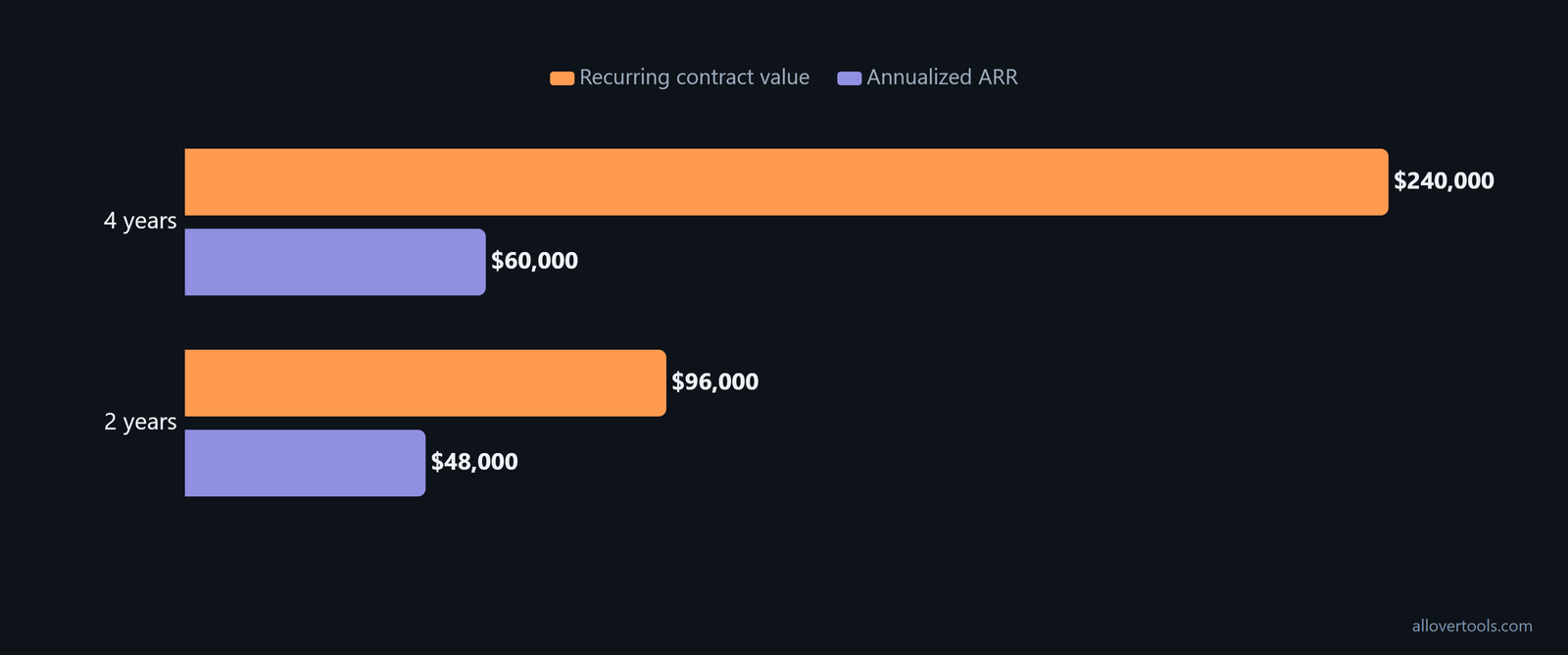
The same calculation applies to ARR from multi year deal values. A chosen recurring value of $96,000 over two years gives $48,000 ARR. A chosen recurring value of $240,000 over four years gives $60,000 ARR. Setup charges, one-time fees, and non-recurring discounts are left out of both figures.
To check either result, open the ARR Calculator. Enter the calculated annual amount as Recurring revenue per billing period, select Annual (1 period/year), leave Number of identical subscriptions (optional) at 1, and select Calculate ARR. The tool then shows ARR and MRR from the values entered in the browser.
Upfront cash does not make a multi-year contract into multi-year ARR. A $24,000 contract covering two years contributes $12,000 ARR because only the first twelve months count toward the annualized run-rate. The full amount is closer to a contract-value or cash measure, as this ARR normalization guide explains.
The contract structure also tells you how secure that annual run-rate is. Typical multi-year terms are 2-4 years, non-cancellable throughout the contracted term, and invoiced for each annual period at the beginning of that year, according to a filed contract description. Record the term, cancellation clause, and invoice timing beside ARR. That helps stakeholders separate the live run-rate from the payment schedule.
For an odd-length term, use days when the contract policy calls for day-level precision. Divide active contract value by expiration date minus start date, then multiply by 365 days, or 366 in a leap year. Ramped pricing needs a separate check too: include only the annualized value of the components active on the ARR calculation date and leave future committed increases out, as the ramp-contract guidance sets out.
A signed deal that is not live belongs in a forward-looking contracted metric, not current ARR. CARR is defined as ARR plus the annualized recurring value of signed-but-not-live contracts, less signed downgrades and communicated churn. Use it to show where signed business will take the company once it starts, as the CARR explanation describes.
Keep the sales and accounting measures separate when reviewing a multi-year booking. For a fully recurring two-year contract worth $300,000, bookings are $300,000, ARR is $150,000, and the monthly recurring amount is $12,500. Invoices issued and revenue recognized are separate values because they answer different timing questions, as this four-metric comparison shows.
| Measure | Two-year, $300,000 recurring contract | Use it for |
|---|---|---|
| Bookings | $300,000 | Signed business value |
| ARR | $150,000 | Annualized run-rate at the date |
| Monthly recurring amount | $12,500 | Monthly view of the ARR |
| Invoices issued | Separate billing value | Amounts billed under the schedule |
| Revenue recognized | Separate service-delivery value | Accounting timing |
Two-year and four-year ARR examples
| Chosen recurring input | Contract term | Calculation | ARR |
|---|---|---|---|
| $96,000 | 2 years | $96,000 / 2 | $48,000 |
| $240,000 | 4 years | $240,000 / 4 | $60,000 |
These are chosen examples. Each input is the total recurring contract value; each ARR result is the annual run-rate. Treating the full $96,000 or $240,000 as ARR would ignore the contract term.
How to annualize quarterly subscription payments
ARR for quarterly billing uses the charge for one quarter and four billing periods per year. Multiply the quarterly charge by four. If a monthly figure is also needed, divide the annual result by 12.
Chosen quarterly charge: $7,500
ARR = $7,500 * 4 = $30,000
MRR = $30,000 / 12 = $2,500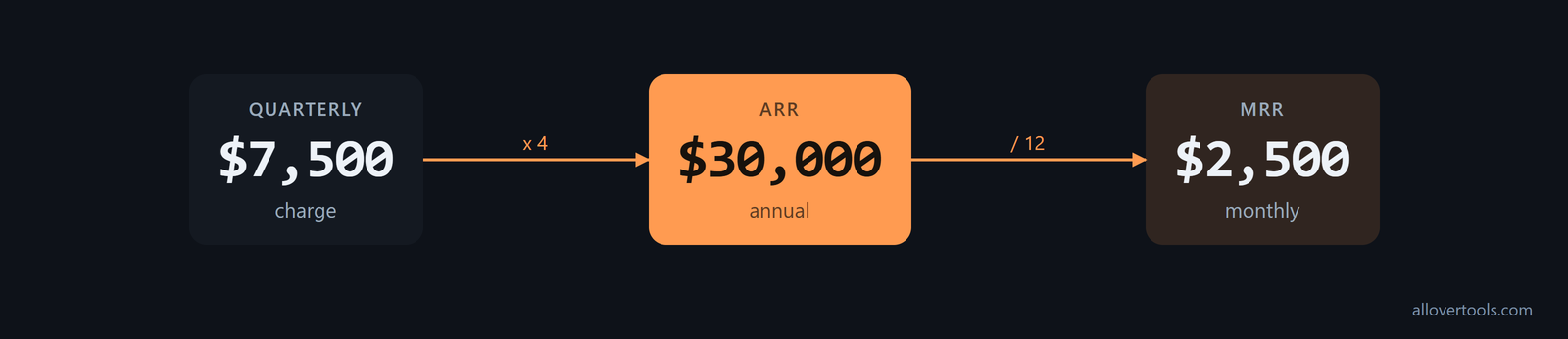
In the ARR Calculator, enter $7,500 in Recurring revenue per billing period. Choose Quarterly (4 periods/year), leave Number of identical subscriptions (optional) at 1, and select Calculate ARR.
The Billing period control also offers Monthly (12 periods/year), Semi-annual (2 periods/year), Annual (1 period/year), Weekly (52 periods/year), and Custom cycle length…. For a custom cycle, enter Days per billing cycle; the tool uses 365.25 / days per billing cycle to determine periods per year. Do not multiply an amount that is already annualized by four.
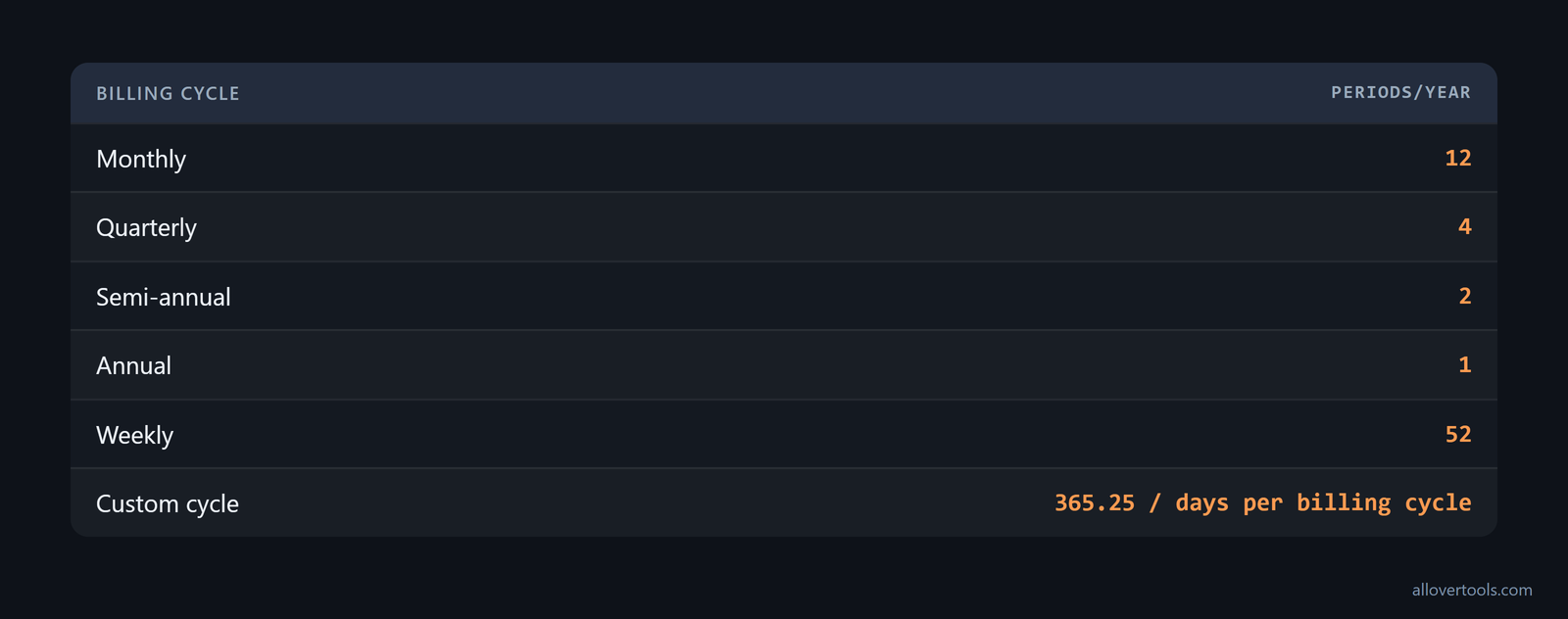
Once each active contract is normalized, billing frequency does not change the annual metric. Convert quarterly, semi-annual, and annual charges to a monthly rate, then multiply that rate by 12. For a contract shorter than one year, include the annualized amount only while the contract is active, as this billing-cycle guidance states.
The shortcut depends on the portfolio. Quarterly recurring revenue multiplied by 4 works for a simple quarterly-invoiced set. For mixed terms and board-ready reporting, calculate each contract by dividing contract value by contract years, then sum the results. A customer paying $1,200 annually, $100 monthly, or $300 quarterly maps to the same $1,200 ARR once normalized, as this ARR tutorial demonstrates.
How to combine monthly and annual customers into ARR
For ARR for mixed billing cycles, convert every customer or billing cohort to the same annual metric before adding anything. Monthly and annual invoice totals cannot be compared as they stand. Keep each cohort visible until its billing-period factor and annualized amount have been checked.
Normalize each billing cohort before adding it
| Billing basis | Chosen input | Annual factor | Normalized ARR |
|---|---|---|---|
| 12 monthly customers | $400 each | 12 * $400 * 12 | $57,600 |
| 3 annual customers | $6,000 each | 3 * $6,000 * 1 | $18,000 |
| Combined | Both cohorts | $57,600 + $18,000 | $75,600 |
These are chosen values. The monthly cohort produces $57,600 ARR and the annual cohort produces $18,000 ARR. The combined normalized ARR is $75,600. That total adds the annualized recurring amounts, not the face values of monthly and annual invoices. This is ARR contract normalization.
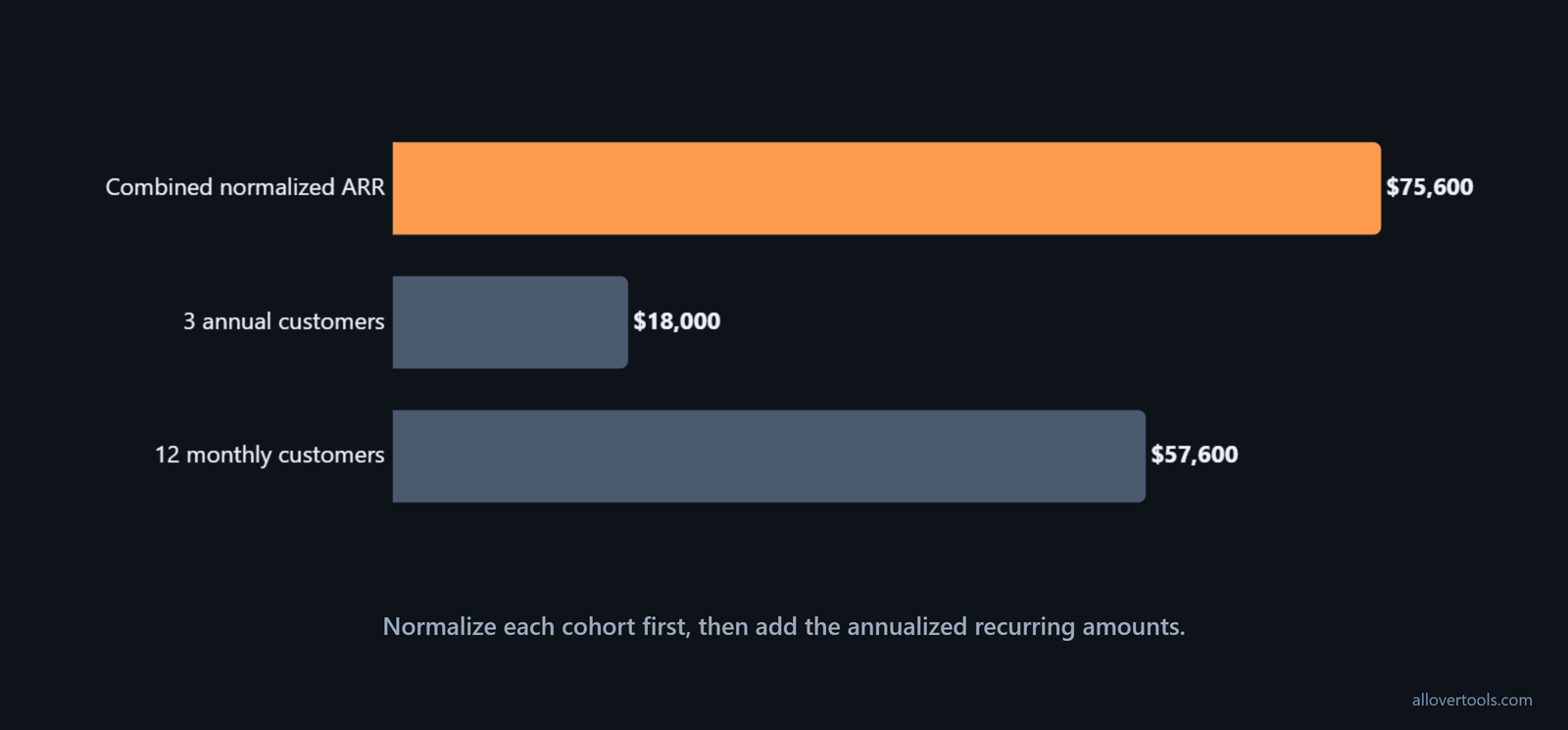
Calculate each cohort separately in the ARR Calculator. Its currency selection changes the displayed symbol, but it does not convert amounts. Keep currencies separate unless an exchange-rate policy is applied outside this calculation.
Apply the same mapping to every contract type so the annual figure does not accidentally absorb total contract value:
| Contract type | ARR treatment | Where the full value belongs |
|---|---|---|
| Monthly | Recurring monthly value converted to twelve months | ARR after normalization |
| Annual | Recurring annual value at a one-year factor | ARR after normalization |
| Multi-year | $270,000 / 3 years = $90,000 ARR | $270,000 in TCV and backlog |
The multi-year row is the check: report $90,000 in ARR and retain $270,000 in TCV or backlog. The dashboard can then show annual recurring capacity without treating the remaining committed value as current run-rate, following the contract-type mapping.
How upgrades and downgrades change ARR mid-period
For an ARR snapshot, use the recurring run-rate active after an upgrade or downgrade takes effect at the reporting cutoff. A change that happens partway through a period does not require prorating the ARR run-rate. Revenue recognition, cash collected, and partial-period billing are separate measures.
Use effective recurring revenue at the reporting cutoff
Enter expansion and contraction as positive amounts in the MRR movement tool. The formula adds Expansion MRR, then subtracts Contraction MRR and Churned MRR.
Starting MRR: $10,000
New MRR: $0
Expansion MRR: $1,200
Contraction MRR: $400
Churned MRR: $0

Ending MRR = $10,000 + $0 + $1,200 - $400 - $0 = $10,800
Ending ARR = $10,800 * 12 = $129,600
The upgrade adds $1,200 * 12 = +$14,400 to the annualized run-rate. The downgrade removes $400 * 12 = -$4,800. Together, they produce a net ARR change of +$14,400 - $4,800 = +$9,600.
In the MRR Calculator, enter the five values under Starting MRR, New MRR, Expansion MRR, Contraction MRR, and Churned MRR. Select Calculate MRR movement, then annualize the resulting ending MRR by multiplying it by 12.
How to report normalized ARR consistently to stakeholders
Use the same treatment in every reporting period. Define ARR as recurring annual run-rate. Divide recurring multi-year contract value by years, apply the correct billing-period factor, put every customer on the same annual basis, and apply upgrades or downgrades at the agreed cutoff. Exclude one-time fees and non-recurring discounts. Keep currencies separate when no conversion policy is in place.
Set the scope rule before publishing the number. Exclude one-time or non-recurring revenue. Do not include anticipated renewals or non-renewals, and leave out users on offerings shorter than an annual subscription term when following the filed ARR definition. The issuer's scope rule makes those exclusions explicit. This keeps a trial, pilot, implementation fee, or expected renewal from inflating a period-end ARR snapshot.
Multi-year changes also require a policy choice. One documented policy uses the initial year of annualized contract value for the whole multi-year term, does not reflect later in-term changes, and resets ARR to the first-year value of the renewal contract. It is described as more conservative because most multi-year contracts have the same annual recurring revenue each year and fluctuating contracts mostly increase over the term, according to this SEC response. If used, label it as the company's ARR policy and apply it to every comparable contract.
ARR is a contract operating measure, not a replacement for the income statement. It comes from annualized values of active contracts and aligns with amounts invoiced annually. It is not annualized recognized or unearned revenue, and there is no direct relationship between ARR and revenue recognized under ASC 606, as the accounting clarification states. Reconcile the two in separate reports instead of forcing ARR to equal GAAP revenue.
When discounts or price locks are material, report the durability of the annual number as well as its size. The cited buying guidance puts additional multi-year discounts at 10-15% for two-year commitments and 15-25% for three-year commitments. Price locks with no annual escalation can be achieved at both tiers. Record the discount band and price-lock condition because a three-year deal at 15% off is described as producing more predictable ARR than three one-year deals at list price when renewal is not guaranteed, according to the SaaS buying guide.
A consistent ARR reconciliation format
Present the reconciliation in this order:
- Opening normalized ARR.
- Additions from new or upgraded recurring contracts.
- Reductions from downgrades or churn.
- Ending normalized ARR.
- An assumptions note.
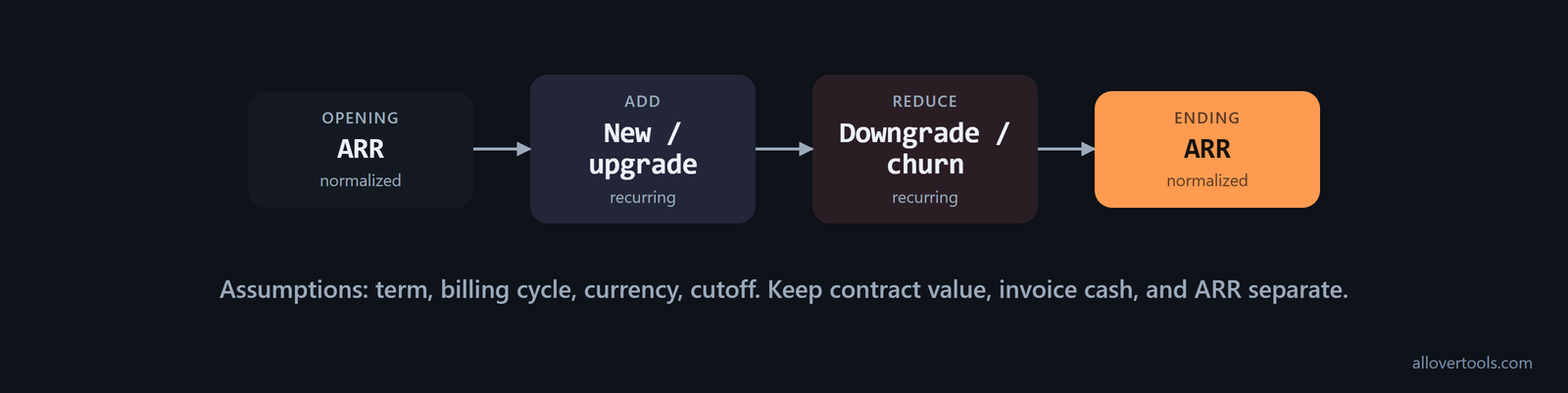
Add notes for contract term, billing cycle, currency, and cutoff convention. Keep the cohort calculations with the report so stakeholders can trace the $75,600 mixed-billing ARR or the $129,600 post-movement ARR back to its inputs. Do not put contract value, invoice cash, and annualized run-rate in one column.
The SaaS Metrics Calculator supports a broader one-period review of MRR, ARR, and movement. Use one period type for all its inputs: Monthly - figures below are for one month or Annual - figures below are for one year.
Frequently asked questions
How do I calculate ARR from a two-year contract?
Divide the recurring contract value by 2. For the chosen $96,000 example, $96,000 / 2 = $48,000 ARR; one-time fees are not included.
How do you annualize quarterly subscription revenue?
Multiply the recurring quarterly amount by 4. The chosen $7,500 quarterly charge produces $30,000 ARR, and the ARR Calculator's Quarterly (4 periods/year) option applies that factor.
Should a four-year contract count at its full value in ARR?
No. Divide the recurring total contract value by 4; the chosen $240,000 four-year contract produces $60,000 ARR.
How should a mid-period upgrade or downgrade affect ARR?
At the agreed reporting cutoff, use the active recurring run-rate after the change is effective. In the chosen example, +$1,200 expansion and -$400 contraction change ARR by ($1,200 - $400) * 12 = +$9,600.