ARR calculation methods start with either total monthly recurring revenue or each subscription contract. Multiply steady-state MRR by 12, or annualize each recurring contract and add the results. ARR expresses recurring revenue for one year; MRR expresses recurring revenue for one month.
Annualized run rate versus contracted ARR
Before comparing a dashboard, spreadsheet, or calculator result with another system, name the ARR convention it uses. In modern SaaS reporting, ARR usually means Annualized Run Rate: current Monthly Recurring Revenue multiplied by 12. A stricter Annual Recurring Revenue definition counts only contracts lasting 12 months or longer, as this ARR definition explains.
With the run-rate convention, MRR x 12 is the recurring-revenue pace implied by the current month. With the contract-based convention, divide total contract value by the number of contracted years and count only qualifying annual or multi-year commitments. A $6,000 contract over 4 years gives $1,500 ARR in 2026; counting the full $6,000 as one year's ARR would overstate it.
Use the first convention when you start with a current MRR total. Use the second when you are reporting committed contract value. Put the convention next to the result, especially when comparing investors' reports, internal dashboards, and tools that may use different definitions. The figures are comparable only when the commitment rule is the same.
ARR is a run-rate measure. It is not recognized revenue or a guaranteed forecast. Ending ARR is Ending MRR x 12, which annualizes the current recurring-revenue pace. Customers and plans can change, so the calculator guidance separates this figure from revenue actually recognized and from a promise about next year's result. Use the annualized number to compare recurring performance. Report recognized revenue on its own basis.
How to calculate ARR from MRR: MRR x 12
If MRR is the full steady-state monthly recurring revenue, use the ARR MRR x 12 formula:
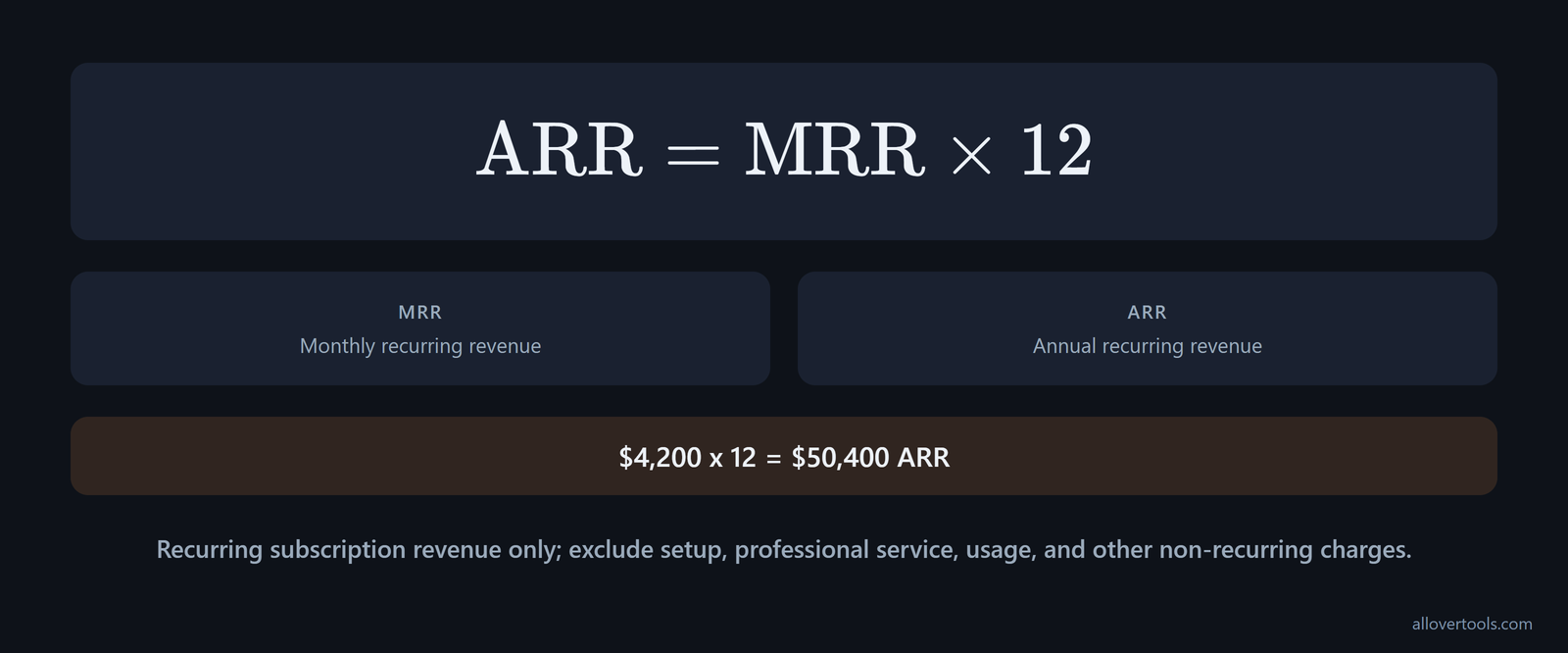
ARR = MRR x 12For the chosen $4,200 MRR:
$4,200 x 12 = $50,400 ARR
$50,400 / 12 = $4,200 MRR
Use recurring subscription revenue only. Leave setup, professional service, usage, and other non-recurring charges out of MRR before applying the formula.
How to calculate ARR from individual subscription contracts
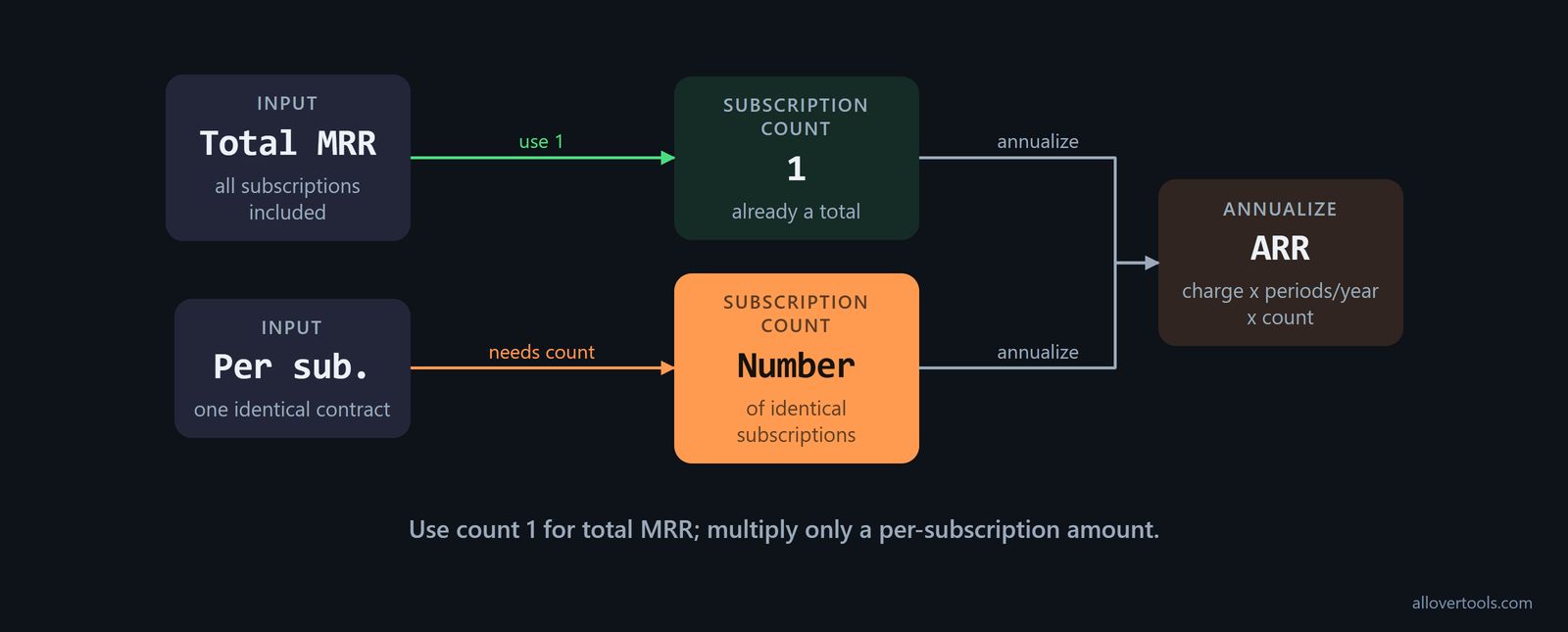
Calculate ARR for each recurring contract, then add the contract amounts. For one contract, multiply the recurring charge per billing cycle by the number of billing periods in a year. Multiply again by the subscription count only when the input is for one identical subscription.
A total MRR input already includes all subscriptions, so use a count of 1. A per-subscription input needs the number of identical subscriptions. Keeping those inputs separate prevents the same revenue from being counted twice when calculating ARR from contract values or annualizing subscription revenue.
Monthly subscription payments
For one monthly contract at $250:
$250 x 12 = $3,000 ARR per contractWith 18 identical contracts, apply the count to the per-subscription amount:
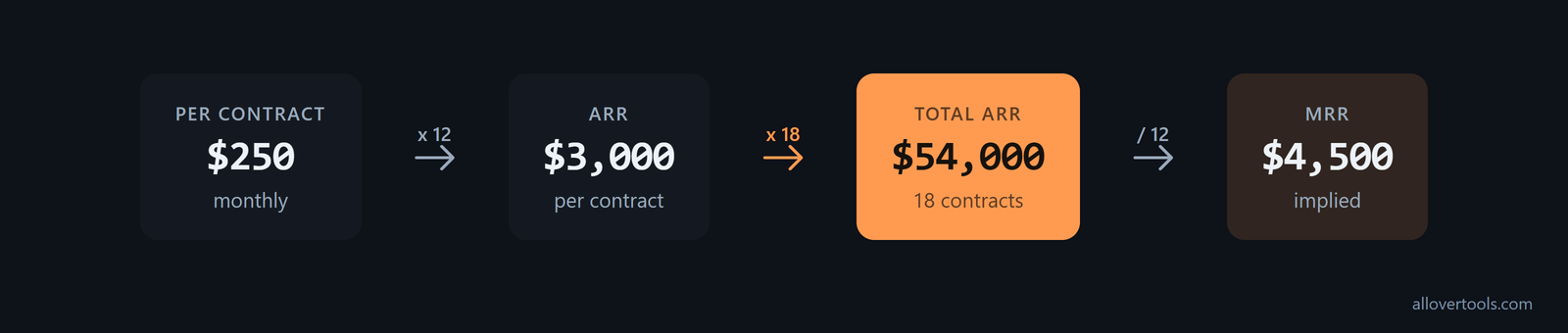
$250 x 12 x 18 = $54,000 total ARR
$54,000 / 12 = $4,500 MRR
If $4,500 is already the total monthly recurring revenue, use a count of 1. Multiplying that total by 18 would count the same contracts again.
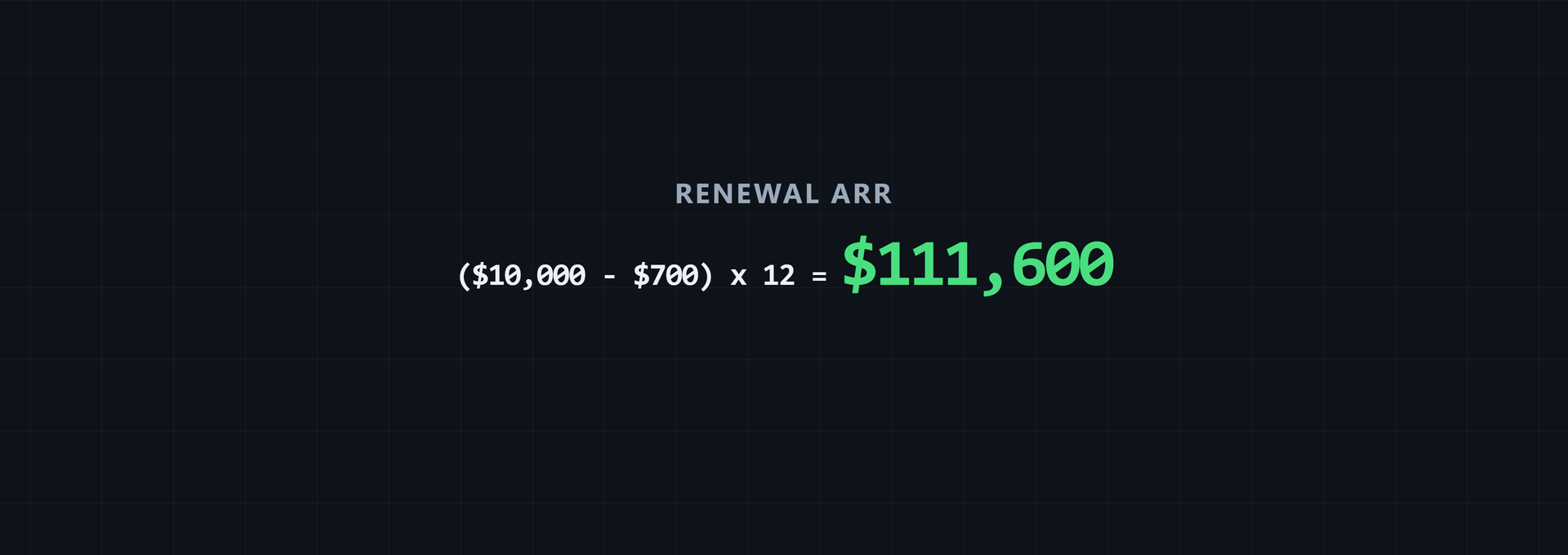
Do not turn every monthly payment into ARR if the reporting rule requires a contractual commitment. Under that rule, a customer who pays $10,000 with no contract has $0 ARR. A customer with a $1,000 monthly renewal agreement has $12,000 ARR in 2026, according to this ARR rule. Keep non-contracted monthly revenue in MRR or in a separate run-rate measure when that is the convention.
Quarterly and annual subscription payments
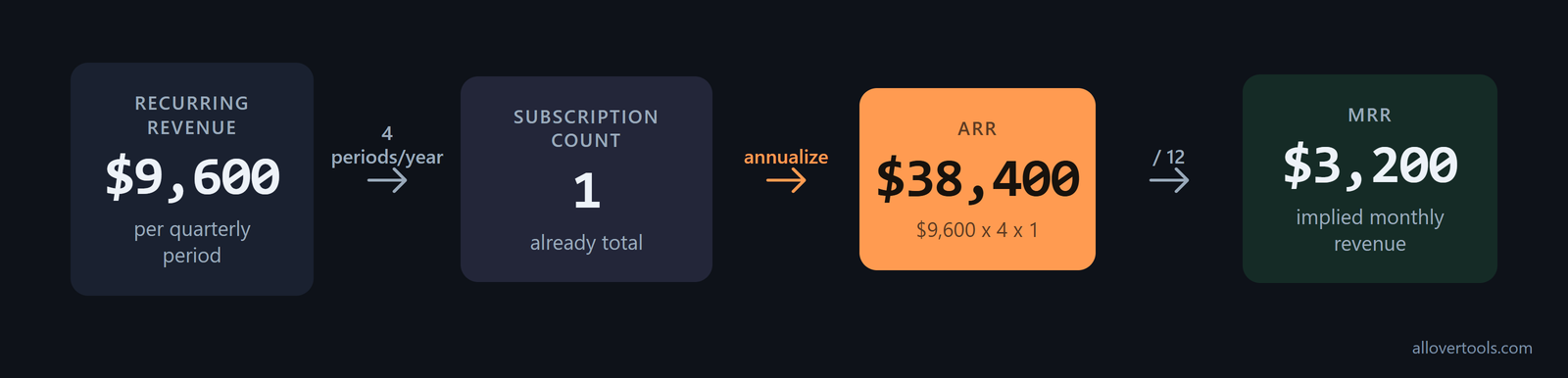
Use billing periods to set the annual factor. A quarterly charge of $9,600 has four billing periods per year:
$9,600 x 4 = $38,400 ARR
$38,400 / 12 = $3,200 MRR
An annual charge has one billing period per year:
$28,000 x 1 = $28,000 ARR
$28,000 / 12 = $2,333.33 MRR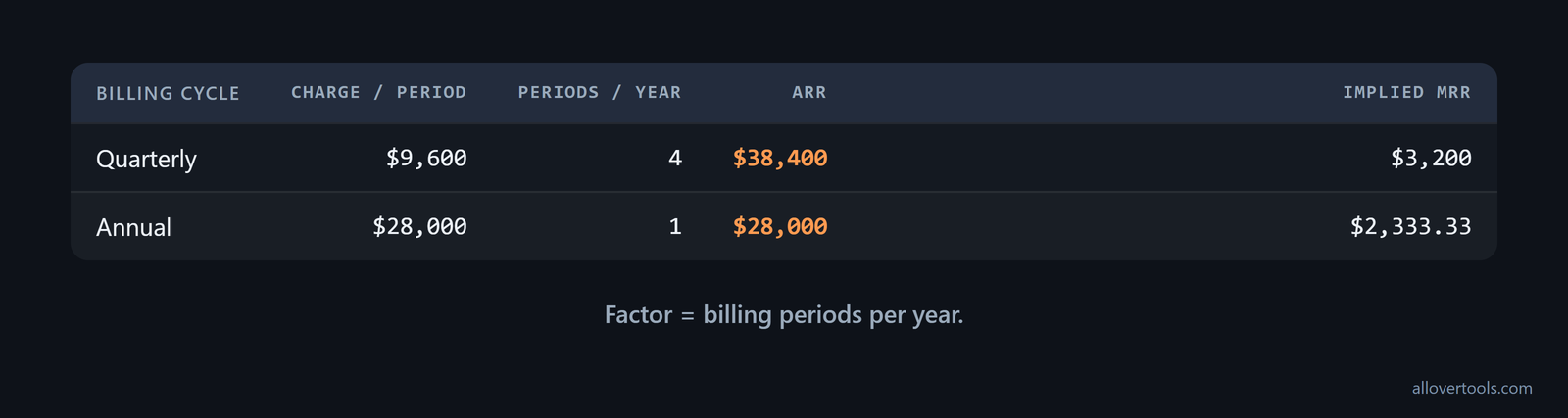
The annual MRR display is rounded to two decimal places. The ARR Calculator also labels semi-annual and weekly factors, but the examples here use monthly, quarterly, and annual contracts.
Multi-year subscription contracts
Divide a multi-year total contract value by the contracted years before treating it as annual recurring revenue. For $72,000 over three years:
$72,000 / 3 years = $24,000 ARR
$24,000 / 12 = $2,000 MRR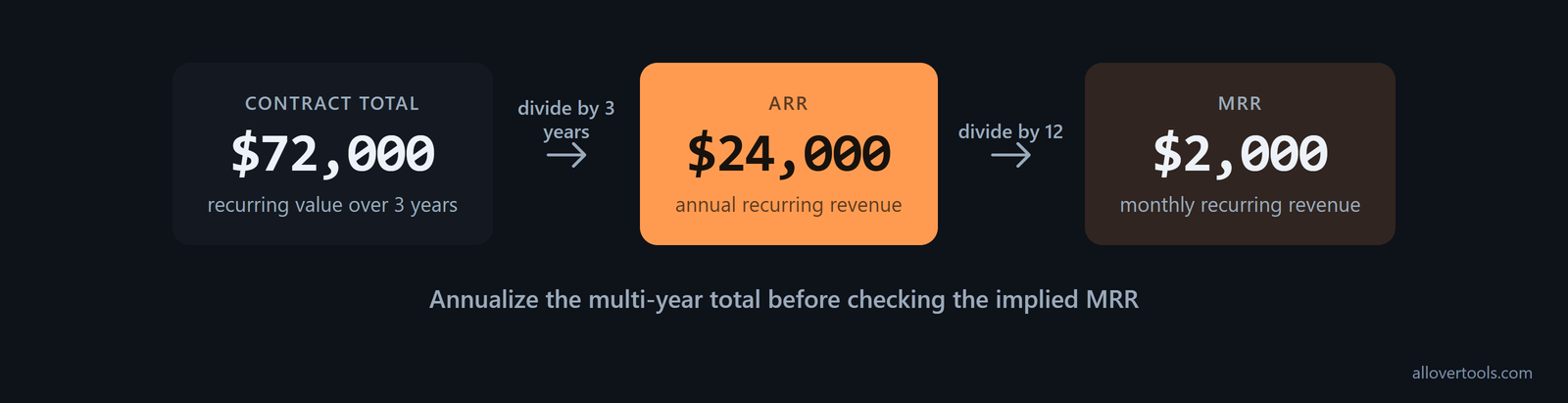
Using the full $72,000 as one year's ARR would overstate the annualized value.
How upgrades and churn change ARR
An ARR formula with upgrades and churn must use ending recurring revenue. Starting MRR alone does not include new subscriptions, upgrades, downgrades, or cancellations:
Ending MRR = Starting MRR + New MRR + Expansion MRR
             - Contraction MRR - Churned MRR
Expansion is added recurring revenue from an existing subscriber. Contraction is a downgrade or seat reduction while the subscriber remains active. Churn is a full cancellation. For the chosen inputs:
$42,000 + $5,000 + $2,400 - $900 - $1,600 = $46,900 ending MRR
$46,900 x 12 = $562,800 ARR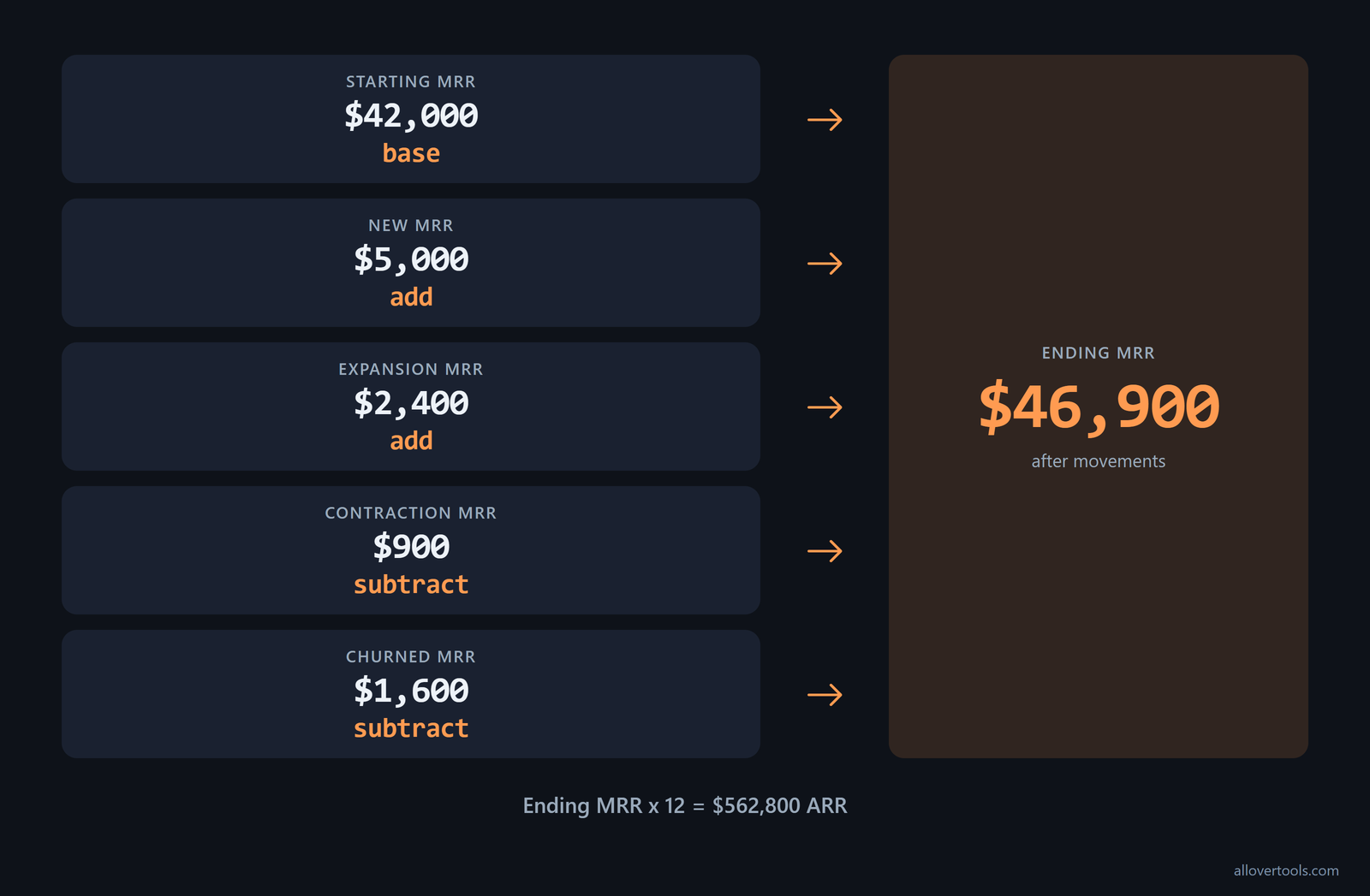
Enter loss inputs as positive amounts and subtract them in the formula. The MRR Calculator separates these movements before showing ending MRR.
Track ARR movement across the year
When the customer base changes, track the annualized movements directly: Beginning ARR + New ARR + Expansion ARR - Churned ARR = Ending ARR. the ARR movement method describes this approach. Add the annualized value of new and expansion contracts, then subtract annualized churn. Do not rely only on opening MRR.
ARR = MRR x 12 works as a shortcut only for an early-stage company with simple, consistent monthly pricing, where every customer pays the same amount every month and nothing changes. Tiered pricing, frequent plan changes, and seasonal billing break those assumptions. In those cases, use a beginning-to-ending ARR schedule. Keep expansion, contraction, and churn as separate movements so you can check the ending figure.
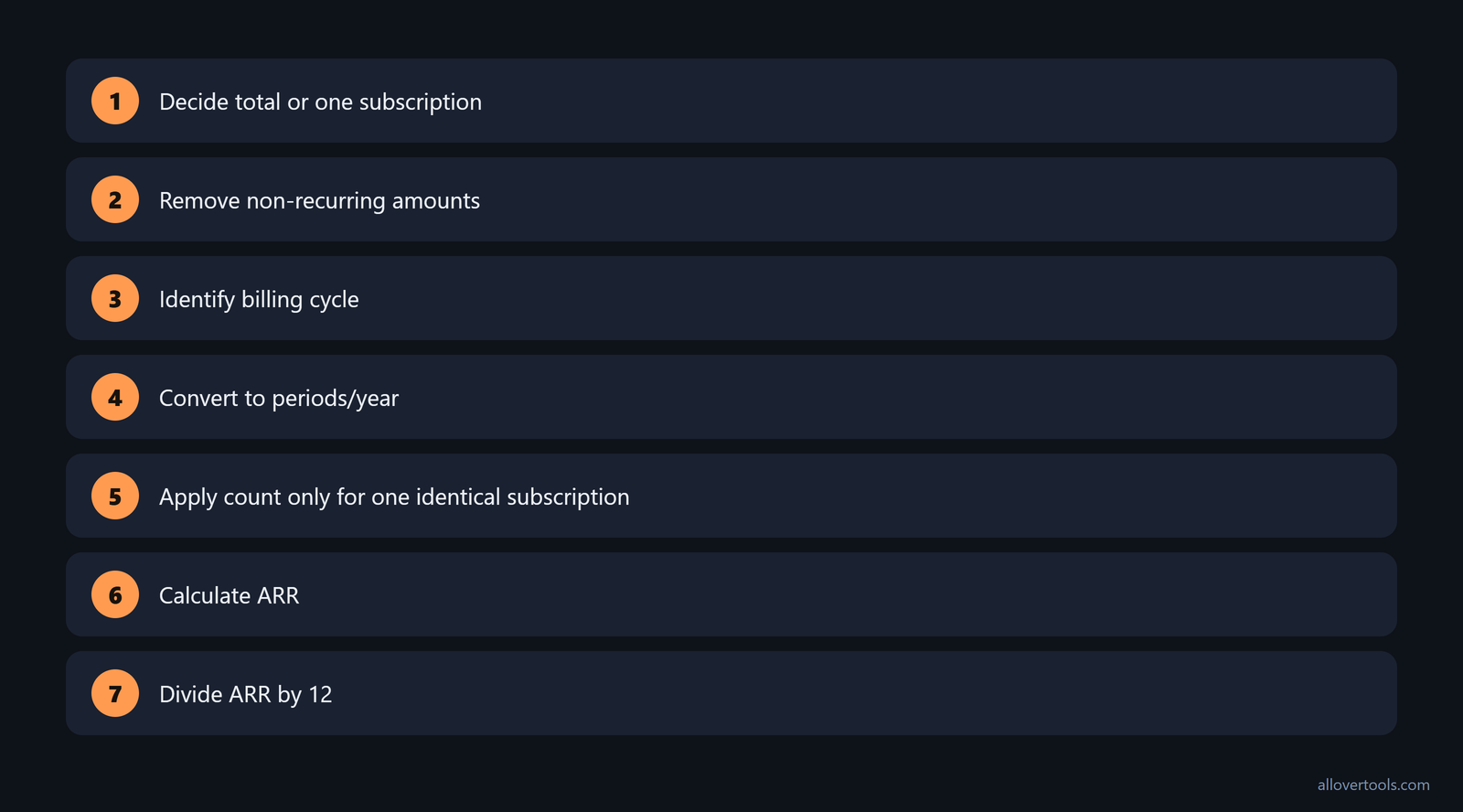
ARR calculation step by step: check your inputs
- Decide whether the amount is total recurring revenue or the charge for one subscription.
- Remove setup fees, professional services, one-time purchases, usage charges, and other amounts that do not recur on the subscription cycle.
- Identify the billing cycle: monthly, quarterly, semi-annual, annual, weekly, or custom.
- Convert that cycle to periods per year. Quarterly is 4, and annual is 1.
- Apply an identical-subscription count only when the amount represents one identical subscription.
- Calculate ARR as recurring revenue per billing period x billing periods per year x subscription count.
- Divide ARR by 12 to check the implied MRR.
Before counting customers or recurring revenue, clean the billing export. Free trials, setup charges, and one-off upgrades can show up in monthly billing data even though they do not repeat on the same subscription cycle. The input guidance treats these items as sources of ARR overstatement. Remove them before deriving MRR and ARR instead of correcting the total later.
Open the ARR Calculator and enter the amount in Recurring revenue per billing period. Choose Billing period, then enter Number of identical subscriptions (optional) when the amount is per subscription. Currency symbol changes the display only; it does not convert the amount.
Select Calculate ARR and check Formula used, the assumptions table, ARR, and MRR. If the assumptions are correct, Copy result and Download result (.txt) provide the displayed result in the formats named by those controls.
The calculation uses only values entered in the browser. The ARR Calculator files contain no fetch, XMLHttpRequest, or sendBeacon call, and they show no billing-system connection.
What ARR excludes and how to handle edge cases
Remove setup charges, professional services, one-time purchases, and discounts that do not recur. For the chosen invoice:
$30,000 invoice - $4,000 setup - $2,000 professional service = $24,000 recurring amount
Annual recurring amount = $24,000, not $30,000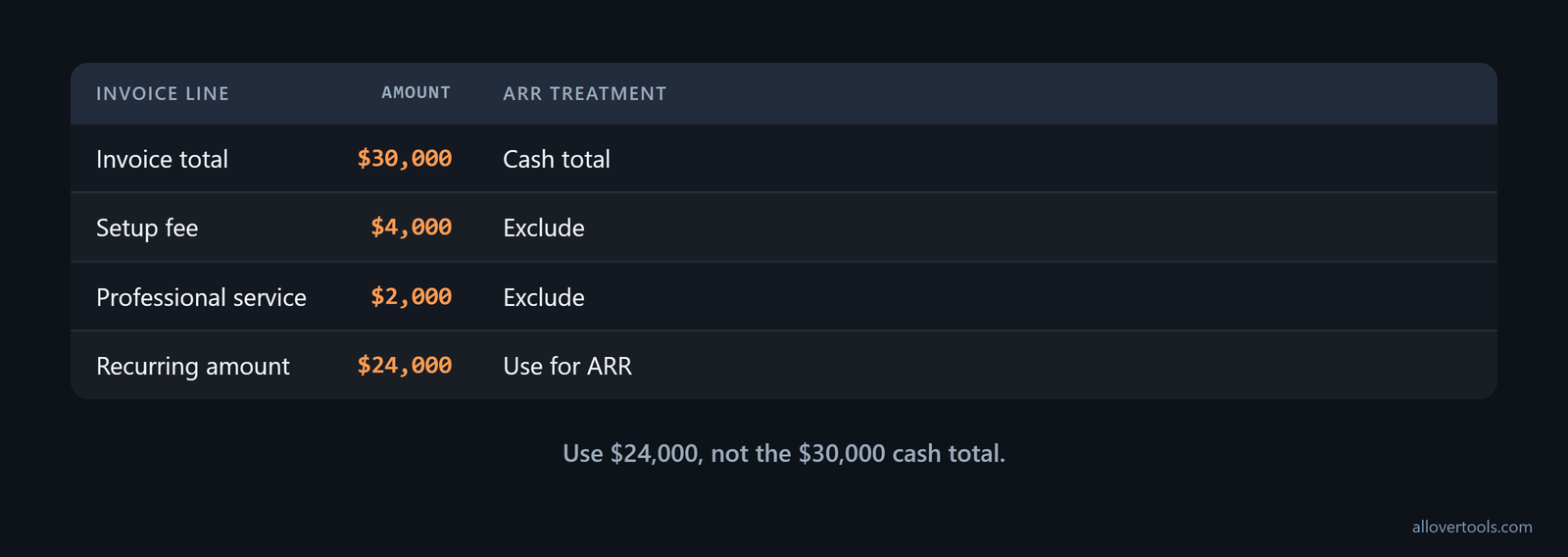
Use $24,000 as the recurring amount. The $30,000 cash total includes charges that do not renew.
Include fixed recurring service lines when the contract requires them to renew. Subscription fees and ongoing maintenance or support belong in ARR. One-time charges and variable usage fees do not. In a Salesforce example from 2024, $1,000,000 of annual maintenance is added to $10,000,000 of subscriptions, and $200,000 of churn is subtracted, producing $10,800,000 ARR, as the worked example shows.
Separate recurring revenue from one-time revenue
An invoice can combine recurring and one-time lines. In this example, removing the setup and professional service lines leaves $24,000. Before including a line, check whether it renews under the same subscription cycle.
For a mixed subscription and usage model, annualize the fixed subscription or reserved-capacity portion the customer is contractually obligated to pay. Leave metered overage and pay-per-use revenue out of ARR and track it separately. the usage-charge rule draws this line even when both amounts appear on one invoice.
Custom billing cycles and validation rules
For a $900 charge every 45 days, use the custom-cycle rule:
Periods/year = 365.25 / 45 = 8.1167 (rounded to four decimals)
ARR = $900 x (365.25 / 45) = $7,305.00
Implied MRR = $7,305 / 12 = $608.75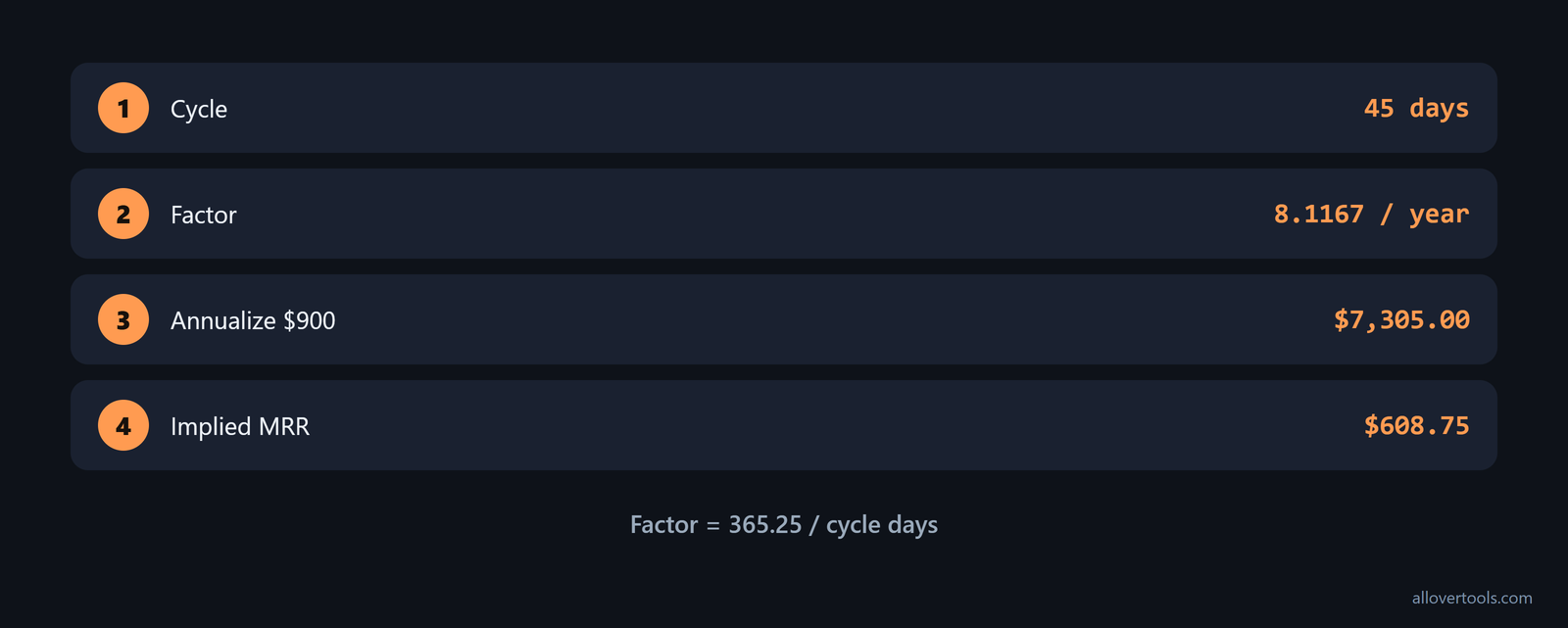
The custom field is Days per billing cycle. Recurring revenue accepts 0 or greater. Custom days must be a whole number of at least 1, and the subscription count must be a whole number of at least 1. A blank or invalid entry keeps the result hidden until it is corrected.
Semi-annual, weekly, and custom periods use their stated factors. Do not apply the monthly formula to a different billing cycle.
ARR Calculator or spreadsheet: choose the checking workflow
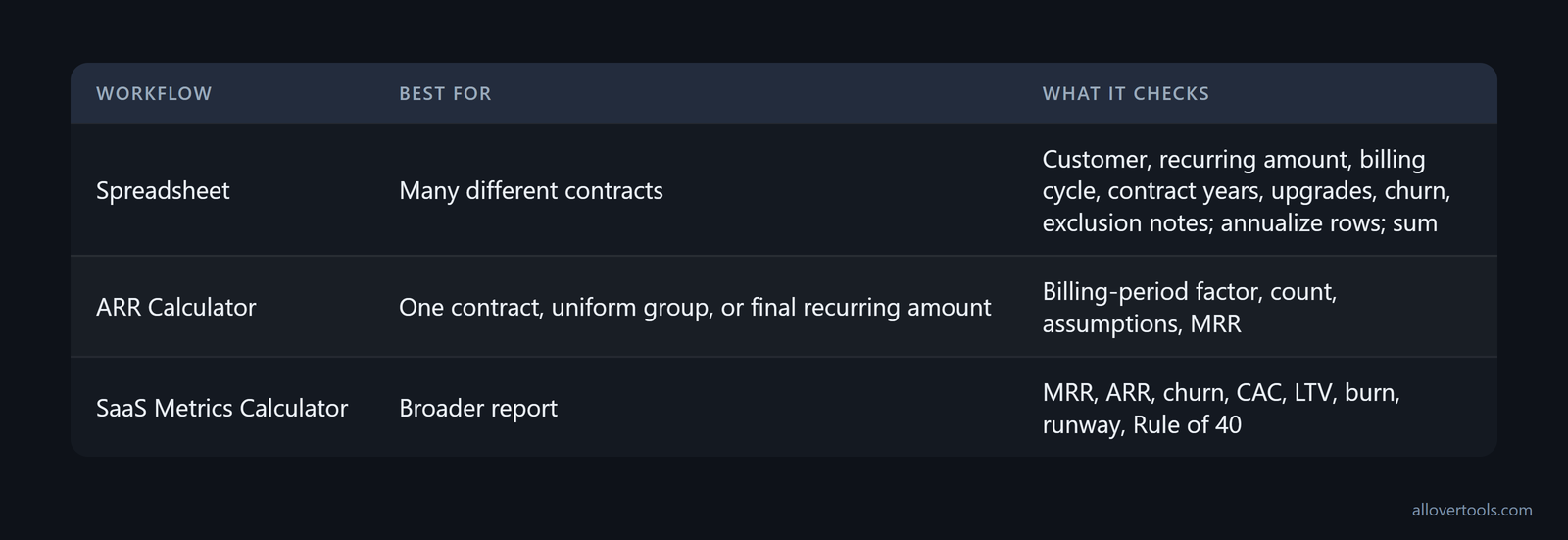
Use a spreadsheet for a portfolio of different contracts. Give each row its customer, recurring amount, billing cycle, contract years, upgrades, churn, and exclusion notes. Calculate each row's annualized recurring value, then sum the rows.
For one contract, a uniform group, or a final recurring amount, use the ARR Calculator to check the billing-period factor, count, assumptions, and intermediate MRR.
The spreadsheet method is a bottom-up ARR model: annualize each contract and add the results. For a large customer base, a top-down estimate is also possible: ARR = total number of customers x average annual contract value. The two approaches do different jobs. The customer-and-average-ACV model is faster for an aggregate estimate. The per-contract model keeps the detail needed to spot billing-cycle, commitment, upgrade, churn, and exclusion differences, as this ARR model guide describes.
Use average MRR for forecasting
A current or ending MRR x 12 is a point-in-time ARR. When monthly revenue fluctuates, a planning model can use average MRR instead. Define MRR as the number of paying customers multiplied by average recurring revenue per user. Then calculate Average MRR by dividing the sum of all monthly MRR values by the number of months. ARR = Average MRR x 12, following this forecasting definition. Use the smoothed figure for annual budgets and year-ahead planning, and label the latest-month result as the current run rate.
A broader report with MRR, ARR, churn, CAC, LTV, burn, runway, and Rule of 40 has a different scope. Use the SaaS Metrics Calculator for that report rather than a single ARR conversion.
Frequently asked questions
How do you calculate ARR from MRR?
Multiply total steady-state MRR by 12 after excluding one-time revenue. For $4,200 MRR, that gives $50,400 ARR.
How do you calculate ARR from a quarterly subscription?
Multiply the recurring quarterly charge by 4 billing periods per year. A $9,600 quarterly charge gives $38,400 ARR; an annual contract uses one period per year.
How do you calculate ARR for a multi-year contract?
Divide the recurring total contract value by the contracted years. $72,000 divided by 3 gives $24,000 ARR, not $72,000 for one year.
Does ARR include setup fees or professional services?
No. Remove setup, professional service, one-time purchase, and other non-recurring amounts before annualizing. The $30,000 invoice becomes $24,000 after removing $4,000 setup and $2,000 professional service.
How do upgrades and churn affect ARR?
Add new and expansion MRR, subtract contraction and churned MRR, then multiply ending MRR by 12. The movement example ends at $46,900 MRR and produces $562,800 ARR.