ARR vs total revenue is a classification problem. Count the recurring charge from active contracts in ARR, keep every recognized income line in total revenue, and report signed business as bookings. ARR is an annualized run-rate metric, not a GAAP income-statement line. Compare these measures only after labeling the date, currency, term, and inclusion rules.
ARR vs total revenue: two different measures
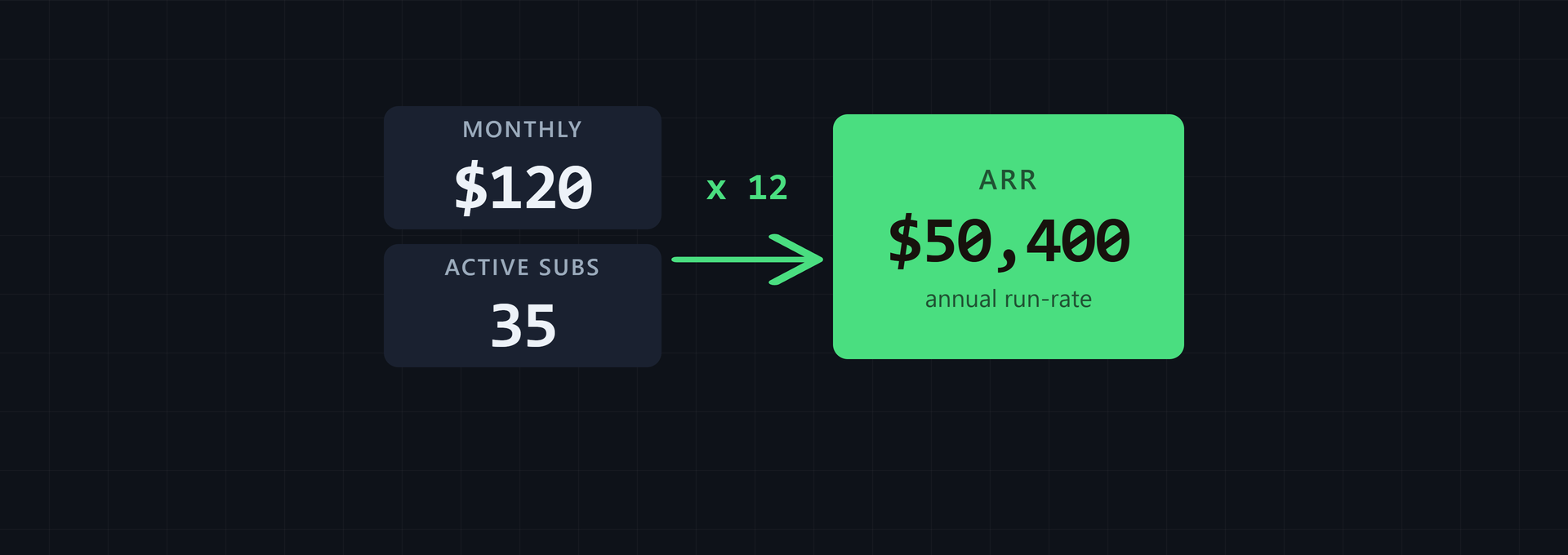
Annual recurring revenue is the recurring run rate of active contracts, expressed over a year. Use the steady-state subscription amount, not every charge on an invoice. The formula is:
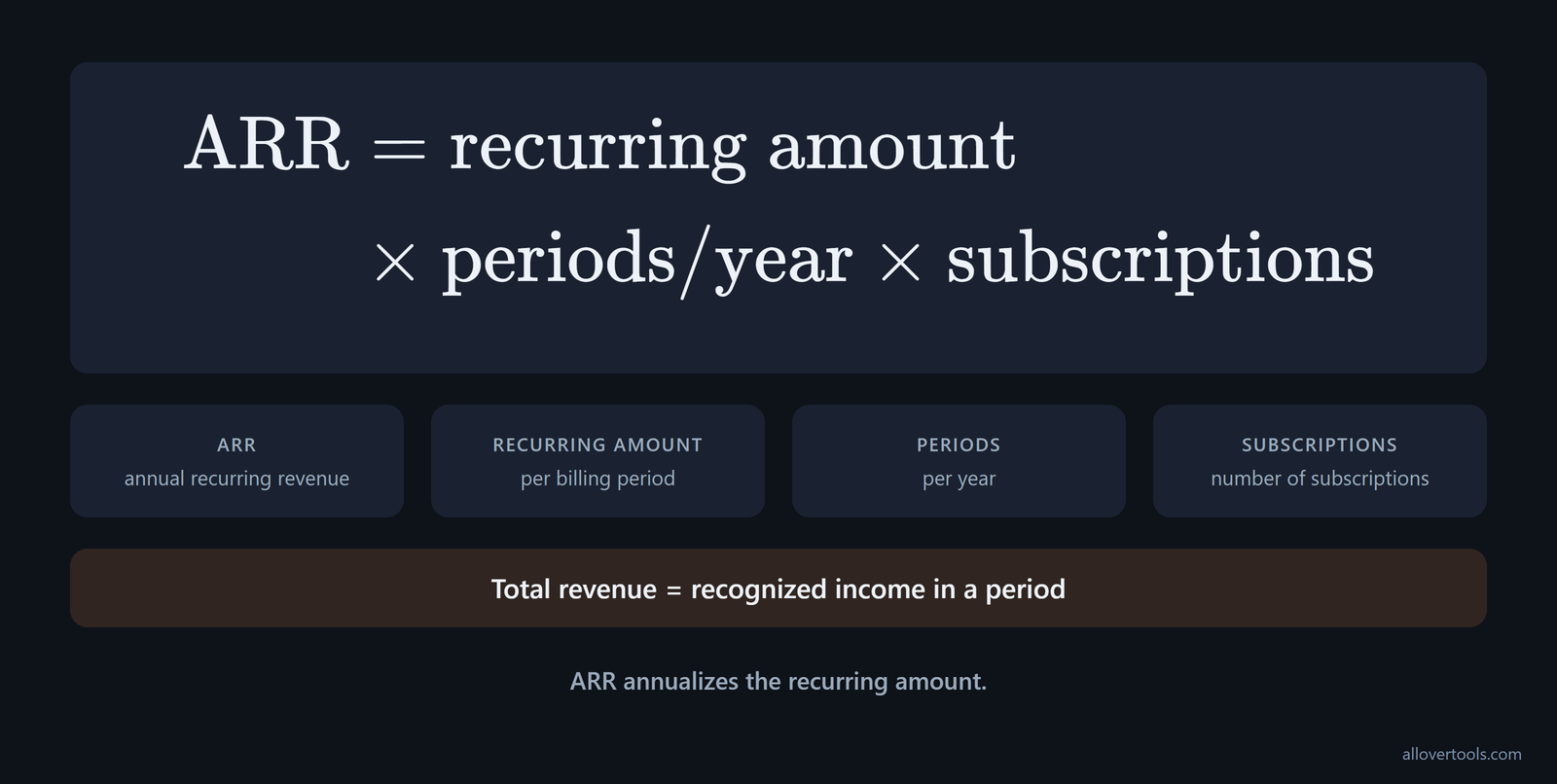
ARR = recurring revenue per billing period × billing periods per year × number of subscriptionsTotal revenue is the amount recognized during a reporting period. It can include subscription revenue, implementation and setup fees, hardware, and one-off services when those amounts meet the applicable recognition rules. Total revenue describes a period. ARR annualizes the recurring part of the contract.
That distinction is the point of recurring revenue versus overall revenue. Put the recurring charge in ARR and keep recognized income in total revenue. A monthly revenue figure and an annual run rate refer to different periods, so label the date, currency, and definition before comparing them.
Use CARR when signed future subscriptions have not started. It shows the committed layer between current ARR and recognized revenue. Contracted annual recurring revenue includes future subscription revenue that is contracted but not yet reflected in either ARR or recognized revenue. In other words, it adds signed but not-yet-active contracts to ARR. ARR covers subscriptions that are already live and billing, while GAAP revenue covers what has been earned and recognized to date, as the CARR distinction explains. This matters when a contract has a delayed start date or an implementation phase: CARR shows total committed recurring revenue, ARR shows the current live run rate, and revenue shows historical performance.
If accounting data combines recurring and non-recurring streams, separate the recurring base before annualizing it. Start with total revenue. Subtract professional services, perpetual license sales, and other non-recurring sources, then treat what's left as MRR. Multiply by 12 when the source period is a month or by 4 when it is a quarter to calculate ARR. That reconciliation method helps when the accounting system does not separate the lines on its own.
- Use the total-revenue figure for the period you chose.
- Subtract professional services, perpetual licenses, and other non-recurring income.
- Annualize the remaining MRR or quarterly recurring amount with the appropriate factor.
ARR vs bookings: run rate versus signed business
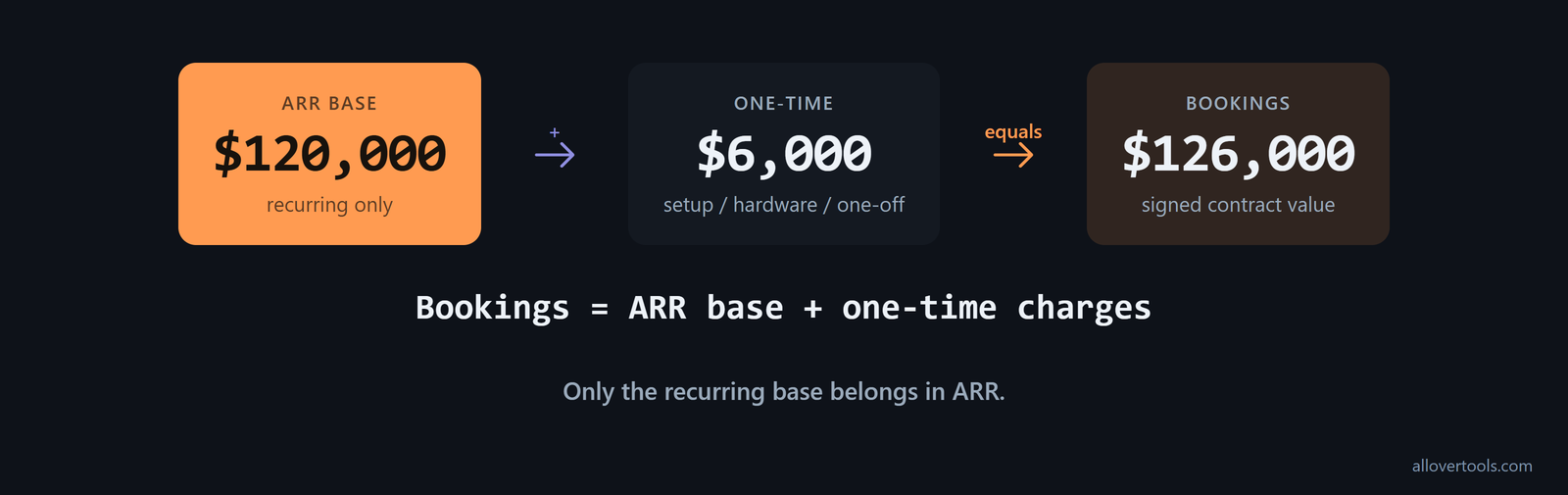
Bookings in SaaS are the value of business committed in signed orders or contracts during a period. They can include the full term value of a subscription plus implementation, hardware, and one-off services. ARR measures the recurring annual run rate of active subscription commitments, so those extra charges do not automatically belong in it.
Use this chosen 12-month contract:
Recurring subscription booking:  $120,000
Setup:                            $3,000
Hardware:                         $2,000
One-off services:                 $1,000
Bookings = $120,000 + $3,000 + $2,000 + $1,000
Bookings = $126,000
Only the recurring subscription enters the run rate:
ARR = $120,000 ÷ 12 months × 12 months
ARR = $120,000
Here, bookings are $126,000 and ARR is $120,000. Neither figure is automatically the revenue recognized in the current period. When these numbers appear together, state the contract term and the revenue-recognition schedule. That keeps an ARR vs bookings comparison from blending signed value, recurring run rate, and recognized income.
One 3-year deal can produce three valid figures. A contract worth $300,000 gives $300,000 in bookings as soon as it is signed, roughly $100,000 in ARR for this year, and roughly $8,333 in recognized revenue this month, as this contract example shows.
| Measure | Value | What the figure represents |
|---|---|---|
| Bookings | $300,000 | Full 3-year commitment at signing |
| ARR contribution | Roughly $100,000 | Current annualized slice of the commitment |
| Recognized revenue | Roughly $8,333 | One month recognized ratably over 36 months |
Keep the contract term next to each number. Bookings tell you how much business was committed, ARR shows the current recurring run rate, and revenue shows what was earned during the period.
What to exclude from ARR calculations
Classify each line before annualizing it. ARR contains the steady-state recurring amount for active subscriptions or another consistently defined recurring contract.
- Exclude implementation and setup fees. They are one-time charges.
- Exclude hardware. Equipment is not recurring subscription revenue.
- Exclude one-off services. Project work is not an annual recurring commitment.
- Exclude non-recurring discounts and temporary adjustments from the steady-state charge.
- Include only the recurring portion of active contracts. An invoice issued again does not make every line item recurring.
Classify variable charges separately, even if they recur. Leave variable usage, professional services, and one-time fees out of the recurring base. Metered overages, pay-per-use APIs, and irregular consumption charges should be modeled separately because they are not predictable fixed commitments. The recurring-base guidance puts these amounts outside normalized subscription ARR. Do not annualize them just because a customer was billed for them in the current period.
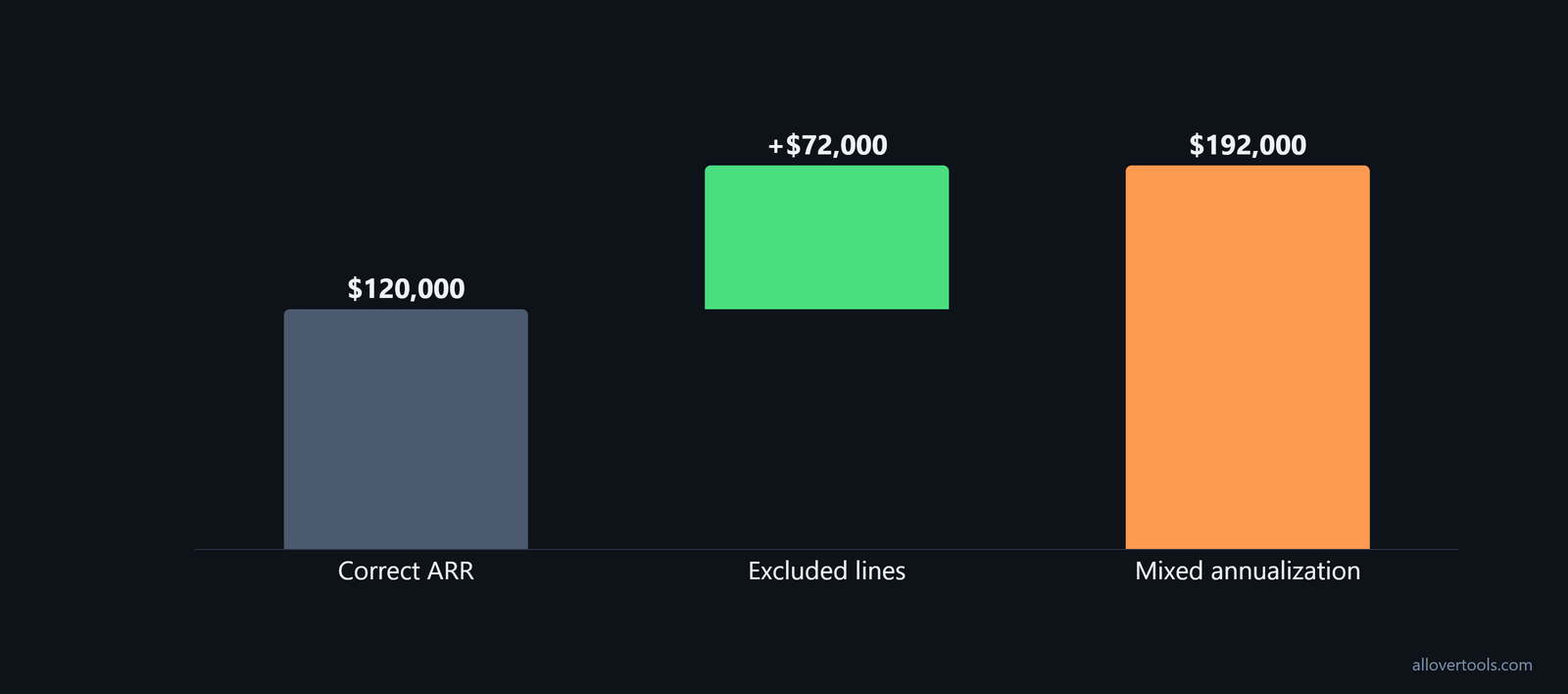
For one chosen set of values, recurring revenue is $10,000, setup is $3,000, hardware is $2,000, and one-off services are $1,000. The current revenue total is $16,000, while the recurring base is $10,000:
Correct ARR = $10,000 × 12
Correct ARR = $120,000

Mixed annualization = ($10,000 + $3,000 + $2,000 + $1,000) × 12
Mixed annualization = $16,000 × 12
Mixed annualization = $192,000

Overstatement = $192,000 − $120,000
Overstatement = $72,000
Annualizing the mixed amount overstates ARR by $72,000. Subscription ARR excludes one time fees because they do not describe the recurring contract commitment. A mixed total-revenue figure needs a line-by-line reconciliation before anyone labels it ARR.
Implementation and setup fees
Onboarding, implementation, and setup charges are non-recurring revenue for ARR purposes. Keep them in the appropriate revenue or bookings line, even when they appear on the first invoice with the subscription payment.
Hardware and one-off services
Keep equipment and project income separate from the subscription charge. Adding either to the recurring base makes the annualized run rate larger than the active contract commitment.
Active recurring contracts only
Use the steady-state recurring amount for active contracts. Leave out cancelled or expired commitments, temporary discounts, and one-time charges. Document the inclusion rule and use it consistently across reporting periods. This is the basis for ARR from active contracts only.
How GAAP revenue recognition changes the picture
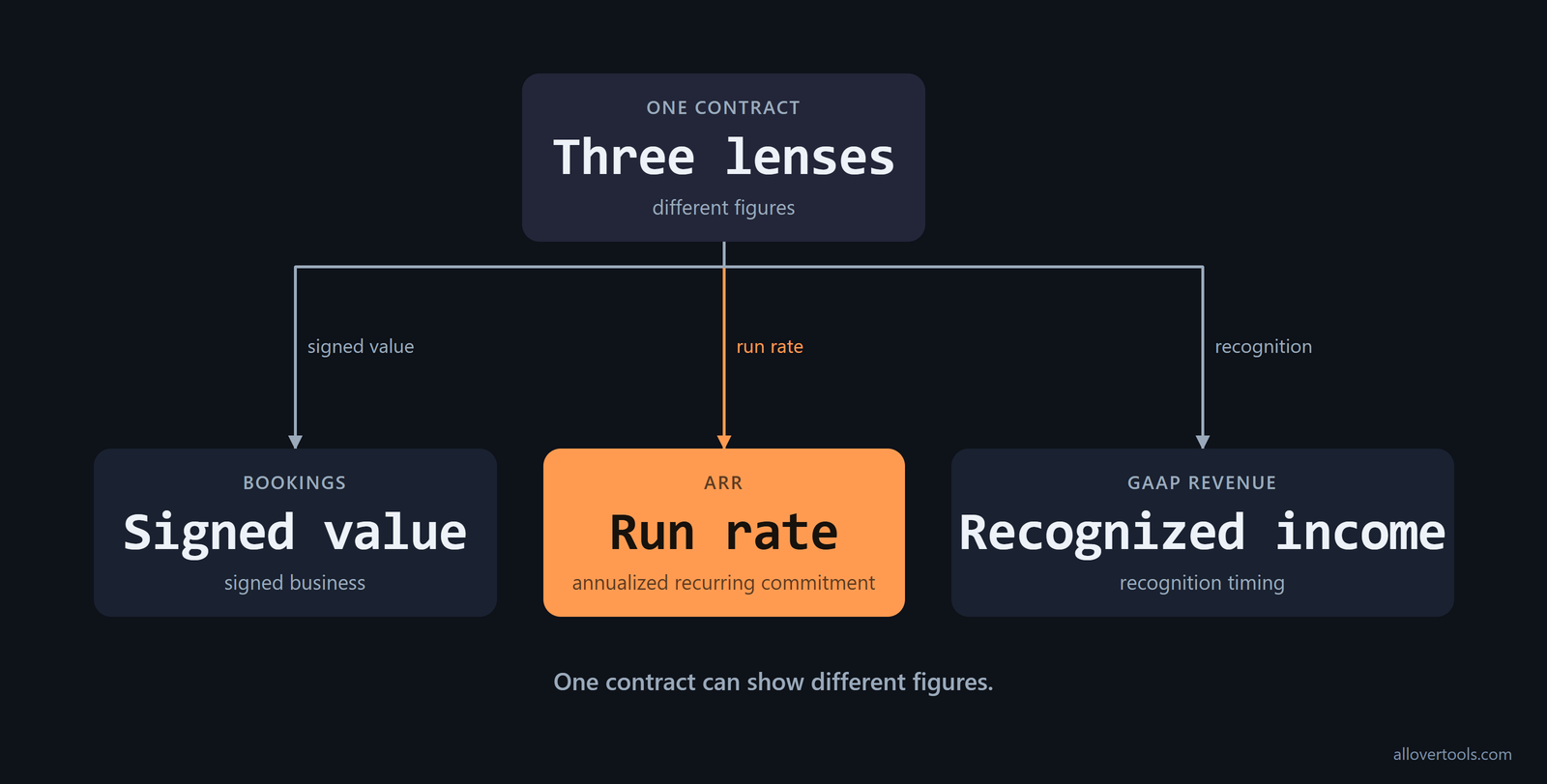
GAAP revenue follows the applicable delivery or performance-obligation timing. ARR follows the annualized recurring commitment. Bookings follow signed business. One contract can show different figures for recognized revenue, recurring run rate, and signed value.
Use the event that produced each metric to decide when it is recorded and whether it is GAAP-compliant. The timing comparison breaks it down as follows:
- Bookings measure the total contract value committed by the customer. They are recorded when the deal is signed and are non-GAAP.
- ARR measures the annualized value of recurring contracts. It is recorded when a recurring deal is signed or renewed and is non-GAAP.
- Revenue measures earned income from services delivered. It is recorded as services are provided under ASC 606 and is GAAP-compliant.
One chosen income-statement example
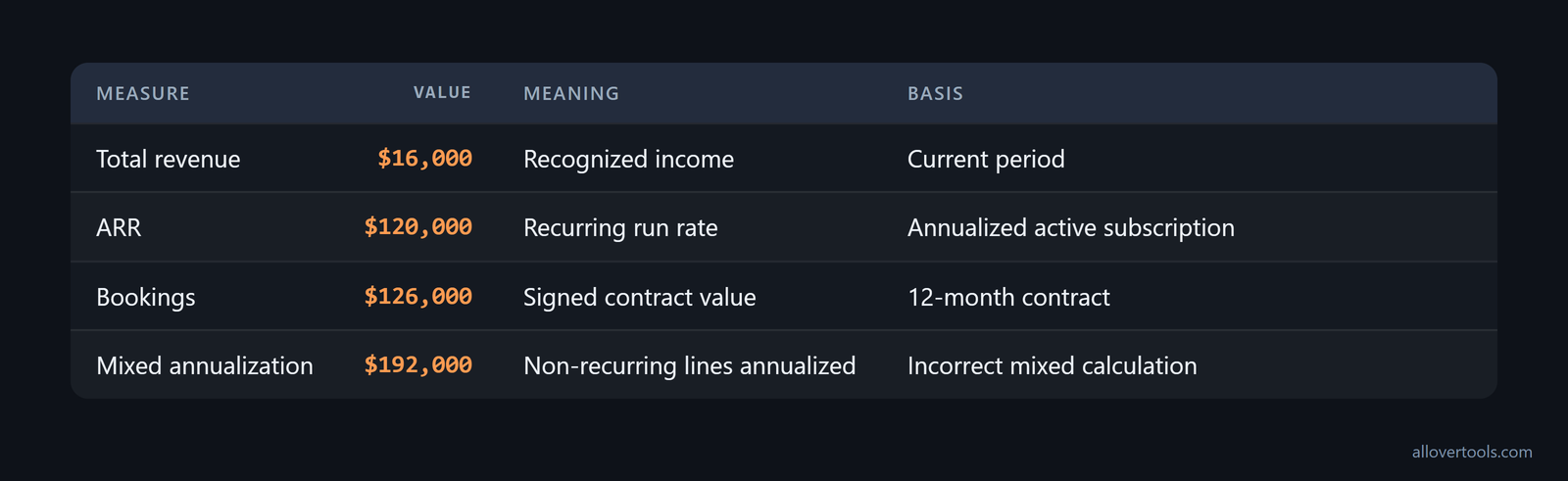
This is one chosen example, not a benchmark. The inputs are monthly subscription revenue of $10,000, implementation revenue of $3,000, hardware revenue of $2,000, and one-off service revenue of $1,000.
Total revenue = $10,000 + $3,000 + $2,000 + $1,000
Total revenue = $16,000

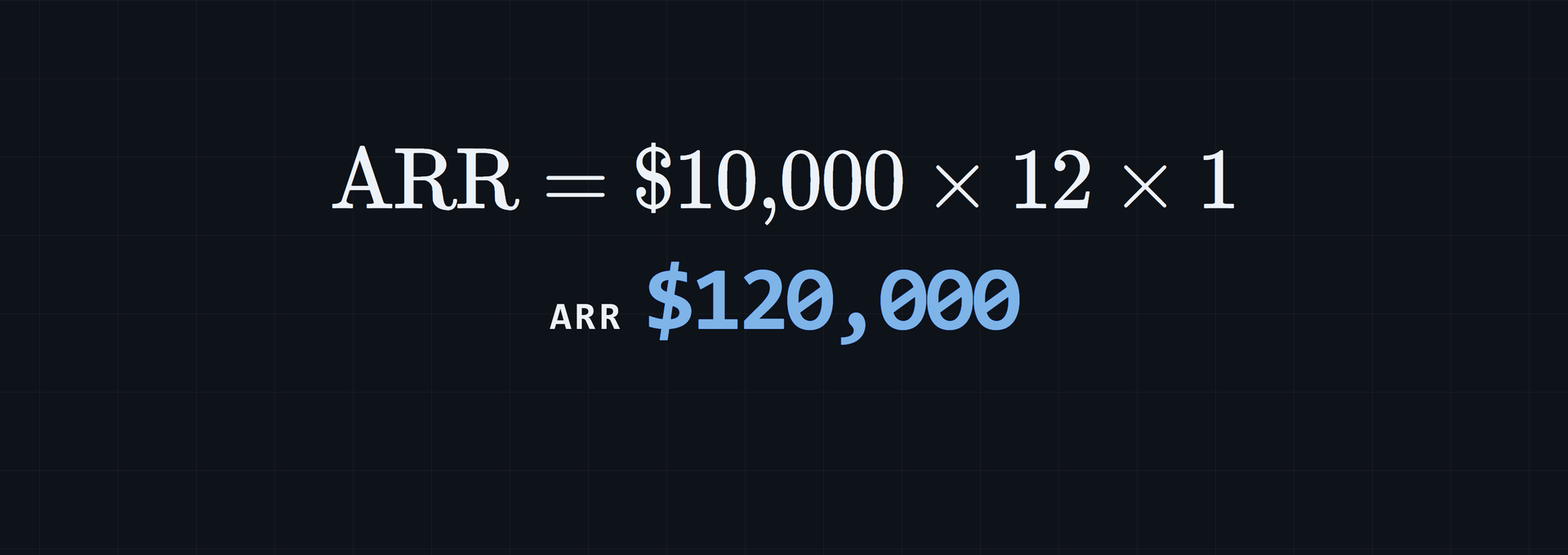
ARR = $10,000 × 12 × 1
ARR = $120,000

MRR = $120,000 ÷ 12
MRR = $10,000

Bookings for the newly signed 12-month contract
= $120,000 + $3,000 + $2,000 + $1,000
= $126,000

Incorrect mixed calculation = $16,000 × 12
= $192,000

Overstatement = $192,000 − $120,000
= $72,000
The $16,000 result is the chosen current-period total revenue. The $120,000 result is the chosen recurring run rate, and $126,000 is the chosen signed bookings value for the 12-month contract. The $192,000 result shows what happens when non-recurring lines enter the annualization.
Recognition and reporting
GAAP revenue is recognized according to the applicable delivery or performance-obligation timing. A current-period recognized-revenue line can differ from the ARR run rate and the signed bookings value. ARR is a management or operating metric, not a substitute for GAAP revenue.
ARR still needs a revenue-recognition schedule behind it. Follow that schedule when modeling ARR to meet GAAP requirements. ARR itself is a management metric, but ignoring the schedule can give a misleading picture of the economic value of active contracts, as this modeling guidance makes clear.
Current recognized revenue is not always lower than ARR. GAAP revenue may include subscription revenue, consulting fees, and one-time installation or onboarding fees, while ARR includes subscriptions only. A long-term contract may therefore have high committed subscription ARR but relatively low recognized revenue early on, since recognition follows ASC 606 and the pace of delivery, as the timing example shows.
For the chosen $10,000 monthly recurring amount, the ARR Calculator provides a direct check. Enter $10,000 in "Recurring revenue per billing period," choose "Monthly (12 periods/year)" under "Billing period," leave "Number of identical subscriptions (optional)" at 1, and select "Calculate ARR." The code multiplies the entered revenue by billing periods per year and the subscription count. It makes no network request with those values, so it calculates in the browser from entered values only and does not import accounting records.
How to align ARR with other financial metrics
Define the ARR population and as-of date first. Keep currency and period labels consistent. Show total revenue and bookings as separate measures. Put gross profit, gross margin, net profit, and cash metrics beside them without treating ARR as GAAP revenue.
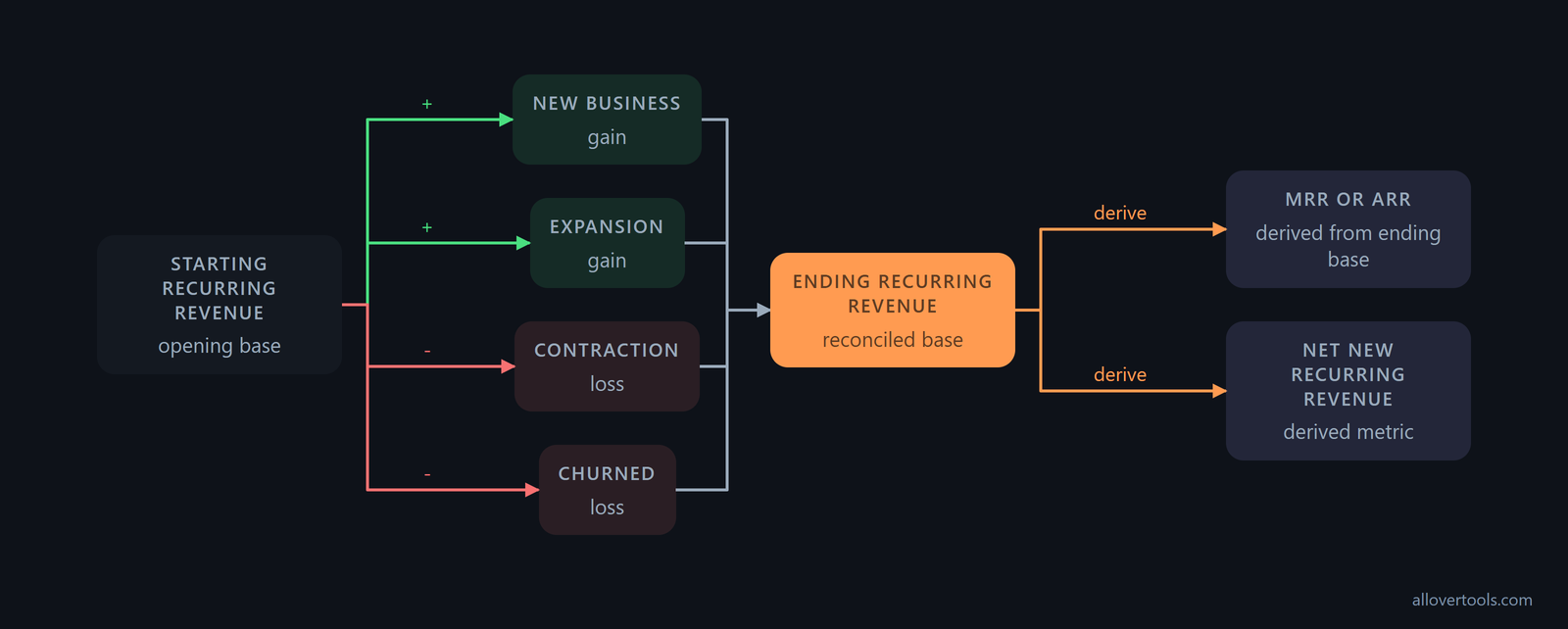
For a movement-based recurring-revenue view, use the SaaS Metrics Calculator. Choose "Monthly - figures below are for one month" or "Annual - figures below are for one year" under "Period type." Then enter "Starting recurring revenue," "New business recurring revenue," "Expansion recurring revenue," "Contraction recurring revenue," and "Churned recurring revenue." The code calculates ending recurring revenue as starting + new business + expansion - contraction - churned, then derives MRR or ARR and net new recurring revenue.
Choose the trend that answers the operating question. Bookings spikes signal a strong pipeline and sales momentum. ARR trends show recurring income and churn, while revenue trends matter for budgeting, taxes, and cash flow. The operating comparison therefore links bookings to sales performance and future revenue potential, ARR to churn and customer growth, and revenue to earned-income decisions.
For gross profit or margin, the Business Profit Calculator has the "COGS & gross profit / margin" mode. The Gross Margin Calculator uses "Revenue" and "Direct cost." The Net Profit Margin Calculator uses "Revenue," "Operating expenses," "Interest expense," and "Tax expense." These tools calculate from entered values only. Use the same reporting period and reconcile any different denominator before presenting the metrics to investors.
Keep periods and definitions aligned
Use one as-of date, one currency convention, and clearly named periods. Keep ARR as the recurring run rate, total revenue as recognized revenue, and bookings as signed business. Profit metrics use their own revenue-and-cost formulas. If one figure is monthly and another is annual, show that difference beside the figure.
For annual planning and investor reporting, ARR is usually easier to compare with GAAP revenue over a 12-month period. MRR and monthly GAAP revenue can differ significantly in a given month because revenue allocations vary across months with 28, 29, 30, or 31 days. That annual-period comparison is why monthly figures should not be treated as a direct monthly GAAP match.
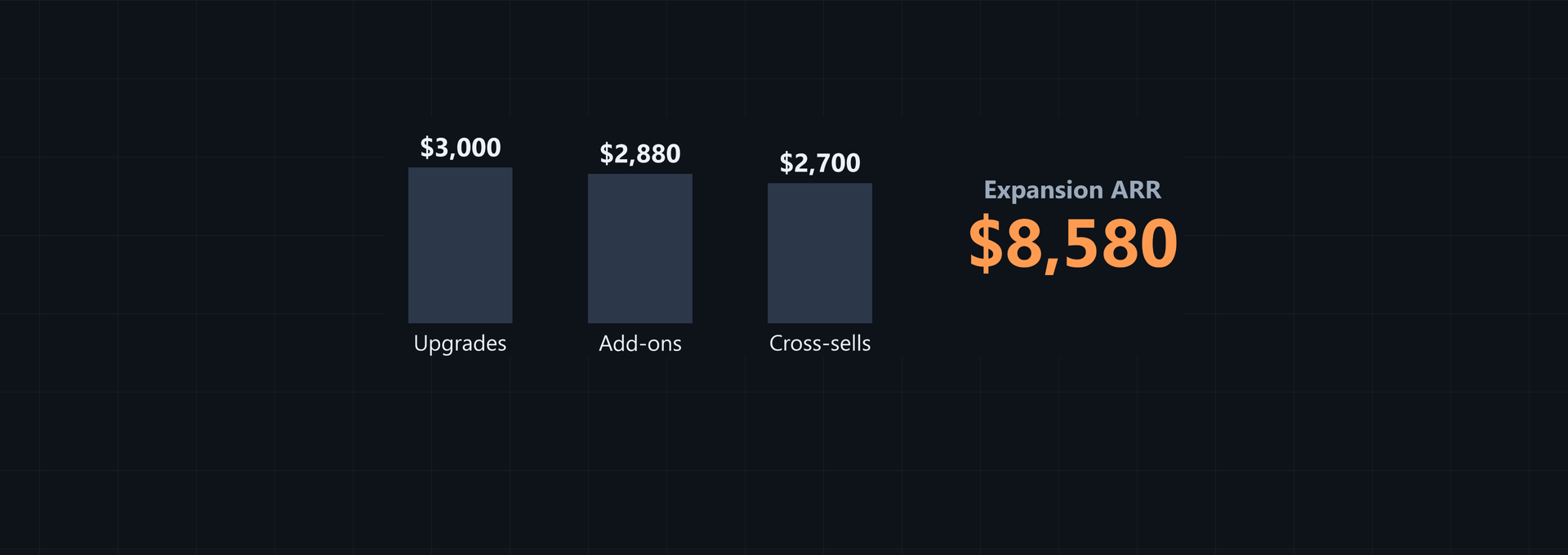
Track the recurring base both as a movement metric and as a snapshot. Total ARR = total yearly subscription revenue + total expansion revenue - total contraction revenue, with contract terms and pricing structures accounted for. Upgrades and cross-sell increase the recurring base; downgrades and partial cancellations reduce it, as the ARR movement formula sets out.
Use ARR in investor presentations
Place the ARR definition, inclusion and exclusion policy, as-of date, and reconciliation or bridge beside the metric. Show bookings and recognized revenue separately. Show gross profit or margin and net profit separately so the reader can follow the move from recurring revenue to profit metrics.
- Define ARR and its active-contract population.
- List exclusions such as setup, hardware, and one-off services.
- State the as-of date, currency, and period basis.
- Separate bookings from recognized revenue.
- Explain the bridge to profit metrics.
When total revenue includes a large non-recurring portion, show that difference clearly in the investor view. A company with $2 million in total revenue may have only $1.2 million ARR if $800,000 comes from one-time implementation and professional services. Investors often focus on the $1.2 million recurring figure for valuation and like-for-like SaaS comparison, as this investor example demonstrates.
Frequently asked questions
Is ARR the same as total revenue?
No. ARR annualizes the recurring portion of active contracts. Total revenue includes all revenue recognized in the reporting period, including non-recurring items.
Does ARR include implementation or setup fees?
No. Exclude one-time implementation and setup fees, hardware, and one-off services from ARR. Keep them in the appropriate revenue or bookings measure.
What is the difference between ARR and bookings?
ARR is the annualized recurring run rate of active subscription commitments. Bookings measure signed business and can include the full contract term plus non-recurring items, so the figures answer different questions.
How does ARR relate to GAAP revenue?
ARR is a management run-rate metric. GAAP revenue follows recognition timing for delivered goods or services. Report them separately and state the ARR definition, date, and reconciliation.
Should I calculate ARR from total revenue?
Only after removing non-recurring revenue and isolating the recurring amount from active contracts. Annualizing a mixed total-revenue figure overstates ARR when setup, hardware, or one-off services are present.