An ARR components breakdown sorts recurring-revenue movement over one consistent period. New, expansion, renewal, contraction, churned, and reactivation ARR show what changed in the opening base and what came from additions. Keep retained opening ARR separate from new money, then use one signed bridge to reach the ending total.
What each ARR component means
Use the same period and ARR basis for every component. New ARR is the annualized recurring value from brand-new customers. Expansion ARR is the increase from upgrades, added seats, or add-ons for active customers. Renewal ARR is the recurring value retained when existing contracts renew. Contraction ARR is the positive amount lost in a downgrade while the customer remains active. Churned ARR is the positive amount lost when a customer cancels fully or does not renew. Reactivation ARR is recurring value from a former customer who returns.
New ARR and reactivation ARR add to the total. Expansion ARR increases an active account's value. Contraction ARR and churned ARR reduce the opening base. Renewal usually describes the part of Starting ARR that stayed in place, so it is not added again in the movement bridge.
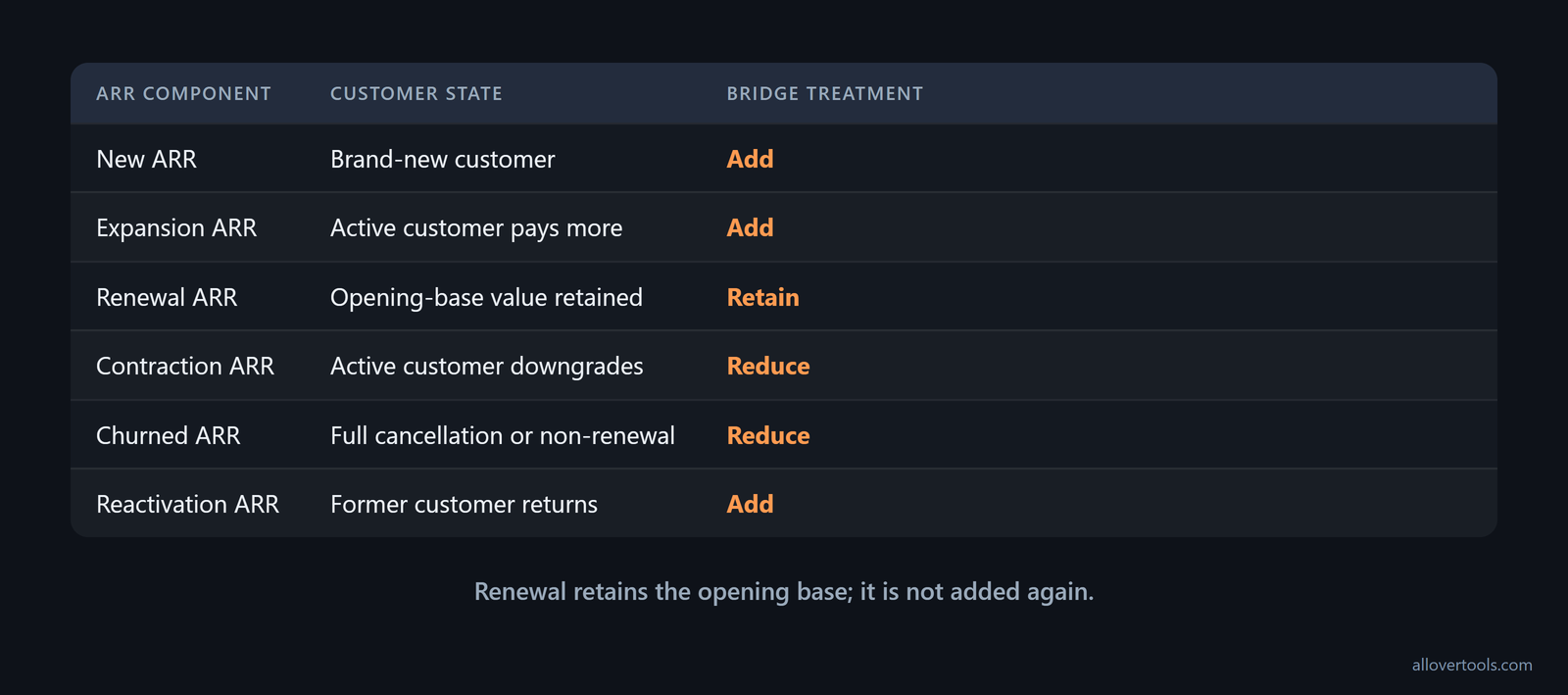
One account can return and upgrade during the same period. Separate the returning base from the upgrade in the ledger. Otherwise the same dollars can be counted as both reactivation ARR and expansion ARR.
Set the ARR basis before classifying components
Use contracted recurring value, normalized to one year, for every component. Exclude one-time setup fees, usage overages that are not contracted, and professional services billed as nonrecurring. According to the ARR definition, those items fall outside the basis. With that rule, the bridge stays comparable across periods instead of turning a one-off project or an incidental charge into apparent recurring growth.
ARR is not total revenue. It covers the predictable recurring part of term subscriptions, including subscriptions or maintenance. Total revenue also includes one-off projects and nonrecurring services. Do not reconcile the bridge directly to the income statement without adjustments. The ARR components guidance makes this boundary explicit.
Set the inclusion policy before calculating New, Expansion, Contraction, and Churned ARR. MRR can be the monthly fee times the number of contracts, and ARR can be MRR times 12. Initial fees and usage-based charges can make those figures fluctuate significantly when they are included inconsistently, as this RevOps guide notes. Use one documented in-or-out rule for every period.
Handle usage pricing and multi-year contracts
Include a usage-based amount in ARR only when it is a contracted minimum or a formalized usage commitment. Keep purely variable, pay-as-you-go consumption on a separate usage or non-ARR line. That keeps a temporary increase in consumption from looking like predictable Expansion ARR. This is the boundary set by the usage-based rule.
Annualize a multi-year contract before adding it to the bridge. A $36,000 three-year contract contributes $12,000 to ARR because total contract value is divided by the number of years. If it is a new three-year deal, record $12,000 as New ARR for the period. Measure later expansions or contractions against that annualized baseline, as this ARR example shows.
Use the same test for overage pricing. Recurring subscription revenue, recurring add-ons, annualized multi-year contracts, and contracted recurring overage can enter the bridge. Non-contracted overage and other variable usage charges stay out. A fixed monthly block of extra API calls can therefore be included, while a volume spike that is not contractually committed should be reported separately, following the overage guidance.
Additions and retained revenue
For the new ARR definition, use recurring value from a customer who was not in the opening base. Expansion ARR comes from an active customer who pays more after an upgrade, added seats, or an add-on. An expansion ARR calculation uses only the increase for that account, not its full contract value. Renewal ARR is the opening-base value that remains recurring when an existing contract renews.
Reactivation ARR follows a different customer history. It is the annualized recurring value from a customer who had already churned and then returned. The reactivation ARR metric therefore depends on the customer's earlier churn status. Put the returning base in reactivation ARR and any separate upgrade in expansion ARR.
Keep Reactivation ARR on its own line when the install base is large enough for win-backs and lapsed renewals to be a meaningful, trackable source. Many off-the-shelf SaaS metrics tools fold it into New business, which hides win-back performance; the waterfall guidance lists it as a movement type many guides skip.
Reductions from the opening base
Contraction ARR is a downgrade without cancellation. The customer stays active, but the recurring amount falls. Churned ARR is the positive amount from a full cancellation or non-renewal. Enter both as positive magnitudes, then apply the minus signs in the bridge.
How to write the ARR movement bridge
The comprehensive movement formula is:
Ending ARR = Starting ARR + New ARR + Expansion ARR + Reactivation ARR
             - Contraction ARR - Churned ARR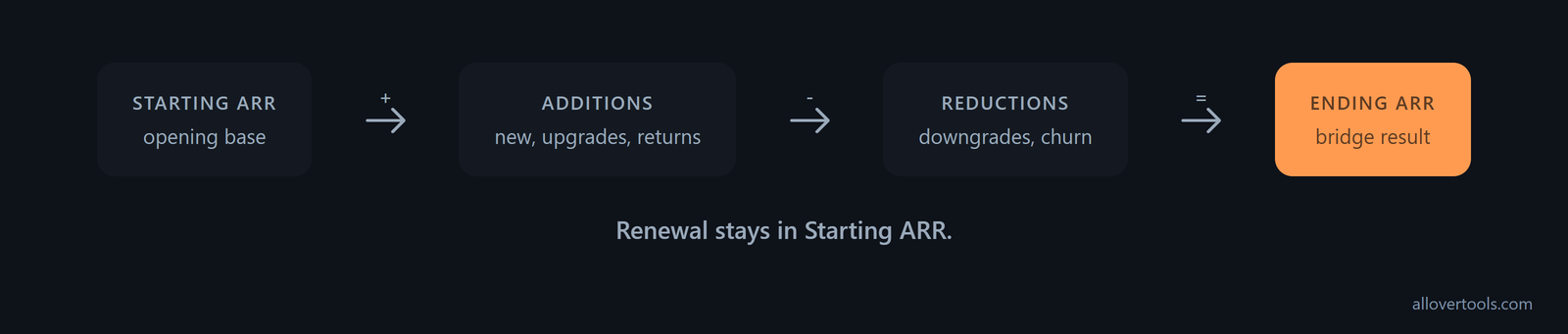
Renewal is the surviving part of Starting ARR. It is not another addition when Starting ARR already contains the contracts that renewed.
Treat Ending ARR as a forward-looking run-rate projection, not revenue billed during the period. ARR is MRR multiplied by 12. It projects the next 12 months from the MRR the company has today, so the ending figure is annualized subscription value if nothing changes. According to the SaaS metrics cheat sheet, ARR is forward-looking, and the bridge therefore tracks a change in run rate rather than a historical revenue roll-forward. This is also why investors prefer ARR for assessing future recurring revenue.
In a simple case in which every opening-base reduction is captured as contraction or churn, the renewal view is:
Renewal ARR = Starting ARR - Contraction ARR - Churned ARR
Ending ARR = Renewal ARR + New ARR + Expansion ARR + Reactivation ARR
These are two views of the same movement. Do not add Renewal ARR to the signed bridge as well, or retained opening revenue will be counted twice.
The signed bridge formula
Store each component field as a non-negative magnitude. Add New ARR, Expansion ARR, and Reactivation ARR. Subtract Contraction ARR and Churned ARR only when writing the signed bridge:
Ending ARR = Starting ARR + New ARR + Expansion ARR + Reactivation ARR
             - Contraction ARR - Churned ARR
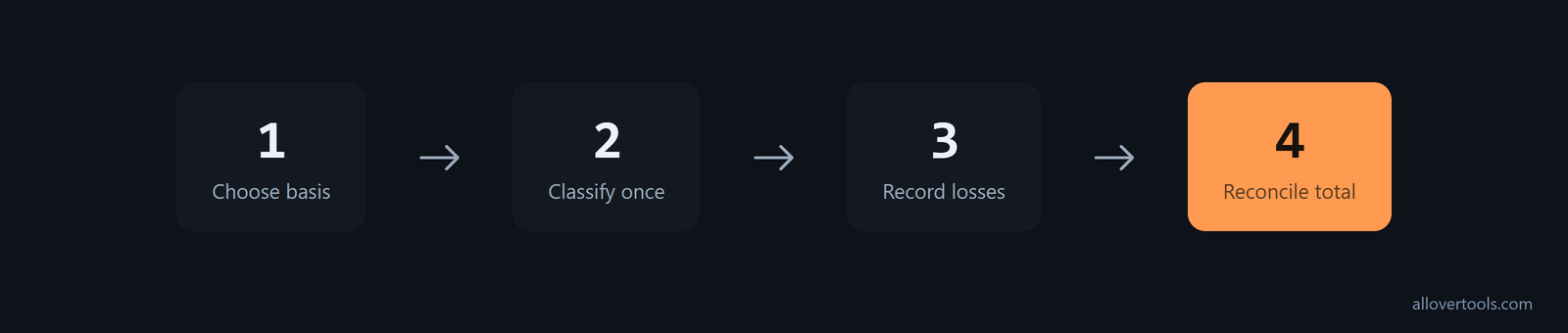
Build the bridge in four passes: choose one period and ARR basis, classify each account movement once, record reductions as positive magnitudes, and reconcile the ending total to the bridge.
The renewal view without double-counting
Renewal ARR is the opening-base value left after contraction and churn. In the simple case above, Renewal ARR = Starting ARR - Contraction ARR - Churned ARR. The ending total is then Renewal ARR + New ARR + Expansion ARR + Reactivation ARR.
This identity assumes every opening-base reduction is captured as contraction or churn. If the source ledger has other adjustment types, list them separately instead of forcing them into one of these components. Renewal is not a separate addition when Starting ARR already includes the contracts that renewed.
Worked ARR movement bridge with chosen values
These are chosen illustrative values, not a benchmark. Each amount uses the same period and annualized recurring basis.
Inputs and ending ARR
Starting ARR:    $100,000
New ARR:          $30,000
Expansion ARR:    $12,000
Contraction ARR:   $8,000
Churned ARR:      $10,000
Reactivation ARR:  $6,000
First find the retained opening base. In renewal ARR examples, that is the amount left after contraction and churn:
Renewal ARR = $100,000 - $8,000 - $10,000
            = $82,000
Apply the signed bridge:
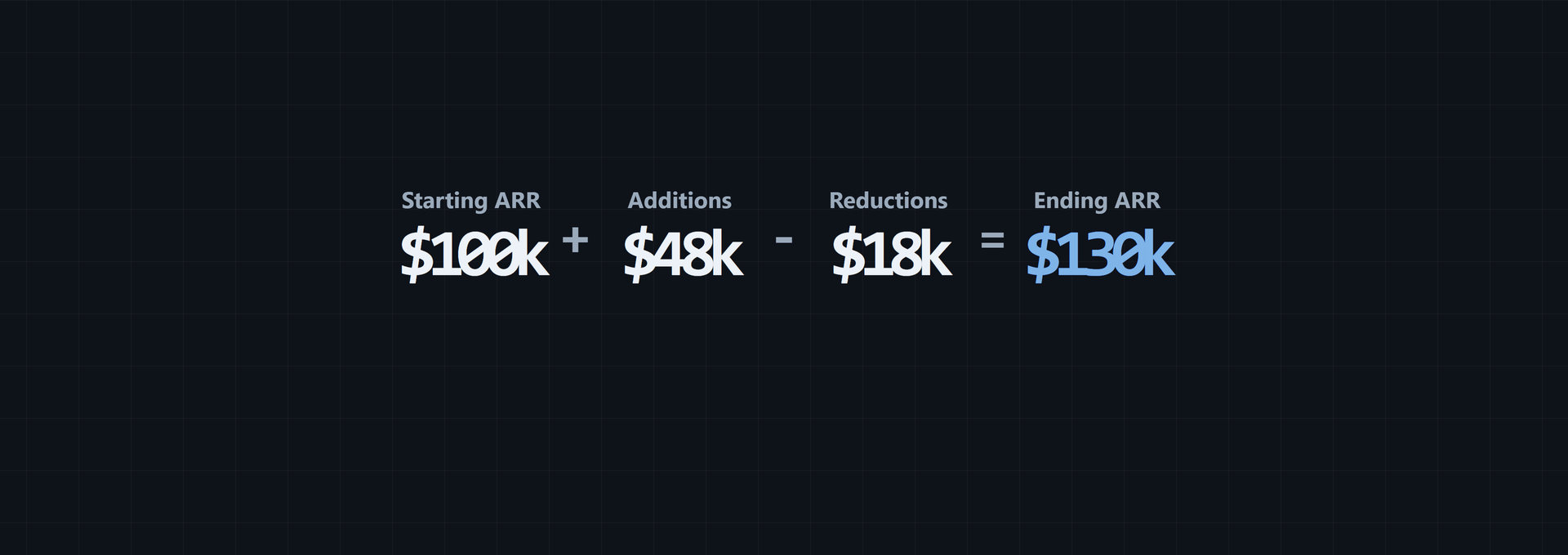
$100,000 + $30,000 + $12,000 + $6,000 - $8,000 - $10,000
= $130,000 Ending ARR
The renewal view reaches the same result:
$82,000 + $30,000 + $12,000 + $6,000 = $130,000What the movement says
Additions total $48,000. Reductions total $18,000. Net ARR movement is $30,000, so the change from $100,000 to $130,000 is 30%.
The $8,000 downgrade is contraction. The $10,000 full cancellation is churn. The $6,000 from returning customers is reactivation, not New ARR. A component can be zero. A customer cannot contribute the same dollars to both contraction and churn.
Use the bridge as a management report, not only to produce a closing number. A closing figure without the new, expansion, contraction, and churn movements does not show whether growth is healthy or where attention is needed. According to the SaaS reporting guidance, that figure is not steering information.
How ARR components connect to growth and churn rates
The bridge separates acquisition, account growth, recovered customers, and losses from the opening base. New ARR measures brand-new customers. Expansion ARR measures more value from active customers. Reactivation ARR measures customers who returned. Contraction ARR and Churned ARR measure lost value from the starting base.
Read the growth mix
In the chosen bridge, additions are $48,000 and contraction plus full churn is $18,000. The difference is $30,000 of net movement. That split shows whether the ending change came from new customers, larger active accounts, returning customers, or lower value in the opening base.
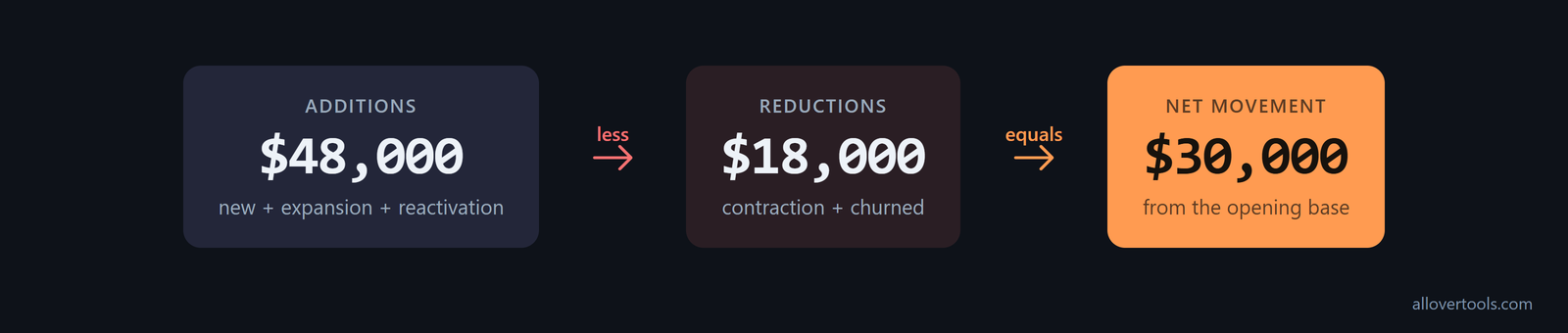
Use customer status to keep the labels stable. A brand-new account contributes New ARR. An active account paying more contributes Expansion ARR. A former customer returning contributes Reactivation ARR. A downgrade and a full cancellation remain separate loss types under churned ARR and contraction ARR.
Before judging your own acquisition and account-growth balance, compare the mix with a like-for-like SaaS population. In H1 2024, among SaaS companies with $1M, $30M+ ARR and net revenue retention of 100% or more, the reported movement analysis defines ARR added as New business ARR plus Expansion ARR plus Reactivation ARR and finds:
- Expansion: 57% of ARR added.
- New business: 39% of ARR added.
- Reactivation: 4% of ARR added.
Use those figures as context for the worked bridge. In that observed group, expansion supplied most of the added ARR, while reactivation was a small fraction. A different mix shows whether the period depended more on new logos, account growth, or returning customers. It does not change the component definitions.
Give each movement line an operating owner so the report points to an action. New ARR is owned by New Business Sales, Expansion ARR by Account Management or Customer Success, and Reactivation ARR by Customer Success or Sales, as the waterfall ownership mapping describes. Keep the lines separate when setting targets. Otherwise, a weak new-business result can be hidden by account expansion or win-backs.
Calculate GRR and NRR from the same bridge
Use the starting base and the two loss components for Gross Revenue Retention, then add Expansion ARR for Net Revenue Retention. The formulas are:
GRR = (Beginning ARR - Contraction ARR - Churned ARR) / Beginning ARR
NRR = (Beginning ARR + Expansion ARR - Contraction ARR - Churned ARR) / Beginning ARR
These measures leave out New ARR and Reactivation ARR because they test what happened to the opening base. Treat GRR below about 90% as a yellow flag in mid-market SaaS and below 95% as a yellow flag in enterprise SaaS. NRR above 100% means expansion more than offsets contraction and churn. According to the retention guidance, NRR is the single most important durability metric in SaaS.
Check the retained base with churn rates
For a revenue check on the existing base, use the Churn Rate Calculator. Select the visible Churn type option Revenue churn (amount), set Period to Annual, and enter:
Starting revenue (period start): $100,000
Lost revenue (churned during period): $18,000
New / gained revenue (during period): $18,000
Ending revenue (period end) - optional: $100,000
The lost amount is the $8,000 contraction plus the $10,000 churn. The gained amount is the $12,000 expansion plus the $6,000 reactivation. Select Calculate churn:
Gross churn rate = $18,000 / $100,000 = 18%
Retention rate = 100% - 18% = 82%
Net churn rate = ($18,000 - $18,000) / $100,000 = 0%
Net retention rate = 100% - 0% = 100%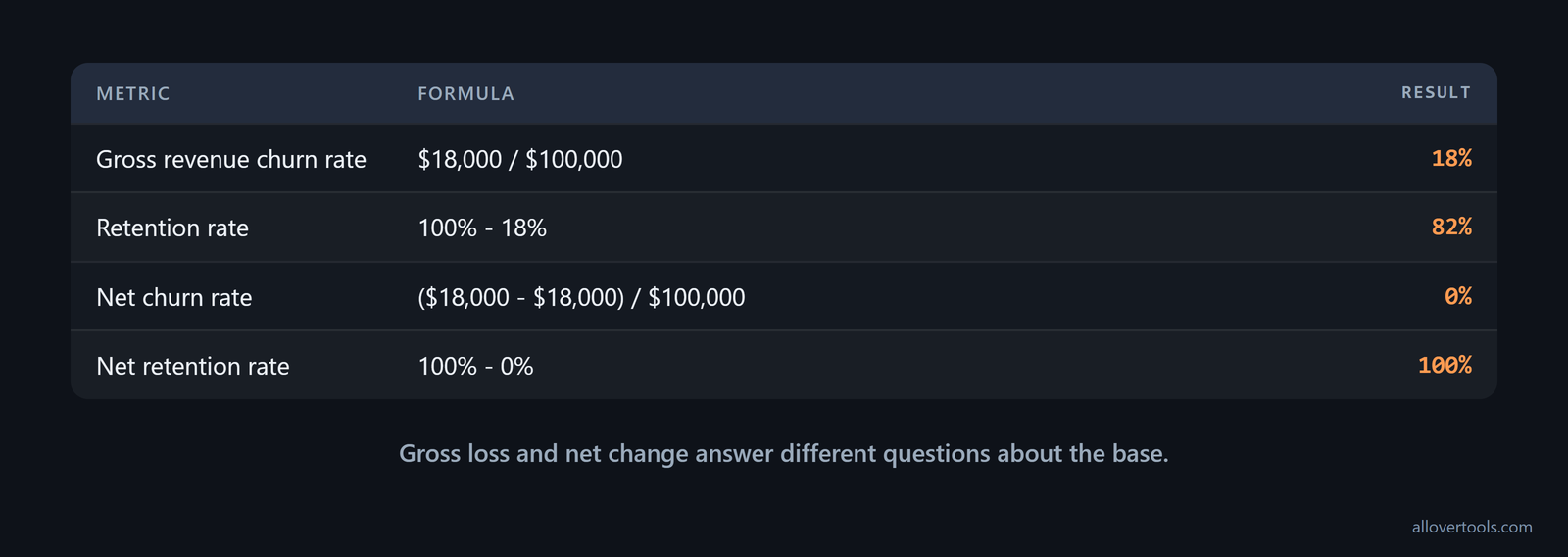
This check covers the existing base, so it leaves out the $30,000 of brand-new ARR. Customer-count churn uses a different input mode. Entering only $10,000 as lost revenue would give 10% gross revenue churn, but it would leave the downgrade loss out.
Keep this component breakdown visible in valuation discussions. ARR, defined as MRR multiplied by 12, is used by investors and acquirers to value SaaS businesses, while high and improving NRR driven by Expansion ARR, with controlled Contraction ARR and Churned ARR, signals durable growth that investors prioritize; the founder's guide links these movement measures to that assessment.
Verify the bridge with ARR and SaaS calculators
Use a calculator after the component bridge to check the total. These tools can reconcile the chosen values, but they do not replace account-level classification.
Check the ending total with ARR Calculator
Open the ARR Calculator. Enter 130000 in Recurring revenue per billing period, choose Annual (1 period/year) in Billing period, leave Number of identical subscriptions (optional) at 1, and select Calculate ARR.
The result follows the tool's formula:
ARR = 130000 x 1 x 1 = $130,000.00
MRR = $130,000.00 / 12 = $10,833.33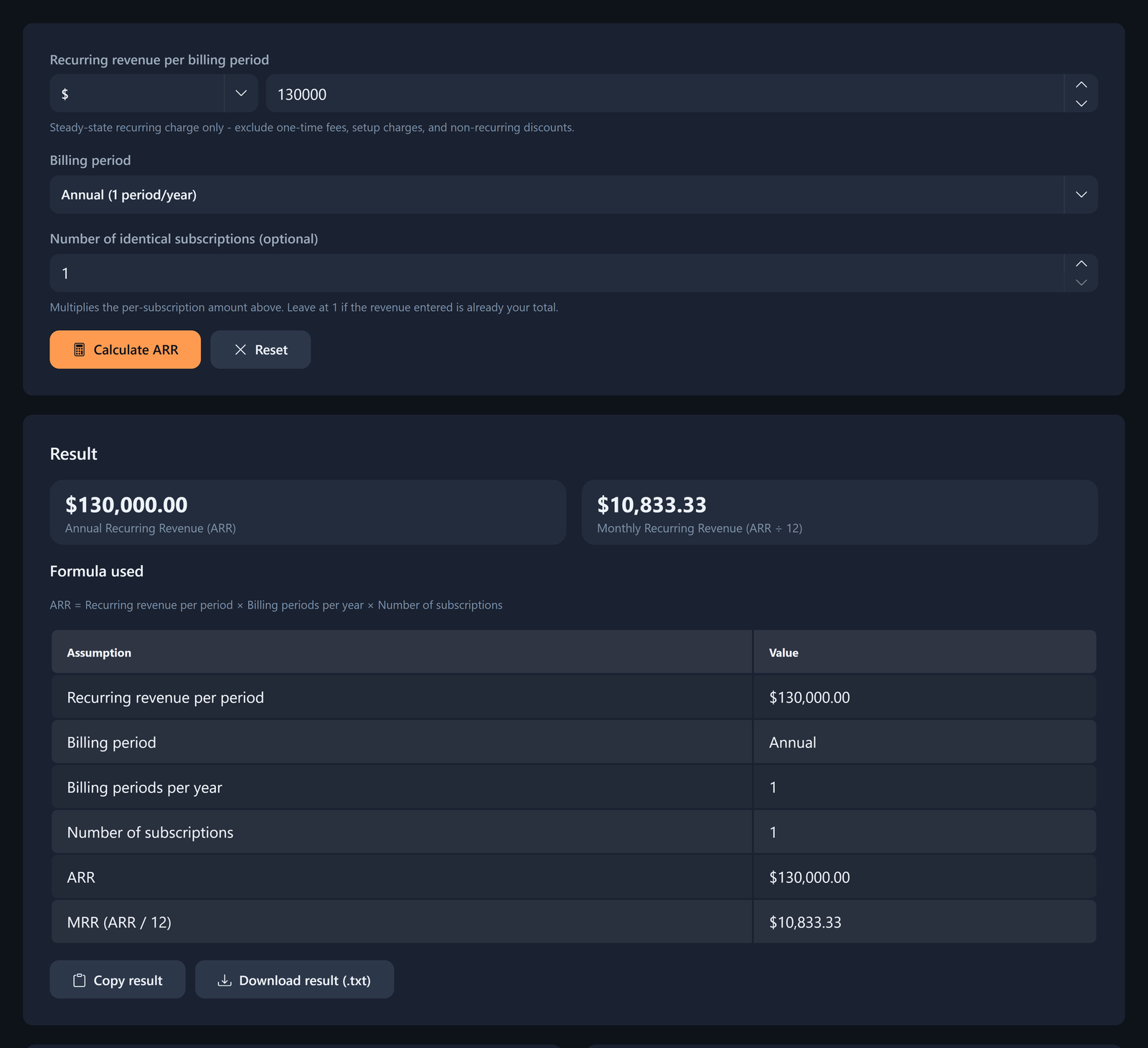
Use SaaS Metrics Calculator with its limits
For a comparable annual report, open the SaaS Metrics Calculator. Set Period type to Annual - figures below are for one year, then enter:
Starting recurring revenue: 100000
New business recurring revenue: 36000
Expansion recurring revenue: 12000
Contraction recurring revenue: 8000
Churned recurring revenue: 10000
The $36,000 New business recurring revenue combines the chosen $30,000 New ARR and $6,000 Reactivation ARR because the tool has no reactivation field. Leave other required fields at their blank-input behavior if they are not part of this revenue reconciliation, then select Calculate metrics:
Ending recurring revenue = 100000 + 36000 + 12000 - 8000 - 10000
                        = $130,000
ARR = $130,000
Gross revenue churn rate = 10000 / 100000 = 10%
Net revenue churn rate = (10000 - 12000) / 100000 = -2%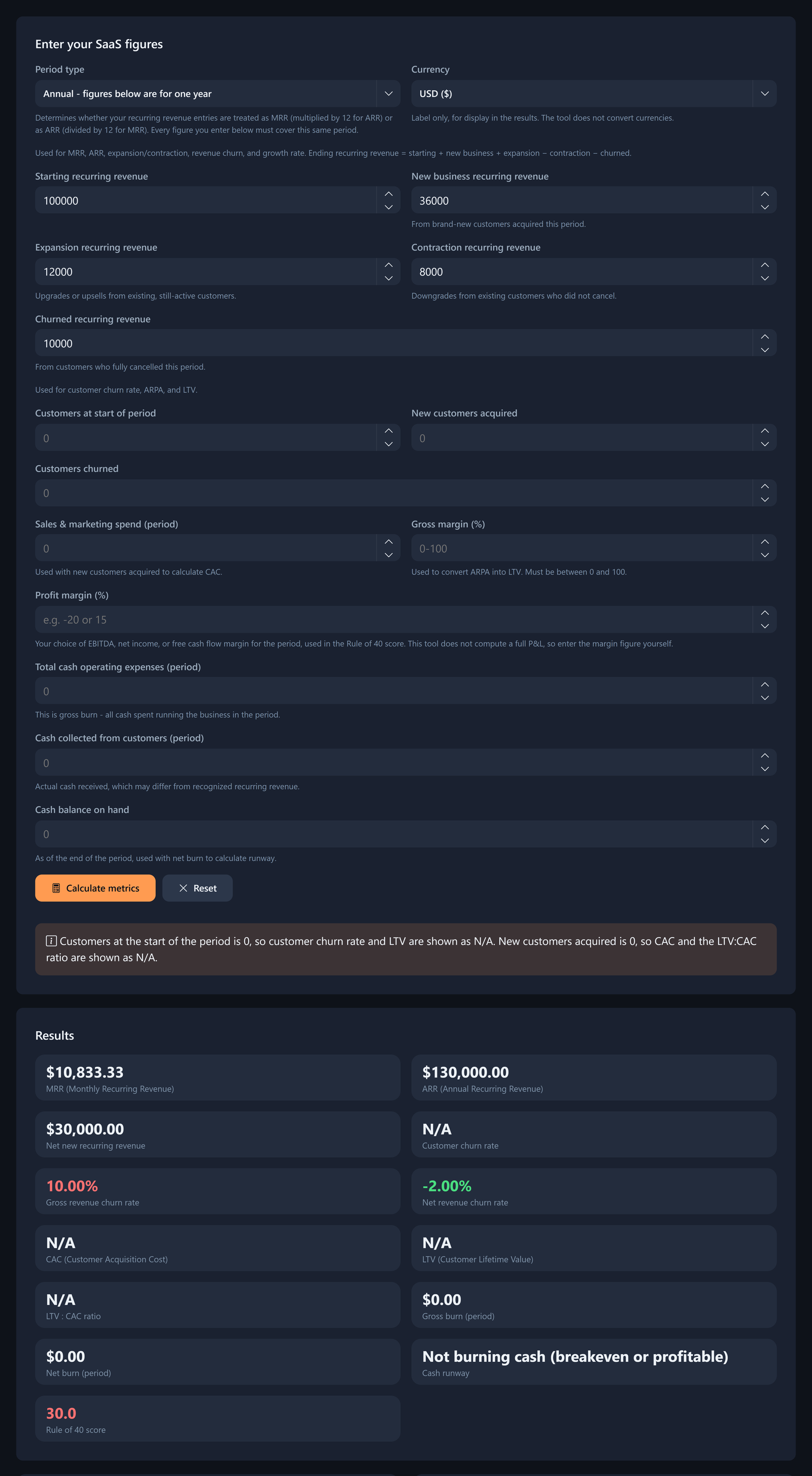
This is a reconciliation check, not a six-component report. The visible inputs do not separate Renewal ARR or Reactivation ARR, and the churn formulas use Churned recurring revenue and Expansion recurring revenue as coded. The tool files make no fetch, XMLHttpRequest, sendBeacon, or form-post request carrying entered values, so these calculations stay in the browser. Copy and download actions export the generated result.
Frequently asked questions
What are the standard ARR components?
The standard components are new, expansion, renewal, contraction, churned, and reactivation ARR. New, expansion, and reactivation are additions, renewal is retained opening-base value, and contraction and churned ARR are reductions.
How is renewal ARR different from new ARR?
Renewal ARR is recurring value retained from customers already in Starting ARR. New ARR comes from brand-new customers, so renewal is not added again when the bridge starts with Starting ARR.
What is the formula for ending ARR?
Ending ARR = Starting ARR + New ARR + Expansion ARR + Reactivation ARR - Contraction ARR - Churned ARR. Renewal is represented by the retained opening base.
Are contraction ARR and churned ARR the same?
No. Contraction is a downgrade while the customer remains active. Churned ARR is lost after full cancellation or non-renewal, so the two reductions should stay separate.
How do you calculate reactivation ARR?
Sum the annualized recurring value of customers who had previously churned and returned during the period. Keep it separate from New ARR when the account history supports that classification.