A working ARR recurring revenue definition starts with one question: does your charge belong to a paid obligation that continues and can be annualized? Include that amount when you calculate ARR. Leave out charges that happen once or only for a limited period.
You can treat ARR as annualized recurring revenue, not an invoice total or cash collection, because a cash receipt alone doesn't set it, so use ARR = recurring input x billing periods per year x number of subscriptions. The figures below are illustrative.
Use ARR as a point-in-time run rate. It asks what the active recurring subscriptions would collect over the next twelve months if nothing changed. It isn't revenue already earned or a forecast, as Metabase's ARR definition explains. That keeps a current recurring snapshot from being mistaken for guaranteed future revenue.
Keep ARR separate from recognized revenue in financial reporting. ARR isn't an accounting metric; it measures recurring revenue on a specific date. Revenue measures what was earned over a month or quarter, according to Burkland's revenue guide.
When you reconcile an ARR dashboard to the income statement, review contracts line by line instead of copying the GAAP revenue total. GAAP revenue can combine recurring subscriptions with professional services, setup fees, and overage charges. The ARR build keeps only the recurring subscription components, following the workflow in Ordway's ARR guide.
What counts as recurring revenue in ARR?
Your recurring base starts with the contracted subscription amount. Add qualifying add-ons and service or maintenance fees, then apply any ongoing discount, so, for example, you can enter a chosen $1,200 recurring maintenance fee billed annually as an annual amount because the billing period is already one year:
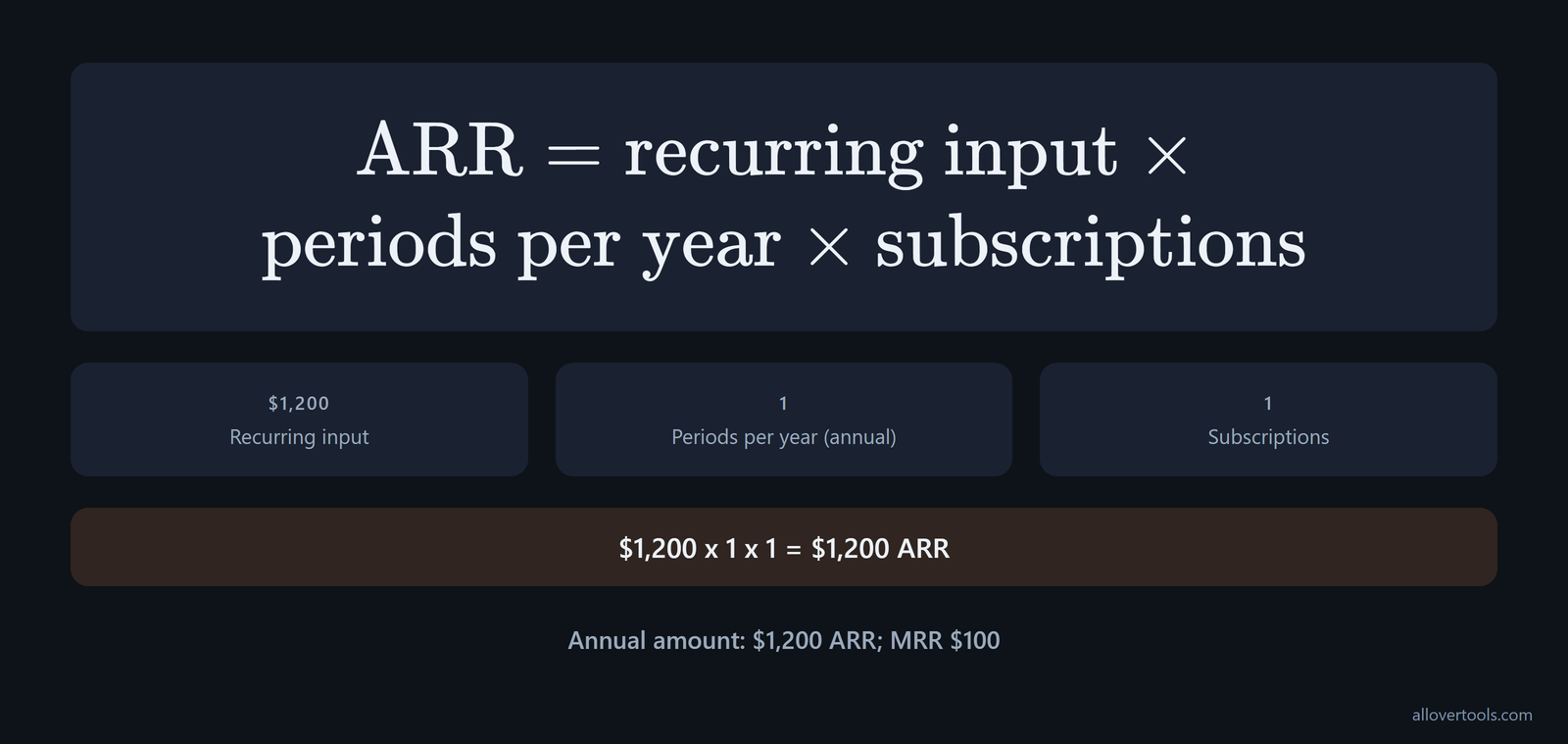
Billing period = Annual
Number of identical subscriptions (optional) = 1
ARR = $1,200 × 1 × 1 = $1,200
MRR = $1,200 ÷ 12 = $100
Don't annualize a setup charge, and don't use list price when your customer has a continuing discount. Either choice would make your recurring base different from the customer's active paid arrangement.
Add a contracted price escalator once it takes effect. Because the increase was agreed in advance and repeats under the contract, it belongs in recurring revenue. Leave one-time setup fees, non-contracted usage overages, and nonrecurring professional services out of the input, as NetSuite's ARR rule sets out.
Core subscriptions, add-ons, and recurring services
Include the paid subscription or license that repeats. Your recurring seats and modules belong in the base when they repeat under the same obligation; other continuing services, including support and maintenance, do too. Annual recurring lines are annual. Normalize monthly or quarterly lines before combining them.
For a multi-year subscription, divide the total contract value by the number of years in the term. A $36,000 three-year contract contributes $12,000 to ARR, not $36,000. If the term isn't a whole number of years, divide the total contract value by the number of days in the contract term and multiply by 365.
Use the term written into the contract, then enter that annualized recurring amount. Don't treat the full contract value as one billing period. Both methods are set out in CRV's ARR primer.
The recurring test for each revenue line
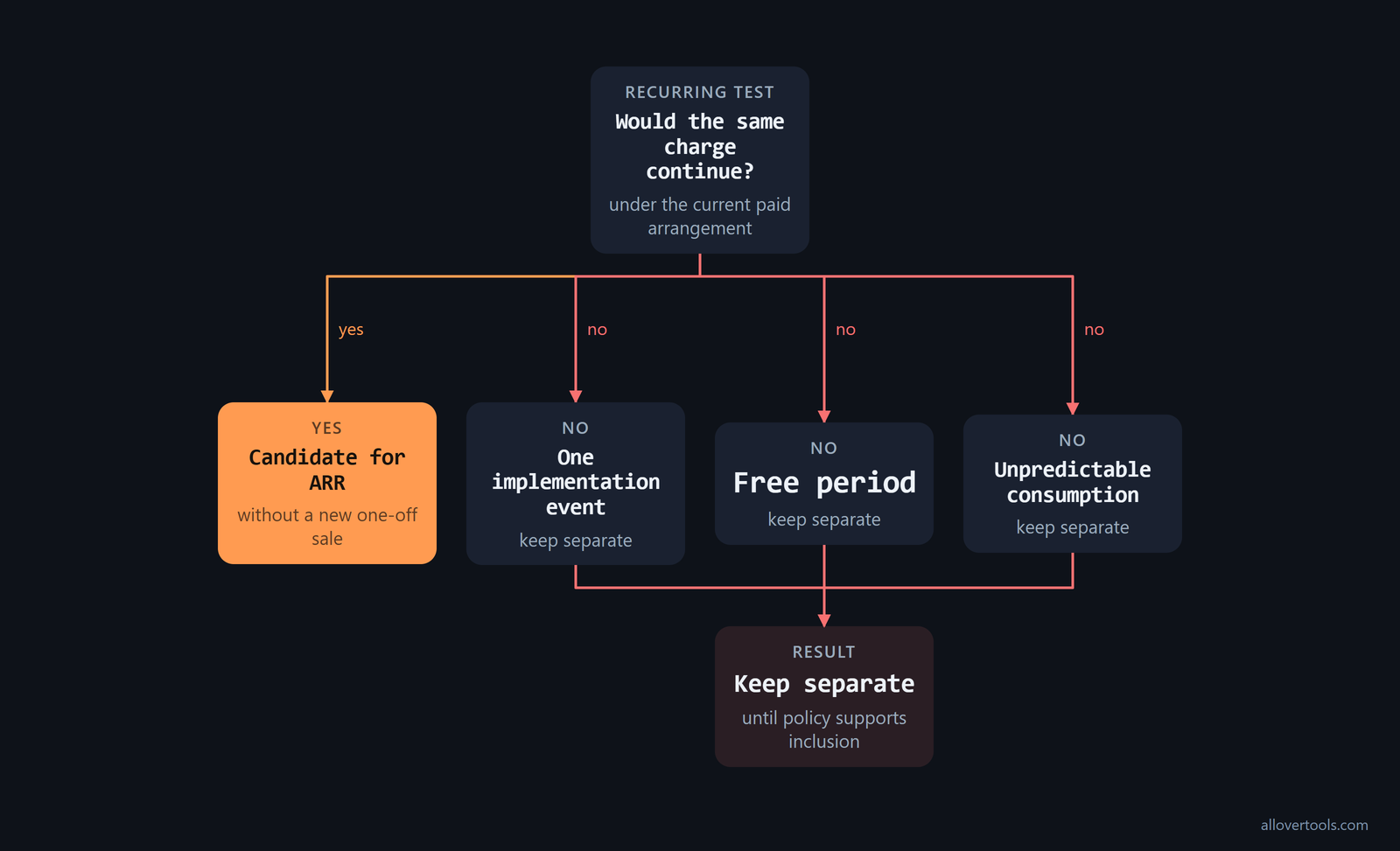
Use a direct test for each line: would the same charge continue under the current paid arrangement without a new one-off sale? If so, it's a candidate for ARR. If your charge depends on one implementation event, a free period, or unpredictable consumption, keep it separate until your policy supports including it in ARR.
How usage fees, maintenance, and add-ons affect ARR
Usage-based revenue isn't automatically excluded. Include the committed minimum or one contracted capacity charge when it's part of the continuing obligation. Predictable usage may qualify when your policy supports it. Keep volatile overage outside ARR when you can't support it as steady revenue.
Before you treat a repeating charge as ARR, check the commitment. Traditional ARR is designed for term-based agreements. One stated criterion in Stripe's ARR guidance is a minimum 12-month subscriber commitment alongside the exclusion of nonrecurring revenue. A month-to-month relationship that can be canceled at any time doesn't carry the same commitment as a term contract, so repeated invoices alone aren't enough.
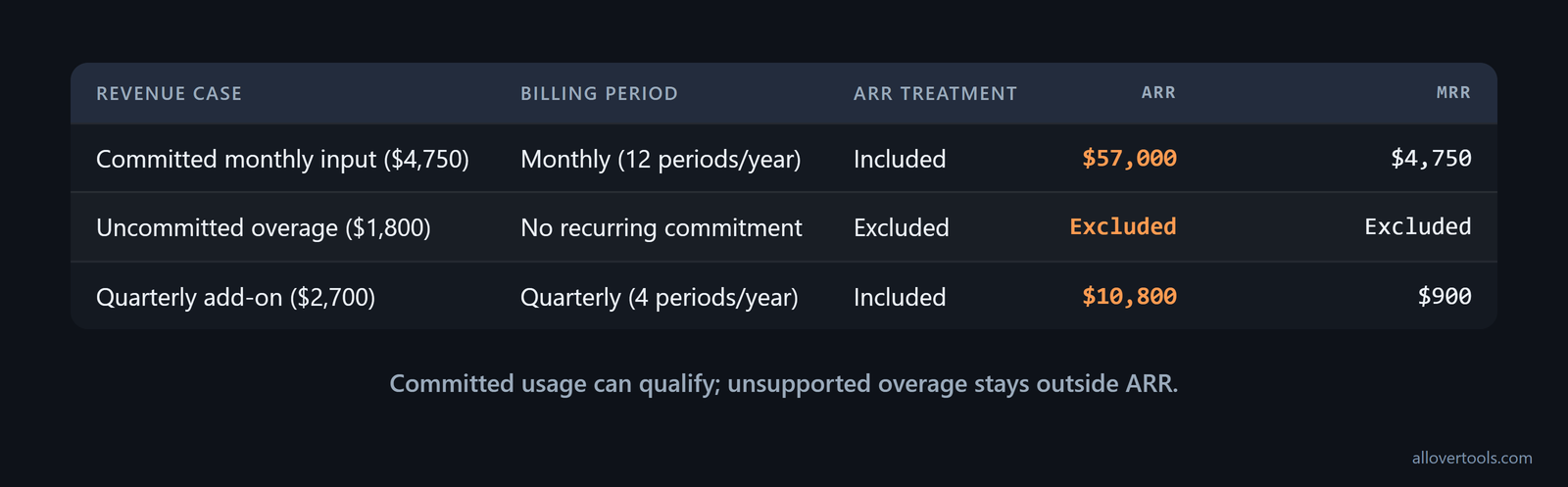
In one example, a $4,000 monthly subscription and a $750 monthly committed usage minimum make a monthly input of $4,750 for the calculator. With Monthly (12 periods/year) and 1 subscription:
ARR = $4,750 × 12 × 1 = $57,000
MRR = $57,000 ÷ 12 = $4,750
A $1,800 uncommitted usage overage is excluded from that example. A separate $2,700 quarterly add-on gives:
Billing period = Quarterly (4 periods/year)
ARR = $2,700 × 4 × 1 = $10,800
MRR = $10,800 ÷ 12 = $900
Recurring support and maintenance go through the same test, as do add-ons. Your volatile invoice line doesn't become recurring just because it appeared in one billing period.
Committed usage versus unpredictable overage
Separate the recurring minimum or committed capacity fee from excess consumption. Define the included portion in your policy. Spikes stay outside ARR. So do ad hoc usage and one-off overage.
A monthly add-on doesn't become ARR just because it appears on several invoices. Include annual subscriptions, renewals, and upgrades or add-ons with an annual commitment. Exclude monthly add-ons without a long-term commitment. For usage-based items, count the contracted minimum unless the usage is formalized and predictable, as HiBob's inclusion table explains.
Overage has a narrower exception. Include a usage charge when the contract commits it to recur. A $10,000 custom-project fee is still outside ARR because it's a one-time payment; contracted recurring overage is eligible, as CRV's overage rule distinguishes. Classify the contract line before annualizing it, rather than relying on the label "overage."
Recurring maintenance and add-ons
A continuing support or maintenance fee qualifies, as does a product add-on, when it renews or repeats. Normalize quarterly or annual billing before merging it with monthly revenue. A one-time professional-service add-on is tied to delivery, so it isn't a recurring product fee.
Recurring ARR can include more than SaaS seats when the contract makes the service ongoing. One investor-reported definition includes term licenses, SaaS, utility software, maintenance tied to perpetual and term licenses, extended maintenance contracts such as enterprise support, and managed services. It excludes the perpetual license itself and professional services delivered at a point in time. Classify the recurring service separately from the one-time delivery under the SEC filing definition.
What to exclude: setup fees, free trials, and variable charges
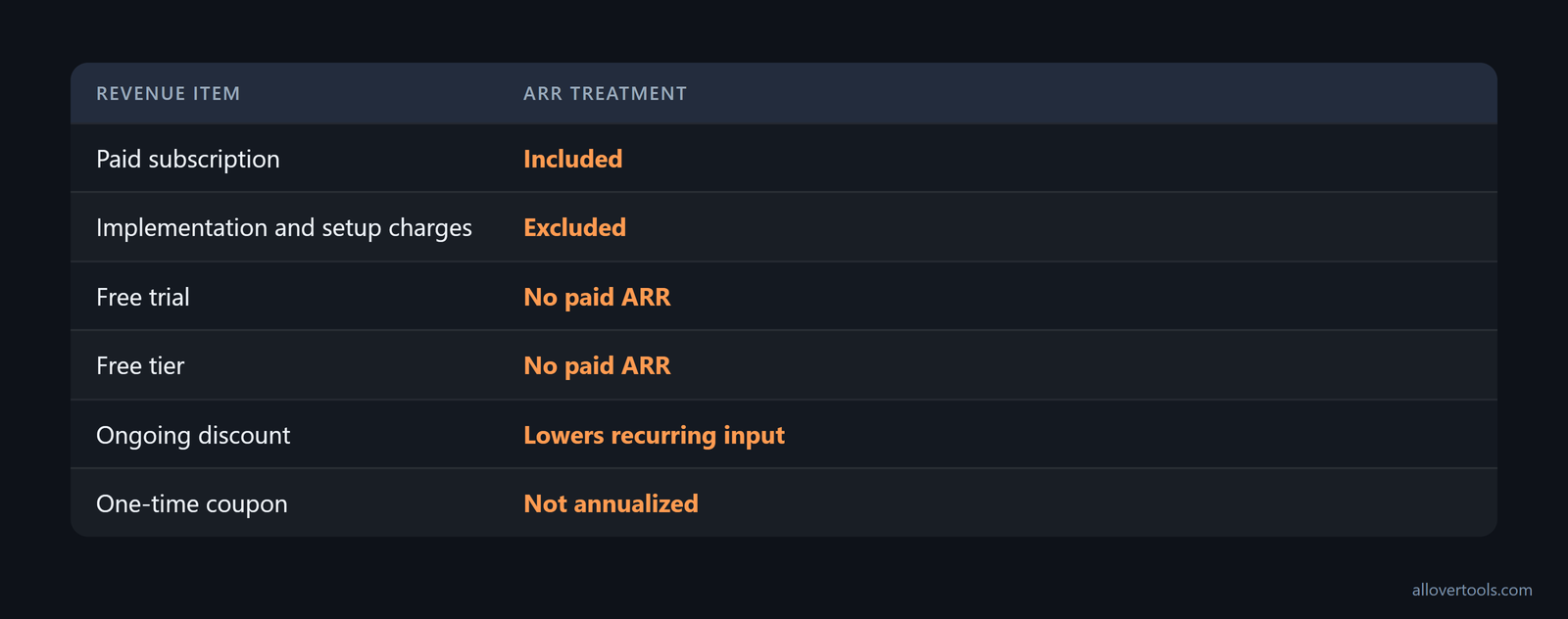
Exclude implementation and migration charges first. Onboarding and setup charges also stay out. One-time professional services and purchases stay out, as do temporary credits and highly variable usage without a recurring commitment. In your chosen example, enter only the $4,200 monthly subscription from a $4,200 subscription plus a $1,500 one-time implementation charge as the recurring input:
ARR = $4,200 × 12 × 1 = $50,400
MRR = $50,400 ÷ 12 = $4,200
The $1,500 stays out of ARR. A free trial and a free tier have no paid recurring charge, so they contribute no ARR until your paid recurring obligation begins. A possible future conversion doesn't create ARR.
Keep your one-time coupon separate from a continuing discount. The coupon isn't annualized; the ongoing discount lowers your recurring input, so use your contract terms and documented policy rather than the invoice layout. How should you classify prepaid annual service? Use those contract terms for usage above a committed minimum or a service that renews only after a separate order, not invoice appearance.
One-time implementation and setup charges
A charge tied to getting your customer live isn't annualized, even when it appears on the same invoice as a subscription. Keep the $1,500 implementation amount outside the recurring input.
Free trials and free tiers
A trial or free tier contributes no paid ARR. Count your paid subscription only after conversion creates an active recurring charge. A user's possible future conversion isn't ARR.
Worked example: classify a mixed monthly contract
All values in this example are chosen for illustration. Classify each line before doing the arithmetic:
- $4,200 core subscription, included
- $800 recurring add-on, included
- $600 recurring maintenance, included
- -$300 ongoing discount, reduces the recurring amount
- $1,500 implementation, excluded
- $2,000 variable usage overage, excluded
The net recurring revenue per month is:
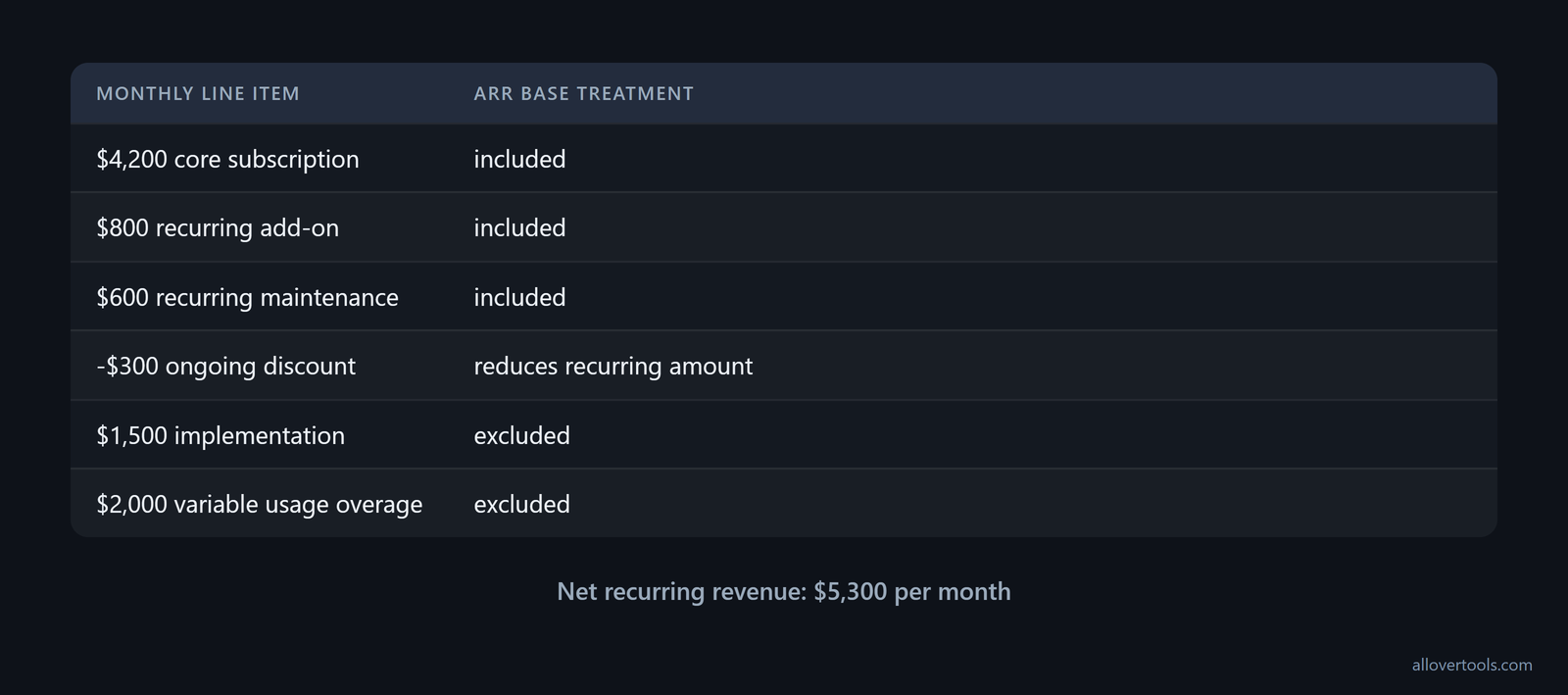
$4,200 + $800 + $600 − $300 = $5,300
$5,300 × 12 × 1 = $63,600 ARR
$63,600 ÷ 12 = $5,300 MRR
Apply the discount before annualization. The implementation and overage stay out of the formula. To run your example, open the ARR Calculator after you classify the contract lines.
Separate included and excluded lines
This six-line check lets you audit the net base. It also keeps your one-time implementation charge and a single volatile overage from being treated as repeating revenue.
Enter the net recurring amount
- Enter $5,300 in "Recurring revenue per billing period".
- Choose "Monthly (12 periods/year)" under "Billing period".
- Leave "Number of identical subscriptions (optional)" at 1 because the amount is already a total.
- Choose a Currency symbol for display.
- Select "Calculate ARR".
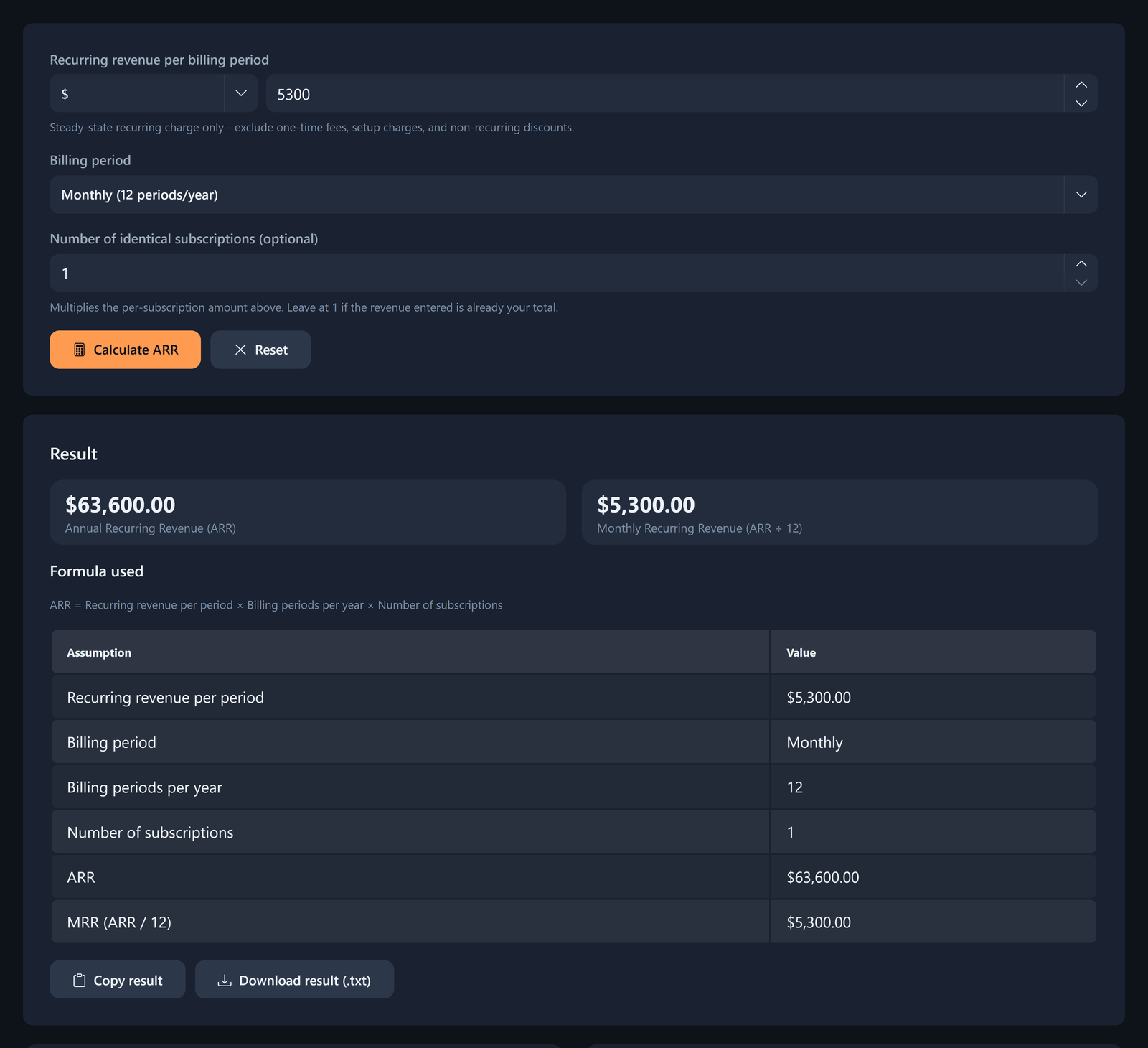
Expected outputs: ARR $63,600 and MRR $5,300. The result shows ARR, MRR, the formula, and assumptions. Currency symbol changes the presentation, not the amount. The calculator uses the entered values locally and makes no fetch, XMLHttpRequest, sendBeacon, or form post for the calculation.
Before you combine distinct billing cycles, normalize them or calculate them separately. Don't multiply your amount by a customer count when your input already covers all subscriptions.
For planning, divide a forecasted ARR figure for a given month by 12 to get the recommended revenue forecast for that month. This is a forecasting bridge, not recognized revenue, and it doesn't change ARR's point-in-time definition. The method appears in Burkland's modeling guide.
How to document and keep ARR rules consistent
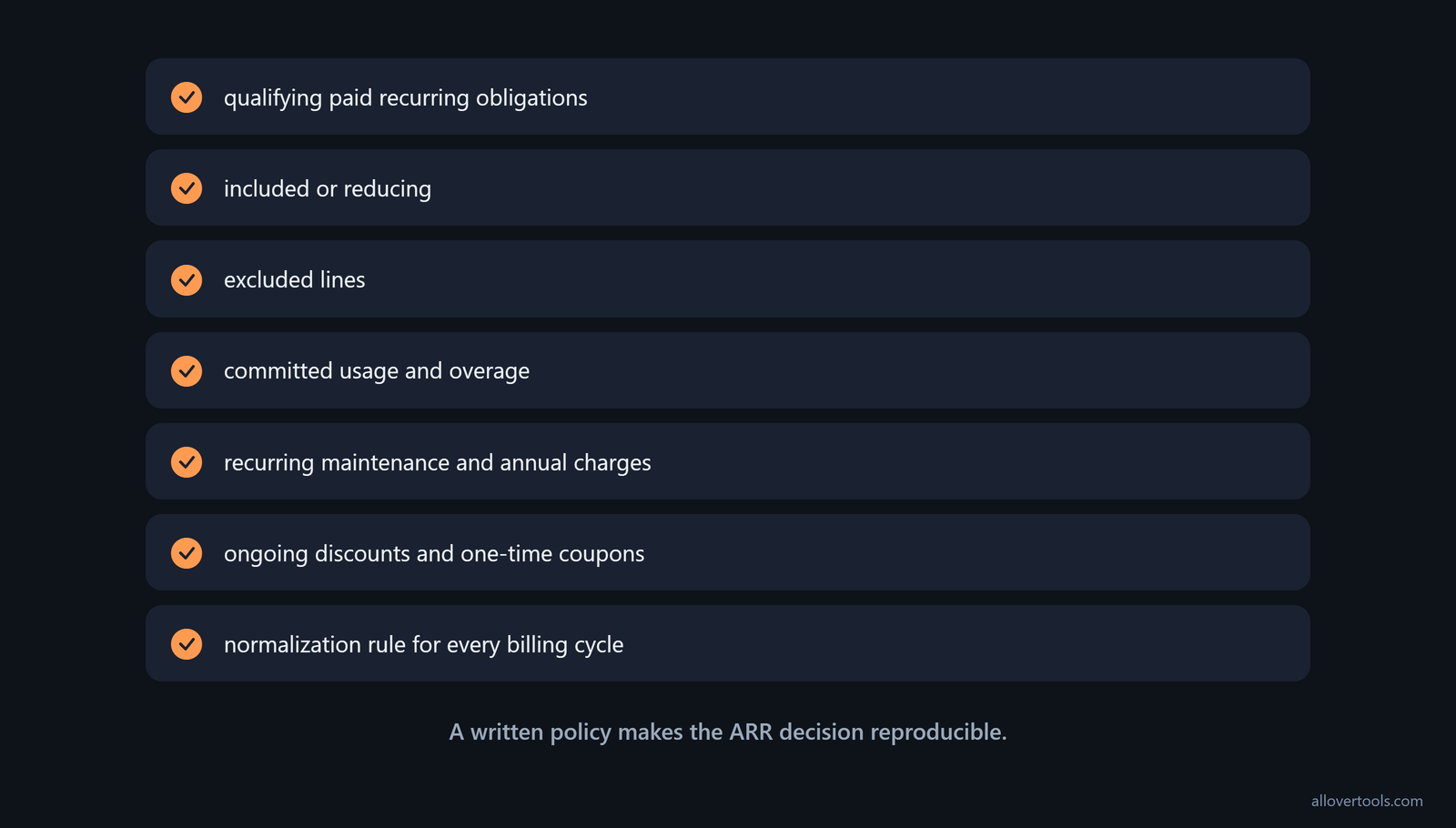
A written policy defines ARR as the annualized value of qualifying paid recurring obligations. It maps each invoice or contract label to a treatment, such as included or reducing, with excluded lines marked separately. It also states how you'll treat committed usage and overage, covers recurring maintenance and annual charges, and records ongoing discounts and one-time coupons. State a normalization rule for every billing cycle.
Keep your line-item mapping with the metric calculation. Record your contract or pricing changes before recalculating, then apply the same rule to every reporting cycle. Watch for switches between gross list price and net billed price, added one-off fees, or counted free users. Review volatile usage treated as recurring, or a total multiplied by subscriptions twice.
Break ARR changes into movement components
To explain a change in headline ARR, separate new, expanded, reduced, and lost revenue. New ARR comes from newly acquired customers. Expansion ARR is additional revenue from upgrades, upsells, or increased usage.
Contraction ARR is revenue reduced by downgrades or seat reductions. Churned ARR is revenue lost when subscriptions are canceled. Track these alongside the line-item policy so discounts, usage changes, trial conversions, and cancellations are assigned to the right movement instead of disappearing into the total. The formula appears in CFI's ARR breakdown:
Apply the same movement formula each time: ARR = New ARR + Expansion ARR - Contraction ARR - Churned ARR.
Write the inclusion policy
Turn the recurring test into a checklist. Give each common revenue line a named treatment, and give each billing cycle a normalization rule. Your decision should be reproducible from the contract, not from the order in which invoice lines appear.
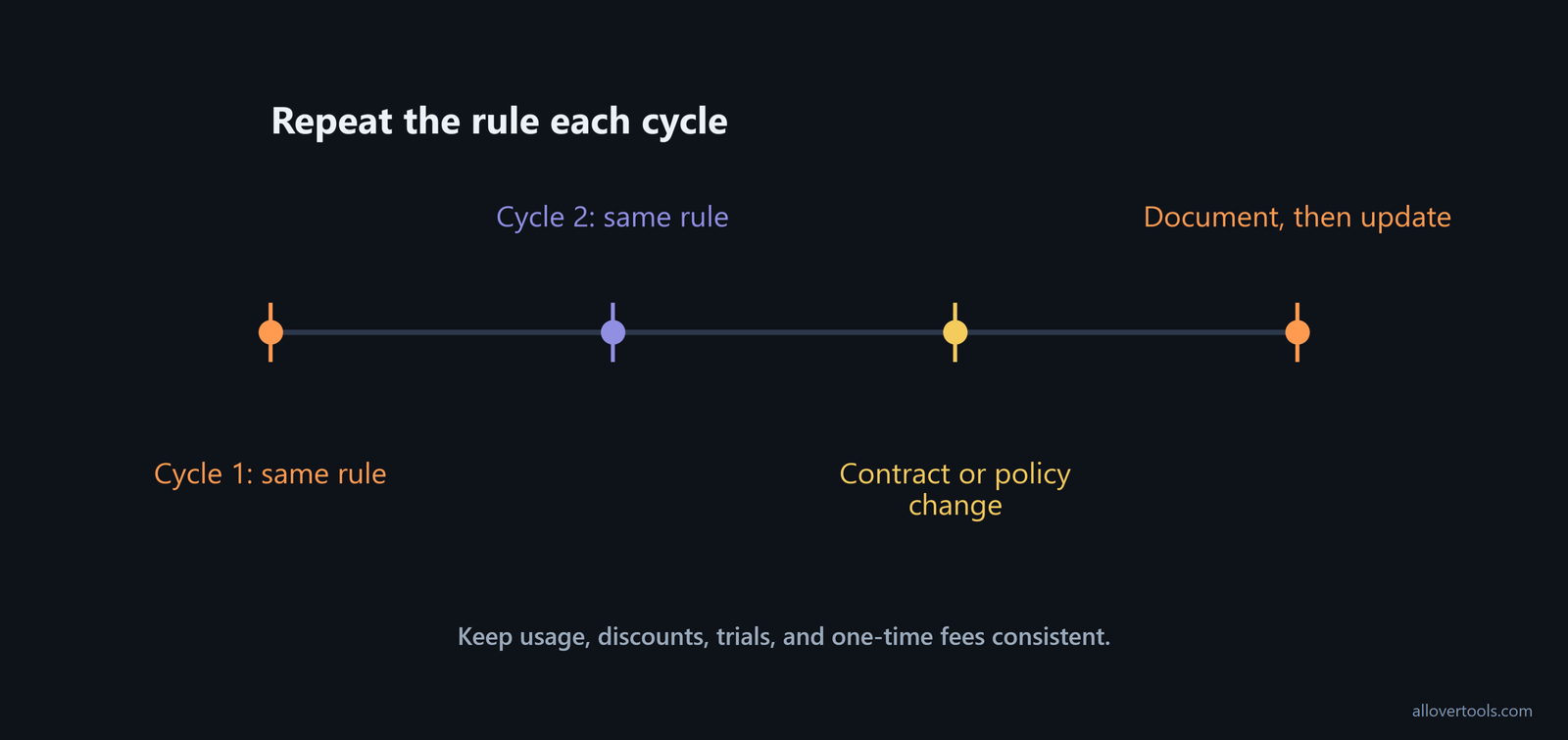
Apply one definition over time
Preserve comparability by using your same gross-versus-net decision each time. Keep the same treatment for usage, discounts, trials, and one-time fees. Change the definition only when the underlying contract or policy changes. Document your reason before applying the new rule.
Frequently asked questions
Does ARR include subscription fees and recurring add-ons?
Yes. Include your paid subscription fees and continuing add-ons. Include recurring service or maintenance charges in the active obligation, then apply ongoing discounts before annualizing the net recurring amount.
Can usage-based fees be included in ARR?
Include a contracted minimum or predictable recurring usage component when your contract and policy support it. Leave unsupported, highly variable overage outside ARR instead of annualizing a one-period spike.
How should discounts and coupons be treated in ARR?
An ongoing discount lowers the recurring input used for ARR. A one-time coupon or credit isn't annualized and doesn't change the steady-state recurring charge after the promotion ends.
Are setup fees, implementation fees, or free trials part of ARR?
No. Exclude one-time setup and implementation charges, and count neither a free trial nor a free tier as paid ARR. Include your revenue after a paid recurring obligation is active.
How do I calculate ARR from a mixed revenue stream?
Classify every line first, sum only the included recurring amounts for one billing period, and enter that net amount in the ARR Calculator with the matching Billing period. Leave the optional subscription count at 1 when your entered amount already covers the total.