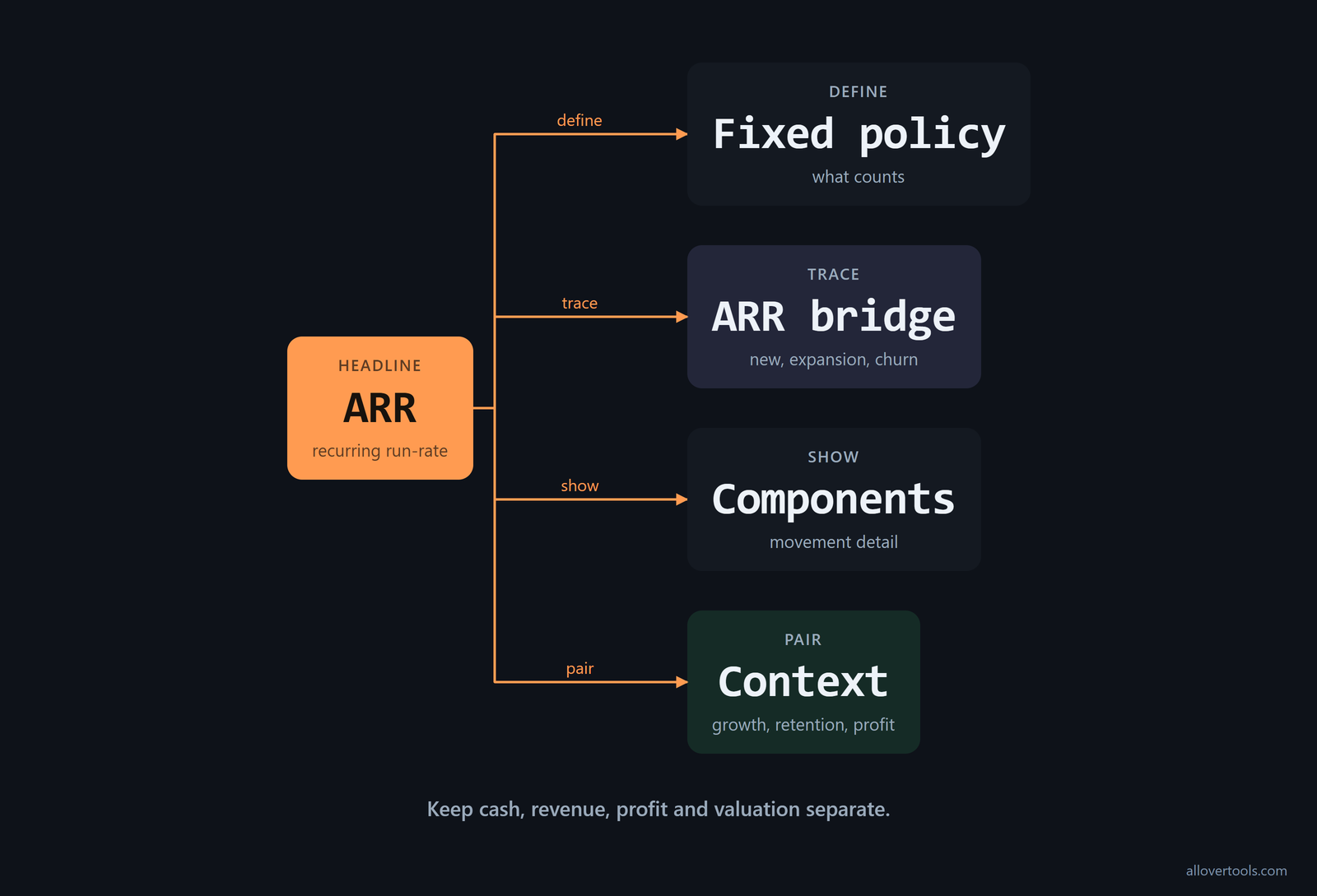
ARR reporting to investors needs a definition that does not move from one update to the next. The report should show what changed through a bridge, spell out what counts, and place new, retained, expansion, contraction and churned ARR beside growth, retention, profitability and cash measures. That gives readers a number they can trace to the cut-off and the underlying accounts.
Why ARR is a headline metric in SaaS reporting
ARR is the annualized run-rate of recurring subscription commitments at a stated reporting point. Subscription companies put it near the top of board and investor updates because it shows the size of the recurring base and makes changes easier to follow than one period's recognized revenue. It is not cash collected, recognized revenue, profit or a valuation on its own. A useful packet pairs it with a fixed definition, an ARR bridge, component detail, and growth, retention and profitability context.
The ARR Calculator can sanity-check the annualized total from the recurring amount and billing period before the figure goes into the update.
Choose ARR or MRR based on the contract profile. Keep usage-based overages out of ARR unless they are contractually committed. ARR covers recurring revenue only, so one-time implementation fees, professional services charges and uncommitted usage-based overages do not count, according to Fullcast's ARR guide. Most B2B SaaS companies with average contract values above $10,000 default to ARR as their primary metric. High-volume, low-ACV monthly subscriptions lean on MRR for operational decisions and convert it to ARR for board reporting. State which approach you use so readers can tell whether the monthly view is operational or ARR is the main operating measure.
Choose and document an ARR definition
Set the policy before choosing the number. Record the reporting cut-off, contract status, currency treatment, annualization basis, and whether the unit is customer-level or an already aggregated total. For monthly recurring revenue, the core formula is MRR × 12. The ARR Calculator uses ARR = Recurring revenue per period × Billing periods per year × Number of subscriptions and supports monthly, quarterly, semi-annual, annual, weekly and custom cycles.
For a check, enter 45,500 in Recurring revenue per billing period, choose Monthly (12 periods/year) in Billing period, and leave Number of identical subscriptions (optional) at 1.
ARR = 45,500 × 12 × 1 = 546,000
MRR = 546,000 ÷ 12 = 45,500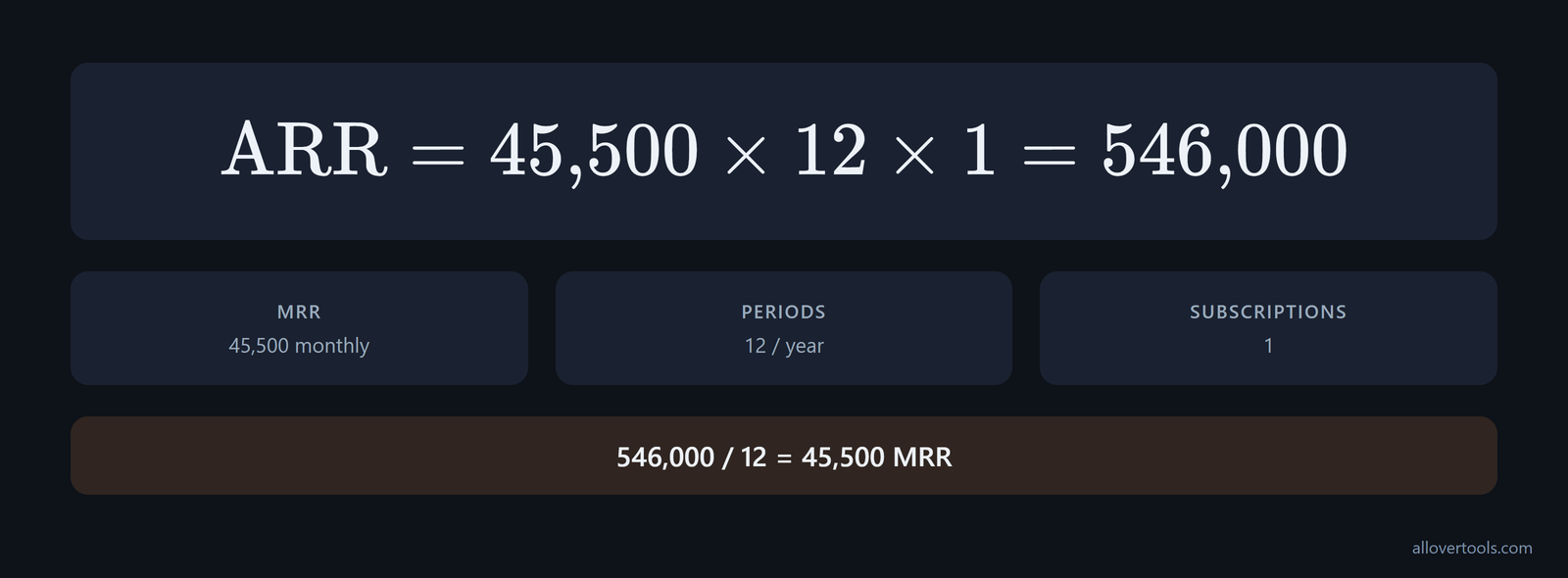
The calculator uses only the values entered and performs the calculation in the browser. Run the check in the ARR Calculator, then put the policy note beside the result.
Treat ARR as a normalized forward-looking run-rate, not a forecast of booked revenue. It represents the recurring contract value for the coming twelve months if existing customers do not cancel and no new customers are acquired, as Amplifa's ARR definition sets out. Put that assumption beside the figure; otherwise, a reader may mistake the steady-state snapshot for a plan that includes churn or new logos.
Write the definition note beside the number
A reusable note can say: "ARR includes contracted recurring subscription charges active at the cut-off. ARR excludes one-time setup or implementation fees, non-recurring discounts and other amounts that are not expected to recur." Add the treatment for usage, services, paused accounts, mid-period changes, foreign currency and signed-but-not-started contracts. Keep those cases from changing silently between reports.
Use the billing system for ARR because it records actual customer payments. The CRM or a manually maintained spreadsheet should not be the primary record for the headline number. Base the calculation on billing data, then show its movements in an ARR waterfall: starting ARR, new, expansion, contraction and churn, following the billing-system guidance. Name the system in the report so the source is clear before anyone reviews the formula.
Disclose what is included and excluded in ARR
Put the policy in a compact decision table. For each edge case, state the rule, apply it in every period, and flag any restatement. Two ARR totals can look identical while representing different recurring quality if their component policies differ.
| Included | Excluded | Decision needed |
|---|---|---|
| Active subscription fees | Implementation fees | Committed usage minimums |
| Recurring plan upgrades that meet the policy | One-off purchases and temporary credits | Annual prepayments and free-to-paid conversions |
| Variable usage or services without a committed recurring amount | Paused contracts and foreign-currency balances |
The ARR Calculator's Recurring revenue per billing period help text says to leave out one-time fees, setup charges and non-recurring discounts. It does not settle the company's wider accounting or contract policy. A footnote should name the definition, cut-off, included plans, exclusions, currency, contract status and changes from the prior report.
Separate recurring commitments from non-recurring amounts
A one-time fee or variable charge can inflate an annualized total if it is treated as recurring. Put that amount outside ARR and label it separately. The adjustment should be visible instead of being buried in the headline number.
Fundraising ARR must contain recurring software revenue that is real, durable and easy to diligence. Remove pilots, one-off service bundles and soft verbal renewals from the fundraising figure. They are not backed by a firm, renewable subscription contract, and the fundraising ARR guidance defines the measure as the yearly value of contracted recurring software revenue. Keep those amounts on a separately labelled line if they matter to the wider commercial picture, but leave them out of the ARR headline.
Do not count unstarted bookings as ARR. Do not annualise a ramped deal at its final-year rate when the contracted schedule starts lower. Use the actual contracted schedule for graduated pricing and keep future contract value out of the current run-rate. These are specific overstatement traps identified in the diligence review. The bridge should show the resulting movement rather than treat future contract value as current ARR.
ARR depends on the activation date and revenue type. Apply the same operational rules in every period:
- Exclude one-time setup fees, implementation costs and consulting day rates.
- When implementation takes months, do not book bookings as ARR immediately. Start true license usage on the contractually agreed start date.
- Treat paid proof-of-concept projects as non-recurring.
- Exclude repeatedly purchased services when they lack automatic contractual renewal.
- Amortize contractually granted discounts and free months linearly over the contract term.
Amplifa's ARR rules set out these timing, classification and discount rules.
Remove contracts due to expire within 30 days from the reported ARR. Also leave out one-time professional services fees and usage-based overages that are not contractually committed. This limits the headline to active subscription contracts whose forward value remains supported at the cut-off, following the board-reporting rule. Flag that exclusion in the policy note so a falling total is not mistaken for an unexplained restatement.
Build an ARR bridge with new, renewal and expansion ARR
Use the bridge formula ending ARR = starting ARR + new business ARR + expansion ARR − contraction ARR − churned ARR. This makes the total easier to check. Define "renewal ARR" before using it. In this example, renewal ARR means the retained starting ARR after contraction and churn, not gross contract renewals.
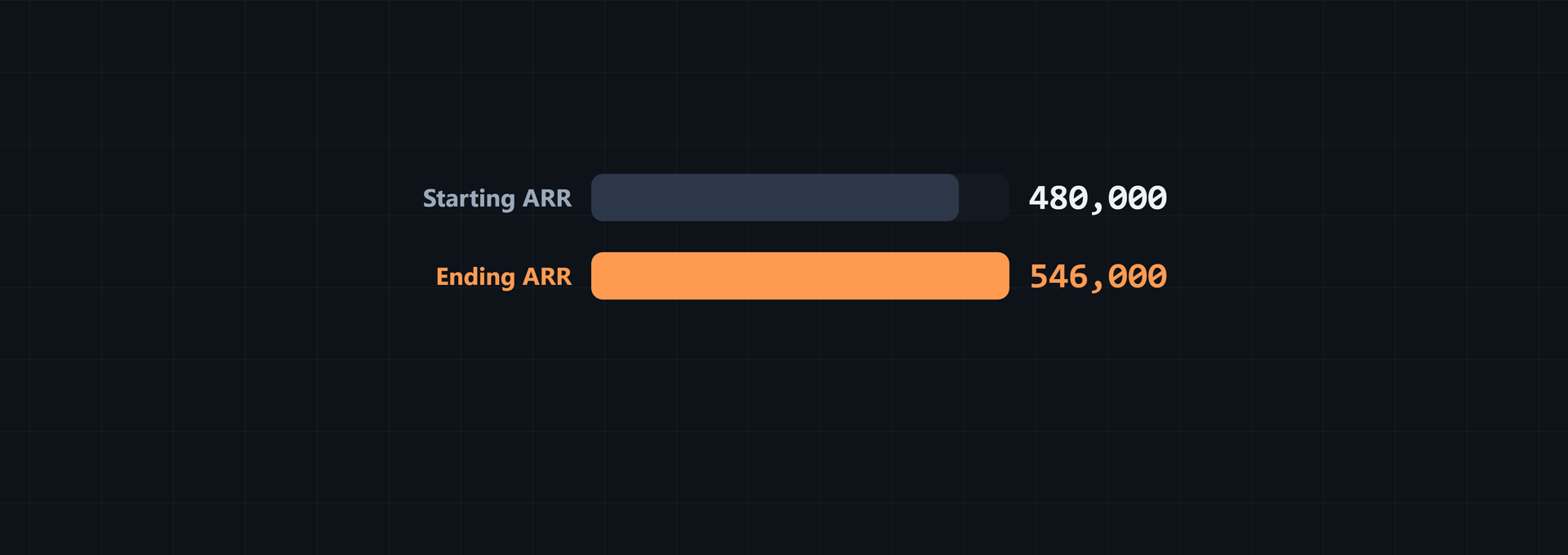
These are the chosen values: starting ARR 480,000, new business ARR 72,000, expansion ARR 24,000, contraction ARR 12,000 and churned ARR 18,000.
Retained starting or renewal-base ARR = 480,000 − 12,000 − 18,000 = 450,000
Net new ARR = 72,000 + 24,000 − 12,000 − 18,000 = 66,000
Ending ARR = 480,000 + 72,000 + 24,000 − 12,000 − 18,000 = 546,000
Ending ARR = 450,000 + 72,000 + 24,000 = 546,000
Enter the same movement values in the SaaS Metrics Calculator using Starting recurring revenue, New business recurring revenue, Expansion revenue, Contraction revenue and Churned revenue. With an annual period, its calculation treats the ending recurring amount as ARR. Results use entered values only and are calculated in the browser.
Label the movement categories precisely
New means first-time recurring business. Expansion is additional recurring value from existing accounts. Contraction is lost recurring value without full churn. Churn is recurring value lost when an account leaves. Renewal or base retained is the surviving starting base under the stated rule. Do not put a renewal total in the bridge unless its relationship to starting ARR is clear.
Show the bridge as a reader-checkable table
| Bridge row | Amount |
|---|---|
| Starting ARR | 480,000 |
| New business ARR | +72,000 |
| Renewal/base retained | 450,000 after deductions |
| Expansion ARR | +24,000 |
| Contraction ARR | -12,000 |
| Churned ARR | -18,000 |
| Ending ARR | 546,000 |
For reconciliation, 480,000 + 72,000 + 24,000 - 12,000 - 18,000 equals 546,000. The renewal/base retained row is a subtotal, so it should not be added to starting ARR again.
Use the bridge as a time series, not a one-period fundraising exhibit. Quality-of-earnings providers build one for each of the last eight to twelve quarters. Ongoing management reporting should show it monthly and cumulatively for the year, so readers can see both the monthly rhythm and the larger picture; this is the multi-period bridge expectation. Keep the row definitions the same across views so readers can tell a genuine movement from a reporting-policy change.
Turn the ARR bridge into an ownership and forecast model
Assign an owner to each bridge row, then forecast from the drivers behind it. Sales and marketing own new ARR; customer success and pricing own expansion; product and support own contraction and churn, according to the bridge forecasting guide. Forecast new ARR from pipeline and sales capacity, expansion from assumptions about existing customers, and contraction or churn from cohort retention. Convert ARR to revenue only after setting those drivers. This gives the board an explanation of the historical bridge and a way to ask which team owns the next movement.
Pair ARR with growth, churn, retention and profitability
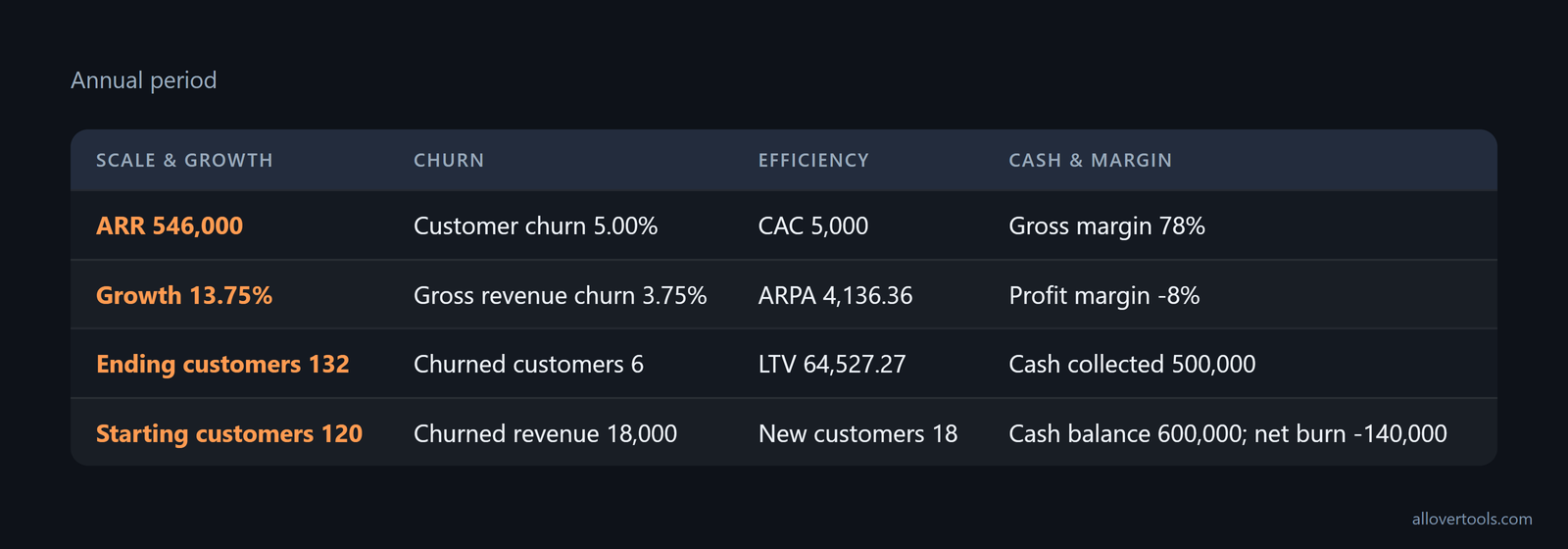
Place one companion-metrics panel beside ARR. The chosen annual-period inputs are starting recurring revenue 480,000; new business 72,000; expansion 24,000; contraction 12,000; churned revenue 18,000; starting customers 120; new customers 18; churned customers 6; sales and marketing spend 90,000; gross margin 78%; profit margin -8%; operating expenses 360,000; cash collected 500,000; and cash balance 600,000.
Ending ARR = 480,000 + 72,000 + 24,000 − 12,000 − 18,000 = 546,000
Revenue growth = (546,000 − 480,000) ÷ 480,000 × 100 = 13.75%
Customer churn = 6 ÷ 120 × 100 = 5.00%
Gross revenue churn = 18,000 ÷ 480,000 × 100 = 3.75%
Ending customers = 120 + 18 − 6 = 132
CAC = 90,000 ÷ 18 = 5,000
ARPA = 546,000 ÷ 132 = 4,136.36
LTV = (4,136.36 × 78%) ÷ 5.00% = 64,527.27
Net burn = 360,000 − 500,000 = −140,000
The SaaS Metrics Calculator labels that net burn result "Not burning cash (breakeven or profitable)." Its annual mode treats the ending recurring amount as ARR and derives MRR as ARR ÷ 12. Enter the full companion set in the SaaS Metrics Calculator to see the displayed formulas and denominators.
Distinguish churn measures from net retention
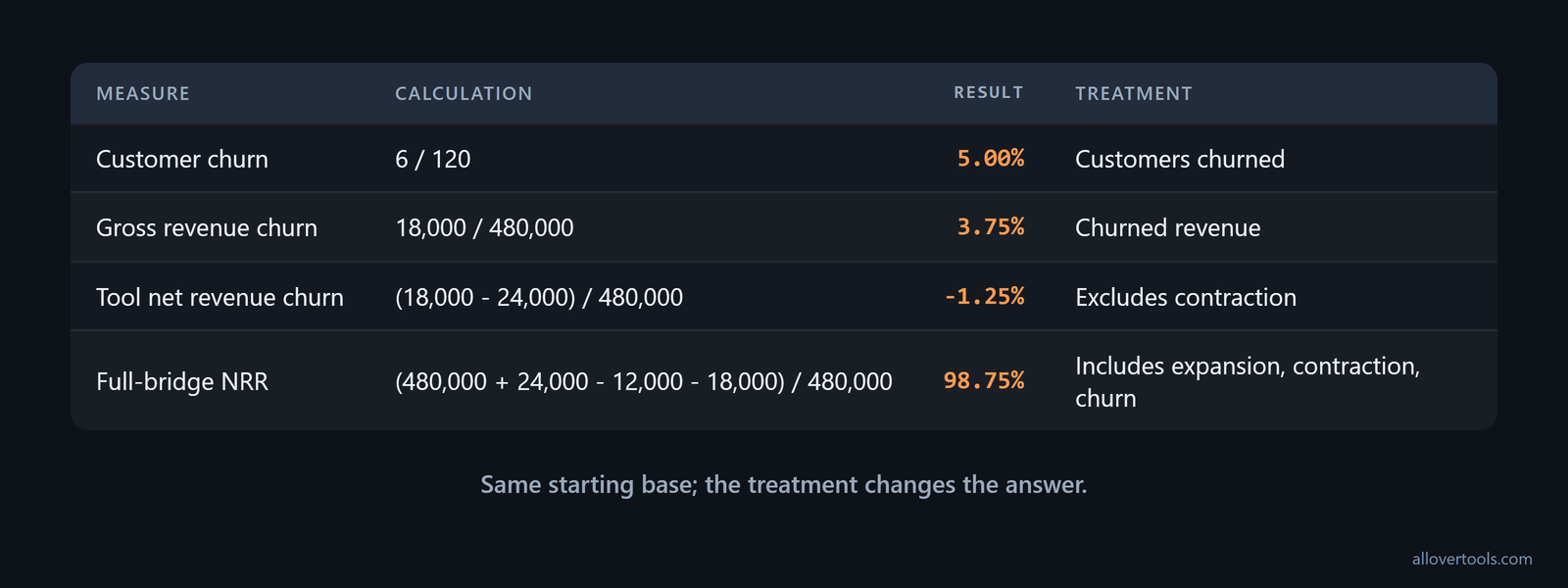
Customer churn is churned customers ÷ starting customers. Gross revenue churn is churned recurring revenue ÷ starting recurring revenue. Full-bridge NRR is the retained starting base plus expansion divided by starting ARR, so here (480,000 + 24,000 − 12,000 − 18,000) ÷ 480,000 × 100 = 98.75%.
The tool's displayed net revenue churn rate is (18,000 − 24,000) ÷ 480,000 × 100 = −1.25% because its formula excludes contraction. Label the two outputs separately, show the denominator and state the contraction treatment. For this example, gross revenue churn is 3.75%, tool net revenue churn is -1.25% and full-bridge NRR is 98.75%.
Use net expansion to see whether the recurring base is strengthening or eroding beneath the headline. Above 120%, expansion revenue exceeds contraction and churn combined. Below 100%, the base is eroding faster than it is growing, even when new logos are strong, as the bridge benchmarks describe. Put the threshold beside the bridge metric. Check the expansion, contraction and churn rows before treating ARR growth as healthy.
Give the board a metric row with denominators
Place ending ARR beside 13.75% growth, a churn or retention measure, the -8% profit margin and cash context. State that the growth and margin cover the selected annual period. No single row turns ARR into a valuation conclusion.
In investor diligence, ARR sits within a wider operating set. Label the companion panel accordingly. The nine measures carrying most weight in SaaS deals are:
- ARR and the ARR bridge.
- Gross and net revenue retention.
- Logo churn and cohort behaviour.
- Customer concentration and gross margin.
- CAC payback and the Rule of 40.
- Revenue recognition under ASC 606 or IFRS 15.
Together, those measures put the ARR headline beside retention, concentration, unit economics and the revenue-recognition policy buyers test, as the diligence metric set makes clear.
Keep ARR consistent across periods and answer investor questions
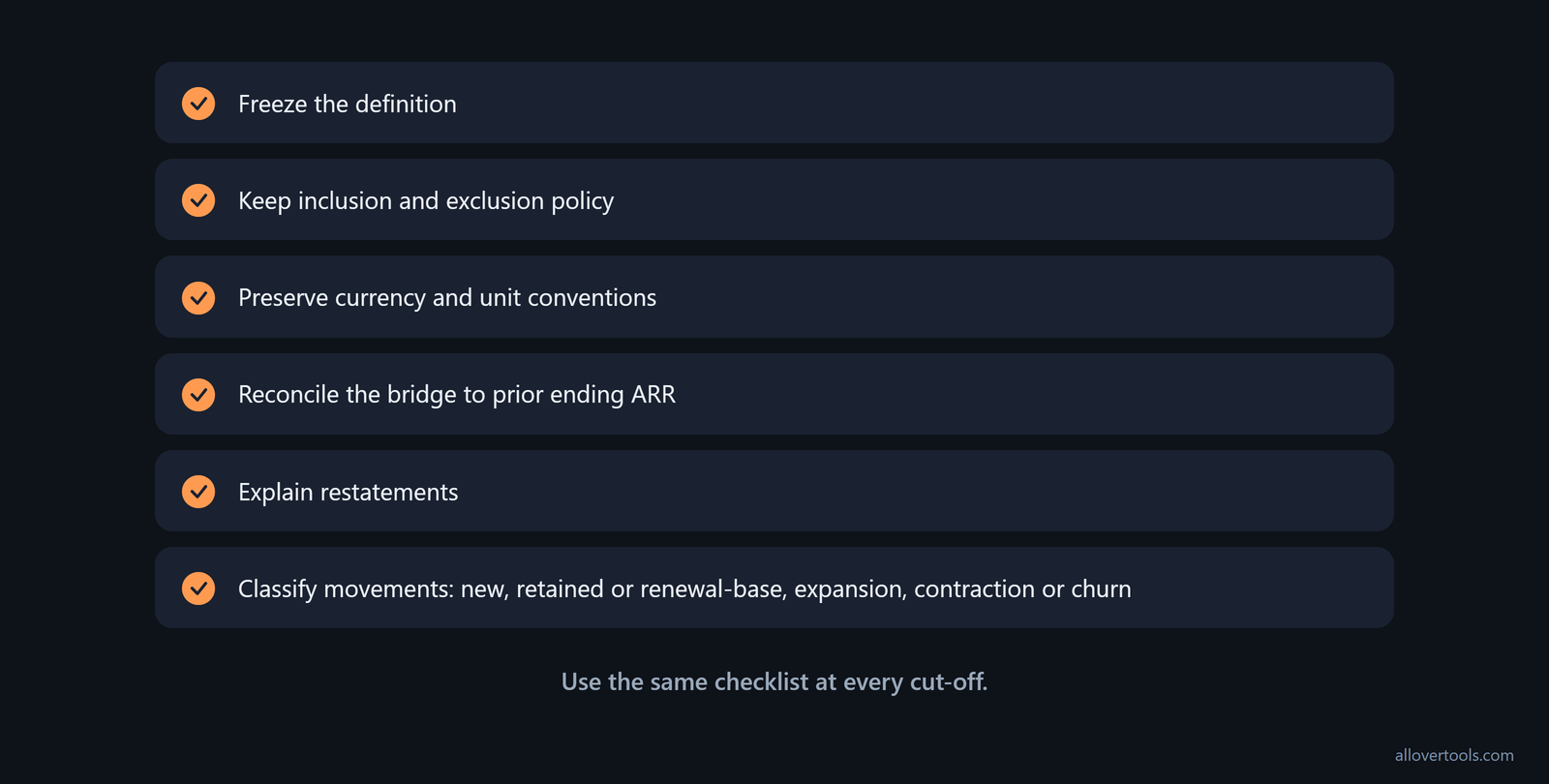
Use the same checklist at every cut-off: freeze the definition, keep the inclusion and exclusion policy, preserve currency and unit conventions, reconcile the bridge to the prior ending ARR, explain restatements, and classify movements as new, retained or renewal-base, expansion, contraction or churn. Investors commonly ask what is included, how much ARR is new versus existing-base retained, why ARR changed, how it reconciles to recognized revenue and cash, and which assumptions changed.
For valuation discussions, ARR can be one input about scale and recurring quality. Put the bridge, growth, retention, margin, cash and definition note beside it. ARR alone is not a valuation. The calculator outputs are management calculations from entered values, not a substitute for the company's accounting or contract review.
Use the same ARR policy every reporting period
Carry forward the prior ending ARR. Tie every movement to a contract or account list, record policy exceptions and disclose any restatement before showing growth. If the rule changes, show that change beside the affected period.
Prepare answers before the board meeting
Prepare one sentence and one supporting row for definition, composition, movement, reconciliation and valuation context. Keep ARR, recognized revenue and cash as separate labels, with the period and denominator beside every derived measure.
Make ARR traceable in SaaS diligence
Prepare the underlying records before the ARR number reaches an investor data room. Buyers verify nine core metrics, starting with ARR and its bridge. They rebuild the figures from the raw subscription export from the billing system, the top 20-30 customer contracts, invoice history and cash collections. A quality-of-earnings provider also constructs an ARR bridge for each of the last eight to twelve quarters and ties it to the billing export, the deferred-revenue rollforward for revenue recognized under ASC 606 or IFRS 15, and cash collections, according to the diligence evidence standard.
Any ARR that cannot be traced through all three independent sources is challenged and potentially normalized down. Keep the contract, invoice, recognition and collection trail on the same cut-off and movement categories as the board bridge. Then the reported total can be reproduced from source records rather than from a spreadsheet or a presentation-only calculation.
Frequently asked questions
What should ARR reporting to investors include?
Include the ARR definition and cut-off, included and excluded amounts, a starting-to-ending bridge, movement components, and companion growth, retention, profitability and cash measures. State the denominator and treatment of edge cases beside each derived metric.
How do you define ARR for a board deck?
Define it as the annualized recurring subscription run-rate under a named policy, then say whether the figure is based on MRR or another billing period. Exclude one-time amounts and document treatment for variable charges, discounts, pauses, currency and contract status.
What is the difference between ARR churn and net retention?
ARR churn describes recurring value lost, while net retention measures the starting customer base after expansion, contraction and churn. The report must state whether contraction is included and must not use a tool's net revenue churn output as NRR without checking its formula.
Should ARR include one-time fees or usage revenue?
One-time fees should be excluded. Usage revenue belongs in ARR only when the company's documented policy treats it as a committed recurring amount; otherwise disclose it separately and apply the same rule in every period.
How should ARR be used in valuation discussions?
Use ARR as one operating input alongside its definition, bridge, growth, retention, margin and cash context. ARR alone is not a valuation, so explain the recurring-quality assumptions instead of presenting a multiple or conclusion.