A company's burn multiple metric shows how much net cash it uses to create each unit of net new annual recurring revenue. Divide net burn by net new ARR over the same period. A lower positive result generally means more efficient growth, but this metric does not show runway, profitability, retention, or growth quality by itself.
What is the burn multiple metric?
Burn multiple is the amount of net cash burned for each unit of net new ARR. If a company burns $2 of cash for every $1 of new annual recurring revenue, the result is 2.00x. A lower positive multiple means the measured growth used less cash.
Use the same definitions and reporting period for both parts of the comparison. Net burn is total cash operating expenses minus cash collected. Gross burn is total cash operating expenses before that offset. Burn multiple measures the cash cost of growth. It does not measure runway, profitability, retention, or growth quality on its own.
SaaS capital efficiency depends on consistent underlying figures. A change in collection timing can move net burn, while new business, expansion, contraction, and churn can move net new ARR.
Check the denominator without counting renewals from existing contracts. Net new ARR is defined as New ARR + Expansion ARR - Churned ARR. That leaves new revenue from new customers, upgrades, and expansions after churn in the figure. Use that net new ARR definition when reconciling a reported figure. Strong renewals can still coexist with a weaker denominator if new or expansion ARR is weak.
How to calculate burn multiple from net burn and net new ARR
Build the recurring-revenue bridge and calculate cash burn for the same period. The Burn Rate Calculator covers net burn and runway inputs. The SaaS Metrics Calculator covers the recurring-revenue bridge and net new recurring revenue.
The formula and unit check
Use this formula:
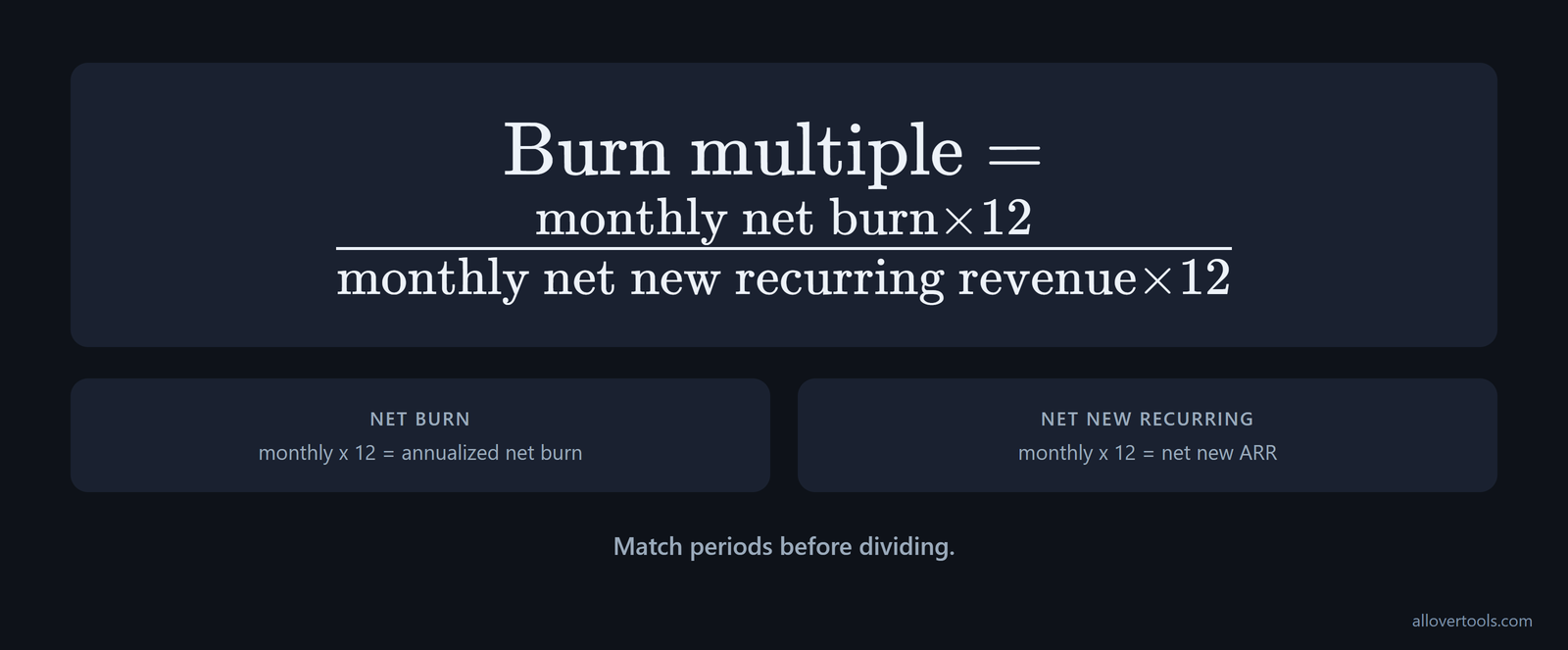
Burn multiple = net burn / net new ARRNet burn is cash operating expenses minus cash collected. Net new ARR is the annualized change in recurring revenue. With monthly inputs, annualize both figures before dividing:
Annualized net burn = monthly net burn * 12
Net new ARR = monthly net new recurring revenue * 12
Do not divide a monthly burn by an annual ARR. That mixes units and makes the result 12 times smaller than the matching-period calculation. The SaaS Metrics Calculator defines ending recurring revenue as starting recurring revenue + new business recurring revenue + expansion recurring revenue - contraction recurring revenue - churned recurring revenue. Net new recurring revenue is new business + expansion - contraction - churned.
If a non-subscription or hybrid business tracks revenue but not ARR, use net new revenue for the same period as the denominator and state that choice beside the result. The metric can be adapted because the alternate denominator guidance explicitly allows net new revenue in place of net new ARR.
Worked SaaS example with chosen values
These figures are chosen for illustration, not used as a benchmark. They cover one month and use one currency.
Starting recurring revenue:        40,000
New business recurring revenue:     8,000
Expansion recurring revenue:        2,000
Contraction recurring revenue:      1,000
Churned recurring revenue:          2,000
Total cash operating expenses:     70,000
Cash collected from customers:     52,000
Cash balance on hand:             180,000
Build the recurring-revenue bridge first:
Net new recurring revenue = 8,000 + 2,000 - 1,000 - 2,000
                          = 7,000
Ending recurring revenue = 40,000 + 8,000 + 2,000 - 1,000 - 2,000
                         = 47,000
Convert the monthly recurring figures:
ARR = 47,000 * 12 = 564,000
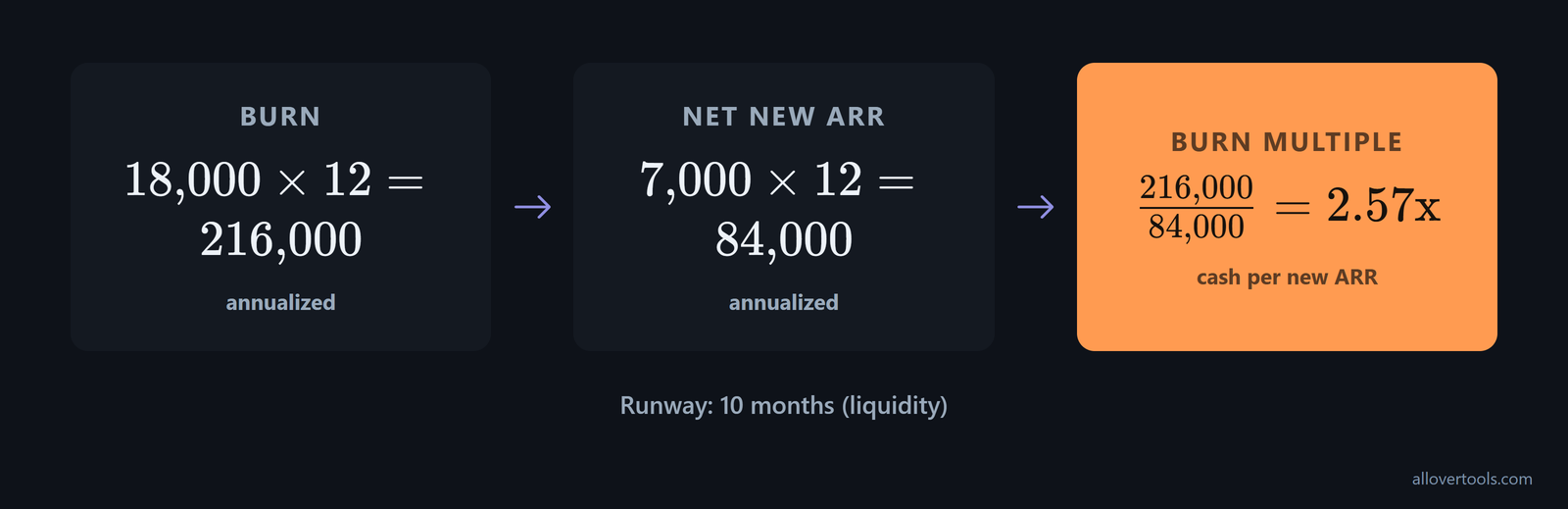
Net new ARR = 7,000 * 12 = 84,000
Calculate and annualize net burn:
Net burn = 70,000 - 52,000 = 18,000 per month
Annualized net burn = 18,000 * 12 = 216,000
That gives this result:
Burn multiple = 216,000 / 84,000
              = 2.57x, rounded to two decimals
Runway is separate: 180,000 / 18,000 = 10 months. It describes liquidity, not another part of the 2.57x multiple.
How to interpret burn multiple values by SaaS stage
What a lower or higher multiple tells you
A lower positive multiple means fewer dollars of net burn were used for each dollar of net new ARR in the measured period. A higher multiple means more cash was used for that growth. Compare the reason for the change before judging it.
Check whether the movement came from new business, expansion, contraction, churn, or timing. Confirm that the burn definition and revenue window stayed the same. A lower number caused by unusual collection timing may not last. A higher number may reflect spending whose recurring revenue has not appeared yet.
Why stage changes the interpretation
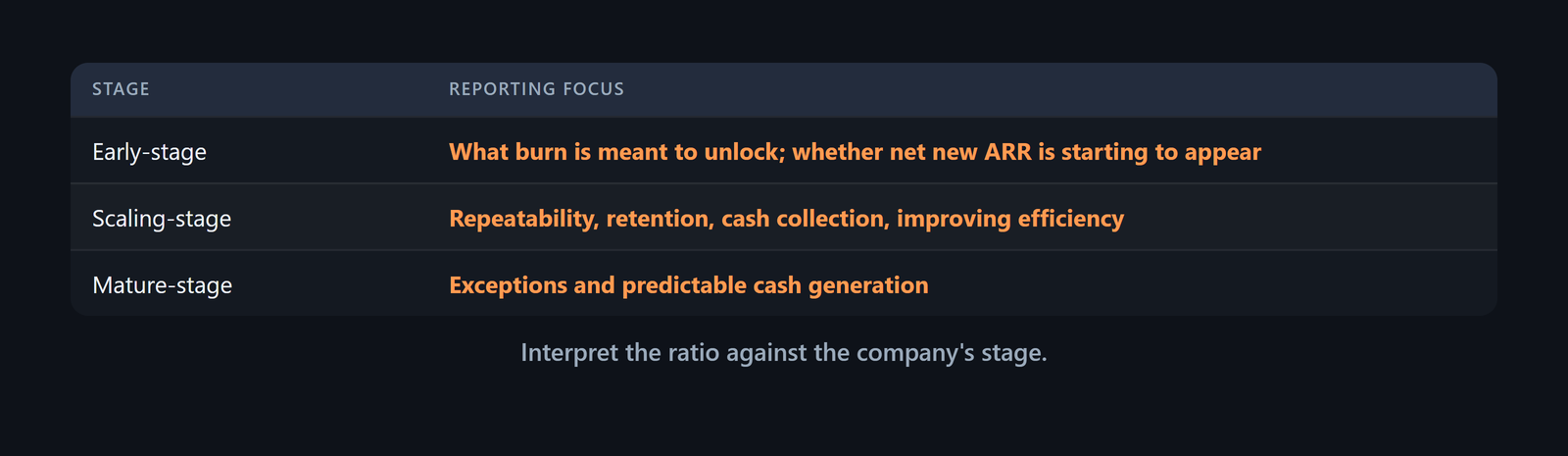
Early-stage reporting should explain what the burn is meant to unlock and whether net new ARR is starting to appear. A company testing acquisition and product fit may accept heavier investment while it learns which growth motion produces recurring revenue.
Scaling-stage reporting should focus on repeatability, retention, cash collection, and whether efficiency improves as spending grows. Mature-stage reporting should explain exceptions and protect predictable cash generation. No stage has one universal target.
Treat observed stage data as a reference range, not a pass/fail test. A 2022 sample of 439 SaaS companies reports these median burn multiples by ARR band, as the MetricHQ summary of the Capchase benchmark data shows:
| ARR range | Median burn multiple |
|---|---|
| $1-3M | 1.7x |
| $3-5M | 1.0x |
| $5-10M | 0.65x |
| $10-15M | 0.85x |
Efficiency generally improves as ARR grows. The rise from 0.65x to 0.85x at $10-15M ARR may reflect heavier investment in scaling operations and go-to-market infrastructure at that stage. Treat the $10-15M figure as a descriptive median from that sample, not proof that efficiency must worsen at scale.
Peer comparisons also depend on company size. Benchmarkit's 2026 software benchmarks cover 62 companies that supplied burn-multiple data and put the overall median at 1.0x. According to the distribution benchmark, roughly one quarter are at 0.4x or less and one quarter at 2.0x or more.
- Companies with $5M, $20M ARR: 1.3x median.
- Companies with $50M, $100M ARR: 0.5x median.
Use both the ARR band and the distribution. The original investor framing calls less than 1x "amazing" and anything less than 2x "still quite good," but treats those qualitative bands as aspirational targets rather than the observed norm for every company. Compare with similar ARR peers and follow the direction of your own consistent series before calling the result good or bad.
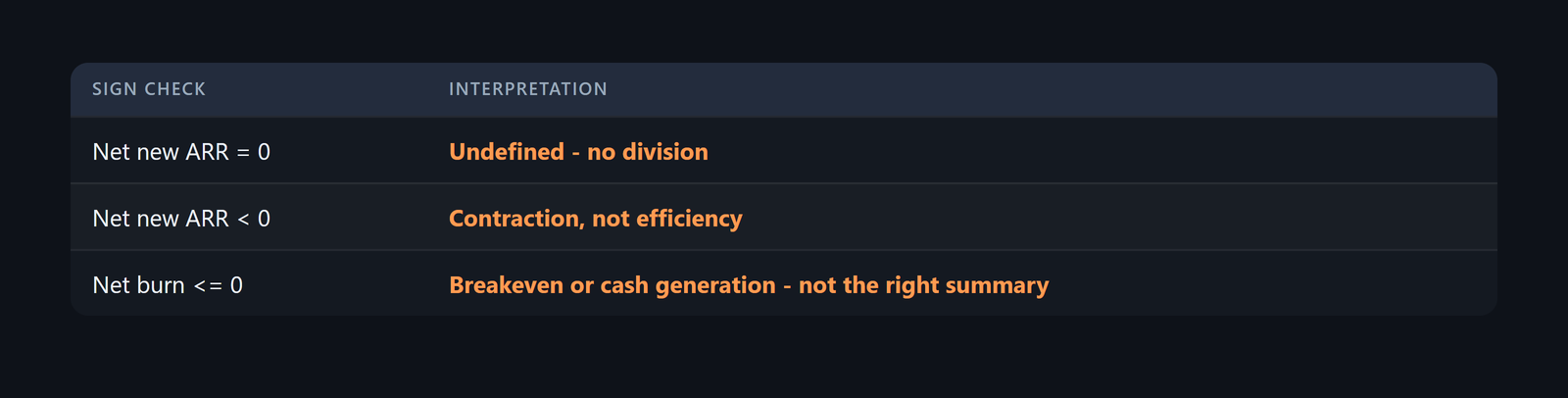
Fixed burn multiple benchmarks are less useful than a consistent internal trend built from comparable definitions. There are no universal burn multiple good values without that context. A zero or negative denominator makes the multiple undefined or misleading. Zero or negative net burn changes the question from cash consumption to breakeven or cash generation.
Burn multiple and other growth-efficiency metrics
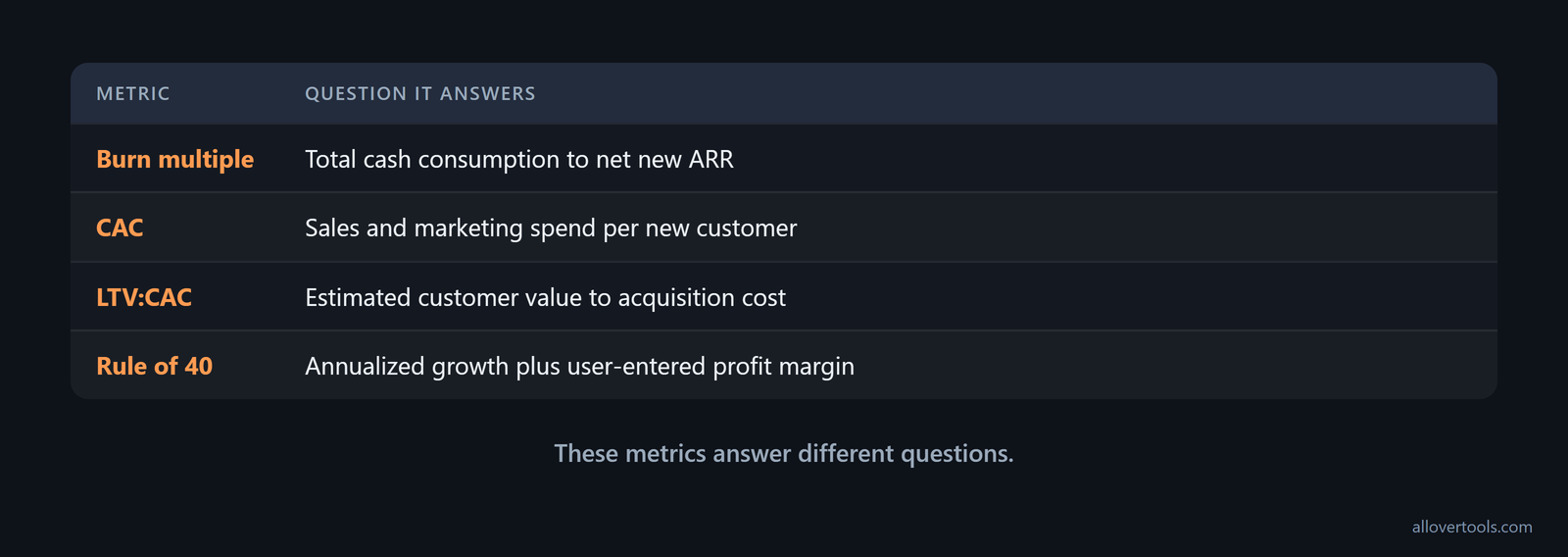
Burn multiple connects total cash consumption to net new ARR at the company level. Customer acquisition cost, or CAC, isolates sales and marketing spend per new customer. LTV:CAC relates estimated customer value to acquisition cost. The SaaS Metrics Calculator also reports a Rule of 40 score, which combines annualized growth with a user-entered profit margin.
These metrics answer different questions. Burn multiple can worsen while CAC improves if other operating costs rise. LTV:CAC can stay unchanged while collection timing changes net burn. Rule of 40 does not replace a cash-efficiency measure.
Put burn multiple next to the SaaS magic number and CAC payback in an investor update. Burn multiple covers company-level capital efficiency; the magic number covers sales productivity; CAC payback covers unit economics. In this investor-update framing, they are complementary rather than interchangeable.
How buyers read burn multiple before an exit
Burn multiple gives buyers and investors a read on efficiency and valuation potential when they assess a company for sale. Higher multiples may concern them, especially when the pattern persists. Use these bands as a deal-review lens, not a substitute for the operating analysis above:
- Below 1.0x: "Amazing."
- 1.0-1.5x: "Great."
- 1.5-2.0x: "Good."
- 2.0-3.0x: "Poor."
- Over 3.0x: "Bad."
Check whether a sustained multiple above roughly 2-3x raises perceived risk in the sale story. Conversely, sub-1x or low-single-digit multiples signal capital-efficient growth and can support stronger valuation multiples in M&A or secondary transactions, according to L40's sale-process guidance. Keep the period definitions and the reason for each movement so a buyer can tell durable efficiency from timing or one-time effects.
How to use burn multiple in board reporting
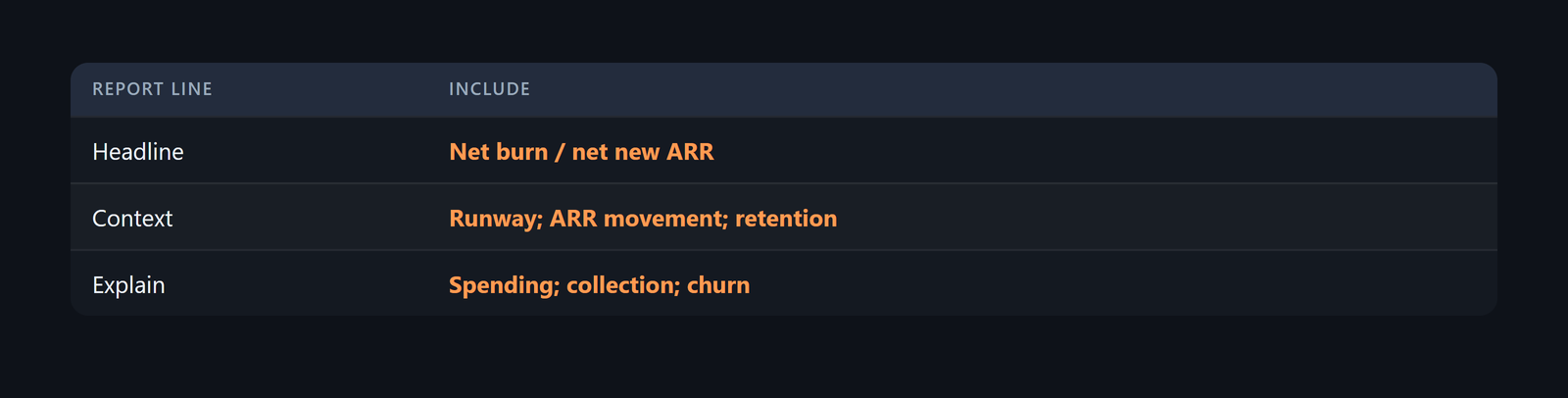
Report the current period using the same formula and period basis as before. Put the net burn numerator, net new ARR denominator, and resulting multiple on one line. Follow it with one sentence about the main movement.
Pair the multiple with net burn, cash runway, ARR or net new recurring revenue, retention or churn context, and cash-collection timing. This lets directors see efficiency and liquidity together. Separate recurring operating spend from one-time items, flag denominator changes, and say whether the movement came from spending, collection, new business, expansion, contraction, or churn.
A board-ready metric line
A compact line can read:
Month: June | Net burn: 18,000 | Net new ARR: 84,000
Burn multiple: 2.57x | Cash runway: 10 months
Change: net burn rose because cash operating expenses exceeded cash collected.
Add a note when a one-time expense or unusual collection timing affects comparability. End with one next-period action, such as protecting a productive channel, reviewing a cost category, or improving collection timing. A single period is neither a forecast nor a universal pass/fail score.
How to improve burn multiple by adjusting burn
The formula gives two levers: reduce net burn without damaging the growth engine, or increase net new ARR with disciplined spend. Review a cost change alongside its likely effect on recurring revenue.
Reduce cash burn without hiding the trade-off
Keep net new ARR at 84,000 and cash collected at 52,000. Then reduce total cash operating expenses from 70,000 to 60,000:
New net burn = 60,000 - 52,000 = 8,000 per month
Annualized net burn = 8,000 * 12 = 96,000
Burn multiple = 96,000 / 84,000 = 1.14x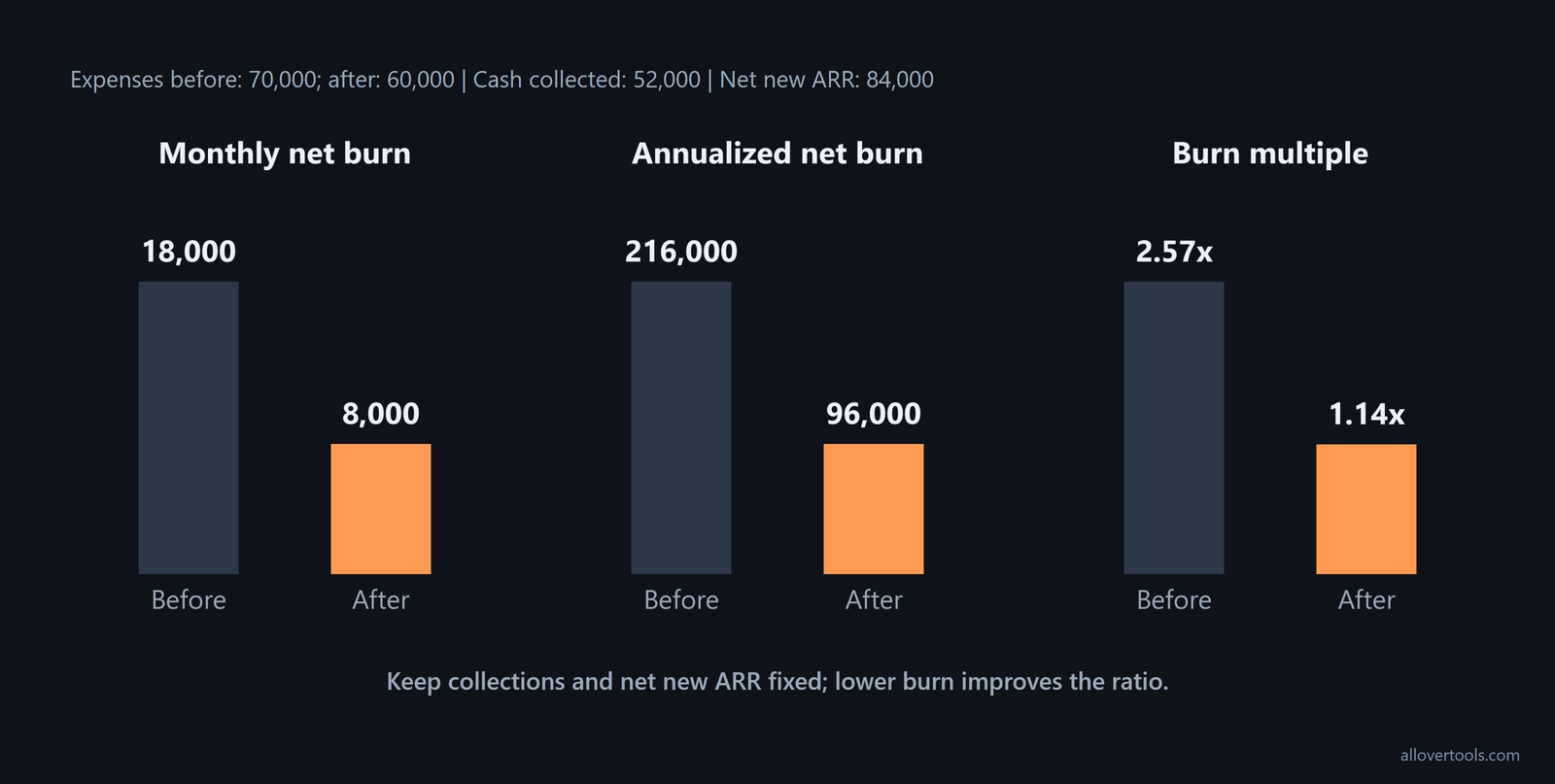
These values are chosen for illustration. Review low-return operating costs for removal or deferral, and improve invoicing and collections when timing is the issue. Separate a durable operating improvement from a temporary deferral, delayed payment, or cut that may reduce future net new ARR.
Do not improve the ratio by starving product, support, or sales while the denominator later deteriorates. Recalculate after each definition-consistent period instead of combining a one-time cost cut with a different revenue window.
Improve the denominator with better growth quality
New business adds recurring revenue from new customers. Expansion adds recurring revenue from existing, still-active customers. Contraction reduces recurring revenue from customers who remain, while churn removes recurring revenue from customers who cancel. Identify the changed movement before calling the ratio an improvement.
Protect work that produces new business or expansion, reduce contraction and churn, and make hiring or campaign changes against a clear ARR outcome. A larger denominator is useful only when it represents recurring revenue the business can retain and collect.
Limitations and edge cases of the burn multiple
Net burn depends on cash collected and total cash operating expenses. Net new ARR depends on recurring-revenue movements. Billing, collection, recognition, seasonality, annual contracts, and one-time costs can put those measures out of sync.
When the denominator or burn changes meaning
With zero net new ARR, division is undefined. Negative net new ARR can produce a negative multiple, but that describes contraction and should not be treated as efficiency. Zero or negative net burn means the company is at breakeven or generating cash, so a conventional burn multiple is not the right summary.
Do not report a burn multiple when net new ARR is zero or negative. A practical implementation returns null in those cases and treats pre-revenue or shrinking-ARR periods as a prompt to control burn, not calculate the ratio. If net burn is zero or negative while net new ARR is positive, the same implementation reports a 0 or negative value and says that "burn has ended." The implementation rule changes the response: manage burn and restore ARR growth in the first case; describe cash generation in the second.
The metric also does not show runway, gross margin, retention, customer payback, or profitability on its own. Pair monthly burn with monthly recurring-revenue movement, or convert both to the same annual basis.
Check the label before comparing an external dashboard. "Burn multiple" can also mean runway. Stripe uses Cash Balance / Burn Rate and prefers a higher result because it indicates more months of runway. That is different from net burn divided by net new ARR for capital efficiency. Keep the denominator and interpretation explicit when sharing the metric; Stripe's runway definition uses the same name for a different calculation.
What the calculators do and do not decide
The SaaS Metrics Calculator accepts Monthly - figures below are for one month or Annual - figures below are for one year. Its numeric fields include Starting recurring revenue, New business recurring revenue, Expansion recurring revenue, Contraction recurring revenue, Churned recurring revenue, Total cash operating expenses (period), Cash collected from customers (period), and Cash balance on hand. Blank numeric inputs are treated as 0, and an undefined denominator displays N/A.
For period conversion, the Burn Rate Calculator accepts Monthly, Quarterly, Annual, Weekly, or Custom period inputs under Period for revenue & expenses below. It normalizes the entered period to monthly burn and assumes the entered revenue and expenses stay constant. Use the linked calculators to check the inputs, but do not treat either one as a source of benchmarks or as a connection to billing, banking, or accounting data.
The scripts calculate from entered values and contain no fetch, XMLHttpRequest, sendBeacon, or form-post path that sends those values. The figures remain in the browser during calculation.
Frequently asked questions
How do you calculate burn multiple from net burn and net new ARR?
Use Burn multiple = net burn / net new ARR. With monthly inputs, multiply monthly net burn and monthly net new recurring revenue by 12 to produce annualized net burn and net new ARR before dividing.
What is a good burn multiple for a SaaS startup?
There is no universal fixed value here. A lower positive multiple generally indicates more efficient growth, but stage, retention, cash collection, and the quality and timing of growth still need review. Compare consistent internal periods instead of using a pass/fail benchmark.
Is a lower burn multiple always better?
No. A lower result can come from under-spending on product or growth, a temporary collection effect, or a denominator that will not persist. Check net new ARR quality, churn or expansion, runway, and why burn changed.
Can I calculate burn multiple with monthly SaaS figures?
Yes. Keep every figure on one monthly period, calculate monthly net burn and net new recurring revenue, multiply each by 12, then divide. The Burn Rate Calculator and SaaS Metrics Calculator cover the respective cash and recurring-revenue inputs.