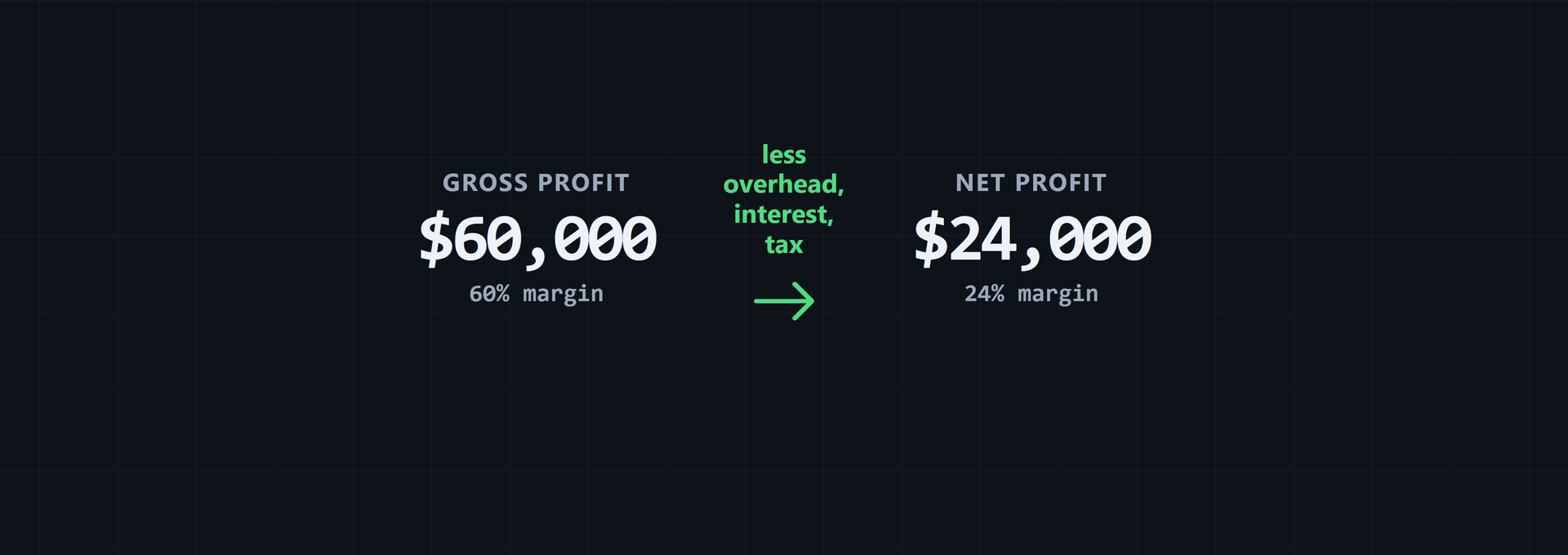
Use gross operating and net margins to see how revenue becomes profit as costs are taken out. Start with revenue, subtract COGS for gross profit, then subtract operating expenses for operating profit. Interest, other non-operating items, and tax take you to net profit. Each margin divides its profit level by revenue from the same reporting period.
Use net sales, not gross billed sales, as the denominator when the income statement separates the two. Net sales are gross sales minus returns, allowances, and discounts. Using gross revenue can overstate all three margins, especially when discounts, returns, or churn are material. When the statement makes that distinction, treat the article's Revenue input as net sales. The profitability-ratio definitions use that realized sales base for gross, operating, and net margins.
How the three margins fit on a multi-step income statement
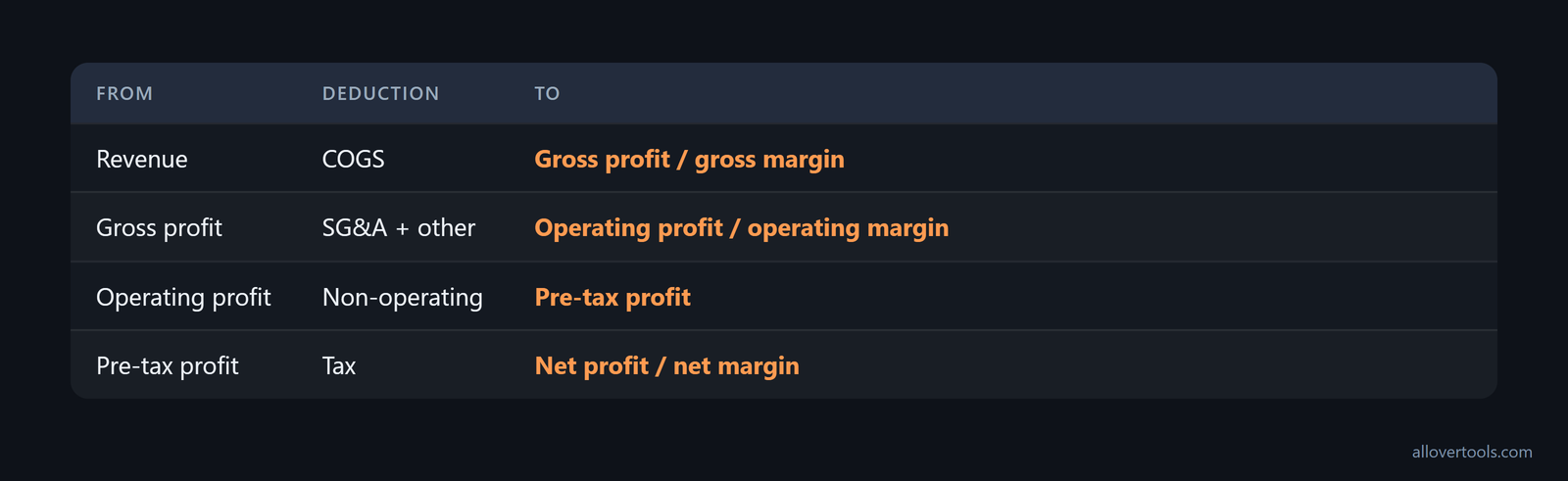
A multi-step income statement puts these deductions in order. Use one reporting basis throughout, including the same period, business scope, and currency.
Revenue - COGS = Gross profit
Gross profit - SG&A and other operating expenses = Operating profit
Operating profit +/- non-operating items = Pre-tax profit
Pre-tax profit - tax expense = Net profit

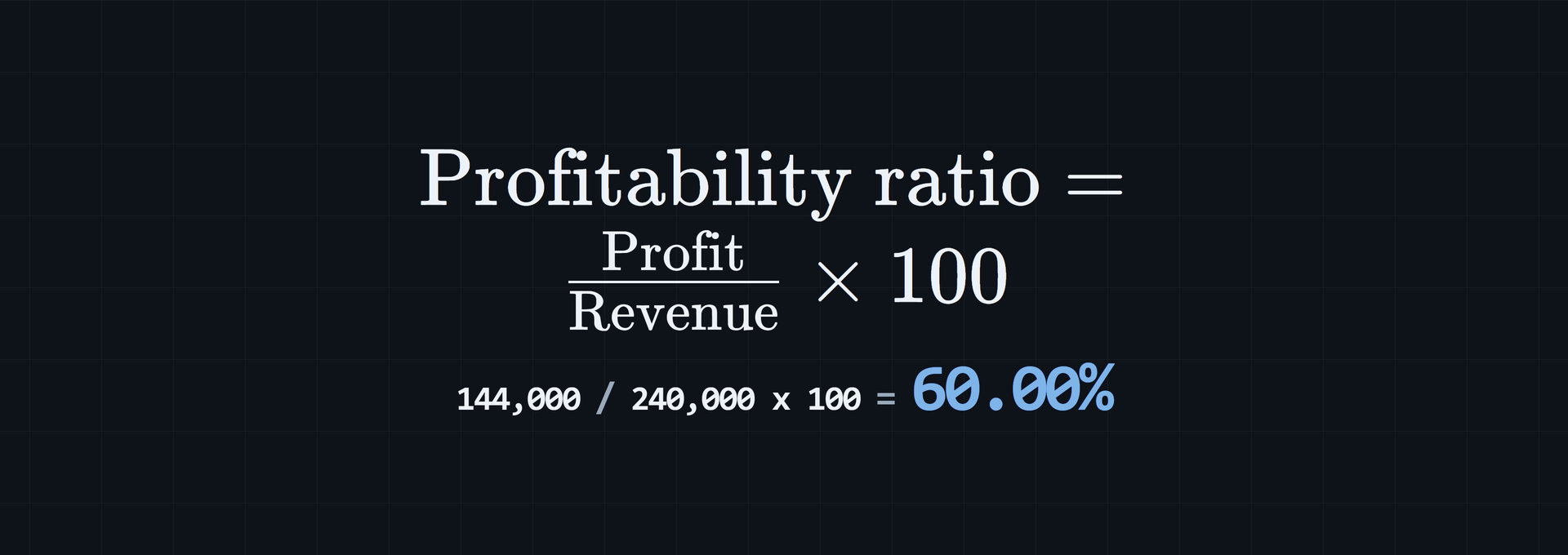
Gross margin = Gross profit / Revenue x 100
Operating margin = Operating profit / Revenue x 100
Net margin = Net profit / Revenue x 100
Each deduction carries into the next line, so the percentages answer different questions. Gross margin stops after costs tied directly to what was sold. Operating margin includes the cost of ordinary operations. Net margin also includes financing, other non-operating activity, and tax.
The margin ladder helps locate the source of a change. Gross margin is the share of revenue left after direct costs, so it reflects pricing power and cost-of-production efficiency without operating overhead, financing, or taxes. Operating margin is the clearest measure of the core operating business before financing and taxes. Net margin is the bottom-line margin after all expenses. The gaps between the levels can point to pricing and production, operating discipline, or financing and tax effects, as described in these ratio definitions.
The order of deductions matters
Revenue
- COGS: cost directly tied to what was sold
= Gross profit
- SG&A: selling, general, and administrative overhead
- Other operating expenses
= Operating profit
+/- Non-operating items: financing or other activity outside core operations
= Pre-tax profit
- Tax: deduction after pre-tax profit
= Net profit
Account labels differ between income statements. Follow the business's accounting policy consistently. If a cost changes category from one period to the next, a margin can move even when the total cost has not.
How to calculate gross margin from revenue and COGS
Start with gross profit: revenue minus COGS. Divide that result by revenue and multiply by 100 to get gross margin. COGS, or direct cost, covers materials, direct labor, and other costs tied to what was sold. Rent, administration, and marketing stay outside gross profit when they are not tied to a specific unit.
The Gross Margin Calculator has visible controls for Revenue, Direct cost, Currency symbol, Period, and Calculate. It returns gross profit, gross margin, and direct cost as a percentage of revenue, and rejects a direct cost above revenue. The Business Profit Calculator also has a COGS & gross profit / margin mode that displays the formula and assumptions. This ratio helps check product or delivery economics before overhead, but it is not the final profit left after running the business.
Gross margin formula
The formula is:
Gross profit = Revenue - COGS
Gross margin = (Gross profit / Revenue) x 100
Use these chosen values to see the calculation:
Revenue = 100
COGS = 60
Gross profit = 100 - 60 = 40
Gross margin = (40 / 100) x 100 = 40%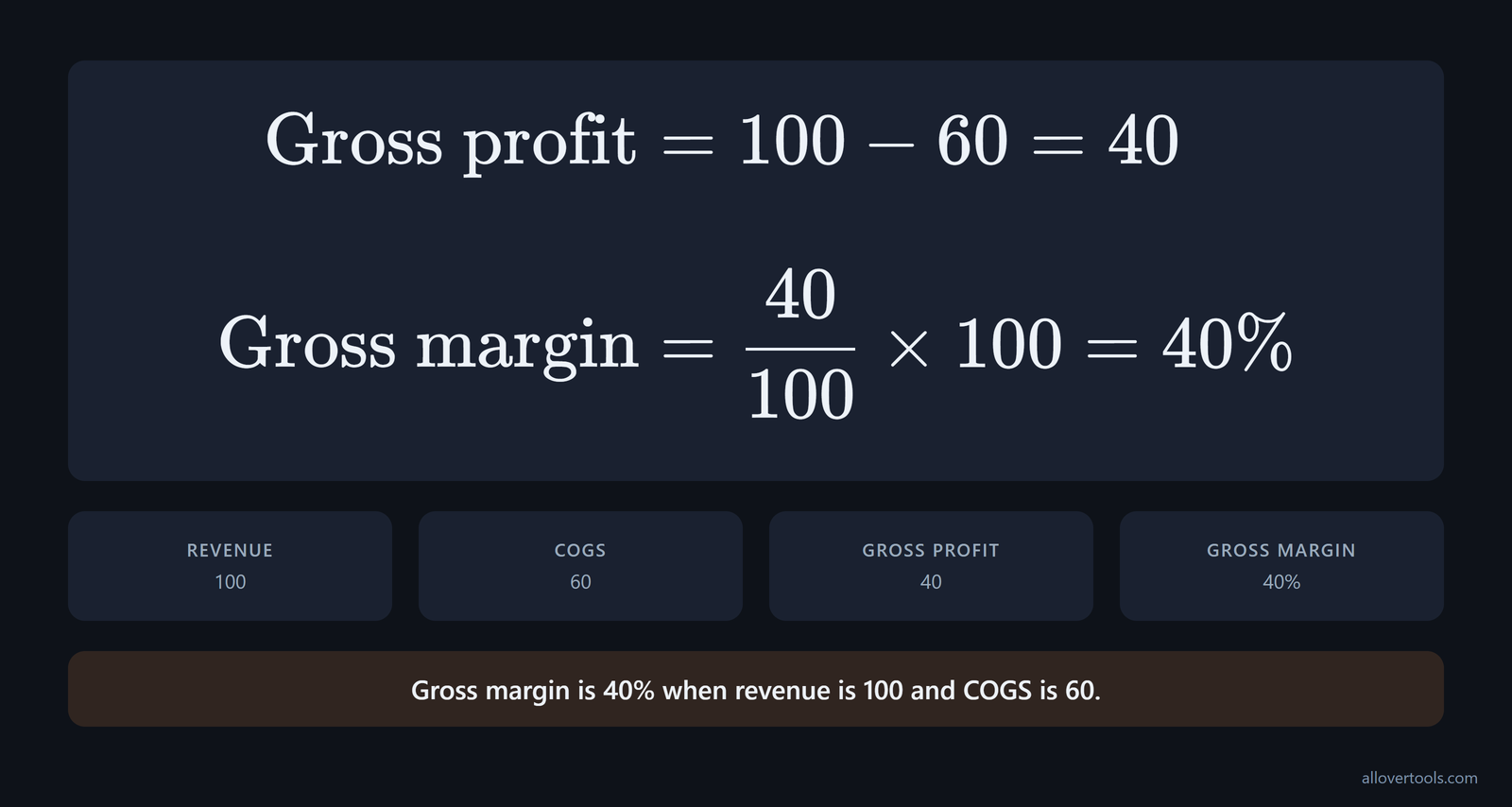
The period selector labels the inputs; it does not turn monthly figures into quarterly or annual figures.
Contribution margin for pricing and break-even
Use contribution margin for decisions about a unit, product mix, price, or break-even point, rather than the whole income statement. It is revenue minus variable costs and shows how much of each sale remains to cover fixed costs and profit. That differs from gross margin, which usually subtracts COGS; operating margin, which includes all operating expenses; and net margin, which also includes interest and taxes. Contribution margin therefore sits above the gross, operating, and net margin ladder for short-term unit economics. The margin formula guide puts these measures side by side, so the variable-cost question does not get confused with the COGS question.
How to calculate operating margin after SG&A
Subtract SG&A and other operating expenses from gross profit to get operating profit. Divide operating profit by revenue and multiply by 100 for operating margin. The same calculation can be written as (revenue minus COGS minus operating expenses) divided by revenue, multiplied by 100.
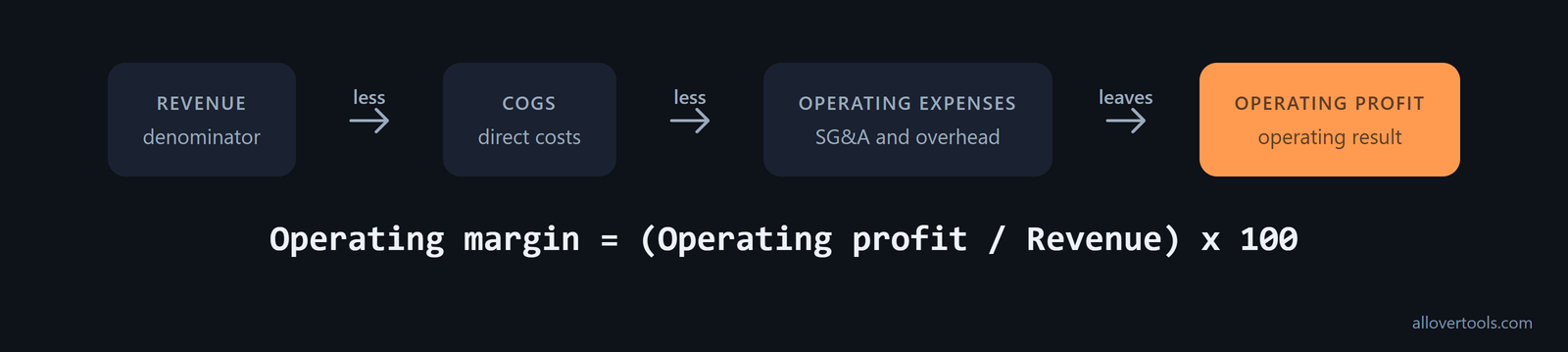
SG&A can include administration, sales, marketing, salaries, rent, and other overhead that supports the business rather than one particular unit sold. Operating margin shows what ordinary operations earn before interest, other non-operating items, and taxes.
Check the label before comparing figures from different reports. Operating margin may also be called operating income margin, operating profit margin, return on sales, or EBIT margin. These names refer to operating income divided by net sales, as this operating-margin guide explains.
Do not treat EBITDA margin as operating margin without noting the difference. Operating margin uses EBIT divided by net sales, and EBIT still includes operating depreciation and amortization. EBITDA-based measures add depreciation and amortization back. If one source reports an EBIT-based operating margin and another reports an EBITDA-based margin, align the definitions before comparing the percentages. Use the EBIT and margin definitions as the distinction.
In the Business Profit Calculator, choose the Net profit margin mode. Enter Revenue, Cost of goods sold (COGS), Operating expenses / overhead, and optional Estimated tax rate % (optional). The tool calculates gross profit and operating profit internally, but does not show a separate operating-margin result. Divide the returned operating profit by revenue and multiply by 100. The Period choice is only a label.
What belongs in operating expenses
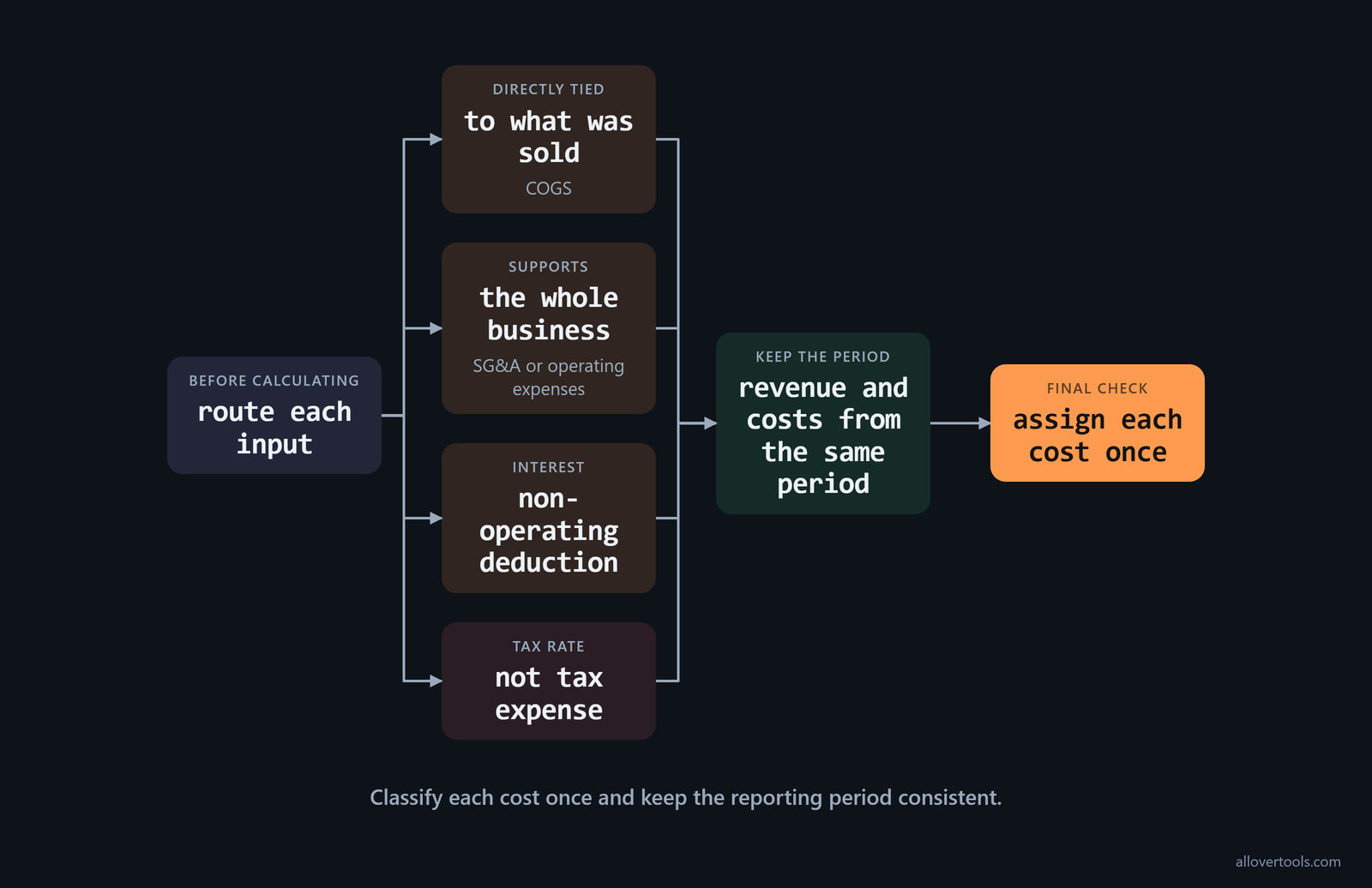
A cost assigned to a product or service belongs in COGS when it is directly tied to what was sold. A cost that supports the whole business belongs in SG&A or operating expenses. Move the same cost between these buckets and gross and operating margin change, even though total profit stays the same.
Operating expenses include more than SG&A. Include nonproduction salaries, rent, utilities, marketing, administrative overhead, research and development, and depreciation and amortization of nonmanufacturing assets when the statement's operating-cost definition calls for them. Moving R&D or nonmanufacturing depreciation into non-operating items changes operating margin even when net margin stays unchanged. Match the expense scope when comparing sectors. The margin-analysis definition treats these costs as part of running the business.

How non-operating items and taxes change net margin
Add or subtract non-operating items from operating profit to get pre-tax profit. Subtract tax expense from that amount for net profit, then divide by revenue and multiply by 100 for net margin. Interest expense is usually presented below operating profit as a non-operating item for non-financial businesses, but its classification can vary by industry and accounting standards. A non-operating gain can raise pre-tax profit. Interest should not be placed in SG&A just to make the statement fit.
Tax expense is an amount in the income statement. An estimated tax rate is a percentage used to estimate that amount, so the two inputs are not interchangeable.
The Net Profit Margin Calculator accepts Revenue, Operating expenses, Interest expense, Tax expense, and Period. It shows operating profit, pre-tax profit, net profit, net margin, and total deductions. The Business Profit Calculator's Net profit margin mode accepts COGS, operating expenses/overhead, and an optional estimated tax rate. It applies tax only when operating profit is positive and has no separate interest input.
Both calculators use the values entered in the form. Their scripts do not use fetch, XMLHttpRequest, sendBeacon, or a form post for visitor-entered content, so the calculation stays in the browser.
Net margin formula
Operating profit = Revenue - COGS - operating expenses
Pre-tax profit = Operating profit plus or minus non-operating items (including interest expense) before income tax
Net profit = Pre-tax profit - tax expense
Net margin = (Net profit / Revenue) x 100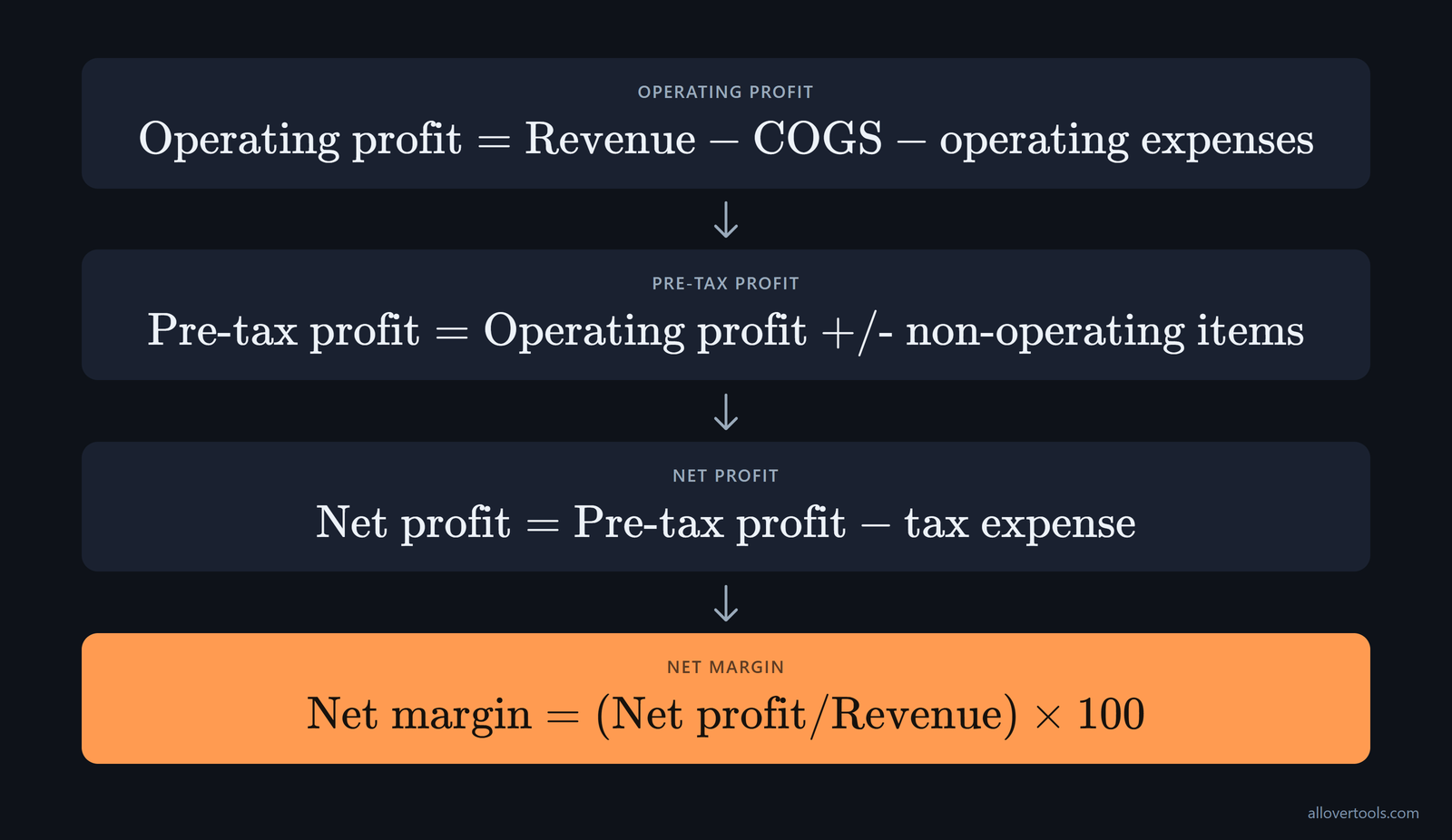
A negative result is possible when the deductions exceed revenue.
One company example: calculate all three margins
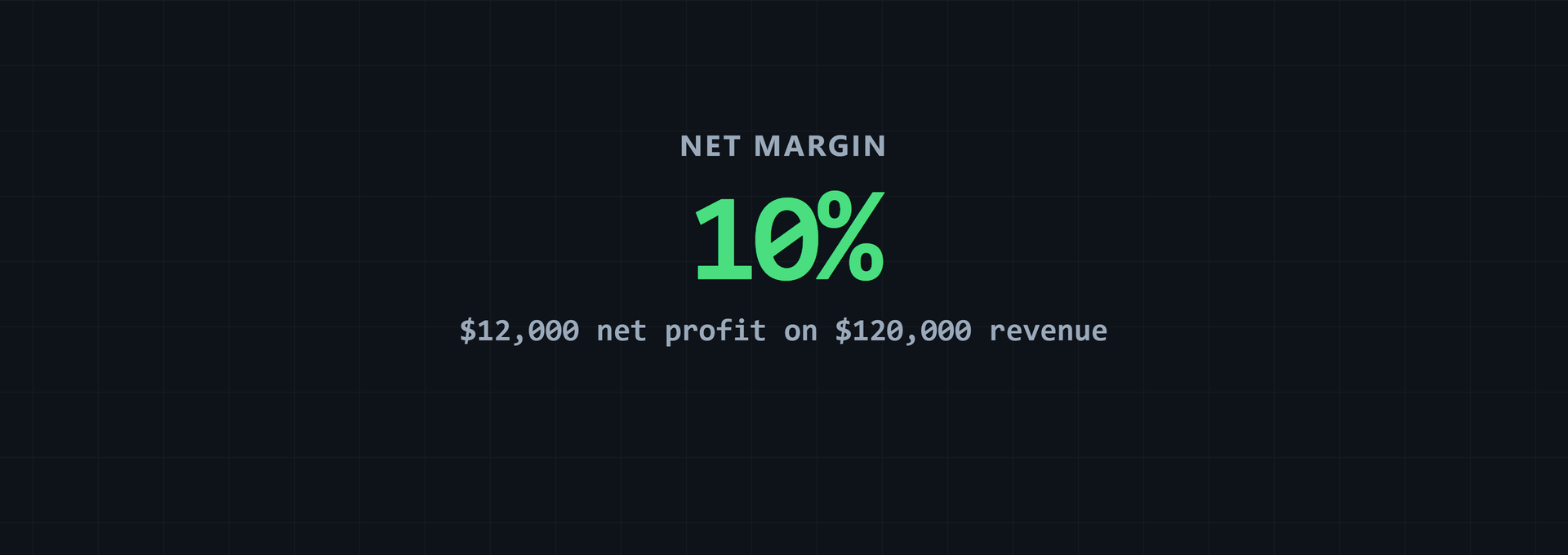
Use one reporting period for every figure in this example: Revenue $120,000, COGS $72,000, SG&A and other operating expenses $30,000, interest expense $3,000, and tax expense $3,000. These are chosen values.
Gross profit = $120,000 - $72,000 = $48,000
Gross margin = ($48,000 / $120,000) x 100 = 40%

Operating profit = $48,000 - $30,000 = $18,000
Operating margin = ($18,000 / $120,000) x 100 = 15%

Pre-tax profit = $18,000 - $3,000 = $15,000
Net profit = $15,000 - $3,000 = $12,000
Net margin = ($12,000 / $120,000) x 100 = 10%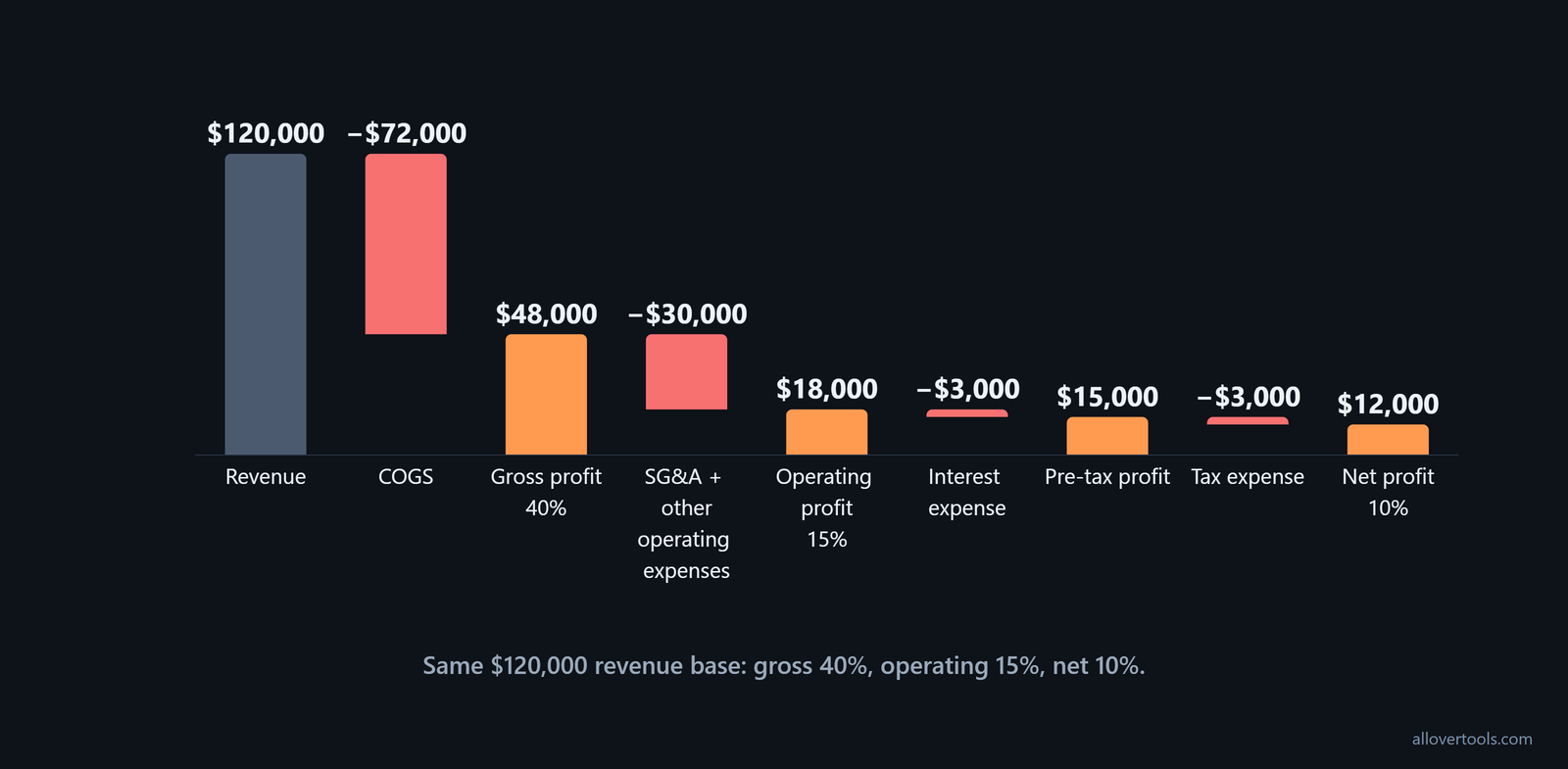
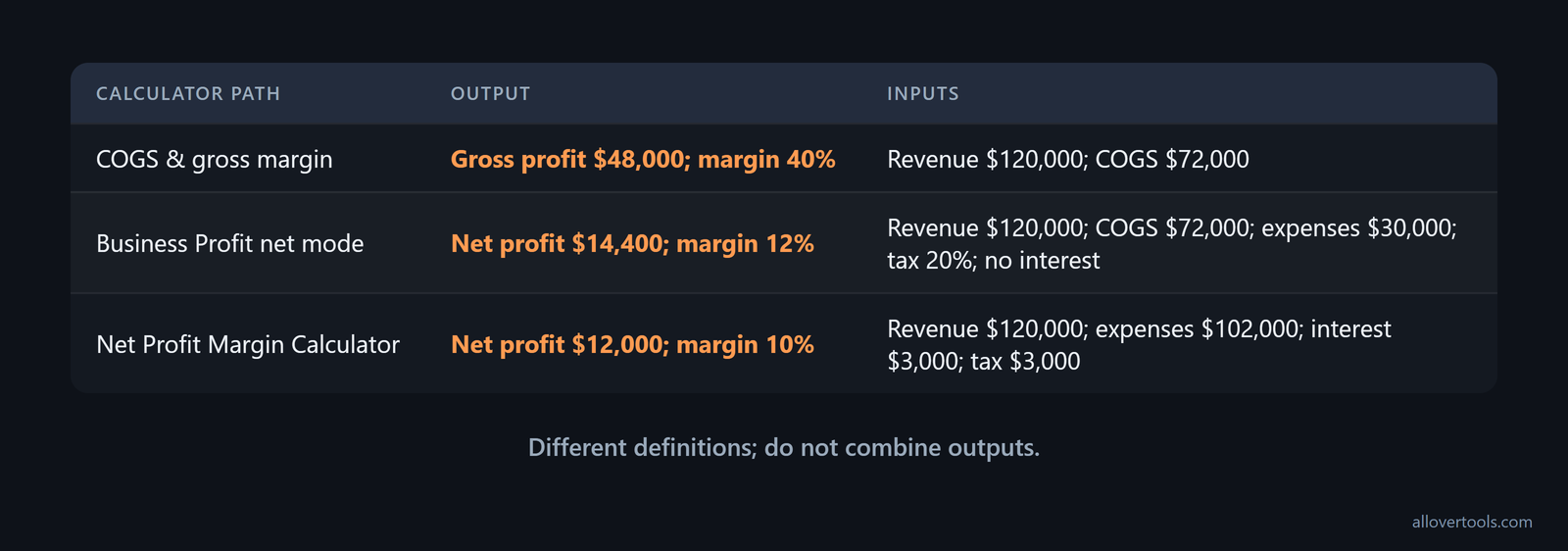
To reproduce the gross result, open the Business Profit Calculator, choose COGS & gross profit / margin, enter Revenue 120000 and Cost of goods sold (COGS) 72000, then calculate. The result is $48,000 gross profit and 40% gross margin.
The same calculator's Net profit margin mode uses different inputs. Enter Revenue 120000, COGS 72000, Operating expenses / overhead 30000, and an estimated tax rate of 20%. Operating profit is $18,000, so the estimated tax is $3,600. This mode returns $14,400 net profit and 12% net margin because it has no interest field.
For the complete multi-step result, open the Net Profit Margin Calculator. Enter Revenue 120000, Operating expenses 102000, Interest expense 3000, and Tax expense 3000. It calculates $18,000 operating profit, $15,000 pre-tax profit, $12,000 net profit, and 10% net margin. These paths use different definitions, so their outputs should not be combined.
Read the margin ladder
After direct costs, the example leaves $48,000, or a 40% gross margin. SG&A reduces that to $18,000, or a 15% operating margin. Interest and tax reduce it again to $12,000, or a 10% net margin. The gaps show where deductions occur. They do not make one margin universally better than the others.
What to use each margin for and how to track it over time
Each ratio answers a different practical question. Gross margin asks whether the direct cost of what was sold leaves enough contribution. Operating margin asks whether core operations cover SG&A and overhead. Net margin asks what remains after financing, other non-operating items, and tax.
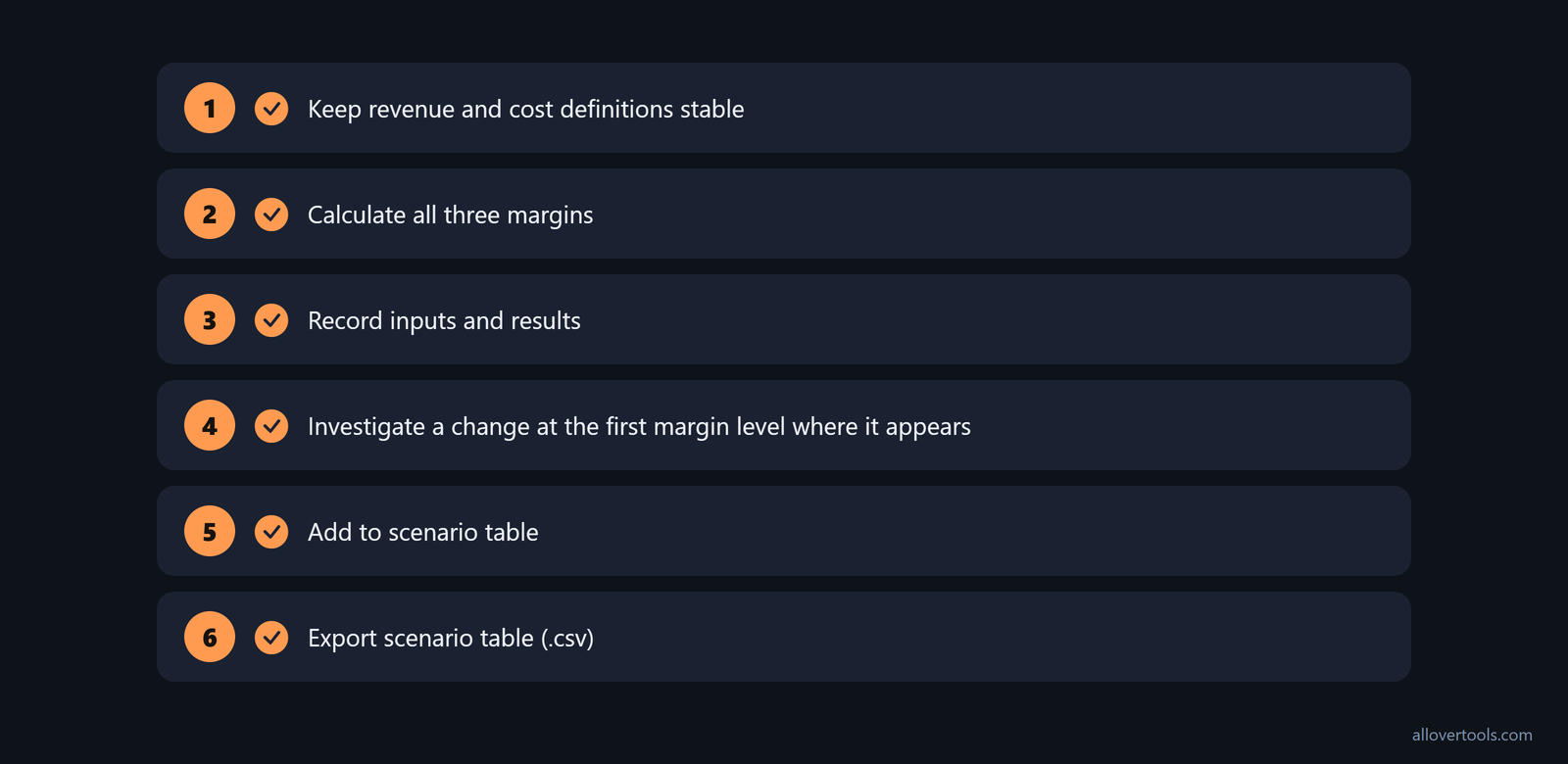
For each reporting period, keep revenue and cost definitions stable. Calculate all three margins, record the inputs and results, and investigate a change at the first margin level where it appears. In the Business Profit Calculator, select Add to scenario table after a result, then Export scenario table (.csv) for a side-by-side record. The period choice labels a scenario; it does not convert monthly, quarterly, or annual figures.
Rerun the chosen calculator with the same definitions after a price, supplier-cost, staffing, financing, or tax change.
Use the three ratios as a series, not a verdict from one period. Compare gross, operating, and net margins over time and with peers. For investors and lenders assessing management performance and the business's longer-term attractiveness, stability or improvement over several years can matter more than one absolute percentage. This investor analysis sets out that use of trends and peer comparisons.
Compare margins with industry benchmarks
Compare each margin with the company's specific industry, rather than assuming a higher percentage is always better. The NYU Stern US sector dataset reports average gross margin, net margin, several operating-margin variants, and the number of firms in each industry. Match the sector and the same margin definition, such as after-tax unadjusted operating margin, before deciding whether a result is strong or weak. The sector margin dataset provides the comparison fields.
Reported operating margin is only one analytical view. The same table lists pre-tax and after-tax lease-adjusted margins and lease-and-R&D-adjusted margins, along with COGS/Sales, R&D/Sales, SG&A/Sales, Stock-Based Compensation/Sales, and Lease Expense/Sales. If the analysis treats R&D or operating leases as capital investments, rebuild the operating margin on that basis and compare it only with peers using the same adjustment. Adjusted and reported operating margins are different measures. Use the sector table's variants to keep the definition visible.
Common mistakes when classifying expenses
- Putting SG&A into COGS lowers gross margin but leaves operating margin unchanged relative to the intended classification when total costs are unchanged. Keep direct costs in COGS and whole-business overhead in operating expenses.
- Leaving COGS out of operating expenses when a calculator's operating-expenses field includes total operating costs overstates operating profit. In that input, use COGS plus SG&A when the method requires total operating expenses.
- Putting interest in SG&A hides the financing effect. Keep interest as a non-operating deduction.
- Entering a tax rate where a calculator asks for a tax expense amount produces an incorrect net result. Apply the rate to the relevant profit base first.
- Mixing periods, or treating a period selector as a conversion, makes the comparison invalid. Use revenue and costs from the same period.
- Double-counting COGS in both direct cost and overhead understates profit. Assign each cost once.
There are a few edge cases to check. The Gross Margin Calculator rejects a direct cost above revenue. The Business Profit Calculator's estimated tax amount is zero when operating profit is not positive. The Net Profit Margin Calculator can display a negative net margin. Reconcile the tool inputs with the income statement labels before interpreting a percentage.
Frequently asked questions
What is the formula for gross operating and net margins?
The three formulas are: gross margin equals (Revenue minus COGS) divided by Revenue; operating margin equals (Gross profit minus operating expenses) divided by Revenue; and net margin equals Net profit divided by Revenue. Multiply each result by 100.
What is the difference between gross margin and operating margin?
The first ratio stops after direct costs or COGS. Operating margin also subtracts SG&A and other operating expenses, so it shows core operating profitability before financing and tax.
How do interest and taxes affect net profit margin?
Interest and other non-operating deductions reduce pre-tax profit, and tax expense reduces it again to reach net profit. Divide that final amount by revenue to get net margin. The effect depends on the amounts entered.
Can net profit margin be negative?
Yes. If COGS, operating expenses, non-operating deductions, and tax exceed revenue, net profit and net margin are negative. The Net Profit Margin Calculator permits and displays that result.
Does the Business Profit Calculator calculate operating margin?
Its COGS and net modes calculate gross profit and operating profit as intermediate values, but they do not present a separate operating-margin result. Divide the displayed operating profit by revenue and multiply by 100. The net mode has no separate interest input.